Key Takeaways
- For Germany, plan 35-50 days production after artwork approval for most custom drinkware orders
- A practical MOQ is 1,000 pcs for single-color logo bottles and 3,000 pcs for custom colors
- Ask for LFGB, REACH, BSCI, and AQL 2.5/4.0 inspection terms before deposit
- FOB China pricing usually changes 8-18% when wall thickness, coating, or packaging changes
If you buy promotional water bottles Deutschland for campaigns, retail packs, staff gifts, or distributor programs, finding a bottle is the easy part. The hard part is picking one that meets German buyer checks, lands before the event date, and does not turn into a compliance mess after the line has printed 10,000 logos. We have seen QC pull finished samples because a 0.3 mm coating gap near the base showed bare metal after a tape test. That hurts.
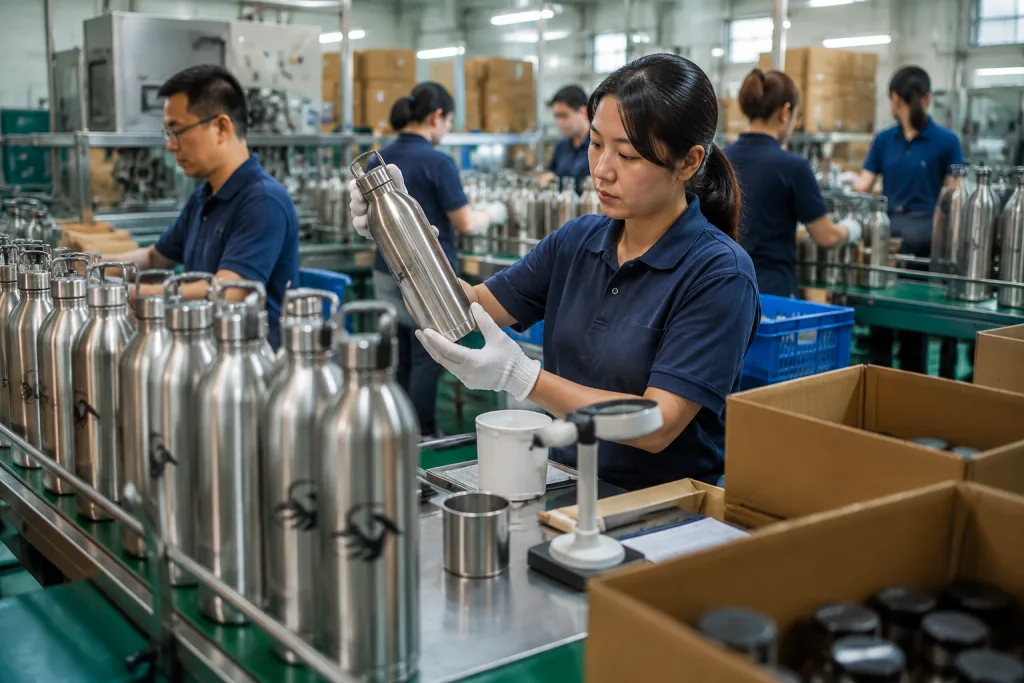
From our factory base in Zhejiang, China, we see the same mistake about 6 times a month: buyers compare unit price and skip wall thickness, coating durability, REACH paperwork, carton strength, and artwork timing. This is the wrong question to ask. A safe custom drinkware project is not fancy; it is 304 stainless checked with an XRF gun, a clear 500 ml fill mark on the PO, 5-layer export cartons, and artwork approved before we run mass printing.
Start With The Use Case
“Promotional water bottles Deutschland” is too wide for a clean quote. A 500 ml aluminum bottle for a 2-day trade show is a different job from a 1 L stainless sports bottle for outdoor retail, and a premium custom growler needs another spec again. Before you ask a canteen supplier for price, lock down how the bottle will be used, washed, packed, stacked, and handed out. We see this go sideways when the buyer sends only one line and expects 6 factories to quote the same thing.
For short-term events, lighter construction can work: 0.5 mm aluminum, single-wall stainless steel, or Tritan plastic with one-color silkscreen. For retail, staff programs, or distributor drinkware, put more time into coating adhesion, leak testing, cap torque, carton drop resistance, and barcode labeling. On our line, QC pulled 32 samples last month because the cap torque sat under 8 kgf.cm after hot-water testing. German buyers flag that fast. Sloppy finishing does not survive there.
A clear RFQ should include capacity, material, finish, lid type, logo method, packing, test requirement, delivery term, and target order quantity. If the message says only “send price for customized drinkware,” every canteen vendor will quote a different bottle, so the comparison is useless. This is the wrong question to ask. Send a spec sheet with wall thickness in mm, carton size, logo artwork, and packing style, even if the PO still has a typo in “stainless.”
- Event giveaways: 500-750 ml, low weight, 1-color logo, MOQ from 1,000 pcs, usually bulk packed or simple white box.
- Retail or distributor programs: 650-1,000 ml, stronger coating with 3M tape check, color box, barcode, MOQ from 3,000 pcs.
- Outdoor or club merchandise: stainless steel, powder coating, laser logo, higher leak test standard, with caps checked one by one before packing.
- Premium gifts: insulated bottles or customized growler formats with gift packaging, foam insert, and cleaner carton marks.
If you work with canteen distributors in Germany, ask how the product will be stored and resold. A distributor canteen project needs repeatable color, stable lids, and the same barcode position across repeat orders. One nice sample is not enough. We ship repeat programs where the buyer compares the new carton against a 12-month-old retained sample under a light box.
Materials That Make Commercial Sense
The right material comes down to target FOB and how much complaint risk the buyer will accept. Stainless steel, aluminum, Tritan, glass, and PP all work, but they answer different briefs. We see this go sideways when a buyer asks only, “Which one is cheapest?” On our Hangzhou line, the same logo file can pass on a 304 stainless body and look weak on a powder-coated aluminum sample after the tape test.
For most German promotional buyers, 304 stainless steel is the safer pick for mid-range custom canteen orders. It handles odor, corrosion, and daily use better than cheap uncoated aluminum. For vacuum bottles, common inner wall thickness is 0.4-0.5 mm and outer wall 0.5-0.6 mm, depending on shape. Going thinner may save USD 0.08-0.18 per unit, but the math does not work if 3% of cartons get dent claims after DPD or DHL handling. QC pulled a 500 ml sample last month with a 0.38 mm outer wall; the buyer liked the price, then flagged side dents before mass approval.
Aluminum still earns its place in canteen promotional campaigns where price and low weight matter. Typical single-wall aluminum bottles may quote around USD 1.20-1.90 FOB China at 5,000 pcs, depending on cap and finish. Stainless single-wall options may run USD 1.80-3.20, while vacuum insulated bottles often sit around USD 3.50-6.80. These are working ranges, not promises; coating, packaging, and exchange rate move the numbers. We run aluminum mainly when the PO says event giveaway, 5,000-20,000 pcs, and the buyer accepts that a 60 g lighter bottle usually gives up some dent resistance.
Tritan works when you need transparent bodies and lower freight weight, but confirm food-contact compliance for the EU before artwork approval. Glass fits office and wellness brands, but breakage protection changes the carton and freight calculation fast; a 6-bottle drop test from 80 cm can force thicker dividers and a larger master carton. For a customizable growler or beer-related campaign, stainless steel is usually the better commercial choice because it survives handling and supports clean laser engraving. The line sees fewer logo rejects on brushed steel than on dark spray coating, especially with small German umlauts in the artwork.
Do not approve a material only from a photo. Ask for a physical sample, net weight, wall thickness, and the exact food-contact test standard.
Compliance For German Buyers
Germany is the wrong place for loose compliance talk. If you import promotional water bottles Deutschland, ask for documents before the 30% deposit, not after the container leaves Ningbo. We usually send a PDF pack with LFGB or EU food-contact testing for the bottle body and lid parts, REACH for coating or ink when it applies, and BSCI or Sedex if the end client asks for a social audit; our QC clerk stamps the file name against the PO number so nobody mixes up black powder coat with white.
Some buyers still write “FDA” on the spec sheet because an old US promotion used it. FDA works for North America, but it does not cover what German buyers expect for EU food contact. For Germany, LFGB is commonly requested because the sensory transfer result gets checked harder; we have seen a buyer reject a sample because the silicone gasket left a smell after 24 hours in a test jar. If the bottle uses silicone seals, a PP lid, or printed ink over powder coating, each material needs its own test route.
Write the inspection rules into the purchase order. Not in a WeChat note. A normal consumer goods inspection might use AQL 2.5 for major defects and AQL 4.0 for minor defects. Critical defects such as leakage, sharp edges, wrong material, heavy contamination, or missing safety markings need zero tolerance. For vacuum bottles, add insulation testing: hot water at 95°C, checked after 6 hours or 12 hours depending on the claim; on the line we use a digital probe and mark each sample cup with masking tape before QC pulls the reading.
At BottleForge Industrial in Zhejiang, China, our typical inspection flow starts with incoming 304 stainless sheet checks using a handheld thickness gauge, then logo first-article approval against the Pantone code on the artwork. During production, we run leak checks at the assembly bench, coating adhesion tests with 3M tape, final random inspection by carton lot, and a drop review on packed cartons. Our monthly output is about 450,000 drinkware units across stainless bottles, tumblers, and growlers, with standard lead time of 35-50 days after artwork confirmation for most customized canteen programs.
If a canteen factory cannot put its testing plan in writing, the low price is not low. The math does not work. We have seen this go sideways over one missing lid test report and a typo in the PO material column.
Logo And Customization Choices
Logo work is where 6 out of 10 drinkware orders lose time. The buyer signs off the bottle shape, then the line waits because the AI file has hairline text, the Pantone code is missing, or the gift box dieline arrives 3 mm short on the side flap. Clear artwork rules on day one save more time than arguing over another bottle sample.
Silkscreen printing is the sensible choice for 1-2 color logos on smooth bodies. We run it for event orders because the setup is quick and the cost stays clean: expect setup charges around USD 35-80 per color per position, depending on the factory and artwork size. Pad printing is better on curved or tight spots such as caps; our QC once pulled a cap sample because the logo shifted 1.5 mm after the pad softened. Laser engraving lasts longer and looks cleaner on 304 stainless steel for premium distributor growler or corporate gift programs, but this is the wrong process if the buyer expects exact brand red unless coating contrast is part of the plan.
Powder coating gives stronger shelf value than basic spray painting. For German and North American buyers, we recommend powder coating for retail-grade customized drinkware because it holds up better against keys, cup holders, and warehouse handling. Ask for cross-hatch adhesion testing, usually based on ISO 2409; on our side, QC cuts the grid with a 1 mm cross-hatch cutter and checks whether coating lifts near the logo window. If the logo edge looks dirty after coating, the math doesn't work for retail returns.
Full custom color normally needs MOQ around 3,000 pcs per color for bottles and sometimes 5,000 pcs for special lids. Pantone matching is workable, but stainless, plastic, silicone, and paper packaging will not all hit the same shade under a D65 light box. We usually send a pre-production photo plus a physical color chip before mass production; one German buyer flagged a lid because the silicone looked 2 tones warmer than the powder-coated body. Fix it before the line opens.
Packaging customization matters more than buyers expect. For a canteen customized for German retail, you may need EAN barcode, recycling icons, German-language care instructions, FNSKU if selling through marketplace warehouses, and carton marks that match your forwarder’s requirements. We have seen a PO typo on “spülmaschinengeeignet” hold carton printing for 2 days, and late barcode files can add 5-7 days before packing starts. Small files stop big shipments.
MOQ Pricing And Lead Time
MOQ is not a trick; it is what the line can run without losing money. For a stocked bottle shape with a one-color logo, 1,000 pcs is a sane starting MOQ because we still set coating racks, screen-printing jigs, material picking, carton marks, and AQL 2.5 inspection hours. We run the first 50 pcs slowly on the conveyor to check logo position with a 0.5 mm tolerance gauge. For custom body colors, custom lids, molded parts, or a customized growler with special capacity, expect 3,000-5,000 pcs.
FOB China pricing needs a line-by-line check. USD 2.65 and USD 2.92 are not the same quote if one bottle uses 0.45 mm stainless and the other uses 0.55 mm, or if one includes a color box while the cheaper one ships in a polybag. Ask the canteen supplier to state material grade and wall thickness in mm, net weight in grams, coating type with curing temperature, logo method with print size, packing with carton quantity, and test report availability. Last month a German buyer flagged a quote because the PO said “powder coating” while the factory worksheet said spray paint. Good catch.
Lead time should be split into sampling and production, not thrown into one soft promise. Digital mockup takes 1-2 days. A printed sample takes 7-12 days if materials are in stock; if the Pantone powder needs ordering, we see 12 days vs 18 days. Mass production for stocked designs is often 35-50 days after sample and artwork approval, and QC pulled the sample again at hour 4 when the logo shifted 1.2 mm on a curved body. Sea freight to Hamburg, Bremerhaven, or Rotterdam can add roughly 30-40 days port to port, plus customs and inland trucking. Air freight is faster, but the math doesn't work on most stainless bottles because volume weight is high.
Payment terms for new buyers are commonly 30% deposit and 70% before shipment after inspection. Larger distributor drinkware buyers with repeat orders may negotiate better terms after 3 or 4 clean shipments, especially when the same SKU repeats and the defect rate stays under AQL 2.5. We ship after the final inspection report is signed, carton labels are checked, and the buyer confirms the shipping mark; one PO typo on “Hamburg” became “Humburg” and delayed carton printing by 1 day. Be careful with any canteen vendor offering low MOQ, low price, and fast lead time together. We've seen this go sideways. One of those three can be true; all three together usually means hidden compromises.
Working With China Factories
Buying direct from China works when the spec is tight. A serious canteen manufacturer in Zhejiang or another China production base will ask the awkward stuff before we run the line: FDA or LFGB, powder coating or spray paint, PP or Tritan cap, 5-layer K=A carton or standard B flute, delivery date, AQL 2.5 or 4.0. Good sign. The supplier who replies “yes, no problem” to a PO with “blue bottle, logo same as last time” is setting you up for rework.
Most buyers use 2 sourcing routes: a trading company for mixed low-volume orders, or a real canteen factory with in-house forming and polishing, plus fixed coating and printing partners. Mixed factory “vendors” sit in the middle, and we have seen this go sideways when 3 workshops match 3 different lid threads. Trading companies can handle 300 pcs here and 500 pcs there. For repeat promotional water bottles Deutschland programs, direct factory coordination gives cleaner control over 304 stainless thickness, batch color, and the production slot on the coating line.
If you are a canteen distributor, or you supply 4 agencies under their own artwork, ask whether the factory can protect your design, hold spare capacity for repeat orders, and keep the same finish across batches. This is the wrong question to ask: “Can you make the same color again?” Ask for the retained color chip and the ΔE tolerance. QC pulled the sample last month on a matte black bottle because Batch 2 looked fine under office light but shifted under the D65 light box.
Communication should be technical, not emotional. Send a spec sheet, not a mood board. Approve drawings, not just photos. Confirm tolerances for capacity, weight, and logo position. A logo position tolerance of ±2 mm works on a sports bottle; it does not work on a premium gift set where the bottle sits in a molded tray and the logo must face front. We once had a buyer flag a 3 mm logo shift only after packing, and the math did not work for reprinting 2,000 pcs.
At BottleForge Industrial, our standard MOQ starts at 1,000 pcs for selected stocked shapes and 3,000 pcs for most custom color projects. That is not the lowest MOQ in China. It is the number where we can run stable coating, keep 20 pcs for pre-shipment inspection, and avoid mixing leftover parts from another order.
Avoid The Expensive Mistakes
The expensive mistakes in customized drinkware are usually dull, and we see them before the buyer does. Wrong Pantone on the logo. 5-ply carton changed to weak 3-ply. German care text missing on the insert card. A cap passes the sample leak test, then mass production fails because the silicone ring moved from 2.4 mm to 2.1 mm. QC pulled the sample from line 3 last month and found exactly that. A catalog photo will never show it.
Build a simple approval chain. Approve the bottle specification first: capacity, 304 stainless, coating, cap type, carton packing, and test standard. Then approve artwork on a flat dieline plus a 3D mockup, because curved logos on a 70 mm bottle body can look wider than the PDF. Approve a physical pre-production sample if the schedule has 7 days to spare. Inspect mass production before balance payment. If the order is above 5,000 pcs, a third-party inspection is usually worth the USD 250-400 cost; the math works better than arguing after 180 cartons are sealed.
For marketplace or retail programs, check packaging early. FNSKU labels, EAN codes, carton dimensions, master carton weight below 15 kg, and country-of-origin marking can all affect receiving, so we run a carton label check before booking the truck. One German buyer flagged a PO typo where “Made in P.R.C.” was missing from the gift box, and fixing it after printing meant 3 days lost. If your warehouse in Germany rejects cartons because labels are wrong, the factory price no longer matters.
Be honest about sustainability claims. Reusable bottles are not automatically sustainable if they are poorly made and discarded after one event. This is the wrong question to ask if the only target is the cheapest unit price. If you want a stronger environmental story, choose durable stainless steel, skip mixed-material gift boxes, and ask for recycled carton paper where possible. On the packing table, we can see the difference fast: one 350 gsm coated box looks nice for 10 seconds, while a plain recycled carton protects the bottle and cuts waste. For some campaigns, a bottle 35 g heavier that lasts two years is a better decision than a cheap bottle that looks tired after two weeks.
The best canteen suppliers will push back when your target price conflicts with the quality promise. That pushback is useful. It tells you where to save money and where the order can go sideways. We’ve seen buyers cut 0.1 mm from wall thickness to hit a tender price, then complain when the bottle dents during drop testing from 80 cm. For German B2B buyers, the usual answer is simple: save on overdesigned packaging before you save on material thickness, cap sealing, or compliance testing.
Send Your Bottle Specification For A Factory Quote
Share capacity, material, quantity, logo method, and delivery date. We will return practical FOB pricing, MOQ, and lead time options.
Frequently asked questions
What is a realistic MOQ for promotional water bottles Deutschland?
For stocked bottle shapes with a one-color logo, 1,000 pcs is a realistic MOQ from our Zhejiang factory. If you need a custom Pantone body color, custom lid, retail box, or canteen customized with several logo positions, plan for 3,000 pcs. A fully customized canteen or customized growler may require 5,000 pcs because molds, coating setup, and material purchasing need stable volume. Very small orders below 500 pcs are possible through local decorators, but FOB China production usually loses its cost advantage at that level once sampling, export handling, and freight are included.
Which material is best for German promotional bottle campaigns?
For mid-range promotional water bottles Deutschland, 304 stainless steel is usually the safest commercial choice. It is durable, food-contact friendly, and works well with powder coating, silkscreen, or laser engraving. Aluminum is cheaper and lighter, often good for short event campaigns, but it dents more easily. Tritan is useful for transparent sports bottles, while glass suits office or wellness gifts but needs stronger packaging. For distributor drinkware or repeat retail programs, we recommend stainless steel with 0.5-0.6 mm outer wall thickness and documented LFGB or EU food-contact testing.
How long does production and delivery to Germany take?
Sampling usually takes 7-12 days after artwork confirmation if the bottle body is in stock. Mass production normally takes 35-50 days after sample approval for custom drinkware from China. Sea freight to Hamburg, Bremerhaven, or Rotterdam often adds 30-40 days port to port, then customs clearance and inland delivery add more time. A safe timeline for a German campaign is 10-14 weeks from confirmed specification to warehouse arrival. If your event date is fixed, approve artwork early and avoid late changes to logo size, Pantone color, or packaging text.
What compliance documents should I request from a canteen supplier?
For Germany, ask for LFGB or EU food-contact test reports covering the bottle, lid, silicone seal, straw if used, and coating or ink where relevant. REACH may be needed for coatings and restricted substances. If your client has corporate sourcing rules, request BSCI, Sedex, or ISO-related factory documents. For quality control, put AQL 2.5 major and AQL 4.0 minor inspection terms in the purchase order. A serious canteen manufacturer should also provide material declarations, product photos, carton marks, and pre-shipment inspection support before you pay the final 70% balance.
Should I buy through a distributor or directly from a China canteen factory?
Use a local distributor when you need small quantities, mixed products, very fast delivery, or local invoicing in Germany. Buy directly from a China canteen factory when you need 1,000-50,000 pcs, stable repeat production, custom color control, or better FOB pricing. Canteen distributors add value through stock, service, and local logistics; factories add value through specification control and production cost. Many buyers use both: local canteen vendors for urgent jobs and a direct canteen manufacturer in Zhejiang, China for planned promotional and retail programs.