Key Takeaways
- Plan 1,000-3,000 pcs MOQ for most custom drinkware orders, with 25-35 days production after sample approval
- Stainless steel 304 is the safer default for premium promotional bottles and custom canteen programs
- Decoration choice changes cost by USD 0.18-1.20 per unit depending on logo size, color count, and finish
- American buyers should confirm CPSIA, FDA food-contact, Prop 65, and REACH requirements before deposit
If you source promotional water bottles for American clients, finding a bottle is the easy part. The hard part is building a custom drinkware order that holds price after logo review, passes basic compliance, ships on the promised vessel, and does not get rejected because the lid squeaks or the PMS color is 2 shades off. We run this on the line every week; last month QC pulled 32 samples from a 5,000 pcs stainless order and flagged 0.3 mm variation on the powder-coat edge.
From our Zhejiang factory network, we see the same buying mistakes too often: a buyer approves a clean render, then the cap feels light in hand, the silk print fails a 3M tape test, the export carton splits at the corner after a 76 cm drop test, or the MOQ changes from 1,000 pcs to 3,000 pcs after artwork review. That is the wrong way to buy bottles. A useful buyer guide needs to cover wall thickness, AQL 2.5, 18-day sample timing vs 35-day bulk production, and landed cost per carton, not just body colors.
Start With The Use Case
Most promotional water bottles American buyers ask us to quote land in 3 jobs: a one-day event handout, retail-style brand merch, or distributor replenishment. The spec changes by job. Treating all 3 the same is the wrong question to ask; last April, QC pulled 200 samples from a rush event order and 17 caps felt loose because the buyer chose the cheapest lid without a torque check.
For a one-day trade show, we run a 600 ml single-wall stainless bottle or BPA-free Tritan bottle when the logo panel is at least 55 mm wide and cartons stay under 14 kg for booth staff. Simple works. For an employee gift or university store, double-wall vacuum insulation is usually worth the extra USD 1.40-2.80 per unit, especially when buyers ask for 12-hour cold claims on the hangtag. For distributor drinkware programs, repeatability beats one shiny sample: same Pantone match, same cap thread, 2% spare lids packed for reorders.
American campaigns have a clear size habit. We see 20 oz, 24 oz, 32 oz, and 40 oz move faster than metric-only designs; one buyer even flagged “750 ml” on the PO and asked us to relabel it as 24 oz for their sales sheet. A custom canteen for outdoor, military-inspired, or camp branding often uses 18 oz to 32 oz capacity, a carry loop, and a powder-coated body with 60-80 μm coating thickness. A custom growler or customizable growler normally starts at 64 oz, with heavier steel and a lid seal we check in the line using a water-fill inversion test for 3 minutes.
Before asking a canteen supplier for price, write down capacity, material, finish, logo method, carton requirement, and delivery address. Give us the basics. A serious canteen manufacturer can quote from that, including carton size and lead time; a vague request like “nice bottle, cheap, USA delivery” only gets you a soft price that goes sideways after artwork or freight is added.
Choose Materials Without Romance
Material choice is where buyers lose money quietly. 304 stainless is still our standard for better promotional bottles because it holds up against corrosion and passes food-contact testing with fewer arguments from the lab. For insulated bottles, we run inner wall 0.4 mm and outer wall 0.5 mm stainless steel; 40 oz tumblers often need slower forming on the hydraulic press or the shoulder wrinkles. If a quote comes in 8–12% under the market, do not celebrate yet. Ask for wall thickness, steel grade, and the coil supplier name.
Tritan works for clear sports bottles, fitness campaigns, and school programs where buyers want to see the liquid level and keep carton weight down. Aluminum costs less, but the interior coating is where claims start; QC pulled 32 pcs from one batch last year and found pinholes near the base curve. Glass looks clean for wellness branding, yet the freight math gets ugly once breakage allowance and thicker export cartons are added. A customized canteen with a plastic body is fine for budget events. Calling it premium custom drinkware is the wrong question to ask.
For canteen promotional projects, caps deserve more attention than bodies. A poor cap kills the reorder. We check silicone ring hardness with a Shore A gauge, thread engagement over 3 full turns, leak test at 45 degrees, then inverted position for 30 minutes. The carry handle also matters: PP is cheap, TPE feels better, stainless hardware survives rougher use. For a customized growler, pressure retention and gasket compression are not optional details; we have seen this go sideways after one buyer changed the gasket color on the PO and missed the material code.
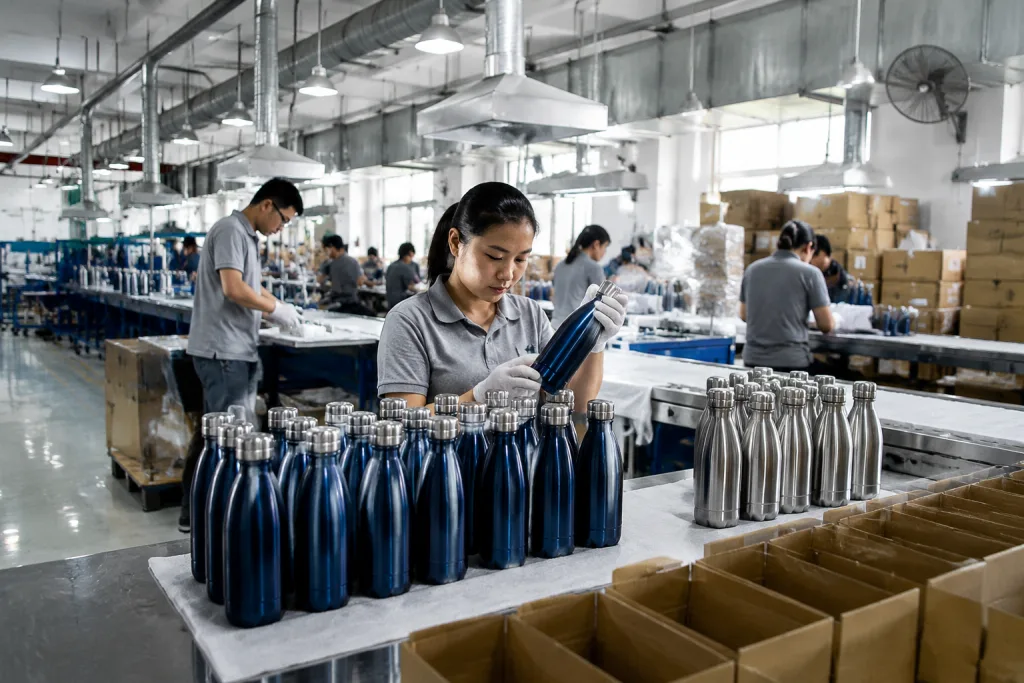
In Zhejiang, China, 40-plus bottle workshops can make similar shapes. The better canteen factory is the one that controls material traceability from coil tags, incoming inspection with calipers, welding checks under the line light, vacuum testing, coating adhesion by cross-cut tape, then final AQL inspection. Shape is easy. Consistency is the real product, and the buyer usually only notices it when 18 cartons come back with the same leaking cap.
Decoration Drives The Real Cost
Logo decoration is not a small afterthought. It changes the tooling list, the scrap allowance, line speed, and what QC has to reject under AQL 2.5. For a simple one-color campaign, we run silkscreen as the lowest-cost route, often around USD 0.18-0.35 per unit depending on print area. On a 70 mm wide logo, the operator can keep registration tight; once the buyer asks for 3 colors on a tapered bottle, setup time jumps and the reject bin fills faster. Laser engraving costs more, commonly USD 0.35-0.80 per unit, but it holds up better on stainless or powder coating.
Full-wrap heat transfer can make customizable drinkware look retail-ready, but the factory needs clean artwork and a controlled surface. Expect higher MOQ, often 3,000 pcs or more, because setup waste is real. Last month QC pulled 42 pcs from the first 500 because the film edge lifted near the seam. UV printing works for complex logos and gradients, though scratch resistance must be checked with a cross-hatch adhesion test and tape pull. For American school and corporate orders, we recommend laser for premium pieces and one-color screen print for high-volume giveaways. The math does not work if a USD 2.20 giveaway bottle carries a USD 0.80 logo.
A canteen customized with a logo on a curved shoulder is harder than a logo on a straight cylinder. Simple point. The pad has to sit flat, and on a 304 stainless canteen with a rounded 18 mm shoulder radius, a tall logo will distort unless we shrink it or move it lower. If your brand guide demands exact Pantone matching, send coated and uncoated references and accept that powder coating, plastic lids, and printed ink will not look identical under warehouse lighting. Good canteen vendors tell you this early, before the buyer flags it after sample photos.
Ask for a pre-production sample with final logo placement, not only a blank sample. A blank bottle proves the mold. A decorated sample proves the order you are actually buying. We have seen this go sideways from one PO typo, where “logo 45 mm from bottom” became “45 mm from top” and 1,200 pcs needed rework before shipment.
MOQ And Lead Time Reality
MOQ comes down to the body you choose. Stock promotional water bottles for American distributors usually start at 1,000 pcs per color and logo; that is the point where the pad-printing jig and carton labels make sense on the line. A canteen customizable with a special powder color normally needs 2,000-3,000 pcs, since we run a separate powder booth setup and check color with a D65 light box. For a new mold, special lid, or fully customized drinkware shape, 5,000-10,000 pcs is the honest range because tooling, fixtures, and trial production have to be spread across enough units.
At BottleForge Industrial in Hangzhou, Zhejiang, our regular insulated bottle capacity is about 450,000 units per month across partner lines, with typical production lead time of 25-35 days after deposit and approved pre-production sample. March to July gets tight. We had one buyer approve a PMS 186C logo 12 days late, then ask for the same vessel date before Labor Day; the math does not work. If you need delivery before a US holiday, do not expect the canteen factory to absorb a sample approval delay.
Sampling usually takes 7-10 days for stock items with logo, and 20-30 days for new tooling. QC pulled a sample last month because the laser logo sat 1.5 mm off center, so sample time is not just waiting for a courier bag. Sea freight to the US West Coast may take 18-28 days port to port, but door delivery, customs, exams, and warehouse appointment delays can add another 7-14 days. Air freight is possible, but a 40 oz stainless bottle can turn a good quote into a bad landed cost.
For canteen distributors and distributor growler programs, build a reorder calendar. Do not start the second PO after inventory hits zero. We ship better when the buyer gives a 60-day rolling forecast, even if the first line is only 3,000 pcs and the PO has a typo in the SKU. That forecast saves more money than fighting over USD 0.05 at quotation stage.
Compliance For American Orders
American buyers should put compliance in the first RFQ, not bury it after the logo mockup. For adult drinkware, ask for FDA food-contact support and material declarations for 304 stainless, silicone seals, PP or Tritan plastic, powder coating, and inks. For children’s bottles, CPSIA and ASTM can apply, including lead, phthalates, small parts, and tracking label rules. If any cartons will land in California, settle Prop 65 before artwork approval; we had a buyer flag the warning text only after 186 cartons were sealed, and the math did not work.
European distributors buying from China often request REACH, LFGB, and sometimes BSCI or Sedex factory files. US buyers now ask for the same stack because Walmart, Amazon, and 14 regional promo distributors will not accept “our other customer used it” as an answer. A responsible canteen supplier should know which documents are on file and which parts need fresh lab testing. QC pulled one sample last month where the lid report was for AS plastic, but the production lid was PP; close enough is the wrong answer.
Put AQL inspection standards directly into the purchase order. A common setup is AQL 2.5 for major defects and 4.0 for minor defects, with critical defects at 0. Define major defects in plain words: leaking, poor vacuum retention, wrong logo, sharp edges, severe dents, odor, coating peel, or carton shortage. For vacuum bottles, random thermal testing belongs in inspection; on our line we run hot-water checks with a calibrated probe at 6 hours or 12 hours depending on the claim, then record the drop in °C on the QC sheet.
Compliance is not paperwork theater. It is the seat belt for your customer, your brand, and your margin when 8 pallets are already sitting in a US warehouse. We have seen this go sideways over one missing tracking label and a PO typo that changed “FDA” to “FAD.” Small detail. Big invoice.
How To Qualify Suppliers
A canteen manufacturer and a trading company can both do the job, but first confirm who controls the machines. A real canteen factory should show the line, not just a sample room: hydraulic forming press, laser welding station, polishing wheels, coating partner name, vacuum leak tester, packing belt, and last-week QC records. We run into this often. A trading company can manage a project well, but if the buyer asks for a video of the welding area and they send a cropped 12-second clip, we start asking harder questions.
Ask practical questions. What is your monthly capacity by product type? What is the MOQ for one powder-coated color? What defect rate did you see on the last 40 oz tumbler order? Can you provide AQL inspection photos before balance payment? What is your standard carton drop test height? Which port do you ship FOB from? In Zhejiang and broader China supply chains, direct questions save time; one U.S. buyer lost 18 days because the PO said “matte navy” while the approved color chip was Pantone 2965C.
For canteen suppliers serving distributor canteen and distributor drinkware accounts, consistency beats a polished showroom. Check whether the factory keeps spare lids, silicone gaskets, and color chips in labeled bins, not loose in a carton under the desk. Ask if they can support repeat orders using the same Pantone and same cap mold after 6 months. We’ve seen this go sideways: QC pulled the sample from a repeat order and the lid thread was 0.35 mm looser than the first shipment. One order is easy. The second order tells the truth.
Price still matters. But if one canteen vendor is 12% lower and cannot explain steel grade, coating thickness in microns, carton spec, or inspection process, the math doesn't work. That discount is not a saving. It is risk moved from the supplier to you.
Build A Clean Purchase Spec
Your purchase spec should be boring, detailed, and hard to misread. Put the item number, capacity in oz and ml, material grade, wall structure, finish, Pantone target, logo file version, decoration method, lid type, packing, carton dimensions, barcode or FNSKU needs, compliance documents, inspection standard, payment terms, Incoterm, and required ship date in one file. We run specs from a 2-page PO checklist; last month QC stopped a canteen customized order because the PO said matte black, while the artwork proof said PMS 426C gloss. Good catch.
If you sell through online channels, tell the supplier before sampling. Amazon FBA and retail DCs often set carton weight limits, suffocation warnings, master carton labels, FNSKU stickers, pallet height rules, and no mixed SKU cartons. Reworking labels after production can cost USD 0.10-0.35 per unit and delay shipment by 4-7 days; the math gets ugly on 12,000 pcs. We had a buyer flag a 16.8 kg carton because their DC cap was 15 kg, so the line had to repack from 24 pcs to 18 pcs per carton.
For customized canteen, custom growler, or customizable canteen programs, attach approved drawings and keep revision control. Do not approve changes by scattered chat messages only. If the lid changes from straw cap to screw cap, update the PI and artwork proof. If the packaging changes from white box to kraft box, update carton testing assumptions. This is where we’ve seen projects go sideways: one buyer typed “kraft box” in WeChat, but the signed PI still showed white box, and QC pulled the sample only after 3,000 boxes were already printed.
A clean spec also helps you compare canteen vendors fairly. Without it, one supplier quotes 0.4 mm steel and another quotes 0.32 mm. One includes individual polybags; another leaves them out. One quotes FOB Ningbo and another quotes EXW. Asking “who is cheapest” is the wrong question to ask. The cheapest line on a spreadsheet often becomes the most expensive shipment after omissions are added back, especially when the final carton CBM jumps from 0.052 to 0.061 after packing is corrected.
Send Your Bottle Spec For A Factory Quote
Share capacity, material, logo, MOQ, delivery market, and target price. We will return a practical FOB quote and production timeline.
Frequently asked questions
What MOQ should I expect for promotional water bottles for American buyers?
For stock shapes with a standard logo, expect 1,000 pcs per SKU as a practical MOQ. If you need a special powder-coated color, 2,000-3,000 pcs is more realistic because coating lines require setup and color change cleaning. New molds, custom lids, or a fully customized canteen usually start at 5,000-10,000 pcs. Some canteen suppliers advertise 100 pcs MOQ, but the unit price, decoration limits, and freight cost usually make that unsuitable for serious B2B programs. For distributor drinkware, it is better to start with one clean 1,000-3,000 pcs run and build repeat orders from real sell-through data.
How much do custom drinkware orders usually cost FOB China?
FOB China pricing varies by capacity, material, insulation, finish, and logo method. A basic single-wall stainless bottle may land around USD 2.20-3.80 FOB. A 20 oz double-wall vacuum bottle often sits around USD 4.20-6.80 FOB. A heavier 40 oz tumbler can move into USD 6.50-9.50 FOB, depending on lid and handle design. A custom growler or customized growler may run USD 8.00-14.00 FOB because the steel, welding, and leak testing are heavier. Decoration may add USD 0.18-1.20 per unit. Always compare quotes with the same steel grade, carton spec, and Incoterm.
Which logo method is best for canteen promotional orders?
For budget canteen promotional orders, one-color silkscreen is usually the most efficient choice. It is fast, readable, and cost-effective at 1,000 pcs and above. Laser engraving is better for premium stainless steel and powder-coated bottles because it does not rub off like weak ink, but it costs more and has a more subtle look. UV printing is useful for gradients and full-color logos, though you should test scratch resistance. Heat transfer works for large wrap designs but usually needs higher MOQ, often 3,000 pcs or more. The best choice depends on logo complexity, bottle surface, target price, and expected use life.
Can a canteen factory ship directly to US distributors or Amazon FBA?
Yes, but you need to specify the logistics rules before production. For Amazon FBA, cartons may need FNSKU labels, carton labels, suffocation warnings, weight controls, and SKU separation. For US distributor warehouses, you may need pallet labels, appointment delivery, carton dimensions under certain limits, and barcodes on inner boxes. A capable canteen factory in China can apply labels and pack to your routing guide, but it must be written into the purchase order. Label rework after packing can add 2-5 days and USD 0.10-0.35 per unit. Share the routing guide with your canteen supplier before approving the PI.
How do I compare canteen manufacturers without visiting China?
Start with documents, then verify with production evidence. Ask each canteen manufacturer for factory photos, business license, audit documents if available, monthly capacity, product test reports, and recent AQL inspection examples. Request a video call from the production floor, not only a showroom. For a serious order, hire a third-party inspection company for pre-shipment inspection using AQL 2.5 major and 4.0 minor. You can also request a pre-production sample and a short production video showing your logo run. Visiting Zhejiang, China is helpful, but disciplined documentation and inspection can remove most of the risk before shipment.