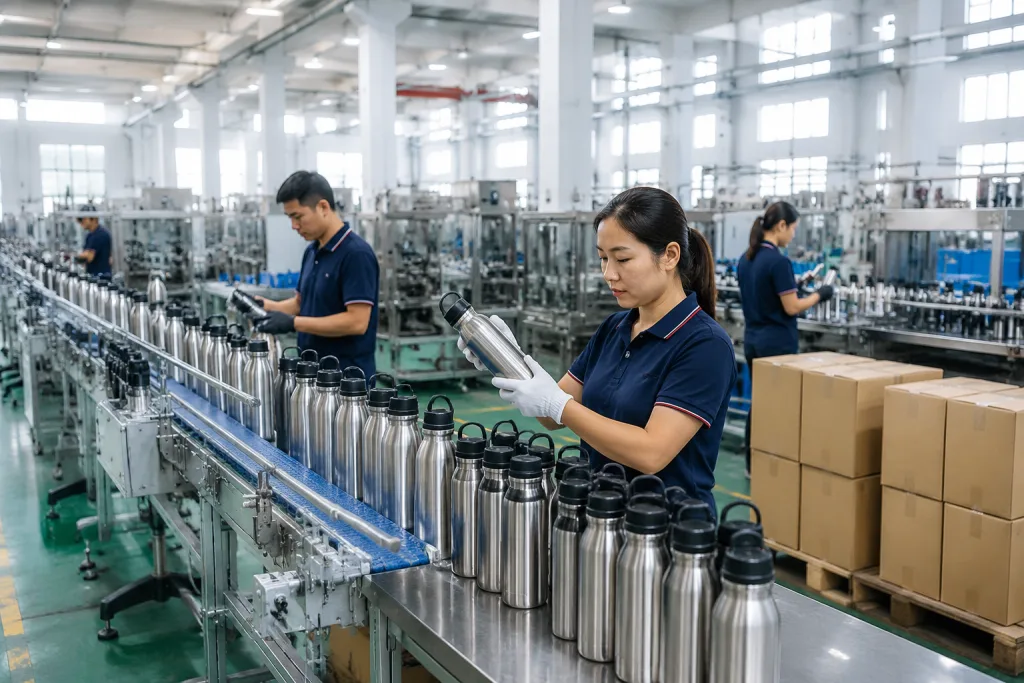
Key Takeaways
- A realistic MOQ for custom drinkware starts at 1,000-3,000 pcs per SKU, not 100 pcs
- 304 stainless steel at 0.4-0.5 mm wall thickness is the normal baseline for vacuum bottles
- Plan 25-35 days production after artwork approval for most custom logo orders
- Use AQL 2.5/4.0 inspection and request FDA, LFGB, REACH, or ASTM documents early
If you searched for promotional water bottle american, you likely need bottles built for U.S. or North American buyers: FDA or LFGB material files, clean logo edges, cartons that stack at 12 kg, and no cracked lids after delivery. Finding a bottle is easy. Matching target price, compliance, print method, and a ship date before the PO lands is where orders get expensive; we had one buyer flag a 0.3 mm logo shift only after the pre-production sample, and the math no longer worked.
From our factory network in Zhejiang, China, we see buyers lose 5 to 8 days on vague quotes like “premium stainless bottle” or “eco plastic canteen.” Those words do not tell you wall thickness, AQL level, carton drop test, or whether the logo survives 100 dishwasher cycles. Ask for factory-level answers before sampling: we run calipers on the body, weigh the empty bottle in grams, and QC pulled the sample if the powder coating shows pinholes under the inspection lamp.
Define the American Use Case
“American promotional water bottle” is the wrong question to ask. It is not a technical product category. In our quoting room, it usually means a bottle for U.S. corporate giveaways, university events, outdoor campaigns, retail promotions, or distributor programs, and each channel changes the spec. A 600 ml stainless vacuum bottle for an insurance conference is not built like a 1 liter canteen promotional item for a camping retailer; last month QC pulled a 600 ml sample at 286 g, while the camping buyer asked us to hold the body under 0.8 mm wall thickness so the line could hit their price.
Start with the user and channel. Office welcome kit? Weight and finish matter more than carabiner strength. School or youth program? We check small-hand grip, leak resistance, and sometimes ASTM or CPSIA review before we run the PP sample. Amazon FBA is another headache: you need FNSKU labeling, carton dimensions, and packaging that survives parcel handling, because we have seen a 12 kg master carton fail a 76 cm drop test when the buyer insisted on thin E-flute color boxes.
For U.S. buyers, the most common capacities are 18 oz, 20 oz, 24 oz, 32 oz, and 40 oz. Europe often asks in 500 ml, 750 ml, and 1,000 ml. If you are a distributor drinkware buyer serving both markets, choose one body mold and print both units on the artwork or bottom sticker. It keeps the mold list clean; we once caught a PO typo where 750 ml was matched to a 24 oz lid set, and the math did not work on the assembly line.
Be careful with the word “canteen.” In North America, a custom canteen can mean a military-style flask, a camping bottle, or a wide-mouth sports bottle. When you speak with a canteen manufacturer in China, send reference photos and a capacity drawing with diameter, height, mouth size, and cap thread. Otherwise one supplier quotes a round aluminum canteen, another quotes a stainless outdoor bottle with a screw cap, and your buyer flags the 3 USD price gap after sampling instead of before tooling.
Pick Materials Before Price
Price is the wrong first question. Lock the material first, then the quote starts to mean something. For promotional water bottle american programs, we usually see 5 paths: single-wall plastic, aluminum, stainless steel, glass, or Tritan. Each one changes the mold charge, logo method, test report, and the way QC checks the line with a caliper and drop-test jig.
For stainless vacuum bottles, ask whether the inner wall is 304 stainless steel. QC pulled one sample last month where the outer shell was 201 stainless and the buyer thought the whole bottle was 304 stainless. Outer 201 can pass for some budget jobs, but not for the food-contact inner wall. Normal wall thickness is around 0.4-0.5 mm for many promotional bottles; we measure it after cutting a failed sample, not by reading the supplier’s PDF. Heavier retail bottles may use thicker steel, but the math changes fast: FOB cost goes up, and a 12 kg export carton becomes 15 kg.
Plastic sports bottles are cheaper, often FOB USD 1.20-2.80 depending on material, cap, capacity, and logo. PP is fine for simple gym giveaways. Tritan looks clearer and survives more abuse, but the buyer will feel it in the unit price. If your buyer wants “BPA-free,” ask for the test report for the actual material grade, not one sentence on a quotation. For California distribution, buyers often request Prop 65 review; we had one PO delayed 6 days because the buyer flagged the resin grade code missing from the report.
Aluminum is common for low-cost canteen customized orders, but most aluminum bottles need an internal liner. That liner touches the drink, so test it like food-contact material, not like paint. We’ve seen this go sideways when a factory passed the bottle body and skipped the liner migration test. Glass works for office and wellness brands, but breakage control decides the profit: silicone sleeve fit, 5-layer carton strength, and a 1.2 m drop test matter. A custom growler or customizable growler for breweries usually runs stainless or amber glass; choose based on insulation need and shelf image, not a pretty mockup.
Our practical view: if the campaign budget allows USD 4.50-7.50 FOB, stainless vacuum is usually safer for brand perception. If the budget is under USD 3.00 FOB, plastic or aluminum is more realistic. Don’t force stainless into a budget that cannot pay for proper steel, vacuum testing, and packaging. We run vacuum checks at 100°C water for 4 hours on pre-shipment samples, and cheap bottles fail there before they fail in a catalog photo.
Understand MOQ and Tooling
MOQ is where new buyers hit the first wall. A canteen factory may show 500 pcs on Alibaba, but that usually means stock color, one-color logo, and a plain white box. Ask for PMS 186C powder coat, molded cap color, retail box artwork, or a canteen customizable shape, and the line has to change paint, jigs, and packing SOP. MOQ jumps fast. We had one US promo buyer flag this after the PO said “navy” but the PDF artwork called out PMS 2965C.
At BottleForge Industrial in Hangzhou, Zhejiang, normal MOQ is 1,000 pcs for stock-shape logo orders, 3,000 pcs for custom powder coating, and 5,000-10,000 pcs for new lid colors or private mold development. Monthly capacity across our drinkware lines is about 500,000 units, but capacity is the wrong question to ask. Setup cost still sits there: paint room cleanup, pad-printing screens, welding fixtures, 5-ply export cartons, and AQL 2.5 inspection time. QC pulled one sample last month because the carton label SKU had a one-digit typo.
For a distributor canteen or distributor growler program, build a tight small family instead of chasing every size. One 20 oz tumbler, one 24 oz sports bottle, and one 32 oz wide-mouth bottle can share the same black coating and kraft retail box style. You may place 3,000 pcs total, but we still run three SKUs. Each SKU needs separate artwork approval, production setup, QC sampling, and carton labels with the right UPC placement. This is where programs go sideways.
Tooling depends on the part you change. A new silicone boot may cost USD 800-1,500. A custom cap mold can be USD 2,000-6,000. A new stainless body mold is more complex and usually only makes sense above 10,000-20,000 pcs. The math does not work for a 500 pcs test order. A canteen supplier will sometimes absorb tooling if annual volume is firm, but we usually wait until two trial orders ship clean and the buyer’s forecast matches real repeat PO dates.
Low MOQ is good for market testing. It is not magic. If the unit price looks too good at 500 pcs, check whether decoration, carton strength, or inspection has been quietly removed.
Choose Decoration That Survives
Logo method decides shelf look and complaint rate. On customized drinkware, we run silk screen for flat color blocks, pad print for tight curves, laser engraving for stainless, heat transfer or water transfer for photo artwork, UV print for short runs, and full-wrap powder coating when the bottle body carries the design. QC pulled 32 bottles from the line last week and found 3 print rub marks before packing. Decoration is not just cosmetic.
Silk screen is the budget choice for simple one- or two-color logos. It works best on straight walls, and we quote roughly USD 0.08-0.25 per position depending on logo size and color count. The screen room sets this up with a 120T mesh for most bottle logos. Pad printing handles curved or small areas, but 0.2 mm fine lines can spread after ink transfer. Laser engraving lasts on stainless bottles and tumblers, usually USD 0.20-0.60 per logo, but it exposes the steel or base layer instead of matching a PMS ink color.
If your American client demands exact brand color, ask for PMS tolerance first. “Can you match our blue?” is the wrong question to ask without a tolerance. Powder coating and printing on curved metal do not behave like paper. A reasonable tolerance is often Delta E less than 2-3 for controlled coatings, but 6 of 10 promotional POs we see still judge color visually under D65 light at the QC table. Put the approval standard in writing before mass production.
For a customized canteen or customized growler, logo position matters as much as the logo method. Engraving across a curved shoulder looks clean in a mockup, then turns uneven when the rotary jig hits the radius. We have seen this go sideways on a 1.9 L growler with a 38 mm shoulder curve. Full-wrap artwork needs seam alignment and taper allowance. For stainless bottles, we request vector AI or PDF files, convert fonts to outlines, and confirm logo size in millimeters, not “large on front.”
Do not approve decoration from a digital rendering only. Ask for a pre-production sample or at least a printed color chip on the actual coating. For urgent campaigns, a photo sample saves about 5 days, but the math does not work if 8,000 bottles arrive with weak adhesion. We run a 3M tape pull and 100-cycle rub test on suspect artwork. A good canteen vendor should tell you when your artwork is too thin, too close to a radius, or likely to fail adhesion testing.
Compliance Is Not Optional
For B2B custom drinkware, clear compliance before deposit, not after 38 cartons are taped and stacked by the loading door. U.S. promotional buyers usually ask us for FDA food-contact documents, BPA-free statements, Prop 65 assessment, sometimes CPSIA or ASTM when the bottle is for children. European buyers often need LFGB, REACH, and EU food-contact declarations. If one SKU ships to the U.S. and Germany, we run the stricter file first; otherwise the buyer flags it during artwork approval and the schedule slips 6 days.
Documents must match the actual bottle. A general stainless steel report from 2022 does not cover a new painted lid, silicone straw, PP cap, or printed coating on this order. Food-contact parts include inner wall, lid, straw, gasket, liner, sometimes paint if the mouth can touch it; QC pulled one sample last month where the logo sat 4 mm too close to the drinking rim. For kids bottles, small parts, lead, cadmium, and phthalates get more attention, and this is where cheap “similar material” reports go sideways.
Factory audits matter too, especially for distributors supplying large brands. BSCI, Sedex, ISO 9001, and social compliance reports do not prove the bottle will not leak, but they lower procurement risk. If your end client requires one audit platform, tell the canteen manufacturers before the PO, not after the 30% deposit; we once lost 12 days waiting for a Sedex window because the buyer’s PO had the wrong factory name in English. A factory cannot invent a valid report after the line starts.
Quality inspection should use a written AQL plan. We usually see AQL 2.5 for major defects and 4.0 for minor defects, with critical defects at zero tolerance. Major defects include leaking, poor vacuum performance, sharp edges, wrong logo, wrong capacity, and failed coating adhesion; minor defects include small paint specks, light scratches, or carton marks inside an agreed limit. Put the limit in writing. “Acceptable scratch” is the wrong question to ask unless both sides agree on length, such as 3 mm on the back side only, checked under a 600 lux inspection lamp.
For stainless vacuum bottles, ask about 100% leak testing and vacuum testing during production. Random final inspection alone misses unstable process control; the math does not work if you inspect 200 pcs from a 10,000 pcs run and skip the line data. In China, serious factories in Zhejiang and nearby provinces already run water leak testing, air pressure testing, and temperature retention checks, often with 24-hour hot water sampling at 95°C. Still specify the standard on the PI, because “normal test” means different things to the sales desk and the pressure-test operator.
Calculate Landed Cost Properly
FOB unit price is one line on the cost sheet. For a promotional water bottle american program, landed cost means ocean or air freight, duty, customs brokerage, inland trucking, insurance, inspection, tariffs if applicable, plus warehouse relabeling when the barcode file arrives late. We had one PO where “matte navy” was typed as “mate navy,” and the buyer still expected the forwarder quote to hold. It did not. A USD 4.80 FOB bottle can land at USD 6.20-7.50 depending on carton CBM and shipping mode.
Drinkware is bulky. No way around it. A 32 oz stainless bottle may pack 24 pcs per carton, with carton size around 50 x 38 x 32 cm and gross weight near 9-12 kg, depending on lid height and powder coating thickness. On the line, we check the master carton with a tape measure before booking space because 20 mm extra height across 600 cartons changes the freight quote. Air freight hurts because you pay by chargeable weight. If the event date is fixed, build the schedule backward: 3-5 days for artwork confirmation, 7-10 days for sampling, 25-35 days for production, 3-5 days for inspection and export handling, then shipping time.
For U.S. West Coast ocean freight, port-to-port transit may be around 15-25 days, but door delivery is often the number that bites. East Coast delivery can add another 10-18 days. We ship Ningbo to Los Angeles faster than Ningbo to a warehouse in Ohio, and the buyer flagged that gap more than once. If you need goods in 45 days from PO, custom mold changes are the wrong fight. Use stock shapes, confirmed colors, and simple decoration.
Packaging changes landed cost fast. Individual kraft boxes look better but add cost and carton volume; bulk polybag packing is cheaper, but some brands push back on plastic waste. QC pulled one sample last month where the box window cracked during a 1.2 m drop test, so the “premium box” became extra scrap and extra delay. For customizable drinkware sold through distributors, we often recommend a plain retail box with a printed barcode label. It keeps the product presentable without locking you into one client’s artwork.
If you are a canteen distributor buying multiple SKUs, consolidate shipments when the dates line up. Mixing custom canteen, travel tumbler, and custom growler orders in one container cuts per-unit freight, but the math doesn't work if one SKU is 12 days late and the container waits at the warehouse. We run carton dimension checks at quotation stage with length x width x height in cm, not after mass production. Ask your supplier for carton dimensions during quotation, then make the forwarder price the same volume before you issue the PO.
Work With the Right Factory
A canteen supplier is not automatically the right partner for every drinkware program. Some canteen vendors are trading companies with access to 80 or 100 molds across three workshops. Some are focused factories with tighter process control but only 12 to 20 active bottle styles. Both can work. This is the wrong question to ask. Ask whether they answer wall-thickness, coating, lid-fit, and packing questions clearly, then put each responsibility on the PI and PO. We have seen this go sideways when a buyer approved a “600ml canteen” by photo, then QC pulled the sample and measured 585ml to the overflow line with a graduated cylinder.
When you evaluate canteen suppliers in China, ask for a quotation sheet that includes material grade, capacity, net weight, coating, logo method, MOQ, sample time, production lead time, carton size, HS code, payment terms, and FOB port. Ningbo and Shanghai are common ports for Zhejiang production. If the quote only says “stainless bottle, customized logo, best price,” push back. We run quotes with actual numbers: 304 stainless body, 0.5mm inner wall, 0.4mm outer wall, 500ml capacity, 3,000 pcs MOQ, 7 days for logo sample, 30 days for mass production after approval. If one line is missing, the line will find it later, usually at the worst time.
For distributor drinkware programs, responsiveness after the deposit matters more than charm before the deposit. You need artwork checking, sample tracking, production photos, inline QC updates, final inspection support, and export documents. A good canteen manufacturer flags risk early: dark logo on matte black coating, weak handle design on a 1.2kg filled bottle, cap color MOQ stuck at 5,000 pcs, or a delivery date that needs 18 days when the buyer only allowed 12. We had one PO where “PMS 186C” was typed as “PMS 168C”; prepress caught it before pad printing plates were made. Small catch. Big save.
At BottleForge Industrial, we prefer direct technical conversations because they prevent expensive surprises. If your client wants a canteen promotional bottle for a U.S. outdoor event, we ask about capacity, drinking lid, coating durability, carton drop requirement, compliance market, and delivery address before quoting. The buyer sometimes says, “Just give me the price.” The math does not work that way. A powder-coated bottle packed 24 pcs per carton may pass the unit cost target, then fail a 76cm carton drop because the divider board is too thin. That may feel slower than a one-line price, but it produces a PO your operations team can execute.
The best buyer-supplier relationship is boring in the right way: approved sample, written spec, controlled production, AQL inspection, clean documents, and cartons that arrive as expected. For one U.S. promo order, our final inspection found 9 logo scratches in a 315-piece AQL 2.5 sample pull, so the line reworked the cartons before booking the Ningbo truck. No drama. That is what you should demand from canteen manufacturers, whether you buy one custom canteen SKU or a full customized drinkware range.
Send your bottle spec for a factory quote
Share capacity, material, logo artwork, target market, quantity, and delivery date. We will return a practical FOB quote with MOQ and lead time.
Frequently asked questions
What is a realistic MOQ for a promotional water bottle american order?
For stock-shape bottles with one logo, 1,000 pcs per SKU is realistic at many China factories. For custom PMS powder coating, expect 3,000 pcs. For a new lid color, custom canteen shape, or private mold, 5,000-10,000 pcs is more normal. Some suppliers quote 300-500 pcs, but check what is excluded: custom color, retail box, inspection, and stable lead time may not be included. If you are testing a new distributor canteen program, start with a stock mold and spend the budget on reliable decoration and packaging instead of tooling.
Which material is best for American promotional campaigns?
For higher perceived value, 304 stainless steel vacuum bottles are the safest choice, especially in 20 oz, 24 oz, and 32 oz sizes. Budget FOB pricing often falls around USD 4.50-7.50 depending on cap, coating, and logo. For mass giveaways under USD 3.00 FOB, Tritan, PP, or aluminum may fit better. If the product targets children, schools, or healthcare, compliance documentation becomes more important than saving USD 0.20. For outdoor retail or brewery programs, a customized growler or stainless wide-mouth bottle usually gives a stronger brand impression than thin aluminum.
How long does custom drinkware production take from China?
A normal schedule is 7-10 days for pre-production sampling and 25-35 days for mass production after sample and artwork approval. Add 3-5 days for inspection, export documents, and loading. Ocean shipping to the U.S. West Coast may take about 15-25 days port-to-port, while East Coast delivery takes longer. Air freight can save time but often ruins the margin on bulky drinkware. If your event date is within 45 days, avoid private molds, unusual coatings, and multi-location decoration.
What logo method should I choose for a canteen customized order?
Use silk screen printing for simple one- or two-color logos when unit cost matters. Use laser engraving for stainless bottles when durability matters more than exact PMS color. Use heat transfer or UV print for multicolor artwork, but confirm adhesion and scratch resistance before mass production. For a canteen customized outdoor bottle, avoid placing tiny text across curved shoulders or textured powder coating. A good canteen vendor should confirm logo size in millimeters and provide a sample photo or physical sample before production.
Do I need third-party inspection for promotional drinkware?
Yes, especially above 3,000 pcs or when the goods ship directly to a U.S. distributor warehouse. Use AQL 2.5 for major defects and 4.0 for minor defects, with critical defects at zero tolerance. The inspection should check leakage, vacuum performance, coating defects, logo position, capacity, carton labels, barcode scans, and packaging. For Amazon or retail orders, include FNSKU, carton weight, and drop-test expectations. Factory QC is necessary, but an independent final inspection gives you leverage before the balance payment is released.