Key Takeaways
- A practical MOQ for custom thermos orders is 1,000 pieces per color and 3,000 pieces for molded lid changes
- 304 stainless steel is standard for food-contact bodies; 316 is useful for coastal or premium outdoor ranges
- Laser engraving adds about USD 0.18-0.45 per unit, while powder coating can add USD 0.60-1.20
- Plan 35-50 days production after artwork approval for most thermos bulk orders from China
If you sell outdoor gear or run promo campaigns in Germany, a low-cost flask that leaks after 14 days is not a small issue. It turns into 37 return emails, one-star reviews, and a buyer asking why their logo sits on a cup that smells like metal. We had QC pull a sample last month after the lid torque test failed at 0.8 N·m. Not fun.
A promotional vacuum flask Deutschland order needs more than a clean 3D render. The right questions are stainless grade, real heat-retention data, REACH documents, lid fit, logo proofing, carton marks, and whether the line can ship before your campaign date. From Zhejiang, China, we see this go sideways when the MOQ is written as “about 1,000 pcs” on the PO, the silicone ring is 0.3 mm undersized, or nobody books AQL 2.5 inspection before loading.
Start with the actual use case
Before you ask for a promotional thermos quote, pin down where the flask will be used. This matters. A hiking retailer selling to alpine customers should not buy the same bottle as a beer festival sponsor handing out 500 ml flasks for an autumn campaign. On our line, the cap torque, powder-coating thickness, carton K=A strength, and even the hangtag hole position change once the use case is clear.
For outdoor retail, we usually push buyers toward 500 ml, 750 ml, or 1,000 ml capacities with a double-wall 304 stainless body, 0.4-0.5 mm inner wall, and 0.5-0.6 mm outer wall. That gives a solid hand feel without turning sea freight into a problem; a 1,000 ml sample we weighed last month came in 482 g before color coating. For promotional giveaways, 350 ml and 500 ml models are easier to budget and pack. A 500 ml stainless vacuum flask normally lands around USD 3.20-5.80 FOB Ningbo or Shanghai depending on finish, lid, and packaging.
If you are buying for Deutschland, do not assume one model fits every channel. That is the wrong question to ask. Outdoor retailers want drop resistance and a retail box that does not crush at the corners after 12 cartons stacked on a pallet. Promotional brands push us on 18-day delivery, low logo reject rate, and clean visibility on curved bodies. Distributors thermos buyers care about barcode accuracy, pallet configuration, and replacement stock; we once had QC pull 240 boxes because one PO had the EAN digit typed wrong.
Ask your supplier thermos contact for three numbers early: measured heat retention at 6 hours, filled product weight, and carton drop-test result. If they need to check the lab sheet or ask QC, fine. We do that too. If they refuse to answer, move on; we have seen this go sideways when a buyer approved a glossy sample, then found the 1.2 m drop test split the inner tray during pre-shipment inspection.
Choose steel and vacuum construction
For most promotional vacuum flask Deutschland programs, we run 18/8, also called 304 stainless steel, on the inner wall and outer shell. It passes food-contact expectations, our coil suppliers in Ningbo keep it in stock, and it handles coffee or tea without leaving the metallic smell buyers complain about during sample checks. 201 stainless on the outer shell saves about USD 0.18-0.32 on a 500 ml flask, depending on the week’s coil price. Fine for a one-day giveaway if the PO says 201 clearly. For outdoor retail in Germany, the math doesn't work. QC pulled 12 samples from a 201-shell job last winter, and 3 showed small dents after the 80 cm carton drop test.
A reliable manufacturer thermos build is not just a steel-grade line on the quotation. The vacuum gap, mouth weld, copper lining option, and bottom seal decide whether the flask performs after it leaves the line. For a 500 ml customized thermos, heat retention should sit around 60-70°C after 6 hours when filled with 95°C water at room temperature; we check this with a probe thermometer after the bottles rest on the stainless test rack. Copper coating and tighter lids can lift the result, but I push back on 24-hour claims unless the supplier shows the test method, fill volume, lid type, and starting temperature.
Check these construction details before confirming a bulk thermos order. This is where we’ve seen orders go sideways: one buyer approved “304 inside” by email, then flagged the outer shell after arrival because the PO missed the material note. Small typo. Big argument.
- Inner wall: 304 stainless, usually 0.4-0.5 mm thickness, checked with a digital thickness gauge before welding.
- Outer wall: 304 stainless for retail orders; 201 only when the buyer signs off on cost, use case, and marking.
- Lid seal: food-grade silicone, removable if possible, because coffee residue under a fixed gasket fails fast in customer hands.
- Weld: smooth mouth weld with no sharp edge, no black oxidation marks, and no polishing paste left inside the rim.
- Vacuum failure rate: target below 1.0% after production aging test, with failed units pulled before carton packing.
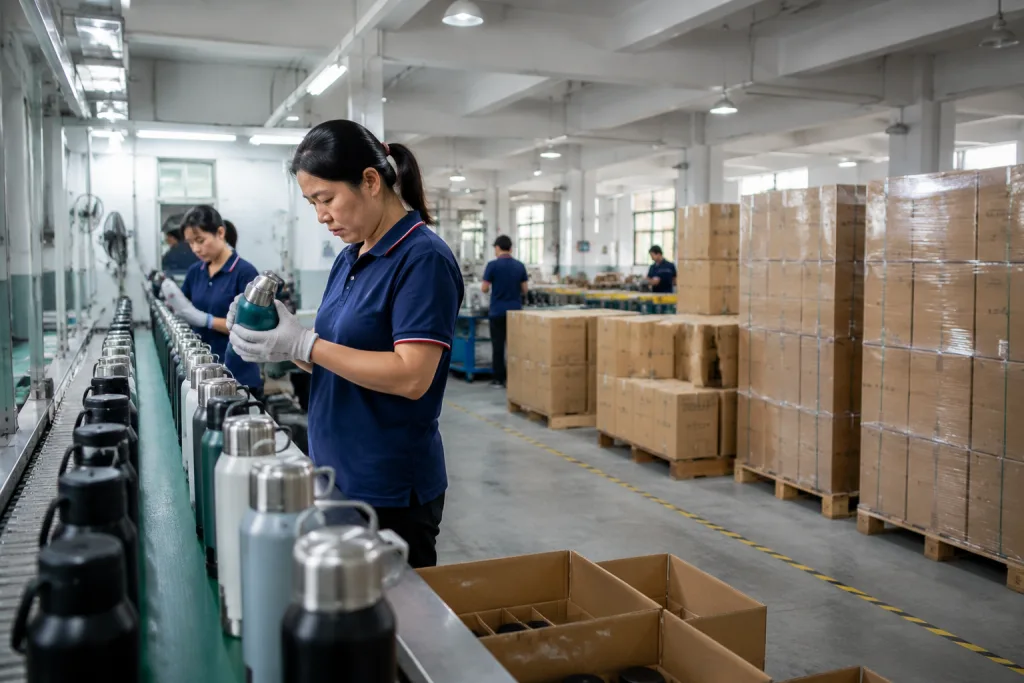
At our Zhejiang factory thermos line, standard capacity is about 450,000 stainless bottles and flasks per month, and we vacuum test 100% of units before packing. Not magic. Just discipline. The operator scans each tray, the heat-response tester rejects weak vacuum pieces, and packing only starts after QC signs the aging-test sheet.
Branding that survives real handling
A custom thermos is not custom because a logo sits on a PDF mockup. It becomes custom when the logo process fits the coating, the AI or CDR file is locked, and the approved sample matches what we ship. For promotional vacuum flask Deutschland buyers, we usually run laser engraving, silk screen printing, UV printing, heat transfer, or embossed/debossed silicone patches. Small detail, big headache: last month QC pulled a sample where the PO said Pantone 286C, but the artwork file showed 2685C.
Laser engraving is the safe choice for outdoor retailers. No peeling. It looks clean on powder coating, and the cost is easy to quote. On most stainless thermos custom jobs, laser adds USD 0.18-0.45 per unit depending on logo size and position; our line checks the first 20 pieces with a 0.5 mm position tolerance jig. Silk screen is cheaper for simple one-color logos, often USD 0.08-0.20 per unit, but the math does not work if the flask gets dragged in backpacks or car cup holders without abrasion testing. UV print gives more color detail, but we avoid it on heavy orange-peel powder coating unless adhesion passed 3M tape and cross-hatch testing.
For a customizable thermos range, build it in layers. Keep the same 500 ml body, then offer three colors, two lids, and three logo methods only if each option has a signed sample card. That gives your sales team 18 sellable combinations without adding mold risk. If you want a fully customized thermos with a new cap shape, new handle, or molded brand icon, expect 3,000-5,000 pieces MOQ and 20-30 days for tooling before mass production. We have seen this go sideways when a buyer added a soft-touch handle after the mold drawing was already signed.
Do not approve production from a digital proof alone. Ask for a pre-production sample with the real coating and real logo, not a clean render from the sales deck. If time is tight, approve a physical logo plate or laser position sample by video, but understand the risk; the camera angle can hide a 1 mm tilt. For Germany, where promotional brands often serve corporate clients, a 2 mm logo shift can still become a complaint. The buyer flagged exactly that on a 1,200-piece reorder for Munich, and we had to sort cartons one by one at final inspection.
Compliance for Germany and EU
For Deutschland, compliance is not a PDF folder we chase after the vessel has left Ningbo. Build it into supplier selection. We run this check before quoting: LFGB food-contact scope, EU Framework Regulation (EC) No 1935/2004, REACH restricted substances, and German packaging registration questions for the importer. If the flask is for children, the line needs a separate design review for EN 14350 or toy-like parts, based on the cap shape, strap length, and any cartoon claim printed on the artwork. Last month QC pulled a 350 ml kids sample because the silicone straw measured 2.1 mm off the approved drawing.
For stainless vacuum flasks, German buyers usually ask for migration testing on the inner 304 stainless, heavy metal checks on coated areas, BPA-free statements for PP or Tritan lids, and silicone food-contact declarations with the correct gasket grade. Do not test a bare cup and then ship a painted lid. The math doesn't work. If the lid has plated trim, check that coating as its own contact or hand-mouth risk, depending on the design. For North America, ASTM and FDA-related food-contact expectations may come up, but for a promotional vacuum flask Deutschland campaign, LFGB and REACH are the reports your customer will flag first. We have seen POs held for 12 days because the report model said “VF-500B” while the carton mark said “VF500-B”.
Factory audits matter too. BSCI, Sedex, ISO 9001, or a recent third-party audit will not guarantee quality, but they cut down the blind spots before you pay the deposit. A suppliers thermos file should include the business license, current audit status, test reports less than 24 months old, and a material declaration that matches the BOM we use on the line. If your distributor thermos customer sells into retail chains, ask for these before sampling. Not after deposit. One German retailer rejected a 3,000 pcs order at pre-shipment because the test report listed a black powder coating, while the approved sample was Pantone 286C blue.
Good compliance practice is boring: define the market, lock the material, test the final construction, and keep the report tied to the same model and material you are shipping. QC should be able to match the report, the BOM, and the carton label with a ruler and a barcode scanner.
China suppliers can move fast, but fast is not the same as compliant. A serious thermos supplier in Zhejiang or another China manufacturing region will tell you which report applies and which one does not. That honesty beats a folder of 18 unrelated certificates. We ship better when the buyer asks the hard questions early, even if it slows the first quote by 1 day.
MOQ, pricing, and lead time
MOQ is where 6 out of 10 promotional thermos projects start to wobble. A buyer asks for 300 pieces, five colors, a custom lid, retail box, and delivery in three weeks. The math doesn’t work. On our line, one powder-coating color change means cleaning the spray gun, checking film thickness at 60-80 μm, and resetting hanging racks; logo jigs and box printing also have their own minimum runs.
For standard models, a workable MOQ is 1,000 pieces per color for powder-coated stainless flasks. Some thermos suppliers accept 500 pieces when you take stock colors and a simple laser logo, but the unit price usually jumps by USD 0.25-0.60 because the line still needs setup time. For thermos bulk orders above 5,000 pieces, we can usually talk about coating cost, 5-layer export cartons, and packing details like insert cards or barcode stickers. For new molds or new plastic lids, expect 3,000-5,000 pieces MOQ and tooling cost from USD 800-3,500 depending on complexity; QC pulled one lid sample last month because the PP hinge gap was 0.8 mm over drawing tolerance.
Indicative FOB China pricing for a 500 ml promotional vacuum flask, based on 304 stainless inner wall and normal export packing:
- Basic stainless finish: USD 2.80-3.80, simple white box, usually the safest choice for tight campaign budgets.
- Powder coating plus laser logo: USD 3.60-5.20, with logo fixture setup checked before mass engraving.
- Retail-grade lid and color box: USD 4.50-6.80, where box artwork approval often takes longer than the flask sample.
- Premium copper-lined model: USD 5.80-8.50, better for gift channels than throwaway promo pricing.
Normal lead time is 7-10 days for sampling and 35-50 days for mass production after deposit and artwork approval. Add 3-7 days if you need third-party inspection, FBA labeling, or special palletization; we’ve seen this go sideways when the PO says “Hamburg warehouse” but the carton mark says “Berlin event.” If your campaign date is fixed, build the schedule backward. For sea freight to Hamburg, 8 of 10 Deutschland buyers plan 30-40 days port-to-port plus customs and inland movement. Air freight saves time, but on a low-cost promotional item it can wipe out the margin fast.
Inspection before you pay balance
Inspection does not mean you distrust the factory. It is a normal control point on a manufacturer thermos order, especially with a printed logo. We run most flask orders at AQL Level II, with critical defects at 0, major at 2.5, and minor at 4.0. For a retail launch in Germany, I would tighten the plan or add an inline check when the line reaches 30% output; once we found a 1.5 mm logo drift at that stage and saved 7,200 bodies from rework.
Check vacuum performance, leakage, coating adhesion, logo position, odor, capacity, lid fit, carton strength, barcode readability, and color shade against the approved sample. For powder coating, ask for a cross-hatch adhesion test on production samples using 3M 600 tape, not just a fingernail scratch. For leak testing, QC should fill units, turn them upside down and lay them horizontally for at least 30 minutes. For vacuum testing, our line uses hot water filling and infrared temperature checks after aging; failed units go into a red rejection crate, not back beside packed stock.
If you are a thermos distributor or promotional agency, do not skip packaging inspection. German customers notice crushed boxes and crooked labels. We have had a buyer flag a 4 mm label tilt before approving shipment, and honestly, they were right. Confirm master carton size, gross weight, recycling marks, EAN or FNSKU labels if needed, and pallet height. For Amazon-style shipments, carton labels and FNSKU placement matter as much as the flask, because one wrong sticker can hold 38 cartons at the warehouse gate.
Pay the balance after the inspection report passes, not after someone sends clean photos from the packing area. Photos help. They are not a checklist. A serious thermos factory will accept this process because it protects both sides. It catches fixable issues before the goods leave China; after loading, the math does not work, and we have seen small problems turn into 18 days of email claims instead of 12 minutes of rework on the packing table.
How to brief your factory
A clear brief beats another 3% discount. We see this weekly. When you contact thermos manufacturers, send a one-page specification sheet, not “please quote best price.” List capacity, fixed dimensions in mm, stainless grade, finish, logo method, logo size, packaging, target market, compliance needs, order quantity, delivery date, and Incoterm. If you need FOB Ningbo, write FOB Ningbo. If you need DDP Germany, write DDP Germany, but ask for freight as a separate line; our shipping desk may quote 12 days by rail truck versus 18 days by sea-truck, and the math changes fast.
For a promotional vacuum flask Deutschland order, the first email should state the campaign date and whether the flask is for retail resale or a corporate giveaway. Those 2 details change the job. Retail usually needs a stronger color box, German user instructions, barcode position, and extra drop-test attention. Corporate giveaway is more about artwork approval speed, carton marks, and keeping the Pantone color steady across 3,000 or 30,000 pcs. Last month QC pulled a sample where the logo sat 4 mm too low; the buyer flagged it before mass production, which saved a painful rework.
Use one golden sample. After you approve the customized thermos sample, seal it in a PE bag, photograph the front, bottom, lid, and gift box, then reference it on the purchase order. Your PO should state acceptable color tolerance, logo placement tolerance, AQL standard, inspection right, spare parts if any, and replacement policy for confirmed defects. This is not legal drama. It is basic export hygiene. We once had a PO typo showing “matte black” while the approved sample was “sand beige”; the line stopped for 6 hours until the buyer confirmed by stamped sample photo.
Good China factories like clear buyers. Bad briefs create slow quotes, wrong samples, and arguments about what was included. If you want a dependable supplier thermos relationship from Zhejiang, China, treat the first order as a system test: check reply speed, sample accuracy, document quality, and how the team handles small problems before they get expensive. The wrong question is “who is cheapest?” Ask who can hold 0.5 mm logo placement tolerance, pass pre-shipment inspection, and ship the right cartons when the warehouse in Hamburg refuses mixed labels.
Send your thermos brief for a factory quote
Share quantity, target price, logo file, and delivery market. We will reply with MOQ, FOB cost, lead time, and compliance options.
Frequently asked questions
What MOQ should I expect for a promotional vacuum flask Deutschland order?
For a standard stainless model, expect 1,000 pieces per color if you want powder coating and logo printing. Some factories can accept 500 pieces for stock colors with laser engraving, but the FOB unit price may rise by 8-18% because setup costs are spread over fewer units. For a custom thermos with a new lid, handle, or molded detail, plan for 3,000-5,000 pieces and tooling charges from about USD 800 to USD 3,500. If your budget is tight, use an existing factory thermos body, choose one stock color, and invest in better packaging or a cleaner logo finish.
Which logo method is best for outdoor retailers?
For outdoor retail, laser engraving is usually the safest choice. It resists abrasion, works well on powder-coated stainless steel, and does not peel when the flask is packed in a rucksack or cup holder. Cost is normally USD 0.18-0.45 per unit. Silk screen printing is cheaper, often USD 0.08-0.20 per unit, but it needs adhesion and rub testing. UV printing is useful for full-color logos, but not every textured coating holds it well. For a premium promotional thermos, I would approve a physical sample and run a simple tape test and 100-cycle rub test before mass production.
How long does production take from China to Germany?
For an existing stainless flask model, allow 7-10 days for sampling and 35-50 days for mass production after deposit, artwork approval, and packaging confirmation. Sea freight to Hamburg or Bremerhaven often needs another 30-40 days port-to-port, plus customs clearance and inland delivery. If you need inspection, add 3-7 days. A realistic calendar for thermos bulk orders is 75-100 days from first approved sample to warehouse arrival in Germany. Air freight can reduce transit to 5-10 days, but the freight cost may be too high for low-margin promotional campaigns.
Do I need LFGB testing for a stainless thermos?
If you sell or distribute in Germany, LFGB food-contact testing is strongly recommended and often required by serious retailers or corporate buyers. At minimum, test the stainless inner wall, plastic lid, silicone seal, coating where relevant, and any parts that contact drinks. REACH checks may also apply to coatings, inks, and packaging materials. Ask your thermos supplier for test reports linked to the same materials and construction, not just a similar product. Reports older than 24 months may still be useful, but for a new customized thermos order, fresh testing on the final sample is cleaner.
What defects are most common in custom stainless flasks?
The most common defects are vacuum failure, small leaks from lid seals, coating scratches, inconsistent logo position, odor from silicone parts, and dented retail boxes. AQL inspection helps catch these before shipment. For most promotional vacuum flask Deutschland orders, use AQL Level II, with major defects at 2.5 and minor defects at 4.0. Ask the factory to test 100% of units for vacuum performance and leakage during production, then use third-party inspection before balance payment. Pay special attention to carton strength if the order ships by sea and then moves through distributor warehouses.