Key Takeaways
- Plan 35-55 days production after sample approval for most customized thermos orders
- A practical MOQ starts at 1,000 pcs per color for standard stainless vacuum flask models
- 304 stainless steel inner walls at 0.4-0.5 mm are common for reliable promotional thermos programs
- Use AQL 2.5/4.0 inspection plus 100% leak testing before shipment
If you sell outdoor gear or run promotional drinkware programs in America, a stainless vacuum flask looks simple until the first PO bites you. We see the same 6 issues on repeat: 0.4 mm body steel sold as “premium,” powder coat rubbing off after a 3M tape test, lids weeping at the silicone ring, crushed export cartons, artwork approvals stuck for 5 days, and no clear rule for FDA or LFGB reports. By the time QC pulled the sample, your retail launch or corporate handout date was already printed on the calendar.
BottleForge Industrial manufactures stainless drinkware in Zhejiang, China for bulk thermos and custom thermos orders. A serious buyer should treat a promotional thermos like a small engineered product, not a blank cylinder with a logo. Capacity, 304 stainless choice, vacuum hold time, coating, packaging, FOB terms, and AQL 2.5 inspection all change your landed cost. The logo is not the hard part. On the line, a 0.2 mm mouth-size drift or a buyer typo on “matte black” versus “satin black” can turn 3,000 bottles into a claims file.
Start With The Real Use Case
For promotional vacuum flask America projects, decide who will hold the bottle before you ask for a quote. This is the wrong question to ask first: “What is your cheapest 500 ml?” An outdoor retailer buying for shelf resale needs a different build than a promotional brand shipping 5,000 units to a corporate event in Texas. The end user may carry it in an F-150 cup holder, a hiking pack side pocket, a golf cart basket, or an office bag with a laptop. We check this on the line with a 75 mm cup-holder gauge and a loaded carton drop record, because the real use changes the lid, finish, capacity, and packing.
For retail outdoor programs, 750 ml and 1,000 ml sizes usually make sense because customers expect real hydration capacity. For corporate gifting, 500 ml and 600 ml ship cleaner, cost less per unit, and fit standard gift boxes without fighting the insert. A 1,000 ml flask looks strong in a mockup, but one recent 24 pcs carton came out near 15.8 kg gross weight after color box packing, and the buyer flagged the UPS surcharge. The math doesn't work if the gift budget ignores domestic freight. If you are selling through distributors thermos programs, carton size, pallet count, and warehouse slots matter more than the hero photo.
Do not choose a shape only because the rendering looks good. Tall, narrow bottles tip over on a desk, and QC pulled one 68 mm base sample after it rocked on the stainless inspection table. Wide-mouth models are easier to clean and fill with ice, but the cap structure costs more and needs tighter sealing control at the silicone ring. A manufacturer thermos quote should show capacity, dimensions, net weight, carton quantity, and estimated gross weight; if the PO says “mat black” instead of “matte black,” we ask before printing. If a thermos supplier only sends a pretty photo and a price, ask again.
At BottleForge in Zhejiang, China, our standard stainless thermos line runs at about 600,000 units/month across vacuum bottles, travel tumblers, and sports bottles. For promotional thermos orders, the practical starting point is usually 1,000 pcs per color for existing molds, with laser logo samples taking about 3 days after artwork approval. Custom mold projects are possible, but we’ve seen this go sideways on first American campaigns when the volume sits under 20,000 pcs and the buyer still wants 6 colorways. We run mold checks with calipers at the mouth thread and base diameter before quoting, because a 0.3 mm miss can turn into leaking caps later.
Steel Grade And Vacuum Performance
Ask for 2 things before price: steel grade and wall thickness. We run most custom thermos jobs with 304 stainless on the inner wall, then 201 or 304 on the outer wall. For America, 304 inside is the baseline; outside steel depends on budget and where the bottle will sit. If the flask is going to coastal golf shops, fishing promos, or salt-water outdoor use, choose 304 outside. We have seen 201 outer shells come back with rust complaints after 3 months in humid warehouse storage, and that is not a fun claim to defend.
Normal wall thickness is 0.4-0.5 mm for the inner shell and 0.5-0.6 mm for the outer shell. Thinner steel can cut FOB by USD 0.15-0.35 per unit, but the math doesn't work if the line starts seeing dented bodies or weak welds. QC pulled one 750 ml sample last season with a 0.38 mm inner shell on the micrometer; it passed the catalog photo, then failed the drop check. For thermos bulk orders, the cheapest steel choice often becomes expensive after returns. The bottle should survive packing tables, carton stacking, and courier handling before your customer even opens it.
Vacuum insulation depends on weld quality, vacuum pumping time, copper lining if the design uses it, and the lid seal. A fair test for a 500 ml or 750 ml stainless flask is simple: fill with 95°C hot water, place it in a 20°C room, then measure at 6 hours and 12 hours with a probe thermometer. Many models can hold above 60°C after 12 hours, but do not print that claim unless the actual production batch has been tested. We ship what the batch proves. One buyer once flagged a PO that promised "24 hours hot" on a lid design we knew would only hold 12 hours; we corrected it before printing 3,000 color boxes.
For food-contact compliance, America-focused orders commonly need FDA/LFGB-style material documents. European buyers often ask for LFGB, REACH, and sometimes PAH testing depending on the coating and plastic parts. For North America, 4 out of 10 retail programs we quote also ask for ASTM-related checks on packaging, drop resistance, or labeling. Your suppliers thermos shortlist should show recent SGS, Intertek, TÜV, or BV reports for the same model or same material stack. Old reports on a different model are background only, not proof for your shipment.
Logo Methods That Actually Last
A promotional vacuum flask earns its money only when the logo survives backpacks, dish racks, and truck cup holders. Match the logo method to the surface finish and the buyer’s brand book; chasing the cheapest print is the wrong question to ask. We run laser engraving on stainless steel and powder coating when buyers want the least drama, because there is no ink layer to fail and no ink compliance file to chase. On our line, QC pulled a black 500 ml sample last month and checked the mark under a 10x loupe after engraving at 0.08 mm depth. Clean result. The tradeoff is color: the logo shows as exposed metal or a darker burn mark, not Pantone 186C red.
Silkscreen printing keeps cost down for a one-color logo on a straight wall. It can look sharp. On curved or tapered flasks, artwork width becomes the headache; a 90 mm wrap on a bottle that narrows from 72 mm to 64 mm will start to look stretched near the bottom. Heat transfer and water transfer printing handle color gradients or full-wrap artwork, but the math doesn't work unless the campaign budget allows testing and a slower line speed. For a customized thermos campaign, ask for a 3M tape test and a 50-cycle rub test before mass production; we’ve seen this go sideways when a buyer approved a glossy render and skipped the rub jig.
Powder coating sells well in America because it feels tough and outdoor-ready. A decent coating thickness is often 60-80 microns. Too thin, it chips at the base ring after carton drop testing; too thick, and the lid thread or silicone boot may fit tight by 0.3 mm. Matte finishes hide fingerprints, then show oil from sunscreen. Glossy finishes pop on shelf, then show scratch lines from metal keys faster. For retail, we advise one neutral color plus one seasonal color first, not six colors that split your MOQ and leave 480 pcs of slow-moving teal in the warehouse.
For thermos custom orders, artwork approval should be strict. Send vector files in AI, EPS, or PDF. Confirm logo size in millimeters, Pantone color if printing, position from base or seam, and whether the logo faces the drinking side or the back side. We mark this on the sample tag because one PO came in with “front logo 45m” instead of “45 mm,” and the buyer flagged it only after the digital proof. A good thermos vendor makes a digital proof, then a pre-production sample. Do not approve mass production from a mockup alone if the order is above USD 10,000.
MOQ, Price, And Lead Time
Buyers ask us for 250 pcs split into four colors, retail box, and a FOB price that looks like a stock giveaway cup. The math doesn't work. On existing stainless vacuum flask molds, BottleForge usually quotes from 1,000 pcs per color for logo customization because the powder coating line needs a clean color change, not 62 pcs of red sitting between two black jobs. We can run 500 pcs on a few simple models when stock shells are on the rack, but the buyer loses choices on Pantone color, lid style, and box size. For a serious promotional vacuum flask America order, 1,000-3,000 pcs is the first order range we trust.
FOB Ningbo or FOB Shanghai pricing for a standard 500 ml stainless vacuum flask often sits around USD 3.20-5.80, driven by 304 stainless weight, lid parts, coating type, logo method, and packaging. A 750 ml or 1,000 ml model may run USD 4.80-8.50. Gift boxes or color boxes can add USD 0.20-0.90 per unit once you include barcode stickers, EPE insert, and the extra 5-ply export carton. Last month QC pulled a 500 ml sample at 268 g body weight when the PO called for 285 g; that 17 g gap is where cheap quotes hide. If a quote is 25% lower than the rest, check steel grade, weight, lid material, and carton strength before celebrating.
Lead time starts after deposit, artwork approval, and sample approval, not after the first email. A normal schedule is 5-7 days for digital proof and sampling arrangement, 7-12 days for a logo sample, and 35-55 days for mass production after approval. Peak season before Q4 can add 10-20 days because the coating line gets booked by retail programs, and one failed 3M tape test on a powder coat panel can push the job back 2 days. If your American promotion has a fixed event date, build in ocean freight, customs clearance, and domestic delivery. West Coast ocean transit can be 16-25 days port-to-port; East Coast can be 30-40 days.
Payment terms for new buyers are commonly 30% deposit and 70% before shipment after inspection. Larger distributor thermos buyers with stable order history may negotiate different terms, but for a first PO under 3,000 pcs, asking for net 60 is usually a dead end. We once had a buyer flag “FOB Shanghai” on the quote while the PO said “DDP Chicago,” and that typo changed the landed cost by more than USD 1.10 per unit. If you are comparing thermos manufacturers, ask each one to quote the same Incoterm, packaging spec, test requirement, and logo method. Otherwise you are comparing incomplete numbers.
Packaging For Retail And FBA
Packaging is not decoration; it is damage control and channel compliance. A 500 ml stainless flask with a clean vacuum test can still lose the order if the color box crushes at the corners or the UPC digit is wrong. We had one buyer flag a PO typo where “matte black” became “matt black” on the carton mark. For outdoor retailers, we run a color box with capacity, 304 stainless body, care text, country of origin, and barcode placed where a Zebra scanner can read it. For promotional giveaways, a kraft gift box can work, but the lid needs a paper sleeve or EPE ring so the finish does not rub during truck vibration.
A common export carton for 500 ml bottles holds 24 pcs or 25 pcs. For 750 ml and 1,000 ml flasks, 12 pcs or 16 pcs per carton is more practical because weight and drop impact increase. Carton strength should match the route. For palletized shipments into North America, we usually use 5-ply export cartons and add dividers when the powder coating marks easily. QC pulled one sample after a 76 cm corner drop and found the lid dented through a thin white box. That math does not work for FBA. If your program goes through e-commerce, individual drop testing matters more than a glossy showroom box.
For Amazon-style fulfillment, every unit may need FNSKU labeling, suffocation warnings for polybags, carton labels, and strict carton weight limits. Most drinkware cartons should stay under 15 kg gross weight; our line usually targets 13.5–14.5 kg so warehouse staff do not reject the carton. Small detail, big delay. If you sell thermos bulk through retail shelves and marketplace orders, decide before artwork approval whether you need one universal retail pack or separate packs. We have seen this go sideways when 3,000 pcs are packed in gift boxes, then the buyer asks for FNSKU labels under the shrink wrap.
America also has labeling expectations that buyers sometimes miss. Country of origin should be clear, not hidden under the bottom flap. Care instructions should avoid dishwasher-safe claims unless tested; a lid gasket can deform after 20 cycles even when the steel body looks fine. If the lid includes PP, silicone, or Tritan components, larger retailers may ask for material declarations. For California distribution, some buyers ask about Proposition 65 exposure. A thermos manufacturer in China should not guess on your legal labels, but we can provide material sheets and test reports so your compliance team can make the call.
Inspection Before The Balance Payment
Do not sign off a promotional thermos order from final photos. Photos show cartons are packed; they do not show the goods are shippable. We run AQL inspection before balance payment, usually AQL 2.5 for major defects and 4.0 for minor defects, with critical defects rejected at zero tolerance. Critical issues include leaking, sharp edges, oil or dust inside the cup, broken lids, wrong materials, and unsafe packaging. QC pulled one 40 oz sample last season with a 0.8 mm burr under the sip lid; the photo set looked clean, but the buyer would have had returns in week one.
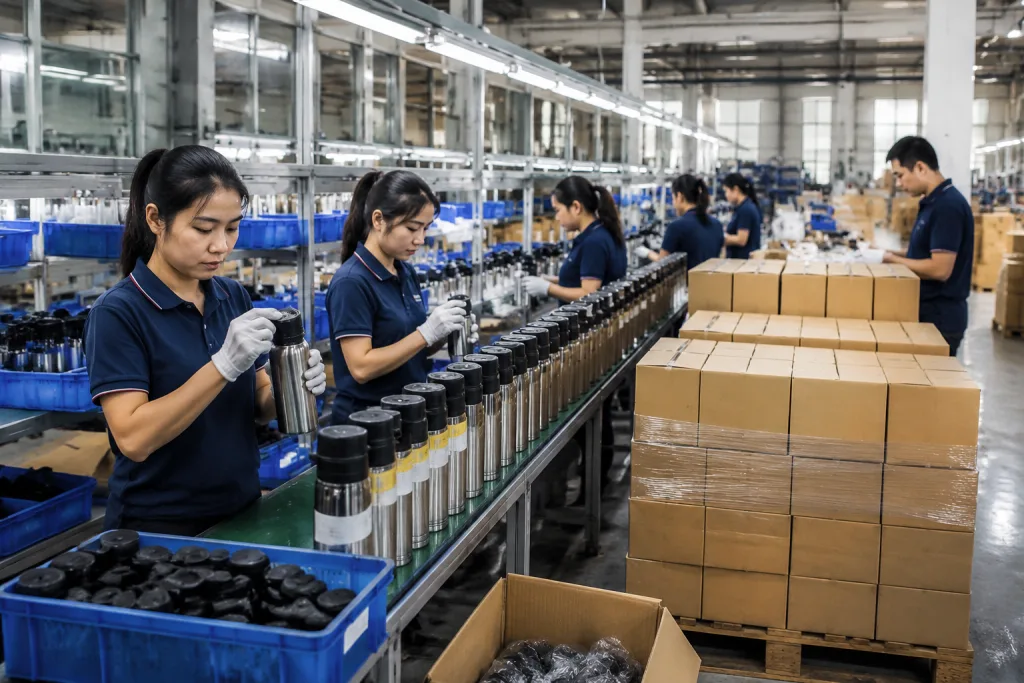
At the factory level, every vacuum flask should pass leak testing. On our line, each bottle goes through an air-pressure leak tester before packing, and the operator marks failed pieces in red pencil on the tracking sheet. Vacuum testing by hot water or temperature retention sampling also needs to be written into the PO, not discussed after packing. For example, select 20 pcs randomly from production, fill with 95°C water, close the lid, invert for 10 minutes, then record temperature drop after 6 hours. For large thermos promotional orders above 10,000 pcs, increase sampling or require a third-party inspection. The wrong question is, “Did the factory test it?” Ask which test, how many pcs, and where the records sit.
Visual standards should be written before production. Define logo deviation in mm, coating dust size, color tolerance against the signed Pantone chip, scratch length, and welding mark limits. Stainless drinkware is made by forming, welding, polishing, coating, and assembly; expecting lab-grade perfection at a USD 4 FOB price makes the math fail. Still, obvious dents, dirty interiors, and crooked logos cannot pass. We have seen this go sideways when a buyer approved a gold logo in a PDF but never approved the silk-screen film; the line held a 1.5 mm shift, and the buyer flagged it during FRI.
For American outdoor retailers, we recommend checking 80-125 pcs during a final random inspection for typical mid-size orders, depending on lot size and inspection level. Confirm carton markings, barcode scanability with a handheld scanner, capacity by scale, net weight, lid fit, odor, coating adhesion, and drop resistance from the agreed height. Small detail: check the master carton PO number too, because one typo on a U.S. warehouse label can cost 3 days at receiving. A professional thermos supplier will not be offended by inspection. If a supplier’s thermos team resists AQL checks, treat it as a warning.
Choosing A China Supply Partner
The cheapest thermos supplier is not automatically the safest choice, and the largest thermos factory is often the wrong fit for a promotional brand with mixed logos and tight launch dates. You need a team that can handle export paperwork, decoration control, retailer packing rules, and repeat production without changing the line setting every week. For a first order, ask for a product specification sheet, factory audit status such as BSCI or Sedex if available, recent test reports, production photos, and a timeline with dates for sample approval, bulk material, inline QC, and shipment. We run into this often: the buyer wants 5,000 pcs with laser logo, FDA test copy, and retail cartons, then the supplier answers “about 30 days.” The math doesn't work. Ask for the actual schedule, such as 7 days for pre-production sample, 18 days for bulk, 2 days for AQL 2.5 inspection, and 3 days to truck into Ningbo. If the answers stay vague, the risk sits on your desk.
There is a real difference between a trading company, a factory, and a coordinated manufacturer thermos supplier. Trading companies make sense when your PO has 12 categories, from pens to tote bags. A direct or factory-managed supplier is stronger when you need control over welding, powder coating, lid fit, and inspection. On our floor, QC pulled a 40 oz sample last month because the lid thread felt rough after 20 open-close cycles on the torque tester. That is the kind of issue a catalog seller may not catch before packing. BottleForge Industrial is based in Hangzhou, Zhejiang, close to major stainless drinkware production clusters and the Ningbo and Shanghai ports. That location in China helps us source lids and silicone rings faster, book inspection windows earlier, and combine export cartons when a buyer splits one program across 2 shipments.
For distributors thermos programs, consistency beats a one-time low price. Your second and third orders should match the first order’s color, lid feel, carton layout, and logo position within a practical tolerance, not “close enough.” Ask whether the supplier keeps golden samples and production records. Ask how long they retain molds, artwork files, and Pantone references. We keep approved logo films in a labeled file bag, because one PO typo, like “PMS 186C” entered as “PMS 168C,” can turn into 3,000 wrong red bottles. These details sound boring. They stop arguments six months later.
If you are building a promotional vacuum flask America line, start with one proven model, 2 capacities, and 4 colors you can reorder without drama. Test it with your customers first. We have seen this go sideways when a buyer launches 9 shapes from 4 thermos manufacturers, then every lid, carton, and insert has a different MOQ. Build a customizable thermos family with shared lids, matching finishes, and packaging set by channel, such as bulk polybag for event giveaways and 350 gsm color box for retail kits. That is how we ship a stable program instead of chasing random catalog items every season.
Quote Your Stainless Thermos Program With Real Specs
Send capacity, quantity, logo file, target market, and delivery date. We will return a practical FOB quote and production schedule.
Frequently asked questions
What MOQ should I expect for a custom stainless vacuum flask?
For existing molds, a practical MOQ is 1,000 pcs per color for most custom thermos orders. If you accept stock colors and a simple laser logo, 500 pcs may be possible on selected models. Fully customized colors, retail boxes, or special lids usually need 2,000-3,000 pcs to keep the FOB price reasonable. Custom mold development is a different project and normally makes sense above 20,000 pcs because tooling, testing, sampling, and production setup costs are not small.
How long does production take for America-bound promotional thermos orders?
Plan 35-55 days for mass production after sample approval, not after the first quote. Before that, allow 5-7 days for artwork and proofing and 7-12 days for a logo sample. Ocean freight to the US West Coast often takes 16-25 days port-to-port, while East Coast routing can take 30-40 days. If your promotion has a fixed event date, add at least 10 days of buffer for inspection, customs, trucking, and warehouse receiving.
Which logo method is best for outdoor retail flasks?
Laser engraving is usually the safest for outdoor retail because it is permanent, clean, and works well on powder-coated or stainless surfaces. Silkscreen is good for low-cost one-color logos, but it needs adhesion testing. Heat transfer is better for multi-color graphics, but it costs more and should pass rub and tape tests. For a 1,000 pcs order, expect laser marking to add roughly USD 0.10-0.35 per unit depending on logo size and position.
What tests should I request before shipment?
Request 100% leak testing at the factory plus final random inspection under AQL 2.5/4.0. For performance, test random samples with 95°C water and record temperature after 6 and 12 hours in a 20°C room. Also check coating adhesion, barcode scanning, carton drop resistance, lid fit, odor, capacity, and visual defects. For America, keep food-contact material reports on file and confirm any retailer-specific requirements before production starts.
Can one thermos design work for retail, promotional, and distributor channels?
Yes, but the packaging and decoration plan should be built that way from the start. The same 500 ml or 750 ml flask body can use laser engraving for corporate promotion, a color box for retail, and carton barcode labels for distributors. The key is shared components: same lid, same powder coating, same carton size where possible. This reduces MOQ pressure and makes repeat orders easier. Separate packaging SKUs may still be needed for FNSKU, retail UPC, or gift box requirements.