Key Takeaways
- A realistic MOQ for a promotional Tritan bottle is 1,000-3,000 units per color, not 100 units
- Tritan is useful when you need BPA-free clarity, impact resistance, and a lighter freight bill than glass
- Logo choice affects cost: one-color silkscreen can add USD 0.08-0.18, while full-wrap heat transfer costs more
- Ask for LFGB, REACH, FDA, and AQL inspection details before you approve mass production
A promotional tritan bottle looks simple on a spec sheet. Then you place 5,000 units for a launch, event, campus store, or distributor catalog, and the small points start biting: resin grade, cap fit, logo method, carton strength, barcode labels, and whether the bottle still looks clear after a dishwasher run. We have QC pull samples off the line with a torque wrench and a drop test box for a reason; this is the wrong question to ask if you only chase unit price.
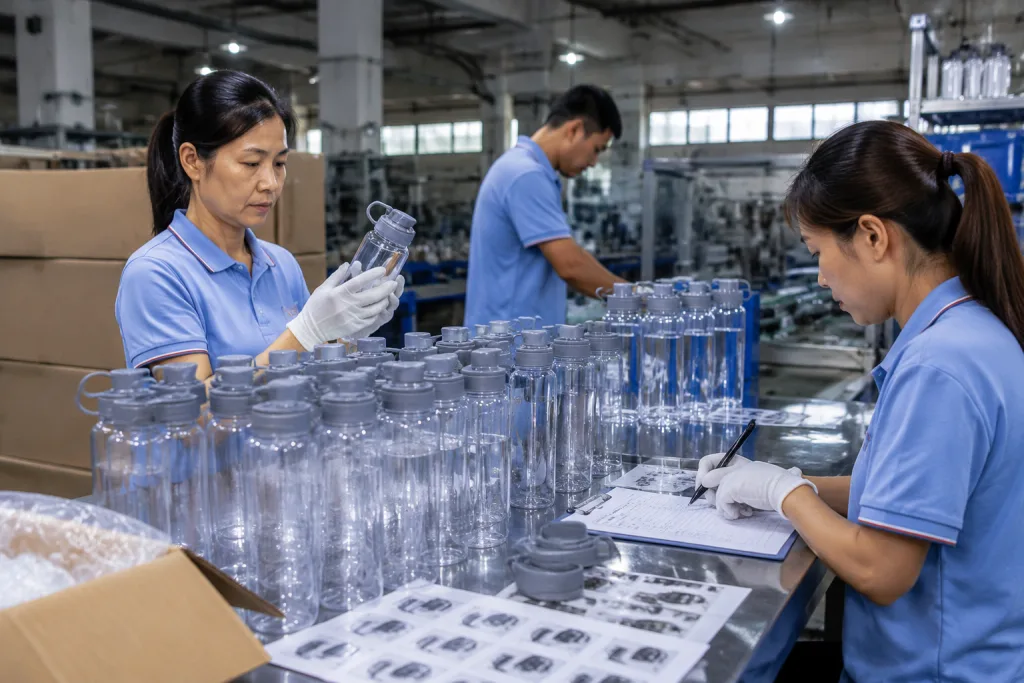
We manufacture custom drinkware in Zhejiang, China, so we see the same errors week after week. Buyers push for the lowest quote, then skip compliance, mold ownership, packing detail, and lead time that actually holds. For a typical Tritan program, our Hangzhou line runs about 220,000 plastic bottles per month, with MOQ from 1,000 units per color and 25-35 days after sample approval. The math does not work any other way.
Start With The Use Case
Do not start with the bottle shape. Start with who carries it and where it gets knocked around. A promotional tritan bottle for a marathon sponsor is a different build from a school canteen custom program or a distributor drinkware line for corporate gifting. We have seen this go sideways: the 3D render passed, then QC pulled the sample after the lid hinge whitened at 8 kg pull force.
For sports and outdoor use, buyers usually ask for 600 ml, 750 ml, or 1,000 ml capacity with a flip straw or push-button lid, plus a carry loop that does not crack when pulled. For office giveaways, 500 ml to 650 ml is enough, and a screw cap often looks cleaner on the desk. If you sell through canteen distributors, check standard retail shelving, peg hooks, or mailer boxes; last month one buyer flagged a 72 mm bottle base because it jammed in their existing carton insert.
Tritan sells well because it gives glass-like clarity without glass weight. A 750 ml Tritan bottle often weighs around 140-190 g before packaging, depending on wall thickness and lid design. That matters when we ship 10,000 units from China to Europe or North America. On one 10,000 pcs run, the carton weight difference against glass changed the quote by 1.8 tons, and the freight math did not work for the buyer.
Be honest about abuse level. If children, gym members, or field crews will use the bottle, choose thicker walls, usually around 1.2-1.6 mm, and skip delicate cap hinges. If it is mainly a conference giveaway, push visual impact and unit cost. A canteen supplier should ask these questions before quoting; if they only send a price table, you are not getting enough engineering input from the line.
Tritan Material And Compliance
Tritan is a branded copolyester, not generic PC, PET, or low-cost AS plastic. That difference changes the quotation. Real Tritan is BPA-free, handles drop tests better, and keeps clear after 50 dishwasher cycles in our sample room. For a promotional tritan bottle, ask your canteen manufacturer to show the resin grade on the quotation, such as Eastman Tritan TX1001 or TX2001, not just type “Tritan material” on a PDF. We have seen buyers flag this at PO stage when the resin line was left blank.
For Europe, buyers usually ask for LFGB food contact testing, REACH screening, and sometimes EN 14350 if the bottle is aimed at children. For the United States, FDA food contact compliance and California Proposition 65 review often come into the file. For Canada, importers usually want documents that match North American food-contact practice. A serious canteen factory in China should know which reports your retailer accepts; SGS, Intertek, and TÜV are not treated the same by every chain. Last month QC pulled a lid sample because the report covered the body only, and the buyer’s compliance team rejected it in 2 days.
Do not assume one report covers every color, lid, straw, gasket, and print ink. The bottle body may be Tritan, but the cap could be PP, the sealing ring could be silicone, and the straw could be PE. If you run metallic ink, soft-touch coating, or a gradient print, the decoration may need its own migration review. This is where new canteen vendors create risk. The line can make the bottle look right, but the compliance file still fails if the 0.8 mm silicone gasket is missing from the test scope.
Ask for the full bill of materials: body resin, cap resin, gasket material, straw material, pigment type, and decoration process. Also ask whether recycled content is involved. For food-contact promotional drinkware, most buyers still choose virgin Tritan because recycled transparent copolyester supply changes from batch to batch and is harder to certify. The math does not work if a supplier promises “eco” language at the same price, same MOQ, and same 18-day lead time without documents behind it. We ship it only when the BOM, resin COA, and print process match the approved sample.
Logo Methods That Actually Work
Decoration is where 7 out of 10 promotional programs lose money or start looking cheap. For a promotional tritan bottle, we run silkscreen printing, pad printing, heat transfer, UV printing, and laser marking on metal lid plates when the lid design allows it. Each method has a hard stop. Last month QC pulled a 650 ml sample because the logo sat 3 mm too close to the shoulder radius.
One-color silkscreen is still the safest choice for a clean corporate logo. On a straight-wall Tritan bottle, it can cost about USD 0.08-0.18 per unit depending on size and order quantity. Two to four colors can work, but registration tolerance matters; on our line we normally control it within about 0.5 mm, not magic. If the bottle has ribs, curves, or a tapered shape, large logos stretch and look drunk. For canteen promotional programs, we often keep the print area within 60 x 90 mm unless the mold has a flat panel designed for more coverage.
Heat transfer gives stronger full-color graphics and handles gradients or mascot artwork better than screen print. It costs more, usually USD 0.25-0.60 per unit, and the film setup charge makes the math weak below 1,000 pcs. UV printing works for small runs and variable artwork, but adhesion must be tested, especially on a light texture or soft coating. We have seen this go sideways when a buyer approved UV on a frosted body, then QC found edge lifting after a 3M tape pull.
A custom canteen project needs a pre-production decorated sample, not only a blank bottle sample. This is the wrong place to save 3 days. Check logo color under daylight, office LED light, and after hand washing with a normal sponge, not a lab-perfect cloth. For North American and European buyers, we recommend a 3M tape test, 24-hour water soak check, and at least 20 dishwasher cycles if the product will claim dishwasher safety. On one Costco-style order, the buyer flagged a red logo that passed under D65 light but looked brown under warehouse LED.
Artwork files should be AI, EPS, or high-resolution PDF. Pantone codes reduce confusion, but plastic color and ink color still shift slightly under different light. Zhejiang factories can match Pantone reasonably well, but do not approve a mass order based only on a computer screen. We once had a PO typo list Pantone 186 C while the artwork showed 185 C, and that 1-code mistake stopped the print room for half a day.
MOQ, Pricing, And Lead Time
For most promotional Tritan bottle jobs, we run 1,000 units per color on existing molds. If the buyer wants a matched PMS body color, a new lid color, or decoration that needs extra jigs, the real MOQ is 3,000-5,000 units. We do see quotes showing 300-unit MOQ, but the math usually doesn't work for B2B resale once the logo screen charge, color change cleaning, and carton mark setup are added. Last month QC pulled a 300-piece trial where the PO had “matte black” typed as “mate black”; that one typo cost 2 days before the line could even confirm resin color.
As a rough FOB China range, a standard 650-750 ml Tritan bottle with a PP lid usually sits around USD 1.45 to USD 2.80 per unit before freight, duty, and tax. Add a straw lid with a spring pin, silicone bumper, time-marker print, or gift box, and USD 3.20-4.50 is more realistic. These are working numbers, not a price promise. Resin cost, RMB/USD rate, carton packing, and inspection level all move the quote; a buyer once flagged a USD 0.06 gap, then asked for 5-layer export cartons at 13 kg gross weight, so the saving disappeared.
Lead time should be split into sample time and mass production time. A blank stock sample can ship in 3-5 days. A logo sample usually takes 7-10 days after artwork approval, assuming the AI file is clean and the logo fits the 55 mm print window. Mass production normally needs 25-35 days after sample approval and deposit. If the bottles are for a fixed event date, add at least 10 days of buffer; we've seen this go sideways when a buyer approved the sample on Friday night and still expected the old ship date. For ocean freight to Europe or the US, plan another 30-45 days port-to-port, plus customs and inland transport.
Payment terms are usually 30% deposit and 70% balance before shipment for first orders. Established distributor canteen buyers can negotiate after several clean shipments, especially when repeat POs stay above 10,000 units and inspection results are steady. Open account terms on the first container are the wrong thing to ask for. If a canteen vendor offers a low price plus generous credit, check the resin grade, wall thickness at the shoulder, and inspection photos; our caliper check has caught 0.8 mm variance on samples that looked fine in a sales photo.
Custom Mold Or Existing Bottle
You have two routes: run an existing mold or pay for new tooling. For 8 out of 10 promotional Tritan bottle orders we see in Hangzhou, existing molds win because the math works: sample in 3 days, bulk production in about 18 days after artwork approval, and no tooling deposit on the PO. The line can still make the bottle feel owned with Pantone-matched body color, a 45 mm logo print area, retail carton artwork, or a silicone carry strap. New shape is not always the smart spend.
Custom tooling makes sense when the bottle silhouette carries the brand, when the lid needs a lock design nobody else has, or when a distributor growler or sports bottle line cannot look like another catalog SKU. For Tritan injection-blow or extrusion-blow projects, tooling cost can range from USD 3,000 to over USD 15,000 depending on cavity count, cap complexity, and whether several sizes share components. Development can take 35-60 days before mass production. We run trial shots first, then QC checks the mouth ID with a digital caliper; a 0.25 mm miss at the thread can turn into leakage after drop testing.
If you develop a canteen customized mold, put ownership terms in writing before the deposit leaves your account. Who pays for maintenance? Can the factory sell the same bottle to other canteen distributors? What happens if you move production to another China factory? These details sound boring until a buyer flags the same bottle shape at a trade show booth 12 aisles away. We have seen this go sideways over one missing sentence on a tooling agreement.
For buyers building a broader custom drinkware range, look hard at component sharing. A 500 ml, 750 ml, and 1,000 ml bottle can sometimes use the same lid, but this only works if the neck finish stays consistent, such as 63 mm across the set. That cuts spare-part mix-ups in the warehouse and gives purchasing cleaner MOQ planning. The same thinking applies if you also source a custom growler, customized growler, or customizable growler for outdoor retail; shared carton height and cap colors make the line easier for a distributor drinkware team to control. QC pulled one sample last month because the PO said “black cap” while the artwork file showed dark grey. Small typo. Big delay.
Packaging For Retail And Logistics
Packaging is not decoration. It protects your margin. When a Tritan bottle reaches the promo warehouse with rub marks, a dented color box, or a lid rattling inside the carton, the buyer does not blame the truck. They debit the invoice. For promotional bulk packing, we usually run 1 unit in a polybag or tissue wrap, 24-48 units per export carton. For retail, the pack spec often changes to a color box, belly band, kraft sleeve, barcode sticker, or instruction leaflet. QC pulled a 750 ml sample last month where the PO said “white tissue,” but the artwork file said “kraft sleeve”; that typo delayed packing by 1 day.
Carton strength matters. For 750 ml Tritan bottles, we normally use 5-layer export cartons for ocean freight, with carton weight kept below 15 kg when possible. Parcel networks and Amazon FBA are less forgiving than a full container load. We add tighter inner dividers, check the ECT mark on the carton, and confirm label placement with a 100 mm ruler before the line starts packing. FNSKU labels, suffocation warnings, country of origin marking, and master carton labels should be locked before production starts, not during final packing.
For canteen distributors and canteen suppliers selling into multiple accounts, mixed packing saves warehouse work, but we have seen this go sideways. If you need 4 colors in one carton, specify the ratio, such as 6 black, 6 blue, 6 clear, 6 green in a 24 pcs carton, and ask for carton photos during production. If carton drop testing is required, define the height. A common basic check is 76 cm drop testing on corners, edges, and faces, but some retail chains ask for their own sequence. The buyer flagged one shipment because the carton mark showed “assorted” with no color split; the goods were correct, but receiving still held 32 cartons.
Packaging should not be the last-minute conversation. Wrong question to ask: “Can we decide the box later?” The math does not work. Packaging changes carton size, container loading, freight cost, and sometimes the FOB price. A bottle quoted at USD 1.95 with bulk packing may become USD 2.25 with color box, barcode, and printed insert. That gap is normal. The surprise is what hurts. Before we ship, we run a carton size check in mm and compare it against the loading plan, because 12 cartons per layer vs 10 cartons per layer can change the freight cost fast.
Quality Control Before Shipment
Plan quality control before anyone signs the PO. For a promotional tritan bottle, we put AQL levels, leak tests, cosmetic limits, and packing checks directly into the PO, not in a later email thread. A normal setup is AQL 2.5 for major defects and AQL 4.0 for minor defects, with critical defects not accepted. The buyer once sent us a PO with “AQl 25” typed in the remarks; QC caught it during order review before the line opened.
QC pulled the sample for the usual trouble spots: black specks in clear Tritan, flow marks near the shoulder, cap leakage, straw misfit, weak hinge pins, logo scratches, color deviation, crushed cartons, wrong barcode placement. For clear bodies, we check under a 600 mm light box because one 0.8 mm black dot looks small on the table and ugly on a retail shelf. A canteen manufacturer in Zhejiang should show in-line QC records, the leak-test procedure, and final inspection photos. If the order is above 5,000 pcs or going into retail, book a third-party inspection before balance payment. Skipping it to save USD 180 is the wrong question to ask.
Leak testing is simple. It must be repeatable. We fill the bottle to the marked capacity, close the lid, invert it for 30 minutes, then run 20 shake cycles by hand or on the small swing tester beside the packing line. For straw lids, test upright and sideways because vent holes leak when the silicone valve sits 1 mm off-center. For printed bottles, run rub testing and tape testing after the ink cures for 24 hours, not right after printing when the surface still feels dry but the adhesion has not settled.
Ask about factory audits if your customer requires them. BSCI, ISO 9001, and social compliance audits are common in China export drinkware, and we ship these documents with the pre-production file when the buyer asks for them. They do not guarantee perfect bottles; we have seen audited factories still fail a 125 pcs final random inspection for loose flip lids. Better results come from approved samples, written specs, audit records, and shipment inspection tied to the same checklist. That is how canteen vendors turn into repeat suppliers instead of one-order risks.
Send Your Tritan Bottle Brief For Review
Share capacity, quantity, logo file, market, and delivery date. We will respond with MOQ, FOB price range, sampling time, and risks.
Frequently asked questions
What is the normal MOQ for a promotional Tritan bottle?
For existing molds, a realistic MOQ is usually 1,000 units per color with one logo. If you need a custom PMS body color, expect 3,000 units or more because pigment mixing, machine setup, and scrap rate become harder to control. For new tooling, many canteen manufacturers prefer 5,000-10,000 units for the first production run. You may find lower MOQ offers, but check the total landed cost. A 300-unit run can carry high setup fees, higher unit pricing, and limited logo options. For distributor programs, 2,000-5,000 units per SKU is usually a better cost point.
Is Tritan better than stainless steel for promotional drinkware?
It depends on the job. Tritan is lighter, transparent, BPA-free, and usually cheaper than vacuum-insulated stainless steel. A 750 ml Tritan bottle may be FOB USD 1.45-2.80, while a comparable insulated stainless bottle is often much higher. Tritan is a good choice for gyms, schools, events, and retail programs where visibility and weight matter. Stainless steel is better when temperature retention is the main selling point. If your customer wants cold water for 12-24 hours, use stainless. If they want a colorful, clear, impact-resistant bottle at scale, Tritan is often the practical choice.
Can I use the same supplier for bottles, growlers, and canteens?
Yes, but check the factory’s real production scope. Some canteen suppliers specialize in plastic injection and blow molding, while others focus on stainless steel vacuum insulation. A supplier that makes a promotional Tritan bottle well may not be the best choice for a custom growler or distributor growler unless they have the right welding, polishing, and vacuum testing lines. If you want a broader customized drinkware range, ask for product-by-product capacity, audit reports, and sample references. It is common to manage plastic bottles and stainless growlers through one export partner in Zhejiang, China, while production happens in different workshops.
How long should I allow before an event deadline?
For a safe schedule, allow 60-90 days from confirmed artwork to delivery for ocean freight orders. Sampling takes 7-10 days for a decorated sample, mass production takes about 25-35 days after approval, and ocean freight to Europe or North America can take 30-45 days port-to-port. Customs clearance and inland trucking add more time. Air freight is faster but can erase your margin on bulky drinkware. If the event date is fixed, approve artwork early, avoid custom tooling, and use an existing canteen customizable mold. Late changes to logo size, carton marking, or color are the usual schedule killers.
What should I put on the purchase order?
Your PO should include capacity, material grade, color, logo method, Pantone codes, packaging, carton marks, barcode rules, testing requirements, AQL level, sample reference, delivery term, and payment term. For example: 750 ml Tritan body, PP flip lid, silicone gasket, one-color silkscreen logo 70 x 80 mm, bulk polybag packing, 24 units per 5-layer carton, FOB Ningbo, AQL 2.5/4.0, FDA and LFGB reports required. If you are buying as a canteen distributor or canteen vendor, also include retail labeling and master carton requirements. Clear specifications prevent expensive arguments at shipment time.