Key Takeaways
- A realistic MOQ for customized thermos projects is 1,000-3,000 units per color or SKU
- 304 stainless steel at 0.4-0.5 mm wall thickness suits most promotional thermos UK programs
- Laser engraving costs more than single-color silk screen but survives retail handling better
- Allow 35-50 days production after sample approval, plus UK sea freight time
If you buy promotional thermos UK stock for outdoor retail, events, corporate gifting, or distributor programs, finding a bottle is the easy part. The hard part is holding the finish, food-contact safety, logo rub resistance, export carton strength, and sailing date while the landed cost still works. We run 0.8 mm wall checks with a digital caliper before print, because one thin batch can turn a nice-looking sample into dented stock after 12 cartons on a pallet.
We manufacture stainless vacuum drinkware in Zhejiang, China, and we see about 7 repeat mistakes each quarter: the logo spec is too fancy for the budget, the steel grade is left vague, samples sit unapproved for 9 days, or the buyer asks for thermos bulk pricing before carton quantity is fixed. That math does not work. A custom thermos order stays simple when the PO, artwork file, carton marks, and AQL 2.5 inspection points are locked before sampling; QC pulled the sample last month because one UK buyer’s PO said “matte black” while the artwork sheet said “satin black.”
Start With The Actual Use Case
Before you ask a thermos supplier for a price, decide where the bottle will sit after delivery. A promotional thermos for a one-day conference is a different build from a retail-ready flask for hill walking customers. Outdoor retailers usually ask us for thicker PP caps, 60–80 μm powder coating, cleaner retail cartons, and heat retention data from a 95°C water test after 6 hours. Promotional brands push harder on logo position, unit cost, and repeat orders across 3 or 4 client campaigns; the buyer often flags a 2 mm logo drift before they notice the cap thread.
For the UK market, the most common stainless vacuum sizes we quote are 350 ml, 500 ml, 750 ml, and 1,000 ml. The 500 ml model is the safest custom thermos choice for corporate gifting because it fits desks, backpacks, and most car cup holders; we check that on the line with a 72 mm cup-holder gauge. Outdoor buyers often prefer 750 ml or 1,000 ml because the perceived value is higher and the user expects a full-day walk, not a train ride from Reading to London.
Be careful with the word thermos. Many buyers type it into Google, but your PO and artwork sheet should say stainless steel vacuum flask, double-wall insulated bottle, or stainless thermos-style bottle. We have seen compliance review slow by 3 days because the buyer wrote “Thermos” on the file name while the carton mark said “vacuum bottle.” Wrong question to ask. Ask what the product must pass, what it must be called on the carton, and what the end client’s brand team will approve.
A good supplier thermos quote should ask for these points before giving a serious FOB price:
- Capacity in ml, plus target retail price or giveaway cost; we usually need the target landed range before opening the mould list
- Body shape: straight wall for laser logo work, tapered for hand feel, handle lid for outdoor packs, cup lid for flask sets, or wide mouth for ice cubes
- Finish: powder coating with a 60–80 μm check, spray paint for lower MOQ runs, polished steel for engraving, or rubberized coating if the buyer accepts scratch risk
- Logo method and number of print positions, including max artwork size in mm and whether the logo crosses the body seam
- Packaging: white box for giveaways, kraft box for eco briefs, color box for retail shelves, or shelf-ready carton with barcode placement checked before mass print
- Testing requirement: LFGB, REACH, food contact, AQL, or client protocol, with the inspection level written before QC pulled the sample
If a thermos vendor gives you a final price without those inputs, treat it as a placeholder, not a buying decision. We ship quotes like that as “budget only” because the math changes fast: one extra print position can add USD 0.08–0.15, and a color box typo on a UK address can hold 2,000 pcs in packing for a full afternoon.
Steel Grade And Vacuum Performance
For a promotional thermos UK order, we usually run 304 stainless steel on the inner wall because coffee, tea, lemon water, and cold brew are rough on cheap steel over time. Some low-cost factory thermos quotes use 201 stainless on the outer shell. Fine for a 10,000-piece giveaway where the buyer is chasing £0.18 savings per unit. For outdoor retail, I’d push back and specify 304 inside and 304 outside unless the target price is already squeezed flat; we had one PO last March where the buyer wrote “304 inner only” in the artwork note, then flagged rust spots on the base after salt-spray checking.
Wall thickness catches first-time buyers. A common build is 0.4 mm inner wall and 0.5 mm outer wall before forming, measured with a digital micrometer at incoming QC. Thinner steel cuts weight and cost, but dent resistance drops fast when cartons take a corner hit in transit. For rugged outdoor programs, ask your thermos manufacturer whether the quoted model uses 0.4 mm, 0.5 mm, or mixed gauge stainless. You do not need 0.8 mm steel for most flasks. The math doesn't work; it adds cost and weight while the usual complaints still come from caps, coating chips, or vacuum leakage.
Vacuum performance comes down to welding, evacuation, sealing, and inspection. On a standard 500 ml stainless bottle, a realistic claim is 6-12 hours hot and 12-24 hours cold, depending on the test start temperature and room temperature. Don’t print bold claims unless the test report matches the exact SKU, lid, coating, and capacity. QC pulled a 500 ml sample last week after a buyer asked for “24h hot” on a half-turn lid; at 95°C start temperature, it held 62°C after 6 hours in a 20°C room, not magic. A lab test is not the same as a consumer leaving the bottle half full in a cold van overnight.
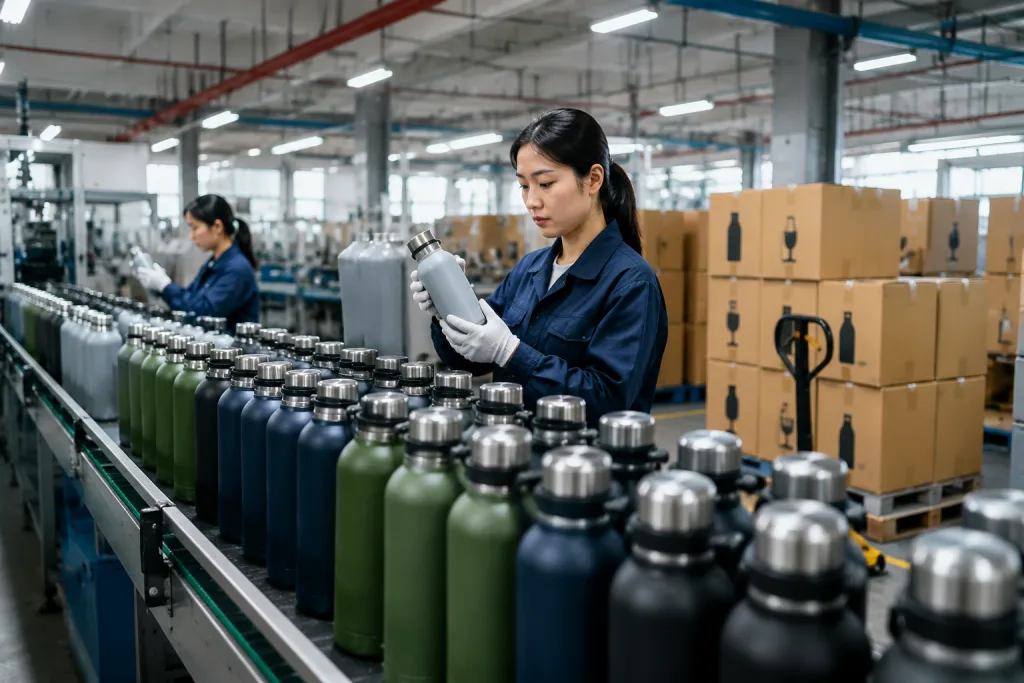
At our Zhejiang production line, routine vacuum inspection includes hot water testing and visual checks before packing; the line checks for sweating, base pinholes, and uneven weld marks under a 600 lux inspection lamp. Our stainless thermos capacity is about 300,000 units per month across stock molds, with typical MOQ at 1,000 units for logo-only orders and 3,000 units for custom color on many models. Capacity is not the hard part for China manufacturers thermos orders. Disciplined QC is the hard part, and we’ve seen this go sideways when a buyer approves the cheapest sample but expects retail-grade failure rates.
Branding Methods That Hold Up
Logo choice can make or break a customized thermos program. Chasing the lowest print price is the wrong question to ask if the UK buyer later rejects 3,000 bottles for rubbed logos. We run the first check with 3M tape, a 500 g rub tester, and a wet cloth on the coated body before we let the line move to bulk. For bulk thermos campaigns, the common options are silk screen for simple solid logos, laser engraving for permanent marks, heat transfer or UV print for multi-colour artwork, and full-wrap sublimation on selected coated bodies.
Silk screen is still the workhorse for promotional thermos orders. Fast setup. Clean edges. Good cost. On a powder-coated 500 ml bottle, a one-position silk screen logo might add about USD 0.08-0.18 per unit depending on artwork size and color count. Our screen room usually checks logo height in mm against the PO, because one buyer once wrote 45 mm in the email and 54 mm on the artwork file. The limitation is fine gradients and text under about 1.5 mm stroke width. If your client has a complex outdoor badge logo, simplify it before sampling.
Laser engraving costs more, often around USD 0.20-0.45 per unit, but it works well for outdoor retailers because it cannot peel. QC pulled the sample after 20 passes on the rub test and the mark still showed clean stainless under the coating. Contrast depends on coating color. Black, navy, forest green, and dark grey usually engrave well because the exposed 304 stainless reads clearly. White and light beige can look weak, and we have seen this go sideways when a buyer approved a dark mockup but ordered ivory bottles.
Heat transfer and UV print suit designs with multiple colours or photo-style artwork. They look good in photos, but ask for abrasion testing if the bottle will be sold through retail stores. Carton rubbing, shelf handling, and warehouse movement can punish pretty decoration, especially after 18 days in mixed cartons versus a clean 12-day sample shipment. For thermos custom work, ask for a pre-production sample with final coating, final logo, and final carton, not just a blank bottle photo. The math does not work if the logo passes on one glossy lab sample and fails after 6 cartons are stacked in the warehouse.
Practical rule: use silk screen for budget campaigns with one-colour logos, choose laser engraving for premium outdoor positioning, and approve UV or heat transfer only after the final bottle passes rub testing.
MOQ, Pricing And UK Landed Cost
Buyers searching promotional thermos uk usually put a UK-held stock price next to a direct China FOB price and think one supplier is overcharging. This is the wrong question to ask. They are different jobs. UK stock can arrive in 3-7 days, but you normally get 6-10 body colors, fixed shapes, and a logo area that the warehouse already approved. A China thermos factory order lets you choose coating, cap, carton, insert, barcode, and inspection, but we run it through sampling, pre-production sign-off, line setup, and AQL packing check. Last month QC pulled the sample because the buyer’s PO said matte black, while the artwork file was marked Pantone 433C.
For a simple 500 ml stainless promotional thermos, realistic FOB China pricing often sits around USD 2.20-4.20 per unit depending on steel grade, cap design, coating, packaging, and logo. A heavier 750 ml or 1,000 ml outdoor flask can move into USD 4.50-8.50. Treat these as guardrails, not a promise for every design. If someone quotes USD 1.85 for a 500 ml powder-coated flask with gift box and full-wrap print, the math doesn’t work. On our line, a 0.4 mm body wall, 304 stainless inner, and PP cap gasket already set the floor before carton, labor, and reject allowance.
MOQ is where 7 out of 10 projects slow down. A thermos supplier may accept 500 units for a stock color with laser engraving, but the unit cost will be higher and the factory may schedule it behind larger orders. For thermos bulk orders, 1,000 units per SKU is a workable starting point. For custom PMS powder coating, expect 3,000 units per color because coating line setup, powder purchase, and rejection allowance need volume. We’ve seen this go sideways when a buyer asks for 800 units in 4 colors; the spray booth still needs cleaning, the powder still has a 25 kg minimum bag, and the reject bin still fills.
Your landed cost should include more than FOB. Add inland trucking in China, export carton upgrades, sea or air freight, duty, UK customs clearance, VAT treatment, insurance, and any third-party inspection. For distributors thermos programs, carton dimensions matter more than buyers expect. A bottle that looks cheap at FOB can become expensive if the gift box is oversized and the container load count drops by 15%. We ship 500 ml flasks in cartons around 48 x 36 x 26 cm when the box design is sensible; add a foam insert and a loose handle, and the same order can lose 200-300 units per CBM.
Compliance For UK And EU Buyers
UK and EU buyers should not leave compliance until cartons are sealed. If the bottle touches drinks, ask for food contact documents before you place the PO, not after the deposit lands. We run this check at quotation stage: LFGB for Germany-focused buyers, EU food contact rules for the full item, UK food contact expectations for UK importers, and REACH for powder coating, paint, ink, and other chemical substances. If the item is for children, do not use an adult flask test file to cover it. Wrong shortcut. Last month QC pulled a kids straw cup sample because the PO said “350ml sports flask” while the artwork brief said “school bottle”; that one typo changed the test route.
For outdoor retailers, request material declarations for 304 stainless steel body and liner, silicone seals with shore hardness, PP or Tritan plastic parts, and the exact coating system. If the cap has a carry loop, straw, plastic hinge, or silicone seal, those parts need a separate look under the light box and leak tester. The steel body is not where most claims start. We see more pushback on odor after 24 hours, silicone migration questions, paint cross-cut adhesion, and cap leakage after a 1.2 m drop than on the stainless grade itself.
AQL inspection is worth budgeting for on most thermos promotional orders above 2,000 units. A standard third-party inspection using AQL 2.5 major and 4.0 minor should check workmanship, logo position against the approved 1:1 artwork, leakage after inversion, carton markings, barcode scanning, and basic function. It is not a lab test. It catches shipment problems. On a 5,000 pcs order, we normally ask the inspector to pull 200 pcs from packed cartons; one buyer flagged a 3 mm logo drift before loading, and fixing it in Hangzhou cost less than reworking stock in the UK.
If your brand needs BSCI, Sedex, ISO 9001, or a retailer-specific social audit, state it at RFQ stage. Not every thermos manufacturers site in Zhejiang or wider China carries the same audit coverage, and the math does not work if you approve a sample first and ask for a new factory later. Switching factories after sampling wastes 2-3 weeks and often changes details already signed off, such as lid thread feel, powder-coat texture, or carton size. We have seen this go sideways: one PO listed Sedex in the small print on page 4, after the sample room had already cut the logo jig.
Packaging, Barcodes And Distributor Needs
A distributor thermos order lives or dies by the small ops details. The bottle can pass AQL 2.5, but if carton marks, FNSKU labels, EAN codes, inner pack quantities, or pallet instructions are wrong, the receiving desk will push it back. We had one UK promo order delayed 3 days because the PO said “24pcs/ctn” and the buyer’s routing sheet said “12pcs/ctn.” QC pulled the sample carton, scanned the EAN with a Zebra DS2208, and the code was fine. The carton data was not.
Decide packaging before artwork starts. A white box is the cheapest choice for giveaways. A kraft box suits outdoor campaigns and avoids thick ink coverage that can rub on corners. A color retail box sells better on shelf, but it adds artwork checking, print plate cost, and usually 7-10 days if the die line is not approved. For a 500 ml customizable thermos, a basic white box may add USD 0.12-0.25, while a printed color box can add USD 0.35-0.80 depending on paper grade and quantity. The wrong question is “which box looks best?” Ask whether the buyer’s warehouse can receive it cleanly, scan it fast, and stack it without crushed corners.
Carton strength matters for sea freight. We run 5-ply export cartons for heavier flasks, and for 500 ml bottles the common master carton quantity is 24 units, unless the gift box size pushes the carton over the buyer’s weight limit. If the UK warehouse wants palletization, send max pallet height, label position, and carton orientation before mass packing starts. Do not send this after the line has sealed 600 cartons with 48 mm BOPP tape. We have seen this go sideways.
For thermos distributors, I suggest approving a packing mock-up before full packing: one unit, one gift box, one inner carton if used, one master carton label, and one barcode scan video. It sounds fussy. It is cheaper than a failed receiving appointment. Our QC team usually checks the mock-up on a 30 kg platform scale, measures carton size in mm, then scans the barcode from 300 mm away to catch poor contrast before the shipment leaves Hangzhou.
Timeline From RFQ To Shipment
A clean manufacturer thermos project is not slow; it just has order. Push every stage too hard and the line will still run, but the risk shifts into the places buyers hate: logo drift by 1.5 mm, powder coating off the approved swatch, or QC checking cartons at 9 p.m. before loading. We run a custom thermos timeline from Zhejiang to UK shipment like this: 2-4 days for RFQ clarification, 5-10 days for logo sample if the blank body is in stock, 3-5 days for sample review and PO confirmation, 35-50 days for mass production after deposit and artwork approval, then freight time.
Air freight works for 300-800 urgent promotional pieces, especially when the event date is printed on the artwork. The math does not work for thermos bulk buying at 2,000-20,000 units unless the campaign margin is strong. Sea freight is slower, but it is the sensible lane for most UK programmes. Work backward from the required arrival date and add buffer. For UK delivery, I prefer seeing final approval at least 12-14 weeks before arrival when sea freight and customs are involved; last October, one buyer lost 6 days because the PO said “matte balck” and QC pulled the sample until the Pantone coating was confirmed.
Give your suppliers thermos team one final spec sheet, not 17 email comments split across purchasing, design, and the UK merchandiser. Include capacity, color Pantone or coating reference, logo file, logo size in mm, print position, lid type, packaging, carton marks, test requirements, inspection standard, Incoterm, and delivery address or port. Be exact. A 750 ml bottle with a 42 mm front logo and kraft box is not the same job as a 500 ml bottle with a wrap print and white gift box. FOB Ningbo or FOB Shanghai are common for Zhejiang factories; EXW can look cheaper, but it puts booking, trucking, and export timing back on your desk.
The best thermos supplier relationship is not built on squeezing USD 0.03 from the quote. That is the wrong fight if the artwork approval sits in someone’s inbox for 5 days. It is built on repeatable specs, fast approvals, honest defect discussion, and clear responsibility when something changes. We have seen this go sideways when a buyer approved the sample, then changed the lid color after steel cutting had started. For promotional thermos UK buyers serving outdoor retailers and brands, that discipline is what makes the second order easier than the first.
Send Your Thermos Spec For Factory Pricing
Share capacity, logo, quantity, packaging, and delivery target. We will return a practical Zhejiang factory quote and sampling plan.
Frequently asked questions
What MOQ should I expect for a promotional thermos UK order?
For a stock stainless body with one logo, expect 1,000 units as a practical MOQ from a China thermos manufacturer. Some factories accept 500 units, but the unit price is usually higher and color choice is limited. If you need a custom PMS powder coating, plan on 3,000 units per color because the coating line setup and powder purchase need volume. For a fully customized thermos with a new lid, new mold, or private tooling, 5,000-10,000 units is more realistic. UK distributors should also consider carton quantity, because 24 units per master carton is common for 500 ml bottles.
How long does a custom stainless thermos order take?
A normal timeline is 5-10 days for a logo sample when the blank model is available, then 35-50 days for mass production after deposit, artwork approval, and sample sign-off. If you need a custom color, add time for coating approval. If you need a color box, add 7-10 days if artwork is late. Sea freight from China to the UK can add several weeks, depending on port and season. For fixed event dates, place the PO at least 12-14 weeks before the required delivery date. Air freight is possible, but often too expensive for bulk thermos orders.
Which logo method is best for outdoor retail thermos products?
For outdoor retail, laser engraving is usually the safest branding method because it does not peel or rub off during shelf handling. It often costs around USD 0.20-0.45 per unit depending on logo size and bottle shape. Silk screen is cheaper, often USD 0.08-0.18 for one color, and works well for simple promotional thermos campaigns. UV print or heat transfer is better for multi-color artwork, but you should request abrasion testing before approving mass production. If the bottle has powder coating, test the final logo on the final coating, not on a similar sample.
What compliance documents should UK buyers request?
For UK and EU drinkware, ask for food contact documentation covering the stainless steel body, silicone seal, plastic lid, coating, and any straw or handle parts. LFGB, EU food contact, REACH, and UK food contact expectations may apply depending on your customer. If the product is for children, request standards specific to that use rather than relying on adult bottle reports. For orders above 2,000 units, budget for third-party inspection using AQL 2.5 major and 4.0 minor. If your retailer requires BSCI, Sedex, or ISO 9001 factory documentation, state it before sampling.
Is FOB China or UK delivered pricing better?
FOB China is better when you already control freight, customs, and UK warehousing. It gives you cleaner visibility on the factory thermos cost and lets you compare suppliers thermos quotes fairly. UK delivered pricing is easier if you want one invoice and less logistics work, but you should still check carton sizes, duty assumptions, and delivery terms. A 500 ml stainless thermos might quote at USD 2.20-4.20 FOB depending on specification, but landed cost must include freight, duty, clearance, insurance, VAT handling, and inland delivery. For repeat distributor thermos programs, FOB is usually more transparent.