Key Takeaways
- For Germany, start with 18/8 stainless, LFGB and REACH testing, and a 500 ml format that usually sells at USD 4.80-7.60 FOB.
- A realistic MOQ for a custom thermos program is 3,000 pcs, with 35-45 day production after sample approval.
- Laser engraving is best for a durable logo; silk screen works well for larger flat areas and lower unit cost.
- A good factory thermos spec should name steel grade, seal material, drop test target, and packaging before pricing starts.
If you are sourcing a promotional thermos flask germany, you are not just buying a bottle. You are buying a retail-grade item that must pass sea freight, 0–5°C winter commuting, and 300 days of daily handling while keeping the logo edge clean. German buyers check the small things: leakage after a bag shake, lid thread feel, 6-hour heat loss, and whether the powder coating still looks clean after rubbing against keys in a backpack. QC pulled one 500ml sample last month because the silicone ring sat 0.6mm high. Good catch.
At our Zhejiang, China factory, we run into the same split almost every week: outdoor retailers ask for durable bulk thermos supply with thicker 304 stainless bodies, while promotional brands want a customizable thermos that looks like a €18 retail item on a €6–€9 landed-cost target. The right supplier thermos should give you stable line control, clear test data, and a lead time you can plan around, such as 12 days for blank stock vs 18 days for logo printing and color box packing after artwork approval. We’ve seen this go sideways when a buyer chases the lowest quote and skips the pre-shipment leak test. The math doesn't work once 2% of cartons come back with lid complaints.
What German buyers care about
If you sell thermos programs in Germany, chasing the lowest FOB is the wrong question to ask. A buyer in Hamburg once pushed back on a 0.18 USD lid upgrade, then accepted it after QC pulled the sample and showed a 3 ml leak after 20 minutes upside down. They want a promotional thermos that feels retail, clears compliance review, and does not fill the inbox with service claims. The checks are simple: cap seal, coating adhesion, carton strength, and whether the bottle survives daily commuting, hiking, or car cup-holder use without rattling.
Good programs usually follow one rule: keep the bottle easy to approve and easy to repeat. We run the same body drawing for 500 ml and 750 ml orders when the line needs stable output, then lock the logo area in mm before making the first pre-production sample. For outdoor retailers, the story should be insulation, grip texture, and dent resistance. For promo buyers, the logo must still look clean after 60 days of hand contact and bag rub. Decoration comes after the use case. We have seen this go sideways when a buyer chose a full-wrap print before checking the real grip position.
- Retail feel: matte powder coat with 60–80 μm coating thickness, straight lid gap, and a white box that can sit on shelf without looking like spare parts packaging.
- Promo value: one-color logo, stable vacuum performance, and cartons that pass a 1.2 m drop test before we ship mixed pallets.
- Channel fit: a thermos promotional item for a 1,000 pcs trade-fair giveaway is a different build from a winter outdoor SKU with hangtag, barcode, and spare gasket.
Choose the right stainless build
A strong custom thermos starts with the steel, not the artwork. For Germany-bound programs, 304 stainless steel is the usual call for both inner and outer shells. If the drink is acidic, the holding time is long, or the bottle sits in a premium range, some buyers move to 316 for the inner liner. Ask for the exact material callout on the sample sheet and mill cert, not a loose label like "food grade steel." We have seen that wording turn into a dispute after QC pulled the first 50 pcs and checked the certs.
Wall thickness matters more than most first-time buyers expect. A 0.5-0.6 mm inner wall and a 0.7 mm outer shell usually give a better balance of weight and durability than ultra-thin steel. On a 500 ml bottle, you want enough mass to feel solid in the hand, but not so much that freight starts eating your margin. The math does not work if you shave 15 g and then pay more per carton. A good factory thermos should also show retention data, such as keeping drinks above 60 C for 12 hours or cold for 24 hours, depending on the lid and vacuum build. We check that with a probe on the line, not by guesswork.
For bulk thermos sourcing, keep the cap simple unless your market needs extra features. A straight drinking lid is easy to clean. A push-button lid adds convenience, but it also adds parts, cost, and failure points. If you are building thermos bulk for outdoor retailers, ask for a drop test from 1.2 m onto concrete, lid cycle testing, and clear seal material spec. Small details like silicone hardness and thread smoothness can change the buyer's opinion fast. This is the wrong question to ask if you are chasing feature count; we have seen a fancy lid fail because the thread was rough and the buyer flagged it on sample two.
A cheap bottle that saves USD 0.18 on steel can cost you far more in returns and bad reviews.
Branding that survives use
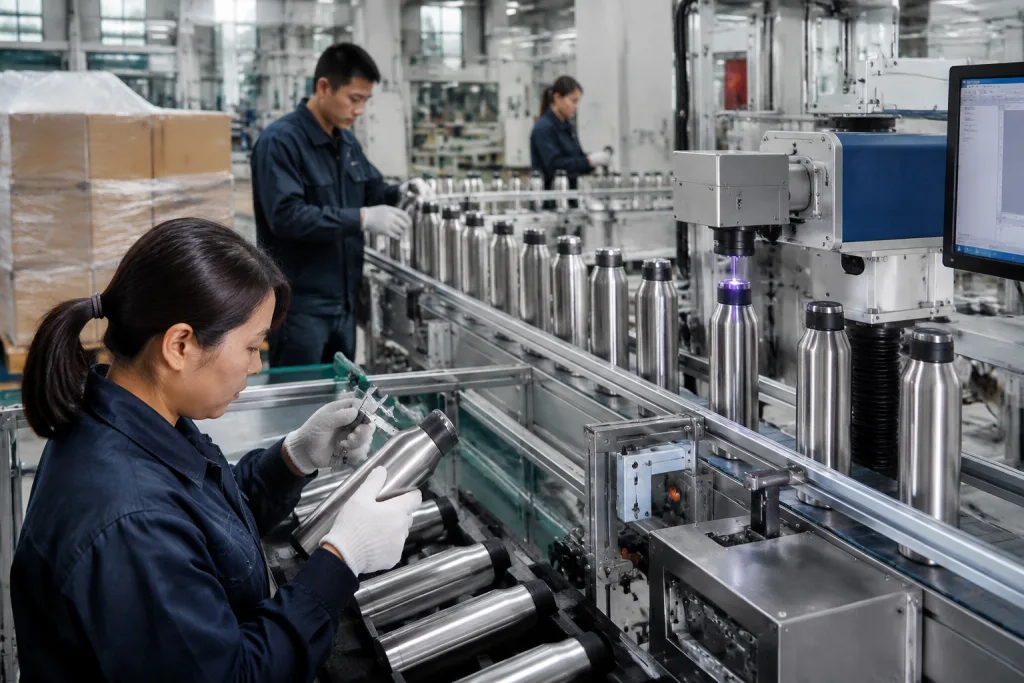
Decoration is what turns a custom thermos into a promotional thermos, but the logo has to survive daily use. On our line, QC pulled the sample after 200 rub cycles, and the engraving still read clean. Laser engraving is the safest pick for a sharp, premium mark because there is no ink layer to scuff off. If you need a bigger logo or stronger brand presence on a powder-coated bottle, silk screen works well. Full-color wraps are possible, but the print room needs tighter control on registration and curing.
Do not pick decoration on unit price alone. That is the wrong question to ask. A custom thermos for an outdoor retailer needs wash resistance and scratch resistance, not just a low quote. A thermos for a trade show gift can put more weight on speed and first impression. We have seen this go sideways when a buyer approved a nice mockup and then the mark faded after a week in a backpack. The right call depends on logo detail, bottle color, and how the bottle will be handled after shipping. If the bottle will bounce in bicycle cages or go through repeated hand washing, laser or a tightly controlled print job is the safer route.
- Laser engraving: best for 1-color logos, long life, and a clean premium look on 304 stainless or powder coat.
- Silk screen: good for bold branding on larger flat areas, with solid edge coverage when the artwork stays simple.
- Full wrap: useful for campaign graphics and full-color artwork, but it needs tight color control and a clear proof before we run the line.
For deeper process detail, a thermos manufacturer should show you proofing, logo placement drawings, and a pre-production sample before mass run approval. On the shop floor, we also check the fixture marks and the PO wording, because one wrong size call can throw off the whole batch. If the buyer flags a 2 mm shift on the logo centerline, fix it before the first 500 pieces move to packing.
Compliance for Germany and EU
For Germany, compliance is not a paperwork afterthought. It is part of the product. We ask our document clerk to match the food-contact declaration to the actual BOM before the first pre-production sample leaves the line, not after cartons are sealed. Your thermos supplier should provide food-contact declarations, REACH support, and LFGB-related test reports when requested. If the lid contains PP, Tritan, silicone, paint, or soft-touch coating, each contact part needs its own testing route. Normal work. This is where weak thermos suppliers get exposed; we have seen a silicone ring pass while the printed lid insert failed migration on a 3 mm contact edge.
Ask for ISO 9001 quality control, BSCI audit status if social compliance matters to your chain, and a written defect standard with photos. In most export programs, AQL 2.5 is used for major appearance defects and 4.0 for minor issues, but the acceptance level belongs in the PO, not buried in a WeChat message. QC pulled the sample. On one 5,000 pcs Germany order, the buyer flagged 0.4 mm logo misalignment, so we added a caliper check at packing. A manufacturer thermos that understands export work keeps batch traceability, carton markings, and sample retention records for at least 12 months. That saves you when a distributor thermos program asks for answers six months later.
Check the claims you plan to print. If the carton says BPA-free, dishwasher safe, or leakproof, the evidence must support that wording. The wrong question is “Can you print it?” The right question is “Which test report backs it?” China factories in Zhejiang can produce to a strong standard, but the brief must name the final material set, including gasket color, coating type, and lid resin grade. We once saw a PO typo change “hand wash only” to “dishwasher safe”; the math does not work when 18 cartons are already in final inspection and the claim is not tested.
MOQ pricing and lead time
For a serious bulk thermos order, the cost sheet should be plain. A standard 500 ml promotional thermos with one-color logo and simple box usually sits around USD 4.80-7.60 FOB, depending on steel thickness, lid type, finish, and print method. Add gift packaging, 2-color pad printing, or a push-button lid with silicone parts, and the quote climbs fast. That is normal. The cheapest quote is the wrong question to ask. Last month QC pulled the sample on a 0.38 mm inner wall because the buyer’s PO said “304 stainless,” but the supplier quote only covered 201 outer shell.
At our Zhejiang, China line, monthly output can reach 1,200,000 units when the schedule is full, but MOQ still matters. For most custom thermos projects, 3,000 pcs is a realistic starting point; below that, the setup loss on laser engraving jigs and color changeover makes the math ugly. Samples typically take 7-10 days, and mass production usually needs 35-45 days after artwork and golden sample approval. We run laser, silk screen, and powder coating in separate slots, so one late logo file can push a 35-day order to 45 days. If you are buying thermos bulk for a seasonal campaign, allow 5-7 extra days for carton changes, compliance testing, and freight booking.
Shipping also affects how you should spec the product. A 20-foot container can often hold roughly 12,000-14,000 pcs of a 500 ml bottle depending on inner boxes and master carton size. We ship many 24 pcs master cartons, but one German buyer flagged a 16.5 kg carton as too heavy for their warehouse handling limit. Fair pushback. If you are a thermos distributor or promotional brand, that freight math matters as much as the unit price. A slightly smaller carton can save more landed cost than shaving USD 0.03 off the bottle, and we have seen this go sideways when the PO approved the bottle but forgot the carton dimensions.
Brief the factory clearly
The fastest way to get a clean quote from a thermos factory or thermos vendor is to send a full brief on day one. A vague inquiry gets a vague price. On the line, QC pulled the 500 ml sample, checked the lid torque, and asked for the channel, target retail price in Germany, decoration method, and compliance level before we touched the next piece. If you want a repeatable promotional thermos flask program, give that information first. The math does not work if the factory has to guess margin, carton count, or testing scope. With a tight brief, we can quote faster and move a sample in 12 days instead of 18.
- Use case: hiking, office desk, cycling, or event giveaway.
- Capacity: 350 ml for a light carry, 500 ml for daily use, 750 ml for road travel, or larger.
- Decoration: laser, silk screen, wrap print, or embossed logo.
- Packaging: white box, gift box, mailer, or retail carton.
- Compliance: LFGB, REACH, BPA-free, or customer-specific testing.
- Commercials: target MOQ, target FOB price, and delivery window.
If you are comparing thermos offers from different regions, put the same spec on the table and check it line by line. Steel grade, wall thickness, lid material, and carton count need to match. We have seen this go sideways when one supplier left out the gasket spec and the buyer flagged it only after the drop test. This is the wrong question to ask: which quote is lowest on paper. The right question is which supplier thermos can hold the same build, the same test result, and the same packing count without a late change on the PO.
Request your Germany-ready thermos quote today
Send your target price, logo file, and packing spec. We will match the right stainless build, decoration method, and compliance package for your channel.
Frequently asked questions
What MOQ should I expect for a promotional thermos flask Germany order?
For most custom thermos programs, a practical MOQ is 3,000 pcs per design and color. Some factory thermos lines can accept 1,000-2,000 pcs if the model is already tooled and the decoration is simple, but the unit price will usually rise by 10-25%. For new mould changes, special lids, or multi-color print, expect the MOQ to stay closer to 3,000-5,000 pcs. If you are buying for Germany, keep the lead time realistic: 7-10 days for samples and 35-45 days for production after sample approval.
Is laser engraving or silk screen better for a custom thermos?
Laser engraving is the safer choice when you want a durable logo that will not peel, fade, or scratch off easily. It is especially strong on matte powder-coated bottles and premium retail SKUs. Silk screen is better if you need a larger logo area, a specific Pantone color, or a lower decoration cost on a bulk thermos order. For outdoor retailers, laser often wins. For event giveaways or thermos promotional campaigns with a simple one-color logo, silk screen can be the better value. Ask for a sample of both before you lock the production method.
What compliance documents do German buyers need?
For Germany, you should ask the thermos supplier for food-contact declarations, REACH support, and LFGB-related testing where applicable. If the lid includes PP, silicone, Tritan, paint, or soft-touch coatings, those components may need separate testing. A serious manufacturer thermos partner should also support ISO 9001, BSCI if required by your buyer, and batch traceability. Keep the purchase order aligned with the sample, because claims like BPA-free, leakproof, or dishwasher safe must match the final build. If you sell through distributors thermos channels, save test reports with the artwork and packing files.
Can I use insulated bottles for outdoor retailer promotions and giveaways?
Yes, but the spec should match the channel. Outdoor retailers usually want a stronger retail feel, often with 500 ml or 750 ml sizes, powder coating, and a logo that survives repeated use. Giveaway programs can use a lighter custom thermos with simpler packaging and a lower unit cost. The best promotional thermos for outdoor use is not necessarily the cheapest one; it is the one that reduces complaints and keeps the brand visible in the field. If you are sourcing from China, ask your thermos manufacturer for a retail-grade sample and a campaign-grade sample so you can compare margin and durability.
How do I avoid quality problems from China suppliers?
Start with a written spec, a signed golden sample, and a clear inspection plan. Use AQL 2.5 for major defects and define what counts as a failure: leak, dent, logo misprint, scratch, or vacuum loss. Ask for lid torque, insulation retention, and drop tests before mass shipment. A good thermos factory in Zhejiang will also keep batch records and carton traceability so you can solve issues quickly if a problem appears later. Do not compare quotations only on price. A cheaper thermos custom offer often hides thinner steel, weaker seals, or packaging that fails in transit.