Key Takeaways
- Plan 30-45 days for normal customized thermos production after artwork approval
- A realistic MOQ is 500 units per color for most stainless vacuum flask projects
- Use 304 stainless steel for the inner wall and request LFGB or REACH paperwork for Britain
- Logo method changes cost, durability, and lead time more than most buyers expect
If you buy promotional thermos flask Britain programs for an outdoor retailer or promotional brand, the hard part is not finding a bottle. It is controlling risk: insulation claims backed by a 6-hour hot-water test at 95°C, logo wear after tape and scratch checks, cartons that survive a 76 cm drop test, UK compliance paperwork ready before shipment, and a delivery date that does not miss the camping season. We have had buyers flag this after the PO was already cut. Too late.
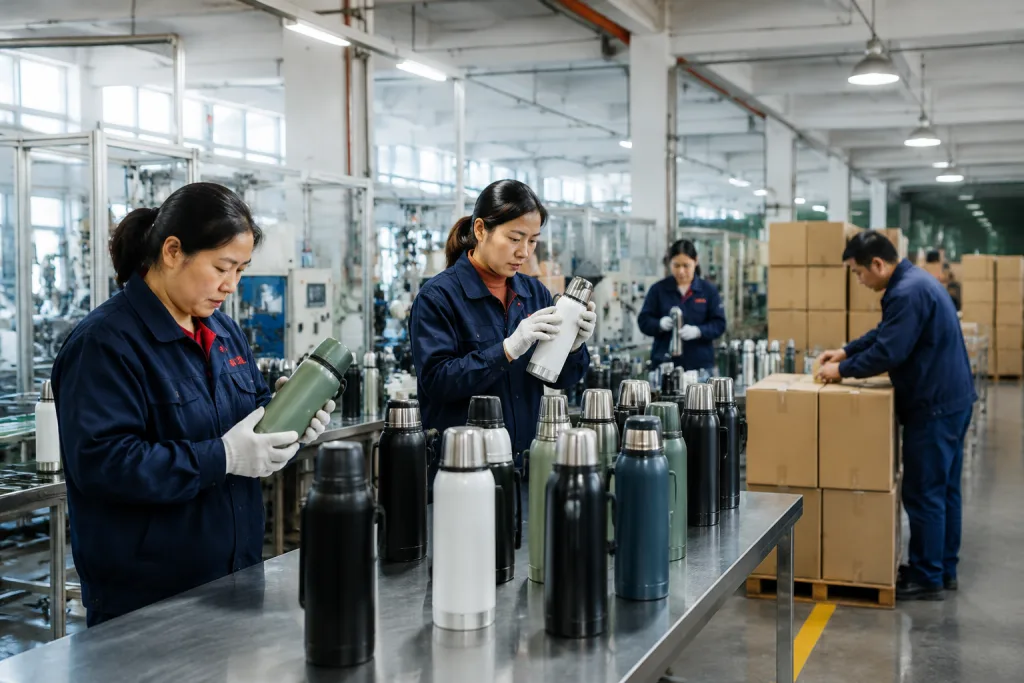
From our Hangzhou, Zhejiang factory network, we see the same mistake in 7 out of 10 quote reviews: buyers compare only unit price, then discover the lid leaks at 180° inversion, the powder coat scratches under a 3H pencil, or the supplier thermos cannot hold color consistency across 5,000 units. QC pulled the sample, not the spreadsheet. A good custom thermos brief needs hard details: 304 stainless steel grade and wall thickness in mm; capacity tolerance, MOQ, test method, packaging spec, and AQL 2.5 inspection level. If those points are missing, the math does not work.
Start With The Use Case
A promotional thermos flask Britain buyer usually sells into 3 channels: outdoor retail, corporate gifting, or event merchandise. The catalogue photo can look almost the same, but the spec should not. A hillwalking retailer will push for a 750 ml bottle with a cup lid, 0.5 mm outer wall, and a powder coat that passes a 3M tape test after logo printing. A bank promotion usually wants a 500 ml slim flask that fits a laptop bag without rubbing the zip. A festival merch order is about loud Pantone color, 24 pcs per carton packing, and landed cost that still leaves margin after VAT.
Do not ask a thermos vendor for “your best price” first. Wrong question. Start with the use case: rucksack, car cup holder, construction site bag, or retail shelf display. For Britain, 500 ml and 750 ml are the safest capacities; we see 500 ml used for office gifting and 750 ml picked for outdoor retail more often than any other size. A 1,000 ml bulk thermos looks good on a spec sheet, but the carton can jump from around 12 kg to 18 kg, and the buyer flagged the shelf depth problem before the sample even left our QC room.
For stainless vacuum construction, the working baseline is 304 stainless steel inner wall, 201 or 304 outer wall depending on budget, and a vacuum gap between the walls. Most manufacturer thermos quotes we see use 0.4 mm outer wall thickness and 0.35 mm inner wall thickness, checked with a digital micrometer before polishing. If you want a more dent-resistant factory thermos for outdoor retail, ask for 0.5 mm outer wall. It adds cost, but the math does not work when QC pulls 37 dented samples from a 1,000 pcs inspection lot and the retailer asks for replacement stock.
At BottleForge Industrial in Zhejiang, China, typical stainless thermos capacity is 300,000-450,000 units per month across shared production lines, with 500 units MOQ per color for stocked shapes and 3,000 units for new mold work. Ask every thermos manufacturer for this kind of factory metric before you place a purchase order. We run shared lines, so a PO typo like “mat black” instead of “matt black” can cost 2 days in artwork confirmation and push dispatch from 12 days to 18 days.
Specify Steel And Insulation Honestly
Insulation claims are where promotional thermos jobs go messy. A supplier thermos listing might say “keeps hot for 12 hours,” but without a test method, that line is nearly useless. For a custom thermos aimed at Britain, ask for the starting water temperature, room temperature, filled volume, lid condition, and final temperature after 6 or 12 hours. We run a practical bench test with 95°C water, 20°C room temperature, bottle filled to rated capacity, lid closed, then checked after 6 hours with a calibrated probe thermometer; last month QC pulled 8 samples from a 3,000 pcs order because the PO forgot to state “lid closed during test.”
A decent 500 ml stainless vacuum flask should stay above 60°C after 6 hours under that test. A wide-mouth food flask often lands lower because the opening is larger, sometimes by 5–8°C on the same line. A narrow-mouth thermos custom design usually performs better. If a thermos suppliers quote promises 24-hour heat retention at a rock-bottom price, ask for the test report before you believe it; we’ve seen this go sideways when the buyer approved artwork first and questioned insulation after mass production.
Material specification matters just as much as the logo position. For food contact surfaces, 304 stainless steel is the normal choice. Some low-cost thermos factory quotes use 201 stainless steel for the inner wall, and this is the wrong place to save USD 0.18–0.25 per piece. We do not recommend that for Britain because it has lower corrosion resistance and can trigger complaints if consumers use acidic drinks. For lids, clarify PP, Tritan, silicone gasket grade, and whether the parts are BPA-free; our incoming team checks gasket hardness with a Shore A durometer because a soft 45A seal can leak after carton drop testing.
For compliance, UK buyers should request documents that match food contact expectations and the sales channel. Depending on the program, this may include LFGB test reports, REACH statements, BPA-free declaration, and migration testing from an ISO 17025 lab. If the product is for children, discuss age grading and safety checks before the mold deposit is paid. For most outdoor retailer and promotional thermos programs, we suggest keeping the first approval sample for your records and running pre-shipment inspection to AQL 2.5 major / 4.0 minor; on the line, we keep one signed sample in the QC cabinet so nobody argues later about a 0.5 mm logo shift.
Choose Logo Method By Wear
A customizable thermos only earns repeat orders if the logo survives daily abuse. UK buyers drag bottles through wet rucksacks, van door pockets, bicycle panniers, and campsite tables with grit on them. QC pulled one returned sample last winter: the logo edge had lifted 3 mm after 4 dishwasher cycles, and the buyer flagged it before paying the balance. Cheap branding can become the expensive line on the claims sheet.
Silkscreen printing is the budget choice for 1-2 color logos on straight bottle bodies. For a simple promotional thermos, expect a setup charge around USD 40-80 per color and a unit logo cost often between USD 0.08 and USD 0.25 depending on size and volume. We run this on powder coat with a 200-mesh screen and check adhesion using 3M 600 tape after curing. It works well, but weak ink or a rushed oven setting will scratch in a backpack pocket.
Laser engraving costs more per unit, commonly USD 0.20-0.60, but it gives the cleanest wear result. For outdoor retailers, premium staff gifts, and distributor thermos programs, the math works because after-sales noise drops. We engrave with a fiber laser, then QC checks the mark depth and logo position within ±0.5 mm on the jig. The trade-off is color: engraving shows the metal or base layer, not a full-color brand mark.
Heat transfer and full-wrap printing give stronger shelf impact. They fit retail gift sets and seasonal campaigns, but artwork approval is slower: 12 days is realistic versus 5-7 days for a plain laser sample. For thermos promotional programs with gradients, landscapes, or full-color club artwork, allow 5-7 extra days for printed film proofing and curing trials. If you need Pantone matching, send coated Pantone references; a screenshot from Canva is the wrong source. On powder coat, a Delta E under 2.0 is possible but not guaranteed on every finish and color.
Our practical advice: choose laser engraving for premium outdoor retail, silkscreen for corporate bulk thermos, and full-wrap only when the design sells the bottle at first glance. We’ve seen this go sideways when a PO says “logo included” but forgets the second-side print, gift box sticker, or barcode label. A good thermos manufacturers quote should separate bottle cost, logo cost, mold cost, sample cost, and packaging cost. If everything sits inside one price, comparison is guesswork.
MOQ, Pricing, And Lead Time
For most promotional thermos flask Britain orders, the cleanest route is simple: pick a stock body, lock the Pantone color, approve the logo file, sign off the pre-production sample, then we run the line. Late changes are where jobs lose days. Last month QC pulled a 500 ml sample because the buyer changed the lid from black to cream after the PP sample; that one note added 4 days for powder matching and a second cap fit check with a 0.2 mm feeler gauge.
As a reference, a 500 ml double-wall stainless vacuum flask with 304 inner wall, powder coating, and 1-color logo often sits around USD 3.20-5.80 FOB Ningbo or Shanghai at 1,000-5,000 units. A 750 ml outdoor flask with cup lid may sit around USD 4.60-7.80 FOB, depending on wall thickness, cap structure, and packaging. These are not promises. They are normal China buying ranges when steel and exchange rates behave; if a quote is 18% under this band, the math usually comes back through thinner steel, loose vacuum testing, or a gift box that crushes in a 12 kg export carton.
MOQ depends on how much customization you need. For a stocked body and standard powder coat, 500 units per color is often possible. For a private color with less common powder, 1,000 units is safer because the coating room does not like stopping after 312 pcs just to clean the gun. For a new lid or body mold, 3,000-5,000 units is a realistic starting point, with tooling cost from USD 1,500 to USD 8,000 depending on complexity. Asking for 200 pcs with a new push-button lid is the wrong question to ask; the mold shop will not even open CAD for that.
Normal lead time from our Zhejiang production base is 30-45 days after deposit and final artwork approval. Samples usually take 7-10 days for existing shapes with logo, or 15-20 days for a new finish or component change. Add sea freight time to Britain, customs clearance, and local delivery. If you have a fixed event date, work backwards from the date goods must be in your UK warehouse, not from the date you want them to leave China. We once saw a PO with “delivery 12/06” typed without saying UK or China date format; the buyer flagged it only after cartons were booked, and that small typo cost 6 days.
Cheap rush orders fail in boring ways: wrong cartons, wet paint, weak vacuum, missing labels. Give the line enough days or cut the customization.
Packaging For UK Distribution
Packaging is not decoration. It changes the damage rate, how fast a UK warehouse can book stock in, how the flask looks on a shelf, and the landed cost per unit. For outdoor-store distributors, we usually run barcode labels, retail color boxes with 300 gsm paper, and 5-ply master cartons that survive pallet stacking at 1.6 m. For promotional agencies, the brief is different: plain white boxes, individual polybags, and carton marks that match the campaign dispatch date. We have seen this go sideways when a PO typo showed “black lid” while the artwork said “silver lid”; QC pulled the sample before mass packing, which saved 38 cartons from rework.
For Britain, the common individual packs are white box, kraft box, printed color box, and rigid gift box, each with a different packing speed on the line. A simple white box may cost USD 0.12-0.25. A printed color box often costs USD 0.25-0.60 depending on paper grade and order quantity. Gift tubes look sharp in a buyer presentation, but the math often doesn’t work. Last month our packing table measured a 500 ml tube at 86 mm diameter, and the export carton dropped from 24 units to 18 units. For thermos bulk orders, volume is money: 24 units per carton instead of 20 can cut freight cost per unit by 8-12% on a UK sea shipment.
Ask for carton dimensions, gross weight, net weight, and units per carton before confirming the order. For a 500 ml flask, 24 units per export carton is common. For a 750 ml or 1,000 ml flask, 12-20 units may be more realistic. We prefer 5-ply export cartons for heavier stainless thermos shipments, usually with corner tape and a 17-22 kg gross weight limit so the cartons still pass manual handling at the UK end. Carton burst strength and edge crush strength sound boring. They matter when cartons sit 26-35 days from Zhejiang to a UK distribution centre, then get moved again by forklift clamps or hand pallet trucks.
If you sell through ecommerce or marketplace channels, request FNSKU or barcode application at the factory and confirm label placement with photos before mass packing. Our QC team scans 10 labels per SKU with a Zebra DS2208 scanner on the pre-production sample; if the buyer sends EAN artwork as a low-resolution JPG, we push back and ask for vector files. For distributor thermos and thermos distributors handling mixed SKUs, carton side marks should show SKU and color on the first line, capacity and PO number on the second line, then carton number and quantity below. Basic work. Still, around 7 out of 100 receiving disputes we see start with poor carton markings, especially when two colors share the same 500 ml flask body.
Inspection Before The Balance Payment
Inspect the stainless thermos order before the balance payment leaves your account. This is not about calling every factory dishonest; the line is mechanical, and small misses still happen at 3,000 or 30,000 pcs. QC pulled one 500 ml sample last month with a 14 mm scratch through the powder coat, and the buyer flagged it straight away. A tilted logo, loose gasket, weak vacuum, or wrong lid colour can turn a clean promotional thermos flask order for Britain into a refund argument.
For most thermos customized orders, we run AQL inspection. A typical setting is General Inspection Level II, AQL 2.5 for major defects and 4.0 for minor defects. Critical defects should be zero. Major defects include leaking, failed vacuum performance, sharp burrs, serious dents, wrong logo, wrong capacity, and unsafe lid assembly; minor defects include small paint dots, slight colour variation, or carton scuffs inside the signed tolerance. The inspector should use a caliper, torque check, and packing list, not just a quick table look at 2 cartons.
For vacuum performance, a visual check is the wrong question to ask. Randomly select units and run a hot-water retention test; the exact duration depends on the flask, but a 6-hour check catches weak vacuum before the goods ship. We usually fill at 95°C, record the start temperature with a probe thermometer, then check again after 6 hours. Also perform leak testing by filling the bottle, tightening the lid, and placing it horizontally for at least 30 minutes. For sports or outdoor flasks, shake testing matters because consumers will throw the bottle into a gym bag, not treat it like lab equipment.
Logo inspection needs a clear approved sample. Measure placement in millimetres from the bottom or seam and define tolerance, for example plus or minus 2 mm. Check Pantone colour under consistent light, ideally in a D65 light box, because warehouse yellow lamps make navy and black look closer than they are. For laser engraving, confirm depth and contrast. For silkscreen, rub testing with a dry cloth and alcohol swab can expose weak curing; we have seen a 1,000-cycle tape test pass while the alcohol swab still lifted the white ink.
The buyer should look hard at spare gaskets and lids. If your thermos manufacturer cannot provide replacement lids for at least 1-2% of order quantity, after-sales service gets messy. For a 5,000 pcs outdoor retail order, that means 50-100 spare lids or gasket sets packed in a marked inner carton, not loose in a mixed accessory box. The math does not work if a UK end user asks for one lid and the factory needs 20 days to remake it.
How To Brief The Factory
A tight RFQ saves more money than hard bargaining. For a manufacturer thermos quote, spell out capacity, steel grade, lid style, surface finish, logo process, packing, order quantity, delivery date, UK port or warehouse address, and the compliance files you need. We see about 6 RFQs a week that say only “quote 1,000 pcs custom thermos”; then one factory prices 201 outer steel, another assumes 304 stainless, and the low number is often just a thinner body. The math doesn’t work.
A workable RFQ for a promotional thermos flask Britain order might read: 750 ml stainless vacuum flask, 304 inner wall, 304 outer wall preferred, matte black powder coat, laser logo 45 mm wide, cup lid, leak-proof silicone gasket, individual kraft box, 1,000 units, FOB Ningbo, delivery to UK warehouse needed by 15 September, REACH and LFGB documents required, inspection to AQL 2.5/4.0. That is enough for a thermos supplier to price the job without guessing. On our line, QC pulled a 750 ml sample last month where the buyer forgot to confirm the logo width; the artwork came in at 62 mm and wrapped too close to the curve.
If you are comparing 3 or 4 thermos manufacturers, put the same specification in a sheet and check it line by line. Ask for sample lead time, production lead time, payment terms, carton size with gross weight, inspection rules, and how warranty claims are handled after delivery. For custom packaging, request the dieline before artwork starts; a 2 mm shift on a kraft box window is enough for the product to sit off-centre. For colour, ask whether the powder is standard stock or bought against your PO. A special powder colour can add 7-12 days if the coating supplier has not booked it.
Our view from Hangzhou, Zhejiang is simple: Britain buyers do not need the fanciest factory thermos. You need a stable one, with repeatable vacuum performance, clean laser work, paperwork that matches the shipment, and cartons that survive the truck from Ningbo to the warehouse. We ship cartons with 5-layer K=A board for heavier flasks because we have seen 18 kg cartons arrive crushed when buyers pushed for cheaper 3-layer board. If a thermos vendor answers technical questions before the deposit, trust that more than glossy photos.
Send Your Thermos Brief For A Factory Quote
Share capacity, logo, quantity, packaging, and UK delivery date. We will return practical options, MOQ, FOB pricing, and sample timing.
Frequently asked questions
What MOQ should I expect for a promotional thermos flask Britain order?
For existing stainless flask shapes, 500 units per color is a realistic MOQ from many China factories, including our Zhejiang production partners. At 1,000 units, you usually get better pricing and more flexibility on powder coating and packaging. If you need a new mold, new cap tooling, or a fully customized thermos shape, expect 3,000-5,000 units and tooling costs from about USD 1,500 upward. For small trial orders under 300 units, the unit price often rises sharply because setup, logo printing, sample approval, and carton preparation still take factory time.
Which logo method is best for outdoor retail thermos flasks?
For outdoor retail, laser engraving is usually the safest method because it resists scratching better than most surface printing. It typically adds USD 0.20-0.60 per unit depending on logo size and order quantity. Silkscreen is cheaper, often USD 0.08-0.25 per unit, and works well for simple corporate promotional thermos orders, but it depends heavily on ink quality and curing. Full-wrap heat transfer is useful for colorful retail designs, but allow 5-7 extra days for artwork proofing and testing. If the flask will be clipped to bags or used outdoors, choose durability before color complexity.
What compliance documents do UK buyers normally request?
For Britain, you should ask for food contact documentation relevant to stainless steel, plastic lid parts, and silicone gaskets. Common documents include LFGB test reports, REACH statements, BPA-free declarations, and migration testing from an ISO 17025 laboratory. If the item is sold for children, additional safety review may be needed based on age grading and product design. Do not accept a generic certificate without checking model number, material description, test date, and issuing lab. For private label or distributor thermos programs, keep one approved sample and all reports in your technical file.
How long does a customized thermos order take from China to Britain?
For a normal stocked shape with custom logo and standard packaging, production usually takes 30-45 days after deposit and artwork approval. Logo samples take about 7-10 days. If you add a special powder color, new lid, or custom gift box, add 5-15 days depending on complexity. Sea freight to Britain, customs clearance, and inland delivery can add several more weeks. For seasonal outdoor retail, do not place the PO only 6 weeks before the launch date. Work backwards from the warehouse delivery deadline and include inspection time before balance payment.
How do I compare quotes from different thermos suppliers fairly?
Make every thermos supplier quote the same specification: capacity, 304 inner wall, outer steel grade, wall thickness, finish, logo method, packaging, carton quantity, FOB port, lead time, and compliance documents. A USD 0.40 cheaper quote may use 201 inner steel, thinner 0.35 mm walls, a lighter carton, or no proper test report. Ask for the weight of the bottle without packaging; it is a useful clue. Also compare payment terms, sample cost, inspection acceptance, and spare lid availability. The best suppliers thermos quote is transparent enough that you can see where the money goes.