Key Takeaways
- A practical MOQ for a custom thermos program is 1,000 units per color, with 30-45 day production after sample approval.
- 304 stainless steel is usually enough for American promotional thermos use; 316 adds cost but helps for saltwater and premium outdoor lines.
- Expect FOB China pricing around USD 3.20-7.80 for 500 ml to 1,000 ml vacuum stainless thermos models, depending on lid and finish.
- AQL 2.5/4.0 inspection, REACH/LFGB-grade material checks, and carton drop tests should be confirmed before mass production.
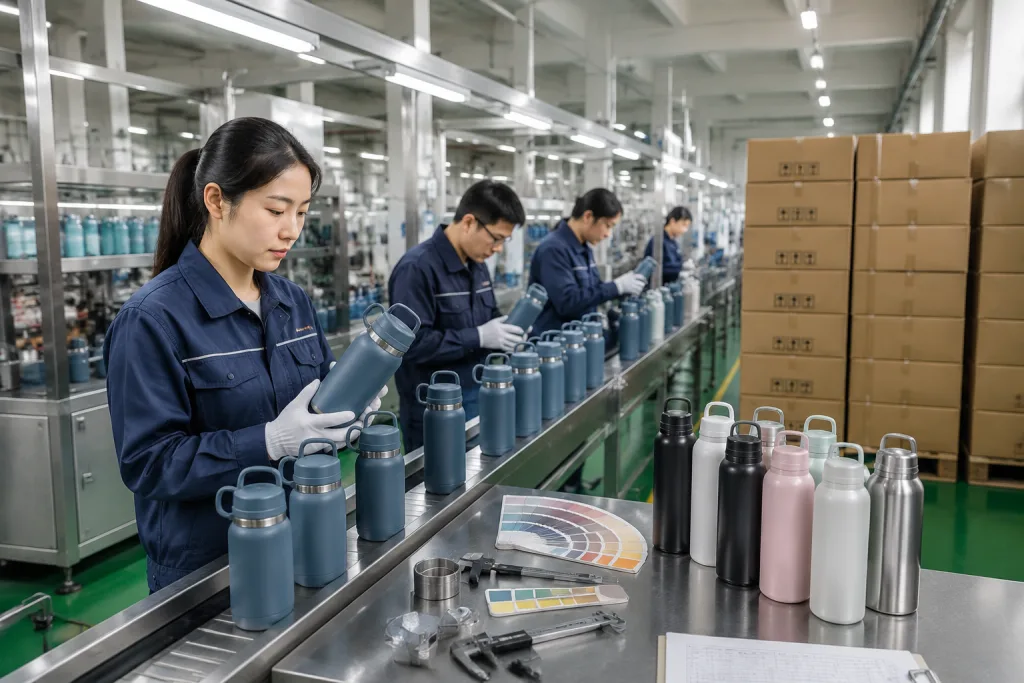
If you are sourcing a promotional thermos flask american customers will keep past the trade show, cheap is the wrong question to ask. We’ve seen the math go sideways on 8,000 pcs when the buyer saved USD 0.18 per unit, then lost more on weak vacuum hold, scratched logos, and crushed gift boxes. QC pulled the sample at 6 a.m. with a digital thermometer in the neck and a caliper on the rim; that is where margin gets protected.
We manufacture stainless thermos products in Hangzhou, Zhejiang, and ship from Ningbo or Shanghai. For outdoor retailers and promotional brands, a bulk thermos order usually sits between 1,000 and 20,000 units. At that size, small choices matter: 0.4 mm wall thickness versus 0.5 mm, laser versus silk screen, 304 versus 316 stainless, and whether your supplier in China runs carton drop testing before the first container leaves Zhejiang. One buyer once flagged a PO typo, “matte back” instead of “matte black,” after 3,000 sleeves were printed. Painful lesson.
Start with the real use case
A promotional thermos flask american buyer usually sends a logo brief like this: 500 ml, black, stainless steel, one-color print, gift box. Good start. Still not enough for a quote we can stand behind. Our thermos line needs the use case first: truck-stop retail, school fundraiser, outdoor promo kit, or office onboarding gift. Outdoor retailers need stronger dent resistance and insulation claims that won’t get killed in reviews. Promo brands care more about clean pad print edges, carton count, and avoiding chargebacks when the end client opens 36 cartons and finds scuffed lids.
For hiking and camping campaigns, I would not go below 0.5 mm outer wall thickness on a 750 ml or 1,000 ml flask. We check that with a digital micrometer before mass production, not after the container is booked. For office giveaways, 0.4 mm can pass if the bottle lives on desks and in cup holders. A sport cap with a carry handle adds USD 0.35-0.80 depending on plastic grade and sealing structure. A stainless cup lid adds weight, but it still sells well for hunting, fishing, and field-work promotions. The buyer often pushes back on weight; we push back harder on cracked PP caps after a 1.2 m drop test.
Capacity changes the buying logic. A 350 ml or 500 ml promotional thermos ships cleanly and fits most gift budgets. A 750 ml bottle feels more outdoor and gives better perceived value. A 1,000 ml flask is strong for retail, but it raises carton size and freight cost, and QC pulled more dents on large flasks after corner-drop testing. The cheapest unit price is the wrong question to ask if the carton goes from 12 pcs to 8 pcs and your landed cost jumps.
If you sell through distributors thermos programs, ask for master carton dimensions before approving the product. We’ve seen this go sideways: the PO said 24 pcs/carton, the approved gift box forced 18 pcs/carton, and one 40HQ container carried 8-12% fewer units than expected. That mistake is preventable during sampling. Ask for the carton L x W x H in mm, gross weight in kg, and a quick carton loading estimate before you sign off on the gold sample.
Choose stainless steel and insulation specs
Most custom thermos jobs we run use food-grade 304 stainless steel on the inner wall and outer shell. It works, mills can supply it fast in Zhejiang, and it handles coffee, tea, water, and normal cold drinks without drama. For marine stores, coastal outdoor shops, or premium fishing promos, ask about 316 stainless on the inner wall. On our shop floor, QC checks incoming coil with an XRF gun before blanking; one 2024 batch marked “304” came in at 201 chemistry and got rejected before the line touched it. 316 usually adds roughly USD 0.25-0.60 per unit, depending on capacity and steel market pricing in China.
Do not buy insulation by the words “double wall.” That is the wrong question to ask. Forming quality, vacuum process, copper plating, lid seal, and mouth diameter decide the real result. A narrow mouth keeps heat better. A wide mouth takes ice cubes and cleans easier, but it drops temperature faster. For a 750 ml stainless vacuum flask, we set a practical lab target: hot water at 95°C, still above 60°C after 12 hours at room temperature. QC pulled the sample at 8:30 a.m. last week, used a calibrated probe through the mouth, and logged 63.4°C after 12 hours. Some premium builds beat this, but do not print a 24-hour claim unless batch test data backs it up.
For American promotional thermos campaigns, I recommend putting these points in the purchase order. Be blunt on the PO. We have seen “SUS304 inner” become “SS inner” after a buyer’s assistant retyped the line, and that one typo caused 6 days of back-and-forth before deposit release.
- Inner wall: SUS304, 0.4-0.5 mm depending on capacity; for 1 L flasks, we usually push closer to 0.5 mm to reduce dent complaints
- Outer wall: SUS304 or 201 stainless for budget programs, declared clearly on the quote and PI
- Vacuum test: 100% production-line heat retention screening; failed pieces get pulled before packing
- Lid seal: silicone gasket, food-contact grade, replaceable if possible, with spare gasket option for retail programs
- Surface: powder coating, spray paint, electro-polish, or brushed steel; powder coating needs cross-hatch tape test after curing
A serious manufacturer thermos quotation should show the steel grade. If a thermos vendor only writes “stainless steel” and dodges 304, 201, or 316, slow the order down. The math does not work when a quote is USD 0.40 lower but the material is unclear. We have seen this go sideways: rust spots at the weld seam, 300-piece complaint emails, and a buyer asking why the carton label still said “premium 304.” Material affects price, compliance, corrosion resistance, and customer complaints.
Decoration methods that survive handling
Logo decoration is where 3 out of 10 promotional thermos samples look sharp in a PDF and weak once the buyer holds the bottle. We run laser engraving for powder-coated jobs, silk screen or pad print for flat single-color marks, heat transfer or UV for photo graphics, water transfer for pattern work, and full-wrap powder coating when the base color is part of the design. The choice starts with artwork line weight, order size, surface finish, and abuse level; last month QC pulled a matte-black sample because a 1.2 mm slogan filled in after printing.
Laser engraving is the safe pick for outdoor retailers. It cuts through the coating and shows the stainless steel underneath, so there is no ink edge for a fingernail to lift. The usual logo size is 40-70 mm wide on the front panel; our fixture uses a 95 mm V-block, and the operator checks the centerline with a steel ruler before the first run. Full-color campaign art is the wrong fit. Returns stay low. For a 1,000-unit custom thermos order, laser setup is usually USD 30-60 per artwork, and per-unit cost often falls between USD 0.08 and USD 0.20.
Silk screen works for simple one- or two-color logos. It gets cheaper once the line passes 2,000 pcs, but adhesion lives or dies on surface treatment, ink mix, and oven curing time. On textured powder coating, 0.8 mm text can break or look fuzzy; we have seen buyers flag this on charity-event PO artwork where the phone number was too small. If you need PMS color matching, ask for a printed pre-production sample, not a digital mockup. A good thermos supplier should run a 3M tape test and abrasion check before mass production.
Full-color heat transfer or UV printing suits promotional thermos campaigns with retail-style graphics. It costs more and needs tighter artwork control, especially when the AI file has 6 gradient layers and the PO spells the brand name two different ways. For American outdoor brands, I usually suggest one side for a bold brand mark and the other side for campaign text. Don’t wrap every surface. A customized thermos should still look like gear, not a billboard.
Practical rule: if the flask will be clipped to a pack, thrown in a truck, or sold in outdoor stores, choose laser or durable powder-coated print before choosing the prettiest rendering. We’ve seen this go sideways after a 500-cycle rub test.
MOQ, pricing, and lead time reality
For a standard stainless thermos factory model, we run MOQ at 1,000 units per color in Zhejiang when the job is only custom logo plus standard packaging. If the buyer asks for a private mold, lid tooling with a new thread gauge, a different body shape, or a Pantone-matched retail color, the workable MOQ moves to 3,000-5,000 units because the setup loss is not small. The line has to purge powder, reset fixtures, and check 3-5 trial pieces with a caliper before approval. A 300-unit run can work only from stock inventory, and the math does not work for a stable promotional price.
FOB China pricing moves with steel cost, coating process, lid structure, and packaging grade. As a working range, a 500 ml promotional thermos may land around USD 3.20-4.80 FOB Ningbo. A 750 ml outdoor flask is often USD 4.20-6.50. A 1,000 ml bottle with cup lid, handle, and retail gift box can sit around USD 5.80-7.80. These are planning numbers, not promises. Before we lock price, QC checks the sample weight on a 0.1 g scale, the carton drawing needs confirmed dimensions, and the PO cannot say “matte balck” in one line and Pantone Black C in the next.
Lead time is more rigid than about 7 out of 10 new promotional buyers expect. A normal timeline looks like this:
- Artwork and quotation: 1-3 working days, if the logo file is AI or clean PDF
- Custom sample: 7-12 days for standard models, including laser setup or silk-screen film
- Sample approval and deposit: buyer-controlled; this is often where 5-10 days disappear
- Mass production: 30-45 days for 1,000-20,000 units, depending on coating queue and lid stock
- Inspection and loading: 2-4 days, including AQL 2.5 check and container booking
Our current stainless drinkware capacity in Hangzhou is about 450,000 units per month across thermos lines and travel tumbler lines. Capacity does not mean every order can ship tomorrow. Powder coating color queues, lid inventory, and carton printing slots still decide the real delivery date; last month QC pulled the sample because the printed sleeve was 2 mm short on the barcode side. A reliable suppliers thermos partner will tell you this early, not after your campaign launch date is already on the buyer’s calendar.
Compliance for American promotional orders
American buyers should lock compliance into the thermos design before we cut the first PP sample, not ask for “paperwork” after the vessel is already packed. For stainless thermos promotional programs, we check food-contact safety, lead and cadmium risk in powder coating or logo ink, BPA-free PP lid parts, packaging warnings, and retailer test rules. If the bottle is for children, the spec gets tighter and can pull in CPSIA and ASTM F963 based on the straw design, cap diameter, and age grading; QC once pulled a kids’ lid sample because the silicone plug measured 6.8 mm loose against the drawing.
For adult outdoor and promotional use, ask your thermos manufacturer for material declarations and test reports from the last 12 months covering stainless steel, silicone, plastic lid components, and surface coating. REACH and LFGB are European references, but 7 out of 10 North American promo buyers we work with still use them as a first screen before PO release. FDA food-contact expectations should be checked with your importer or compliance consultant. We can provide 304 stainless mill sheets, silicone declarations, and coating reports from SGS or Intertek, but the importer of record owns the legal responsibility in the United States. That part is not factory slang. It is how claims get handled.
Write inspection terms into the order, not into a WhatsApp message two days before loading. AQL 2.5 for major defects and 4.0 for minor defects is common for drinkware, and we run that with a digital caliper, leak test fixture, barcode scanner, and 55 °C hot-water hold test on the line. Critical defects should be zero tolerance: leaking lids, sharp edges, rust contamination, wrong logo, wrong barcode, and unsafe packaging. The buyer once flagged a PO typo where UPC-A became UPC-E; the math does not work when 18,000 bottles arrive at a distributor warehouse with the wrong scan code.
Do not skip carton testing. A 1.2 m drop test on export cartons is a reasonable baseline for courier-heavy promotional orders, and we usually test one full master carton at finished weight before mass packing. If you ship to Amazon FBA or a third-party warehouse, carton weight, FNSKU labeling, suffocation warnings for polybags, and master carton labels need approval before production. We have seen this go sideways: 42 cartons were held because the FNSKU label sat 18 mm too close to the carton edge and the warehouse scanner missed it. A thermos suppliers team in China that understands this saves you from those ugly warehouse emails.
Packaging and logistics decisions matter
Packaging is not decoration. It decides breakage claims, freight math, warehouse touches, and whether the buyer can put the flask straight on a promo table. For bulk thermos orders, we usually run an egg-crate divider or single white box into a 5-layer master carton with 32 ECT paper. For outdoor retail, a color box needs the product photo, capacity, 304 stainless callout, care icons, and a scannable barcode. QC pulled one 500 ml sample last month because the barcode sat 3 mm too close to the fold line. For promotional events, a kraft box with one-color print is often the cleanest option; it looks decent and the math still works.
A standard 500 ml thermos custom order might pack 24 units per master carton. A 1,000 ml flask may pack 12 or 16 units depending on gift box size. If you are comparing quotations from thermos manufacturers, do not compare only FOB unit price. This is the wrong question to ask. Compare carton quantity, gross weight, CBM, and whether each bottle has a polybag, paper sleeve, instruction sheet, spare gasket, or hang tag. On our line, one spare silicone gasket adds about 4 g per unit, but the extra picking step can slow packing from 1,200 pcs/day to 900 pcs/day.
Shipping terms need to be written clearly on the PI and PO. FOB Ningbo or FOB Shanghai is common for our Zhejiang production; Hangzhou to Ningbo port is usually 3.5 hours by truck when traffic is normal. EXW can look cheaper, then the buyer gets hit with local handling, export declaration, and trucking. DDP sounds easy for small urgent orders, but for larger programs you should know who controls customs entry and duties. For American buyers, ocean freight is usually the only sensible choice above 2,000-3,000 units unless the event date is already in trouble. We have seen this go sideways when a buyer approved air freight for 2,400 bottles and the freight cost beat the product cost.
If you work through thermos distributors, match the packing plan to their warehouse rules before we seal cartons. Some distributors thermos programs require inner cartons of 6 units for easier picking, and the buyer may flag any master carton over 15 kg. Others need mixed-color cartons, such as 8 black, 8 white, and 8 navy in one carton. Mixed cartons add labor and inspection work because QC has to check color ratio against the packing list, not just count units. Decide it before the purchase order, not after mass production is boxed; changing it later means cutting tape, relabeling cartons, and losing 1-2 days on a 5,000 pc order.
How to brief the factory
A clear brief makes you look like a buyer who has shipped this before, and it usually gets a tighter quote within 24 hours. A loose brief gives you three prices for three different bottles, then everyone argues after sampling. We see this weekly. When you contact a thermos factory or manufacturer thermos exporter in China, send a one-page spec sheet, not 17 screenshots from Amazon and a WhatsApp voice note.
Put capacity in ml, target FOB price, order quantity, delivery date, destination market, logo file format, decoration method, packaging type, compliance needs, and shipping terms. If you have an old campaign sample, send photos with caliper dimensions, empty weight in grams, and carton size; our QC pulled one “500 ml” sample last month that was actually 430 ml to the fill line. If you do not know the exact model, write the use case: “750 ml for outdoor retail, must fit a 78 mm backpack side pocket, laser logo, matte black, individual retail box.” That beats “send best price.” Every time.
For promotional thermos sourcing, ask three blunt questions, but do not leave them vague. Is the quoted model from current tooling, or are we opening a modified lid mold with a 25 to 30 day delay? What heat retention did the lab record at 6, 12, and 24 hours using 95°C water in a 20°C room? Which defects does final inspection catch under AQL 2.5, such as lid leakage after 10 upside-down shakes, logo position off by more than 1.5 mm, or dented retail boxes? A real thermos supplier answers this without drama.
Low price is fine to ask for. We manufacture in Zhejiang, China, so cost control is part of the job. But if your American campaign needs bottles arriving clean, leak-free, compliant, and on time, the lowest spreadsheet cell is the wrong question to ask. The math does not work if a $0.08 cheaper lid causes 600 returns. The best supplier thermos relationship is built on boring details: confirmed steel grade, approved sample, signed artwork, realistic lead time such as 12 days for sampling vs 18 days after a lid change, written AQL, and packaging that survives a 14 kg drop-test carton.
Send your thermos brief for a factory quote
Share capacity, quantity, logo file, packaging needs, and deadline. We will reply with FOB pricing, MOQ, and sampling lead time.
Frequently asked questions
What MOQ should I expect for a promotional thermos flask american campaign?
For a standard stainless model with custom logo, expect 1,000 units per color as a practical MOQ. Some factories will accept 500 units if they have stock bodies and you use laser engraving, but the unit price is usually higher and color choice is limited. For a customized thermos with special powder coating, retail box, PMS matching, or modified lid, plan for 3,000 units. Private mold work normally starts around 5,000 units plus tooling cost. If your deadline is under 25 days, use existing models and avoid custom cartons.
How much does a bulk thermos order cost from China?
As planning numbers, a 500 ml stainless promotional thermos is often USD 3.20-4.80 FOB China, a 750 ml model is around USD 4.20-6.50, and a 1,000 ml flask with cup lid may be USD 5.80-7.80. Decoration, steel grade, lid structure, coating, and packaging can move the price by 10-35%. Air freight can destroy the budget on thermos bulk orders because stainless bottles are bulky. For American outdoor promotions above 2,000 units, ocean freight is usually the better default unless the event date is fixed and urgent.
Is laser engraving better than printing for outdoor thermos products?
For outdoor use, laser engraving is usually the safer decoration method. It will not peel, and it handles abrasion better than most ink systems. On powder-coated stainless steel, laser exposes the metal underneath and gives a clean permanent logo. Silk screen printing is still useful for simple one- or two-color promotional thermos artwork, especially when the bottle is used in offices or events. If you need full-color graphics, use heat transfer or UV printing, but require a pre-production sample and abrasion test. For 1,000 units, laser decoration often adds only USD 0.08-0.20 per unit.
What tests should I require from a thermos manufacturer?
At minimum, require leak testing, heat retention testing, coating adhesion checks, visual inspection, and final AQL inspection. For export orders, AQL 2.5 for major defects and 4.0 for minor defects is common. Ask for food-contact material documentation for stainless steel, silicone, and plastic parts. For American buyers, confirm BPA-free plastic components and discuss FDA-related food-contact expectations with your compliance team. If the product is for children, ask about CPSIA and ASTM requirements before choosing the design. Carton drop testing from 1.2 m is also smart for distributor and e-commerce shipments.
Can one thermos supplier handle both retail and promotional packaging?
Yes, but you need to specify the packing route early. Retail packaging may need color boxes, UPC barcodes, hang tags, instruction sheets, and shelf-ready carton rules. Promotional packaging may use kraft boxes, white boxes, or bulk cartons with event labeling. If you need Amazon FBA, confirm FNSKU labels, carton weight limits, suffocation warnings, and master carton labels before production. Changing from bulk packaging to retail boxes after goods are finished can add 7-14 days and extra repacking cost. A capable thermos vendor should quote both unit price and carton CBM.