Key Takeaways
- A practical MOQ for customized thermos orders is 1,000 pieces per color and 3,000 pieces for new powder coating
- 304 stainless steel at 0.4-0.5 mm inner wall thickness is the safe baseline for most promotional thermos flask America programs
- Laser engraving usually adds USD 0.18-0.45 per unit; full wrap heat transfer can add USD 0.55-1.20 per unit
- Plan 35-50 days production after sample approval, plus 18-32 days ocean transit to major U.S. ports
If you buy a promotional thermos flask America program for an outdoor retailer, event agency, or brand campaign, the hard part is not sourcing another bottle. It is freezing the steel grade, vacuum test target, logo process, carton spec, compliance files, and ship date before the buyer sends “final_v7.ai” at 6:40 p.m.
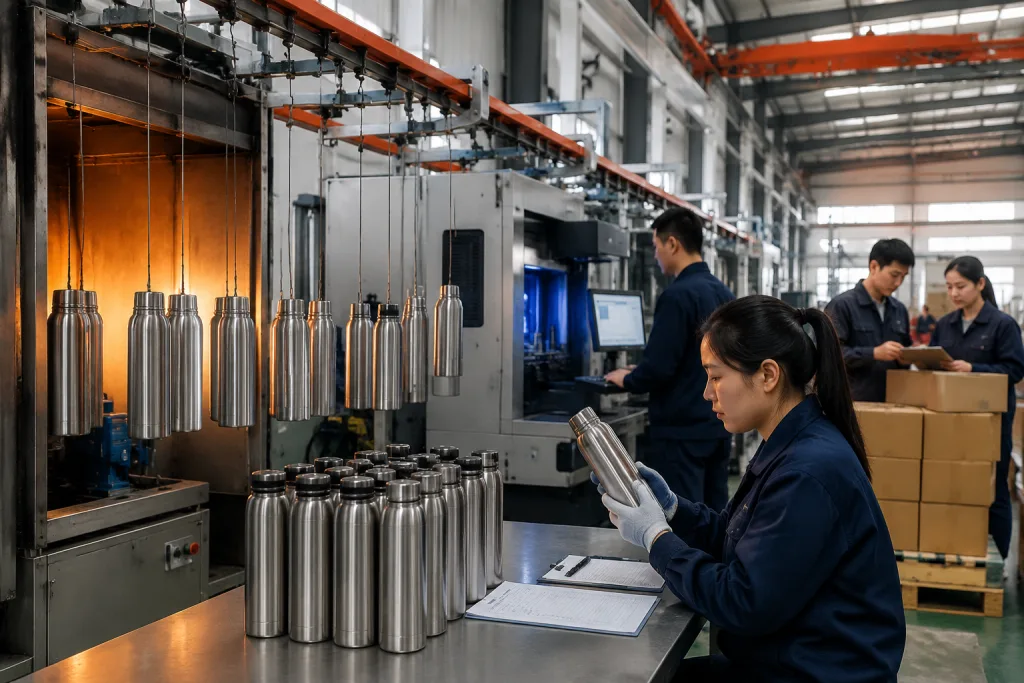
From our Hangzhou, Zhejiang export desk, we see this about 18 times a month: North American buyers want a custom thermos that looks retail-ready, stays inside a promo budget, and passes basic risk checks. Fair request. But treating it as “just add a logo” is the wrong question to ask; we run it like a production job, with the line checking lid torque, print position in mm, and carton drop marks before we ship.
Start With The Real Use Case
Before you ask a thermos supplier for a quote, pin down where the bottle will sit on day 30. A trail-running retailer and a software conference desk gift should not share the same spec. For outdoor retail programs, we run tougher powder coating, a leak-resistant lid, carton drop checks from 80 cm, and retail boxes that can survive 3 warehouse touches before delivery. For promo brands, the buyer usually pushes us on logo area, Pantone match within 1 shade, and landed cost under the campaign target. Wrong question: “What is your cheapest thermos?” Ask what failure you cannot afford.
For a mainstream promotional thermos flask America order, the common sizes are 500 ml, 750 ml, and 1,000 ml. The 500 ml size works for employee gifts and commuter kits. The 750 ml bottle is the outdoor sweet spot because it feels substantial without pushing freight too high; on our line, the packed carton often stays easier to handle under 15 kg. A 1,000 ml stainless thermos looks impressive. Still, carton volume can make your thermos bulk freight cost jump by 20-35% compared with a 750 ml model, and we have seen buyers flag this only after the forwarder updates the CBM.
Be careful with cheap quotes. A factory thermos at USD 3.20 FOB may look attractive, but check what was removed: thinner steel, weak vacuum retention, lower-grade coating, no individual box, or loose AQL discipline. Last month QC pulled a sample that passed the logo check but lost heat too fast after the 6-hour test; the math does not work if replacements eat your margin. A reliable manufacturer thermos quote should list capacity, steel grade, coating, lid material, logo method, packaging, MOQ, lead time, and FOB port. If it does not, you are not comparing suppliers thermos options fairly.
Specify Steel, Vacuum, And Lid
For most promotional programs, we run 304 stainless steel on both the inner liner and outer shell. For food-contact exports from China to North America, 304 is familiar to buyers, stable in production, and simple to document on the material declaration. Some thermos manufacturers quote 201 stainless steel for the outer shell to cut around USD 0.25–0.45 per unit on a 5,000 pcs order. For dry office giveaways, that can pass. For outdoor retail, camping, beach events, or truck-stop promotions, I push back. QC has pulled samples after a 24-hour salt spray check where small scratches near the bottom radius started staining, and the buyer flagged it right away.
Wall thickness gets ignored until the bottle feels cheap in hand. A common build is 0.4 mm inner wall and 0.5 mm outer wall. Premium models may use 0.5 mm inside and outside, but cost and weight go up, usually 18–35 g on a 750 ml bottle depending on the shape. If a thermos vendor will not state wall thickness, ask again and ask for the caliper photo. We check it with a Mitutoyo digital caliper on cut-open samples from the line, because you are buying a manufactured product, not just a logo surface.
Vacuum insulation should be tested with hot water, not guessed from catalog claims. A practical standard for a 750 ml stainless bottle is water filled at 95°C, room temperature at 20°C, and a reading after 6 hours. Strong production models hold above 65°C after 6 hours, while higher-end constructions reach 70°C or more. Cold retention sells well on a flyer, but hot retention catches weak vacuum sealing faster. We have seen this go sideways when a PO said “keeps hot 12 hours” but the approved sample only reached 61°C at 6 hours in our test room.
The lid is where complaints happen. For a customizable thermos aimed at outdoor retailers, check the silicone gasket material, then check whether the threaded closure starts cleanly after 10 open-close cycles with wet hands. PP and food-grade silicone are common. The drinking interface also needs a cleaning path wide enough for a brush, not a tiny slot that traps tea residue. Ask for spare gasket availability if your distributors thermos program will repeat for 2–3 seasons; we usually pack 1 spare gasket per 20 bottles when the buyer requests it on the PO.
Choose Decoration That Survives Use
Logo method is not just a marketing choice. It changes unit cost, line speed, scrap risk, and how the customized thermos looks after 6 months in a Ford F-150 cup holder. Laser engraving is still the safe call for 304 stainless steel and powder-coated bottles when the buyer wants a clean, permanent mark. On a typical 500-750 ml bottle, laser engraving adds about USD 0.18-0.45 per unit depending on logo size and run time; on our 30W fiber laser, a 45 mm logo takes about 18-26 seconds.
Silkscreen printing costs less for a simple one-color logo, often USD 0.08-0.20 per unit, but it needs a smooth surface and ink that passes the 3M tape test after curing. Good for corporate promotional thermos orders. Bad choice for a rugged outdoor giveaway if the artwork is large, because we have seen prints chip at the shoulder radius after the drop test. Heat transfer works better for multi-color graphics and full-wrap designs. It usually adds USD 0.55-1.20 per unit and needs tighter setup control, including film alignment within 1.5 mm.
For a thermos custom project, ask for a pre-production sample with final logo, final color, final packaging, and barcode placement. Better yet, this is the wrong question to ask if the buyer only says, “Can you send a blank sample first?” QC pulled one order last year because the UPC sticker sat 8 mm too low and covered the recycling mark on the kraft box. Do not approve a blank bottle and assume decoration will be fine later. Pantone matching on powder coating is close, not magic. A Delta E below 2.0 is difficult on textured finishes; Delta E 3.0-4.0 is more realistic for many matte colors.
If you need retail shelf appeal and promotional price control, use a standard mold, one powder-coated color, laser logo, and a printed kraft box. We run that setup faster because the line avoids extra fixtures, extra film registration, and second-pass handling. For a 3,000 pcs order, the math usually beats a full-wrap design by 5-7 production days and keeps the thermos factory moving without paying for decoration the end user may not care about.
Understand MOQ And Price Tiers
MOQ is where at least 6 out of 10 American thermos buyers burn a week going back and forth on email. In our Zhejiang production network, we usually run 1,000 pieces per color for existing stainless thermos models, 3,000 pieces for a new powder-coated color, and 5,000-10,000 pieces if the order needs custom tooling or a new lid. A China factory can accept 500 pieces on some stock bodies, but the math doesn't work well: the unit price goes up, laser engraving is easier than full-wrap printing, and QC still has to pull samples under the same caliper and leak-test routine.
For a 750 ml double-wall 304 stainless thermos, a realistic FOB Ningbo or Shanghai range is USD 4.20-7.80 depending on lid, coating, packaging, and inspection requirements. A retail-style box may add USD 0.25-0.60. A gift tube can add USD 0.70-1.40 and pushes carton volume up; we have seen a 12 kg master carton jump from 0.055 cbm to 0.071 cbm after the buyer changed the insert. If you are quoting thermos bulk for an importer, lock the packaging before you promise landed cost.
Price breaks usually matter at 3,000, 5,000, and 10,000 pieces, but each break comes from a different place. At 3,000 pieces, the decoration setup spreads out better; at 5,000 pieces, stainless sheet and lid parts can be purchased with less waste; at 10,000 pieces, the line can get a dedicated slot instead of being squeezed between two bottle programs. Our current stainless thermos capacity is about 420,000 units per month across partner lines in Zhejiang, with standard lead time of 35-50 days after sample approval. Last month, QC pulled the sample at 42 days because the buyer flagged a 1.5 mm logo position shift on the pre-production sample.
When comparing thermos suppliers, ask what is inside the price. Is the quote FOB, EXW, or DDP? Does it include export carton, inner box, polybag, desiccant, FNSKU label, master carton shipping mark, and palletization? This is where we have seen orders go sideways: one PO even had “FNSKU lable” typed wrong, and the warehouse still rejected the cartons until the sticker file was corrected. A low thermos manufacturer price gets expensive fast after normal export details are added.
Check Compliance Before Production
For promotional thermos flask America programs, compliance is not a showpiece; it is a pre-production item. Handle it before we cut the first 304 stainless body on the line. The stainless steel body, PP lid, silicone gasket, powder coating, and logo ink can all end up in the compliance file. For the U.S., buyers usually ask for FDA food-contact confirmation, California Proposition 65 review when the coating or ink needs it, and retail accounts sometimes add ASTM packaging or labeling checks. For Canada, bilingual carton and color box copy matters; we once had QC pull 500 color boxes because “dishwasher safe” was approved in English but missing in French.
If the same distributor thermos program might ship to Europe later, ask for LFGB or EU food-contact testing and REACH screening on coating or decorated surfaces. The math does not work if you save USD 0.08 on coating now and rebuild 10,000 pcs after a retailer asks for documents. Choose compliant materials at the sample stage. A serious supplier thermos team should know which reports are current, which are tied to one model, and which need retesting after a gasket, ink, or coating change; on our side, we check report dates against the BOM before the PI is released.
Factory audits still matter. BSCI, ISO 9001, or a customer social audit will not make the bottle hold heat better, but they lower procurement risk. Ask whether the factory owns vacuum testing equipment, coating adhesion test tools, torque gauges, and carton drop test procedures. We run 3M tape adhesion checks after logo printing and use a 0.6 m drop test on export cartons before mass packing. AQL inspection should be agreed before production. For most promotional orders, AQL 2.5 for major defects and 4.0 for minor defects is a practical baseline.
Do not wait until goods are packed to ask for test reports. If your buyer requires SGS, Intertek, TÜV, or another named lab, reserve 7-12 working days for testing, not 3 days because the event date is close. In China, the factory can prepare 6-10 lab samples fast, but the lab queue and buyer review become the real bottleneck. We have seen this go sideways: the PO said FDA, the buyer later flagged LFGB, and the shipment sat for 9 extra days while new samples moved through the lab.
Plan Logistics For America
A stainless thermos will not break like glass, but the cube is the killer. Freight planning decides margin. A typical 750 ml bottle in an individual box packs 24 pieces per master carton. Carton size may be around 52 x 35 x 33 cm, with gross weight near 12-14 kg depending on model. On our packing table, QC checks the carton with a 5 m tape and puts the gross weight on a Mettler Toledo scale; for this size, the chargeable weight is usually volume, not actual kg. The math doesn't work if the quote only looks at bottle cost.
For U.S. West Coast delivery, ocean transit from Ningbo or Shanghai is often 18-25 days port to port. East Coast delivery is commonly 28-38 days. Then add 3-5 days for booking, 2-4 days for customs clearance if documents are clean, inland trucking, and retailer appointment scheduling. We have seen a buyer lose 6 days because the PO said “Los Angles” and the forwarder held the ISF check. If your event date is fixed, do not build a plan that assumes perfect sailing, instant customs, and no warehouse queue.
Amazon and marketplace programs need tighter control before the line starts mass packing. Confirm FNSKU labels and carton labels with barcode size, confirm suffocation warnings for polybags, and confirm master carton limits against the receiving rules. If the goods need to move through a distributor thermos warehouse first, ask for their routing guide and carton weight limits; one U.S. distributor pushed back on any carton over 15 kg, so our 12-14 kg pack passed but only after they checked the label photo. Reworking labels in a U.S. warehouse can cost USD 0.25-0.80 per unit, which is painful on a promotional item.
Air freight is the emergency option, not the plan. A 3,000-piece thermos promotional order can be expensive to fly because of carton volume; we run the air quote by carton CBM first, not by bottle count. If you must split shipment, send 5-10% by air for the event launch and move the balance by ocean. QC pulled the sample carton once and the buyer flagged the packed size only 2 days before ETD; that is exactly how this goes sideways. A practical thermos vendor in Zhejiang should warn you before the production finish date, not after.
Work With One Accountable Factory
We see about 6 buyer teams use supplier, vendor, manufacturer, and factory as the same word on RFQs. In drinkware sourcing, that shortcut costs money. A trading company can work for 300 mixed cartons across odd SKUs, but a repeat promotional thermos flask America program needs one team owning the sample sign-off, the line schedule, decoration, final AQL 2.5 inspection, and export docs. We run into this on factory audits: the buyer asks who controls logo placement, and the answer cannot be “our partner will check it.”
This does not mean every part is made inside one gate. Stainless bottle production often uses focused workshops for tube drawing, vacuum sealing, powder coating, silk screen printing, and color box packing. The question is ownership. If your customized thermos lands with weak laser contrast under 0.15 mm engraving depth, or lids leak after a 30-minute inverted water test, you do not want 3 subcontractors blaming each other. We have seen this go sideways.
At BottleForge Industrial in Hangzhou, Zhejiang, we quote from a specification sheet, not a loose catalog number. You should see the capacity in ml, 304 stainless thickness, lid build, coating type, logo method with print area in mm, MOQ, sample time, mass production lead time, carton size, gross weight, and FOB terms. For most custom thermos projects, sample lead time is 7-10 days for logo samples and 12-18 days for new color proofing. QC pulled one 500 ml sample last month because the PO said Pantone 286C, but the buyer’s artwork file named 285C.
If you are building a distributor thermos line, ask about continuity before you ask for 3 cents off. Will the model still be open next year? Can the factory keep the same lid mold, silicone gasket hardness, color code, and 24 pcs carton dimensions? Promotional buyers often focus on the first PO. Retailers and distributors need repeatability. A good thermos supplier in China protects your reorder; treating every order like a fresh experiment is the wrong math.
Quote your stainless thermos program with real specs
Send capacity, logo artwork, target quantity, delivery market, and packaging needs. We will return a practical FOB quote and production timeline.
Frequently asked questions
What MOQ should I expect for a promotional thermos flask America order?
For existing stainless thermos models, expect 1,000 pieces per color as a workable MOQ. If you need a new powder-coated Pantone color, 3,000 pieces is more realistic because the coating line has setup loss and cleaning time. Custom molds, new lids, or special handles usually start at 5,000-10,000 pieces. Some suppliers thermos offers will accept 500 pieces, but the unit price may rise by 15-35%, and you may be limited to stock colors and simple laser engraving. For outdoor retailers, I usually recommend starting at 1,000-3,000 pieces so you can test sell-through without overpaying for every unit.
How long does a custom thermos order take from China to the U.S.?
A normal schedule is 7-10 days for a logo sample, 2-3 days for buyer approval if your team is ready, and 35-50 days for mass production after approval. Ocean freight from Ningbo or Shanghai to the U.S. West Coast often takes 18-25 days port to port, while East Coast lanes are commonly 28-38 days. Add customs clearance and inland delivery. For a promotional thermos with a fixed event date, build in at least 80-100 calendar days from artwork confirmation to U.S. warehouse delivery. Rush production is possible, but it increases inspection and logistics risk.
Which logo method is best for a customized thermos?
Laser engraving is the safest choice for most stainless and powder-coated bottles because it is permanent, clean, and hard to scratch off. It usually adds USD 0.18-0.45 per unit. Silkscreen printing is cheaper for one-color artwork, often USD 0.08-0.20, but it needs adhesion testing and is less rugged for outdoor use. Heat transfer is best for multi-color or full-wrap graphics, with a typical cost of USD 0.55-1.20 per unit. If the thermos customized program is for an outdoor retailer, approve a decorated pre-production sample and run tape adhesion plus dishwasher-style hand-wash simulation before mass production.
What compliance documents do American buyers usually request?
For the U.S., buyers commonly ask for food-contact confirmation for stainless steel, PP lid parts, silicone gaskets, and coating materials. FDA-related documentation is common, and California Proposition 65 review may be needed depending on the sales channel. Retailers may also request a factory audit such as BSCI or ISO 9001, plus AQL inspection records. If your thermos bulk order may later sell in Europe, ask about LFGB, EU food-contact, and REACH before production starts. Testing usually takes 7-12 working days once samples reach the lab, so include that time in your launch calendar.
How do I compare quotes from thermos manufacturers fairly?
Compare the same specification, not just the same capacity. Ask every thermos manufacturer for steel grade, wall thickness, lid material, vacuum test result, coating type, logo method, packaging, carton quantity, MOQ, lead time, and trade term. A 750 ml bottle at USD 4.60 FOB with 304 steel, laser logo, and color box may be better value than a USD 4.10 quote with thinner wall, plain white box, and no inspection standard. Also check whether FNSKU labels, shipping marks, desiccants, and pallet requirements are included. Small missing details can add USD 0.20-0.70 per unit after the PO.