Key Takeaways
- Plan 3,000 pcs MOQ for most custom stainless thermos orders with logo and color work
- Vacuum performance depends on steel grade, welding control, and 100% leak testing, not just wall thickness
- FOB Ningbo or Shanghai usually gives America buyers cleaner freight control than bundled DDP quotes
- AQL 2.5/4.0 inspection, REACH/LFGB material checks, and carton drop tests should be agreed before deposit
If you sell outdoor gear or promotional products in America, a stainless thermos looks simple until the quote sheet hits 6 columns. Capacity, lid style, logo method, carton strength, compliance documents, and delivery terms all move the landed cost. We’ve seen a 5,000 pcs bulk thermos order jump from 12 days to 18 days after QC pulled the sample and found the powder coating scratched at 3H pencil hardness. Cheap can get expensive fast.
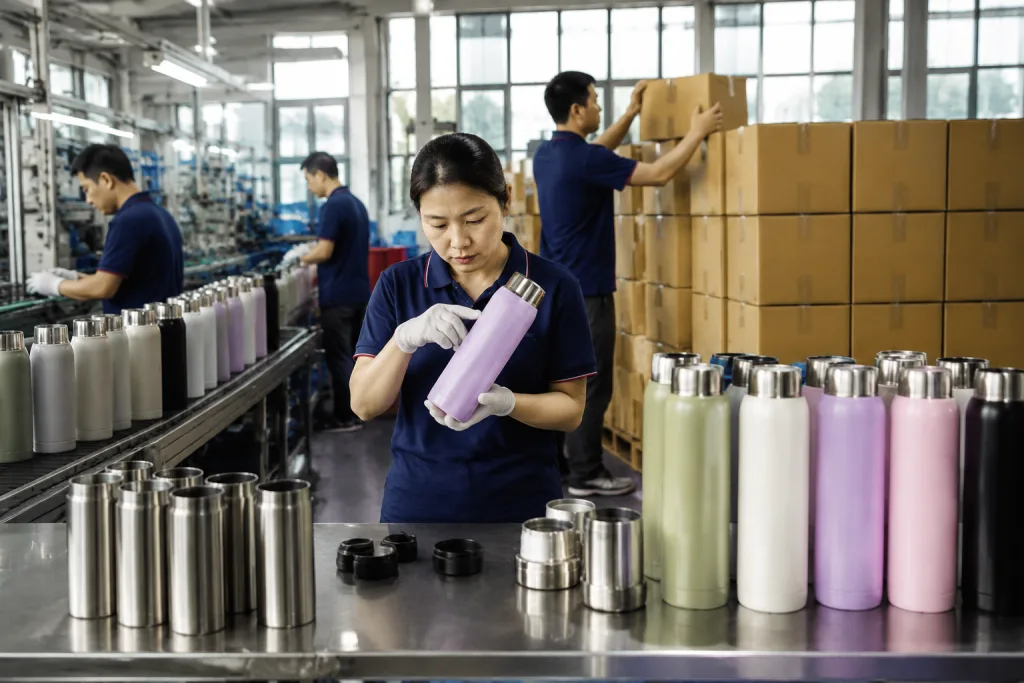
BottleForge Industrial manufactures stainless drinkware in Zhejiang, China for distributors, retailers, and brand programs. Our advice is blunt: choose the use case before chasing the lowest unit price. This is the wrong question to ask first. A custom thermos for a trail retailer needs a tougher lid, cleaner weld line, and better carton drop-test result than a promotional thermos for a bank giveaway, where the buyer flagged logo position by just 2 mm on the pre-production sample.
Start With The Selling Channel
The first question is not color, logo, or price. Ask where the bottle will be sold or handed out. A promotional thermos America order for a 2-day conference carries different risk than a retail shelf program for an outdoor chain with 80 stores. Giveaways can live with plain white cartons, but QC still checks logo edges under a 3M tape test and lid leakage on the vacuum bench. Retail orders need UPC labels, shelf-ready cartons, photo samples, and tighter surface inspection because one scratch on the front row gets flagged fast.
For outdoor retailers, we usually steer buyers toward 18/8 stainless steel inner walls, powder coating, and a lid that opens cleanly with gloves. For promotional brands, the math often works better on a 500 ml or 750 ml model with one-color silkscreen or laser engraving. A distributor thermos order for corporate gifting may need individual kraft boxes and carton labels by end customer. A thermos distributor serving 6 accounts under one master purchase order may need mixed logo batches, and we run those by separating the line with barcode carton stickers so the warehouse does not mix Microsoft-blue with Pepsi-blue.
Be careful with the word custom. This is where projects go sideways. A custom thermos can mean a stock shape with your logo, a customized thermos with PMS powder coating, or a fully tooled thermos custom mold. They are not priced the same. A stock factory thermos with laser logo can ship from China in about 30-35 days after artwork approval. A new mold usually adds 35-50 days before mass production, plus tooling cost, and QC pulled the sample last month because the buyer’s PO said “matte black” while the artwork file named it BK-02 satin.
At our Zhejiang facility, normal MOQ is 3,000 pcs per model for custom color and logo, or 1,000 pcs for selected stock-color programs. Monthly stainless thermos capacity is about 420,000 units across travel, sports, and food-grade vacuum lines. Scale helps. But only if your specification is locked early; changing from laser engraving to wraparound silkscreen after the pre-production sample can push a 30-day schedule to 38 days, because the screen plate, curing oven setting, and AQL carton check all need to be reset.
Choose Steel And Vacuum Construction
America buyers usually specify 304 stainless steel; on our export drawings that means 18/8 food-contact stainless. For outdoor retail programs, 316 stainless gives better corrosion resistance, but the math usually does not work for coffee, tea, or water bottles. For a promotional thermos, we run 304 inner with 201 outer on price-driven jobs, or 304 inner with 304 outer when the buyer wants the product page to say “all 304.” Put it on the PO. Last March, QC pulled a sample where the buyer’s artwork file said all 304, but the PO line only said “SS thermos,” and that argument cost 3 days before mass production.
Typical wall thickness is 0.4-0.5 mm for the inner tank and 0.5-0.6 mm for the outer shell, depending on shape and forming method. Thicker steel is the wrong question to ask. A bad mouth weld on 0.6 mm steel still loses vacuum, and we have scrapped cartons after the water-bath leak tester showed pin bubbles around the neck seam. A solid thermos manufacturer controls tube cutting, stretching, mouth welding, vacuum pumping, and the copper lining or reflective foil step when the model uses it. Watch the vacuum gap and sealing process, not the catalog slogan.
Ask your thermos supplier for heat retention data you can repeat. A 500 ml stainless thermos should commonly hold water above 60°C after 6 hours when tested from 95°C start temperature at 20°C room temperature. Bigger bottles often perform better because the volume-to-surface-area ratio is kinder. If a suppliers thermos quote claims 24 hours hot at a low price, ask for the test method, fill volume, lid status, and starting temperature. We’ve seen this go sideways: one buyer flagged a 24-hour chart, then the lab test used 100°C water and a pre-heated bottle, which is not how customers use a promo flask.
For a manufacturer thermos order, approve a golden sample first, then set checks the line can measure: 100% leak test with the pressure jig, 100% vacuum test by temperature reading or vacuum equipment, and random capacity verification with a 500 ml graduated cylinder. For retail, add salt spray testing for coated surfaces if the thermos will be sold for marine, fishing, or winter road use. Small details decide the result. A 0.3 mm lid gasket mismatch or one typo in the color code on the PO can turn a thermos promotional campaign into 2,000 customer service tickets instead of repeat orders.
Logo Methods And Finish Choices
Logo method decides how the bottle looks after 3 months in a sales rep’s truck, not just how it looks on a PDF mockup. Laser engraving is the safe pick for a custom thermos with a premium outdoor feel. We run it on a rotary laser jig, usually holding logo height within ±0.3 mm, and it either removes the coating or marks the 304 stainless directly. It does not peel. The tradeoff is color: laser normally gives silver, dark gray, or whatever contrast the coating allows. For a simple promotional thermos, laser also avoids the screen-registration headaches we see on curved bodies.
Silkscreen printing costs less for one or two spot colors, especially on straight-wall bottles where the screen sits cleanly against the surface. On tapered bodies, textured powder coat, or wraparound art, the math doesn’t work unless the buyer accepts more setup waste. Heat transfer handles gradients and full-color graphics, but QC should rub-test it, not just admire the sample. We use a 3M tape pull and a 500-cycle abrasion check on risky artwork. UV printing looks sharp for short visual runs, although some thermos lines still fail adhesion after dishwasher-style soaking. If you sell through outdoor retail, do not approve a finish from a studio photo alone.
Powder coating is the default finish for America outdoor and corporate markets. It feels tougher than spray paint and, when the oven curve is right, resists key scratches better. Matte black, navy, white, forest green, and sand cover about 70% of our export orders for this category. PMS matching is possible, but allow a Delta E tolerance, usually within 1.0-2.0 depending on pigment and surface. Metallic colors and rubberized finishes can look good on a sample tray, but we’ve seen this go sideways in mass production when QC pulled 38 scratched lids from a 1,000 pc pre-shipment check.
For a customizable thermos program, keep the base model stable and vary the logo, color sleeve, or gift box. That gives distributors thermos flexibility without turning the line into a sorting mess. If you need six logos across one thermos bulk order, separate them clearly in the purchase order: SKU, logo file name, logo size in mm, placement distance from base, carton mark, and quantity. We once had a PO typo that swapped “75 mm from base” with “57 mm,” and the buyer flagged it only after the golden sample photo. This sounds boring. It prevents expensive mistakes.
Pricing And MOQ Reality
America buyers often ask us for one number on “bulk thermos.” That is the wrong question to ask. A proper supplier thermos quote starts with capacity, inner/outer steel structure, lid material, powder coating or spray paint, logo process, box spec, testing scope, and Incoterms. On our Hangzhou quote sheet, a 500 ml double-wall stainless promotional thermos usually sits around USD 3.20-5.80 FOB China at 3,000 pcs, depending on lid and finish. A 1,000 ml outdoor bottle is closer to USD 5.80-9.50 FOB at similar volume; QC pulled one last month because the lid gasket was 0.6 mm off the drawing, and that small miss still changed the price discussion.
MOQ is not just a sales rule. Powder coating lines need setup time, logo fixtures need alignment, and carton suppliers do not like breaking paper board runs below 1,000 boxes. BottleForge usually quotes 3,000 pcs MOQ for thermos customized color programs, 1,000 pcs for stock color with laser logo, and 5,000 pcs or more for private mold or unusual lid systems. Small runs get messy. If a thermos vendor offers 300 pcs at a custom color price, check whether they are running real factory production or repacking spot inventory from another order; we have seen this go sideways when the buyer flagged shade difference under a D65 light box.
Sample timing is where schedules get squeezed. Existing mold samples normally take 7-10 days with laser logo, or 10-14 days with custom print and color chip matching. Mass production usually needs 30-45 days after deposit and sample approval. Add 18-32 days ocean transit to West Coast or 28-42 days to East Coast, depending on routing and season. Air freight makes sense for samples, not for 5,000 steel bottles unless the event date is already in trouble; the math does not work when one 18 kg carton costs more to fly than the bottles inside.
Payment terms for new buyers from China are commonly 30% deposit and 70% before shipment after inspection. For repeat America distributors, credit terms can be discussed after order history. The cleanest comparison is FOB Ningbo or FOB Shanghai, because you can compare multiple thermos manufacturers without freight padding hidden inside the unit price. We run into this often: one PO had “FOB Shanghai” typed in the header and “DDP Chicago” in the notes, and accounting stopped the PI before the line booked material.
Compliance For America Buyers
For the United States and Canada, stainless drinkware is straightforward, but the file still needs paperwork. Food-contact materials should have FDA-related declarations or third-party test reports, and about 7 of 10 retail buyers we quote also ask for LFGB because the odor and taste checks are tougher. For Europe-facing programs, REACH and LFGB come up often. If your promotional thermos America program might move into the EU later, test the 304 stainless body, silicone ring, and PP lid now; rebuilding the file after mass production costs more, and we have seen a 12-day test plan turn into 18 days when QC pulled the sample for a missing gasket material name.
Paint and coating tests matter. Lead, cadmium, BPA in plastic components, and phthalates for certain soft-touch parts should be checked against the selling market. For children’s items, ASTM and CPSIA requirements may apply, but most adult stainless thermos programs sit outside that category. If your lid has silicone, PP, Tritan, or ABS parts, list the material for each component on the BOM. “Food grade lid” is the wrong wording for larger retailers; one buyer flagged that exact phrase on a PO because the silicone stopper was 38 mm wide and the report only named PP.
Factory audits also affect whether the order moves. BSCI, Sedex, ISO 9001, and internal retailer audits are common requests, but not every thermos factory in Zhejiang or elsewhere in China keeps every audit active at the same time. Ask before you promise a customer. If the audit is mandatory, confirm the factory name on the certificate matches the production site, not a trading office in Ningbo or Yiwu; we run into this during onboarding when the audit address shows Building 3 and the actual line is in Building 5.
Write inspection terms into the order. AQL 2.5 for major defects and 4.0 for minor defects is a common starting point. Critical defects such as leakage, rust inside the bottle, wrong logo, wrong capacity, or sharp edges should be zero tolerance. For Amazon or warehouse programs, add carton drop testing and barcode scanning. For FBA shipments, confirm FNSKU labeling and master carton limits before production packing begins; the math does not work if the buyer asks for 15 kg max cartons after we have packed 24 pcs per carton at 17.8 kg.
Packaging And Freight Decisions
Packaging is where we see 30% of promotional buyers spend too much, while retail buyers often cut the one layer that protects the sale. A giveaway thermos promotional order can run in a plain white box or 300 gsm kraft box, but that box still has to survive export cartons, pallet forks, and the last-mile repack at the buyer’s warehouse. For retail, you may need printed color boxes, hang tags, instruction sheets, UPC labels, and PE inner dividers with 2 mm clearance around the bottle. Each layer changes carton size, CBM, and freight cost. The math gets ugly fast.
For a 500 ml stainless thermos, a common export carton might hold 24 pcs with a gross weight around 9-12 kg, depending on bottle and box. Carton wall strength should match the route. We run 5-ply export cartons for America ocean shipments, especially when goods are repalletized in Los Angeles or Chicago. QC pulled one sample carton last season after a corner drop showed 14 mm compression on the color box inside. If you are shipping to a distributor thermos warehouse, ask for carton size limits before we print the carton marks. Some warehouses push back on cartons above 15 kg because pickers slow down and surcharge emails start.
FOB terms give you control over freight forwarder, sailing schedule, and import process. CIF or DDP works for some small importers, but compare the details line by line. A low DDP quote can hide weak customs classification, thin insurance, or 18 days in consolidation when your buyer expected 12 days. We’ve seen this go sideways when the PO said “thermos mug” and the forwarder declared “vacuum flask” under a different HS code. Most established promotional brands and outdoor retailers use FOB China with their own forwarder. For LCL orders, protect cartons with pallets if budget allows. For FCL orders, confirm container loading photos and seal number before the truck leaves the line.
America market timing is unforgiving. If your customized thermos is for a September outdoor launch, approve samples by May. If it is for a November corporate gifting season, approve artwork by July or early August. China factory schedules compress before Chinese New Year, usually from mid-January to late February. The wrong question is “can production finish on time?” Ask whether the goods can catch the vessel. Orders placed too late may hit the quoted production date, then sit 6 days waiting for space after the buyer flagged one typo on the PO carton mark.
How To Brief Your Factory
A strong RFQ saves time. We usually see 12 days of back-and-forth drop to 3 days when the buyer sends capacity, target price, order quantity, market, logo file, lid preference, coating color, packaging, testing requirements, and delivery term in the first email. If you only ask, “What is your best price for thermos bulk?” the quote will be soft, or the price will move after artwork review. This is the wrong question to ask. A serious thermos supplier needs enough detail to lock the BOM and protect both sides.
Use a one-page specification sheet. Include bottle capacity in ml and oz, dimensions, net weight target, steel grade, lid material, logo size, print color, box type, carton mark, barcode requirements, and inspection standard. We run this through our quotation table before the line opens a sample mold or pulls a similar 500ml body from the shelf. If you are comparing thermos suppliers, force the quotes into the same format. Otherwise, one supplier quotes 201 outer steel, another quotes 304 outer steel; one includes a kraft box, another includes a color box. The math doesn't work.
For a promotional thermos america program, tell the factory how the product will be used. Outdoor retail customers often ask for a 74mm cup-holder base, glove-friendly opening, and heat retention that still looks honest after 6 hours. Promotional distributors usually push harder on logo area, 5-day sampling, and split shipments by end client. We’ve seen this go sideways when the PO says “black lid” but the buyer meant matte PP, not glossy ABS. A thermos manufacturers team can suggest better options once they understand the sales channel.
Our practical recommendation is to approve three items before deposit: the physical bottle, decoration method, and packaging structure. Then approve the pre-production sample before mass production. Keep one signed sample at the factory in Zhejiang and one with your team; QC pulled the sample from a locked cabinet during one AQL 2.5 inspection because the buyer flagged a 1.5mm logo shift. That signed bottle settled the argument in 10 minutes. That is how custom drinkware sourcing from China stays boring, predictable, and profitable.
Send Your Thermos Spec For A Factory Quote
Share quantity, logo, lid, color, packaging, and delivery market. We will return a practical FOB quote and sampling timeline.
Frequently asked questions
What MOQ should I expect for a promotional thermos America order?
For most stainless promotional thermos America programs, plan on 3,000 pcs per model when you need custom powder coating and logo work. If you accept existing factory colors, some suppliers can support 1,000 pcs with laser engraving. Full custom molds, unusual lids, or exclusive colors often need 5,000-10,000 pcs. The MOQ is driven by coating setup, logo fixture alignment, carton printing, and component purchasing. If a thermos vendor offers 200 pcs with a custom PMS color, ask whether it is true production or existing stock being relabeled. For outdoor retail, I would rather see you launch 3,000 pcs correctly than force a tiny run with unstable quality and no replacement inventory.
Which logo method is best for outdoor stainless thermos products?
Laser engraving is usually the safest method for outdoor stainless thermos programs because it does not peel and handles abrasion better than ink. It works especially well on powder-coated bottles in black, navy, green, white, and sand. Silkscreen is cheaper for large one-color logos, usually with a setup charge around USD 40-80 per color, but curved bodies and textured coatings need testing. Heat transfer and UV printing allow more color but should pass tape, rub, and dishwasher-simulation checks if you plan retail sales. For a promotional event, silkscreen may be enough. For a $20-35 retail thermos, laser or a properly tested print process is worth the small cost increase.
How long does production and shipping from China to America take?
For an existing stainless thermos model, sample preparation usually takes 7-14 days depending on logo and color matching. Mass production normally needs 30-45 days after deposit and approved pre-production sample. Ocean freight then adds about 18-32 days to the U.S. West Coast or 28-42 days to the East Coast, before customs clearance and inland delivery. A safe planning window is 75-100 days from RFQ approval to warehouse receipt. Add more time before Chinese New Year because Zhejiang and other China supply chains slow down for several weeks. If your event date is fixed, share it at RFQ stage, not after production starts.
What tests should I require before paying the balance?
At minimum, require 100% leak testing and 100% vacuum performance screening during production, then a final random inspection using AQL 2.5 for major defects and 4.0 for minor defects. Critical defects should be zero tolerance: leaking, rust, wrong logo, sharp edges, wrong capacity, or unsafe lid fit. For food-contact compliance, request FDA-related material declarations for the U.S. and LFGB or REACH if the product may enter Europe. For packaging, run a carton drop test, barcode scan check, and carton mark verification. If the thermos is going to Amazon FBA, confirm FNSKU label placement and master carton weight limits before the factory packs the goods.
Should I buy FOB, CIF, or DDP for bulk thermos shipments?
FOB Ningbo or FOB Shanghai is usually best for experienced America buyers because you control the forwarder, sailing schedule, insurance, and customs broker. CIF can work, but destination charges may surprise you if the quote is not transparent. DDP is convenient for smaller promotional buyers, but you must confirm who is importer of record, what HS code is used, and whether duties are properly included. For a 3,000-10,000 pcs bulk thermos order, hidden freight differences can move landed cost by USD 0.30-1.20 per unit. If you compare thermos manufacturers, compare unit price on the same Incoterm first, then calculate freight separately.