Key Takeaways
- A realistic MOQ for a custom thermal bottle is 1,000 units per SKU, not 100 units
- 304 stainless steel at 0.4-0.5 mm wall thickness is the practical baseline for B2B promotional use
- Logo method changes both unit cost and risk: laser is stable, full-wrap print needs tighter sampling
- FOB China lead time is usually 35-50 days after artwork approval and deposit
If you are sourcing a promotional thermal bottle America program, finding a bottle is the easy part. The risk sits on the line: color drift after 8 hours of powder coating, logo position moving 2 mm on the jig, cartons failing a 12 kg drop test, or a ship date slipping from 12 days to 18 days because the artwork file came in late. We’ve seen this go sideways.
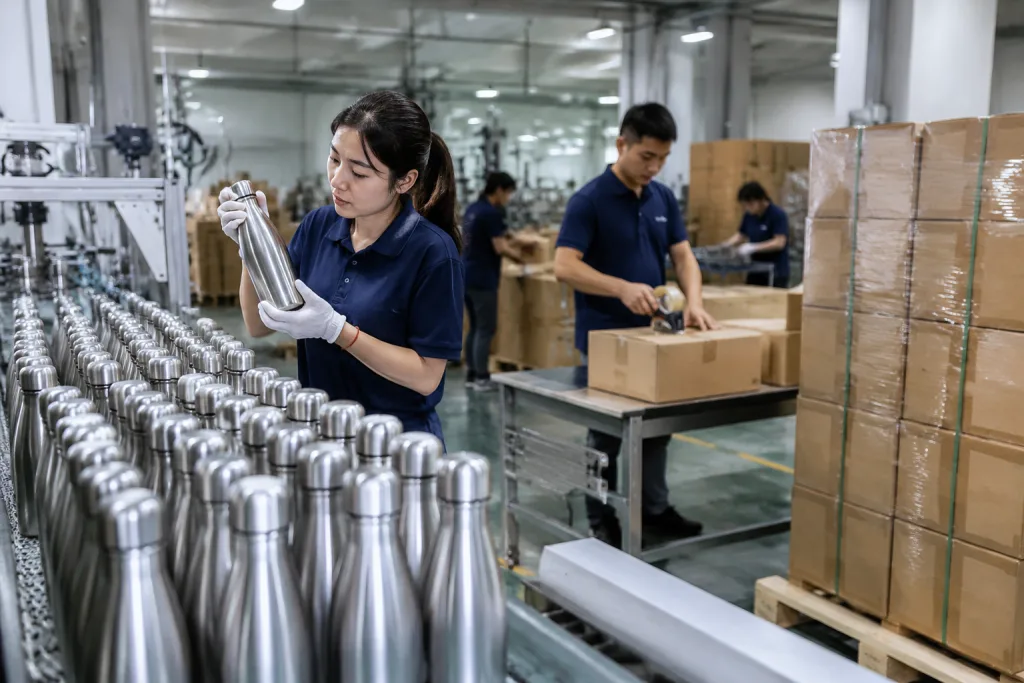
BottleForge Industrial is based in Hangzhou, Zhejiang, China, and we build custom drinkware for distributors, brand owners, and procurement teams. We run about 450,000 stainless bottle units per month, with typical MOQ from 1,000 units per SKU. Before you issue a PO, you need clean answers on cost, compliance, and customization; last week QC pulled a sample because the buyer’s PO said matte black, but the approved Pantone note was for charcoal gray.
Start With The Use Case
A promotional thermal bottle America order can point to 6 different builds on our line. A 500 ml vacuum bottle for a bank giveaway is not the same job as a 1.9 L custom growler for outdoor retail. A safety-award bottle for an industrial distributor has its own problem too: the buyer flagged “too retail-looking” on one sample because the logo area sat under the hand grip. If your RFQ only says “stainless bottle with logo,” the cheap quotes will come fast, but the math does not work when you compare wall thickness, lid tooling, coating, and carton pack-out.
Start with where the bottle will be used. Desk and commuter programs usually sit best at 500-750 ml, with a powder-coated 304 stainless body, screw lid, and leak-resistant silicone seal; we run a 0.45 mm outer wall on many of these orders to keep the hand feel solid without pushing freight weight too high. Sports and field programs need a wider mouth and a stronger carry handle. The coating matters. QC pulled one black sample after 300 hand-abrasion cycles because the edge near the handle started to shine. A canteen promotional project for camping, military-style retail, or student use may need a flatter profile, shoulder strap, or carabiner-compatible cap.
For America, cupholder diameter is not a side detail. We have seen this go sideways: a buyer approved a good-looking 900 ml bottle, then the sales team found it missed common vehicle cupholders by 4 mm. A practical lower body diameter is usually 72-76 mm. If you want more capacity, ask about tapering instead of just increasing diameter.
Use plain specifications in your RFQ: capacity in ml and oz, lid type, coating color, logo size, target retail or giveaway value, pack-out, and delivery market. Better yet, attach a PO-style line with the logo size in mm; one typo from 45 mm to 54 mm changed the print plate on a 3,000 pcs order last spring. A canteen manufacturer in Zhejiang can quote accurately when the request is measurable. A vague request pushes the factory to quote the lowest safe assumption, and that is where surprises start.
Materials And Thermal Performance
For most customized drinkware orders, we run 304 stainless steel on the inner wall. It is the right call. It passes food-contact requirements, resists corrosion, and stays stable with coffee or tea; plain water and sports drinks are fine when users clean the bottle the same day. Some canteen manufacturers quote 201 stainless steel to shave cost. I push back on that for American promotional thermal bottle programs. QC pulled 6 samples from a low-cost 201 trial last year, and rust showed near the inside thread after a 48-hour salt-water soak, especially around the laser-welded neck.
A common build is double-wall vacuum insulation with 304 inner and 201 or 304 outer shell. The body wall is usually 0.4-0.5 mm before forming; after stretching on the hydraulic press, we check the shoulder with a digital thickness gauge. Go thinner and the unit feels lighter, but dent resistance drops fast. For distributor canteen programs where bottles pass through 2-3 warehouses before kitting, the math doesn't work if a $0.06 steel saving turns into crushed cartons and chargebacks.
Thermal claims need to match the bottle, not the sales sheet. A 500 ml narrow-mouth bottle with a clean vacuum can often hold hot liquid above 60°C for 6-8 hours in a 20°C room. Wide-mouth bottles lose heat faster because the lid area is larger. A customized growler can do well on cold retention, but hot retention depends on lid structure and the air gap under the cap; we have seen one 64 oz sample lose 9°C faster after the buyer switched to a flip lid for easier drinking.
Ask your canteen supplier for test conditions, not just catalog wording. Useful data means starting water temperature, room temperature, fill volume, and measured temperature after 6, 12, and 24 hours. We record this on a simple bench test sheet beside the vacuum tester, and the buyer flagged it once because the PO said “24hrs hot” while the artwork only supported “up to 12 hours.” If your program will be sold through a retailer, keep claims conservative unless you have third-party lab data. “Keeps drinks cold up to 24 hours” is safer than a precise claim the package cannot prove.
Customization Choices That Matter
Customization is where 7 out of 10 promotional orders start leaking cost. A one-position laser logo on a black powder-coated bottle is low risk; we run that with a rotary jig and a 0.2 mm logo position tolerance. A full-color wrap on a curved canteen body is a different job because the artwork bends around the radius and the buyer flagged “oval-looking” text on a 12 oz sample last quarter. Both choices can work. Pricing them the same is the wrong question to ask.
For custom canteen and customizable drinkware projects, the main logo options are laser engraving, silk screen printing, heat-transfer printing, UV printing, and embossed or debossed metal parts. Laser is durable and clean, especially for corporate logos, and QC pulled the sample after 300 rubs with 3M tape on our last bank order. Silk screen fits one or two colors, usually adding about USD 0.08-0.25 per unit depending on size and coverage. Heat transfer handles complex artwork, but the line needs tighter checks on adhesion and edge alignment, usually every 500 pcs instead of only final AQL.
Color matching causes more arguments than buyers expect. Powder coating can usually be matched to a Pantone reference, but stainless substrates, coating thickness, and curing temperature all shift the result; 180°C for 18 minutes does not look the same as 200°C for 12 minutes. For America-bound branded programs, approve a physical color chip or pre-production sample, not only a PDF rendering. A 5-8% visual difference may pass for a giveaway, but not for retail packaging sitting under bright store lights.
If you need a canteen customizable range across several capacities, keep the decoration logic consistent. Use the same logo height, same position from the base, and the same coating family, or we have seen this go sideways during incoming inspection. On a 500 ml and 750 ml bottle set, we normally mark logo height with a steel ruler from the base at 62 mm before the first print run. A good canteen vendor should send a dieline or marked sample photo before mass production starts.
Pricing, MOQ, And Tooling
For a standard stainless promotional thermal bottle America order from China, a realistic FOB Ningbo or Shanghai price usually lands at USD 3.20-6.80 per unit for 500-750 ml. Lid structure, powder coating, inner carton, and logo method move the number fast; on our line, a laser logo fixture change takes about 18 minutes, while full-wrap screen printing can add USD 0.18-0.35 per bottle. Large custom growler or customized growler items run USD 8.50-16.00 because the steel weight jumps, the lid seal needs tighter testing, and the export carton often needs 5-layer K=A board instead of light 3-layer board.
MOQ is not just a sales policy. It is tied to coating line setup, logo fixtures, carton printing, and component purchasing. At BottleForge in Zhejiang, we run 1,000 units per SKU for standard mold bottles and 3,000 units when custom color coating and retail packaging are both involved. A fully new mold can require 5,000-10,000 units plus tooling cost. QC pulled a 750 ml sample last month where the Pantone coating looked fine under office light, then failed under the D65 light box; repainting 600 bottles cost more than the buyer expected.
Be cautious when a canteen vendor offers 100 units with custom coating, custom carton, and a low price. The math doesn't work. It usually means stock bottles, hand-applied decoration, or trading-stock substitution. We have seen this go sideways when the buyer flagged a 2 mm height difference between the approved sample and the repeat order. It can work for a test, but it is not the same as a repeatable distributor growler or distributor drinkware program.
Tooling costs depend on what changes. A new silicone gasket may cost only USD 300-800. A new plastic lid can cost USD 2,000-6,000. A new stainless body mold can move higher, especially if the shape needs deep drawing or special shoulder geometry; our mold shop checks the shoulder radius with a 0.02 mm caliper before trial assembly. Before paying tooling, clarify ownership, storage time, and whether the mold is exclusive. Put those terms on the PI, not only in email, because one buyer once sent a PO with “public mold” typed by mistake and it took 2 days to clean up.
Compliance For American Buyers
For the United States and Canada, compliance belongs before the PO, not after the cartons are sealed. Food-contact parts must match the intended use: 304 stainless steel liner, silicone gasket, PP lid, Tritan-style straw, powder coating, pad-printing ink, and even the glue under a badge. We check these on the sample bench with a caliper and material sheet before we quote mass production. For 7 of the last 10 American promo bottle programs we ran, the buyer asked for FDA food-contact support, LFGB-style material control, and Prop 65 screening even when the bottle was a plain 500 ml thermal bottle.
If the order is for children, the rulebook changes. A kids thermal bottle or canteen customized for school use may need CPSIA, ASTM F963 considerations, lead and phthalate limits, tracking labels, and age grading. Do not let a canteen factory treat a children’s item as a normal adult promotional bottle. That is the wrong shortcut. We have seen this go sideways when a buyer flagged the missing age grade on a 12 oz school bottle after the color box artwork was already plated. The testing plan and packaging warnings can shift by one small icon.
For Europe-bound parallel programs, REACH and sometimes LFGB testing may be requested. For social compliance, distributors often ask for BSCI, Sedex, or a customer audit. BottleForge works from Hangzhou, Zhejiang, with audited partner lines in China. We normally prepare material declarations, test reports, and factory profile documents during sampling, not 7 days before ETD when everyone is chasing signatures. On our side, QC pulls the pre-production sample, matches it against the BOM, and stores the report with the sealed sample tag.
Inspection standards should be written clearly. AQL 2.5 for major defects and 4.0 for minor defects is common for promotional drinkware. Critical defects such as leakage, sharp edges, strong odor, wrong logo, or contaminated interior should be zero tolerance. We run a 100% leak check on the line for thermal bottles, then QC rechecks random cartons during final inspection with hot water and inverted storage for 30 minutes. If your canteen distributor customer has its own inspection checklist, send it before production starts. A checklist after packing does not fix a bad lid mold.
Packaging And Logistics Details
Packaging is not decoration. It decides how many bottles arrive saleable after ocean freight, courier sorting, and distributor warehouse moves. For a standard 500 ml thermal bottle, we usually run a white box or kraft box with a 0.03 mm bubble bag. That passes for promo orders. For retail or Amazon-style distribution, the buyer will usually ask for a printed color box, barcode, FNSKU label, suffocation warning on polybags, and carton drop-test control; QC pulled one sample last month because the FNSKU was 6 mm too close to the box edge.
Master cartons should fit real handling, not just container math. A carton above 18-20 kg gets dropped more often in mixed freight; we have seen corners collapse after only 3 warehouse transfers. For powder-coated bottles, we run individual bags and 5-ply export cartons, with dividers when the coating or cap shape needs it. If the bottle has a handle, straw lid, or protruding cap, test the pack-out before mass production. Skipping that test is the wrong place to save 2 days.
Lead time depends on customization level. A normal repeat order can ship in 30-35 days after deposit. A new custom color with logo sample is more often 40-50 days, especially when the spray line needs a second LAB color check under the D65 light box. Add 25-35 days for ocean freight: Ningbo to Los Angeles is often 25-30 days, while New York can run closer to 32-38 days in peak season. Air freight works, but stainless bottles are heavy; at 0.38-0.55 kg per 500 ml unit, the math doesn't work unless the order is urgent or the margin is strong.
FOB China is the cleanest Incoterm for buyers with their own forwarder. DDP suits smaller distributors, but compare it line by line because duties, port fees, and last-mile charges sit inside the unit price. We have seen this go sideways when a PO typo changed “FOB Ningbo” to “DDP Chicago” after the quote was approved. A serious canteen supplier should quote FOB, carton dimensions, gross weight, HS code guidance, and loading quantity for 20GP and 40HQ containers; for example, 24 pcs per carton at 14.5 kg gross gives the forwarder something real to price.
How To Qualify A Supplier
China has roughly 200+ canteen suppliers showing up on Alibaba and trade-show lists, but a fair share are sales offices, not factories. A real canteen factory will talk through 304 stainless thickness, vacuum test pressure, powder-coating line output, AQL inspection, logo jig setup, and CAR follow-up without guessing. Ask one technical question twice. If the answer is still “yes, no problem,” this is the wrong question to trust; our QC team has pulled samples where the PO said “matte black” and the line ran glossy black because nobody checked the coating card.
Ask for production photos, audit documents, recent test reports, and a written sample timeline. For a new promotional thermal bottle America project, we usually quote 7-10 days for a stock shape with laser logo, 12-18 days for custom powder color, and 25-35 days if new tooling is involved. The line should not open mass production until artwork, Pantone color, lid choice, retail box dieline, and carton marks are approved in writing. We run pre-production samples with a 0.2 mm logo position tolerance because one buyer once flagged a 3 mm off-center mark after 8,000 pcs were packed.
You should also ask who owns the process. Some trading companies do solid work, but for a repeatable canteen customized line, you need engineering feedback from the factory floor, not a screenshot from a middleman. A capable canteen manufacturer will push back when your artwork sits too close to the shoulder curve, when a lid request fails a 30-minute inverted leak test, or when a 5-ply carton spec cannot survive a 16 kg drop-test load. That pushback is good service. We have seen this go sideways when everyone stays polite and nobody says the math doesn't work.
BottleForge is a China-based drinkware manufacturer, not a catalog-only reseller. If you are comparing canteen distributors, distributor canteen programs, custom growler sourcing, or customizable canteen ranges, send a tight RFQ with target quantity, delivery date, sales market, logo file, and compliance needs. Give us the real numbers. With MOQ, delivery window, FDA or LFGB requirement, and packaging spec clear on the first email, we can quote like a factory instead of padding 5 days because the PO says “ASAP.”
Send Your Bottle RFQ For A Practical Factory Quote
Share quantity, logo file, market, and delivery date. We will reply with MOQ, FOB pricing, sample timing, and compliance notes.
Frequently asked questions
What is the normal MOQ for a promotional thermal bottle America order?
For a standard existing mold, 1,000 units per SKU is a realistic MOQ. If you need custom powder coating, printed retail box, and barcode labeling, 3,000 units is more practical because coating setup, carton printing, and line changeover all have fixed costs. A canteen supplier may offer 300-500 units using stock colors and simple laser engraving, but unit cost will be higher and repeat color control may be weaker. For a new body shape or private lid, expect 5,000-10,000 units plus tooling. If your project is a market test, start with a stock mold and custom logo before investing in a new canteen customized design.
How long does production and shipping to America take?
For a normal custom drinkware order, plan 7-18 days for sampling, 35-50 days for mass production after deposit and artwork approval, and 25-35 days for ocean freight to many US ports. That means a safe calendar is often 70-100 days from RFQ confirmation to warehouse arrival. Repeat orders can move faster, especially if the canteen factory already has approved color panels, logo fixtures, and packaging files. Air freight can reduce transit to about 5-10 days, but a stainless thermal bottle is heavy, so freight may add USD 1.50-4.00 per unit depending on weight and destination.
Which logo method is best for promotional bottles?
For most B2B promotional thermal bottle programs, laser engraving is the safest method because it is durable, clean, and hard to scratch off. It works especially well on powder-coated stainless bottles. Silk screen printing is cheaper for larger one-color logos, often around USD 0.08-0.25 per unit, but it needs adhesion checks. Heat transfer and UV printing are better for full-color artwork, yet they require more careful sampling on curved surfaces. If you are a canteen distributor selling to corporate clients, offer laser for conservative projects and full-color print only after the buyer approves a physical pre-production sample.
What compliance documents should I ask a China supplier for?
Ask for material declarations, food-contact test reports for stainless steel, silicone and plastic parts, coating or ink safety documents, and any recent factory audit such as BSCI or Sedex if your customer requires social compliance. For US programs, FDA food-contact suitability and Prop 65 screening are common buyer expectations. For children’s bottles, request CPSIA and relevant ASTM review before production. For Europe, REACH and sometimes LFGB may be needed. A serious canteen manufacturer in China should provide documents during the sample stage, not after the goods are finished and sitting in export cartons.
Can I use one supplier for bottles, canteens, and growlers?
Yes, if the supplier has the right production network and QC system. A factory that only makes small vacuum bottles may struggle with a 1.9 L customized growler because steel thickness, welding, lid torque, and carton strength are different. Ask for photos and test records from similar products: custom canteen, customizable growler, and distributor drinkware orders. Also check whether the supplier can keep coating color consistent across different shapes. Using one canteen vendor for a coordinated range can reduce artwork errors and simplify inspections, but only if they control specifications rather than buying random stock from several workshops.