Key Takeaways
- Plan 25-35 days for standard bulk production after artwork and sample approval
- Use AQL 2.5/4.0 inspection for most promotional products drink bottle orders
- Expect practical MOQ from 500 units for logo stock styles and 3,000 units for molded parts
- FOB China pricing can shift 8-15% when steel gauge, lid design, or packaging changes
A promotional products drink bottle looks simple until you place 5,000 units and QC pulls 32 leaky lids from the first carton check. Then the logo fails the 3M tape test, or the 58 x 42 x 36 cm export carton pushes freight past the buyer’s target. The problem usually starts before the line runs: loose material specs, a target price that leaves no room for a decent cap, and artwork nobody wrapped around the bottle curve.
If you buy for a brand, agency, canteen distributor, or event program, catalog talk is the wrong question to ask. You need factory-floor answers. BottleForge Industrial ships from Hangzhou, Zhejiang, and we run stainless steel, Tritan, glass, and aluminum drinkware for Europe and North America. China can make solid bottles, but the math doesn’t work if the PO says “same as sample” and the sample has no wall thickness, lid drawing, or packing method locked before production.
Start With The Use Case
Do not start with the logo. Start with how the bottle will be used. This is the wrong question to ask first, and we see it waste 2 or 3 quote rounds. A promotional products drink bottle for a marathon sponsor is not the same product as a distributor drinkware item for a corporate holiday kit. One sits in sweaty hands for two hours. The other may sit in a gift box next to notebooks and electronics. Last month QC pulled the sample after a wet-hand grip check because the smooth coating slipped during a 1.2 m drop test.
For sports and outdoor campaigns, buyers usually ask for 600 ml to 1,000 ml capacity, one-hand opening, a carry loop, and grip that works after the bottle sweats. For office giveaways, 350 ml to 500 ml travel tumblers or insulated bottles are easier to ship and store; we can fit 24 pcs in a 58 x 39 x 31 cm export carton instead of repacking at the line. For university or camp programs, a custom canteen or canteen customized with a school logo often needs a 25 mm shoulder strap or carabiner lid, not just a printed bottle body.
You should define four things before asking a canteen supplier for a quote: who uses it, how they drink from it, how many weeks it must stay in service, and whether it ships in bulk or an individual box. A two-week event giveaway can accept a different cost structure than a reusable retail loyalty gift. If you expect the bottle to be used for 12 months, choose better wall thickness, stronger lid hinges, and a coating that passes cross-hatch adhesion testing with 3M 600 tape. We have seen cheap lid pins go sideways after 800 open-close cycles.
At our Zhejiang facility, a normal inquiry moves faster when the buyer writes: “750 ml stainless sports bottle, matte powder coating, one-color logo, individual kraft box, 5,000 units, FOB Ningbo.” That is enough for a canteen manufacturer to quote within 24 hours, assuming the artwork is a clean AI or PDF file. “Send your best bottle” is not. The line cannot cost a guess, and our sales team still remembers the PO that said “750 m1” instead of “750 ml.”
Choose Material Without Guesswork
Material choice changes the landed cost, hand feel, test route, and how sharp the logo prints. For premium promotional products drink bottle orders, we usually start with stainless steel because the risk is easier to control. For single-wall stainless bottles, common wall thickness is 0.5 mm to 0.6 mm. For vacuum insulated bottles, inner and outer walls are often 0.4 mm to 0.5 mm depending on shape and capacity. Go thinner and the math looks good on the quote sheet, but we have seen this go sideways after 12 kg export cartons hit the corner-drop test and QC pulled 8 dented samples from one pallet.
Tritan fits clear-bottle projects where the buyer wants lower weight without glass breakage. Ask for BPA-free documentation and food-contact test reports tied to the resin lot, not a generic PDF from 2021. For the EU, REACH and LFGB are commonly requested. For the US, buyers often ask for FDA food-contact compliance and, when children are involved, ASTM or CPSIA-related checks depending on the product type. Glass gives a clean retail look, but silicone sleeves and stronger packing are not optional; last April a buyer flagged 23 cracked bottles after they changed from egg-crate dividers to plain white boxes to save USD 0.06 per unit.
Aluminum works for budget canteen promotional campaigns, especially event giveaways above 5,000 pcs. The trade-off is simple: aluminum usually needs an inner food-grade coating, and you should not sell it as a rugged long-term bottle unless the line has tested it honestly. We run a basic tape test on the coating and check dents after a 1.2 m drop. A cheap aluminum canteen custom order may look fine from 1.5 meters on a tradeshow table, then come back with complaints after the first week of use.
If you are comparing canteen manufacturers in China, ask them to state the grade clearly: 304 stainless steel, 316 stainless steel if required, Tritan model number, borosilicate glass, or aluminum alloy. “Food grade” alone is not a specification. It is a sales phrase until supported by a test report tied to the actual material batch. This is the wrong place to accept loose wording; we once saw a PO typo list “304 inside, 201 outside,” and the buyer only caught it after the pre-production sample was weighed on a 0.1 g scale.
Branding Method Changes The Result
Logo application is where about 7 out of 20 promotional bottle orders get into trouble. The cheap method can be right, but only when it matches the bottle wall and the campaign life. Silk screen printing is still our workhorse for one- or two-color logos on straight walls; we run it with a 120T mesh screen and check ink coverage under a D65 light box. It fits 1,000 to 20,000 units and usually carries a low setup cost, often USD 30-80 per color depending on artwork and factory policy.
Laser engraving looks cleaner on stainless steel and powder-coated bottles. No peeling. QC pulled the sample after 24 hours in the tape test, and the engraved mark stayed sharp on 304 stainless. The catch is color: you get exposed metal or engraved contrast, not Pantone-matched ink. For executive gifts or distributor growler programs, laser is worth the small extra cost when the buyer wants the bottle kept for 18 months, not tossed after a 3-day event.
Heat transfer and UV printing are better for gradients and photo-style designs. They cost more and need tighter adhesion checks; on our line we run a 3M tape pull, then a 60°C warm-water soak for printed samples when the artwork is heavy. If your artwork wraps around a curved body, ask for a digital mockup and a pre-production sample. Curved bottles distort logos. A 70 mm wide logo may look balanced on a flat PDF but stretched on a tapered 500 ml bottle. We’ve seen this go sideways when a buyer approved the PDF only.
For custom drinkware with retail packaging, define logo placement in millimeters: distance from base, distance from seam, plus maximum width and height. Put orientation relative to the lid opening on the PO too; one buyer once typed “left of sip” when they meant “right of sip,” and 500 samples had to be reworked. For a canteen customizable with straps or side handles, confirm the logo is not blocked when the strap hangs naturally. Basic? Yes. Still the right question to ask, because a beautiful logo under the handle does not sell the campaign.
MOQ, Price, And Lead Time
MOQ is not a punishment. It is the break-even point where 304 stainless sheet buying, line changeover, logo screen setup, and packing labor stop fighting the order. For stock-shape bottles with a one-color logo, we run 500 units to 1,000 units at most China drinkware factories; below 500, the math usually does not work after film, fixture, and carton setup. For a customized canteen with a new lid color, silicone gasket, or private mold detail, 3,000 units is a cleaner starting point. For new injection molds, budget USD 1,500-8,000 depending on complexity. Last month QC pulled a lid sample because the silicone ring measured 1.8 mm instead of the approved 2.0 mm, and that tiny change was enough to slow packing for half a day.
FOB China pricing for promotional products drink bottle orders moves more than first-time buyers expect. A basic 750 ml single-wall stainless bottle may sit around USD 1.80-3.20 FOB at volume. A 500 ml vacuum insulated bottle with powder coating and laser logo may land around USD 3.80-6.50 FOB. A custom growler or customized growler at 1.9 L can move from USD 8.00 to USD 15.00 depending on steel gauge and cap construction, then the handle and box push it again. We see buyers compare two quotes and miss a 0.2 mm steel difference; that is the wrong question to ask if the bottle has to survive a trade-show giveaway packed 24 pcs per carton.
BottleForge Industrial in Hangzhou, Zhejiang, runs drinkware lines with monthly output around 450,000 units across stock and custom programs. Normal production lead time is 25-35 days after sample approval for standard orders. Add 7-10 days for pre-production sampling, or plan 38-45 days if the job needs molded accessories, special packaging, or third-party lab testing. The line is fastest when the buyer signs off the golden sample on the first pass; we had one PO last quarter where “matte black” was typed as “matt back,” and the buyer flagged it only after the powder coating chips were already matched.
Be careful with quotes that ignore packaging. Individual white boxes, kraft boxes, color boxes, barcode labels, FNSKU labels for marketplace inventory, master carton strength, and pallet requirements all change cost. A canteen vendor who quotes only the bottle is giving you half a number. Ask for unit price, setup fees, sample cost, mold cost if any, carton dimensions, gross weight, and estimated CBM before you compare canteen vendors. We ship plenty of promo orders where the bottle price looks fine, then the buyer pushes back on freight because the master carton failed a 12 kg compression check or the pallet height ran over 1.6 m.
Compliance Is A Buying Tool
Compliance is not paperwork for the last carton. It is a buying filter. For Europe, ask about LFGB and REACH first, then confirm which food-contact migration items the lab will run on the exact bottle. For the United States or Canada, check FDA food-contact materials, California Proposition 65 where relevant, plus carton and polybag labeling. Children’s bottles need their own review; adult bottle reports do not cover small parts, straw tips, or bite valves. We had one buyer flag a 6 mm silicone straw stopper after QC pulled the sample, and they were right to push back.
A serious canteen factory should talk through test scope, not just email a 3-year-old PDF. Reports need to match the material, color, coating, and lid structure you are buying. If the report is for clear Tritan but the PO says PMS 2925C translucent blue, ask whether the pigment needs review. If the report is for stainless steel but your lid uses PP, silicone, and a painted carry handle, test the lid parts too. We run this check at sample stage with a BOM sheet on the bench, not after 10,000 units are packed.
Factory audits are a separate topic. BSCI, Sedex, ISO 9001, or customer audits tell you something about management control, but they do not prove the bottle itself is compliant. A factory can pass a social audit and still ship a lid gasket that fails odor testing after 24 hours in a sealed PE bag. We have seen this go sideways. Use audits to qualify the canteen manufacturer, and use lab tests to qualify the product.
For promotional products, the real risk is reputation, not a few cents on unit cost. A failed 10,000-unit campaign can hit the distributor, the agency, and the end brand in one week. Spend the extra USD 200-600 on relevant lab testing when the order is public-facing, children-related, or headed to retail shelves. The math is simple: one recall email costs more than the test. On our line, QC would rather pull 12 samples for the lab than argue over a failed campaign after the vessel has shipped.
Quality Control Before Shipment
Do not wait for finished-goods photos and call that inspection. Photos sell the order, but they do not prove thread fit, leakage, odor, coating adhesion, carton drop strength, or logo rub resistance. We had one 8,000 pc bottle order where the photos looked clean, then QC pulled the sample and found 3 lids leaking after a 30-second inverted test. For most distributor drinkware orders, run a pre-shipment inspection under AQL 2.5 for major defects and 4.0 for minor defects. Critical defects should be zero tolerance.
A practical inspection plan for a promotional products drink bottle order should cover capacity check, leak test, lid torque, visual defects, logo position, logo adhesion, coating scratches, odor, carton marking, barcode scan if applicable, and packing count. Make it measurable: logo center tolerance ±1.5 mm, carton gross weight within ±0.5 kg, 1 inner box short equals a packing defect. For insulated bottles, add heat retention testing. We run the simple version with 95°C water and check the temperature drop after 6 hours using a probe thermometer at the QC bench. Put the standard on the purchase order. Do not debate it after the line has packed 320 cartons.
For powder coating, ask for a cross-hatch adhesion test and a rub test. For silk screen logos, test with 3M tape and 50 back-and-forth rubs using a white cotton cloth. For stainless bottles, check inside polishing and welding lines; a flashlight will show black polishing residue near the shoulder faster than any sales photo. For glass, inspect sleeve fit and breakage in transit packing. For custom growler and customizable growler programs, check cap sealing under tilted and inverted positions because 1.9 L of liquid puts more stress on the closure than a 500 ml bottle.
China factories can produce stable quality, but the buyer must define what “good” means. If your PO only says “high quality,” the math doesn't work; QC has no pass line, and the buyer flagged it too late. We once saw a PO typo list matte black as “mate black,” and the line still stopped to confirm color because the approved sample tag said PMS Black 6C. A good canteen supplier will accept clear inspection rules because it cuts arguments. A weak supplier will dodge them. That tells you plenty before your deposit leaves your account.
Work With The Right Supplier Type
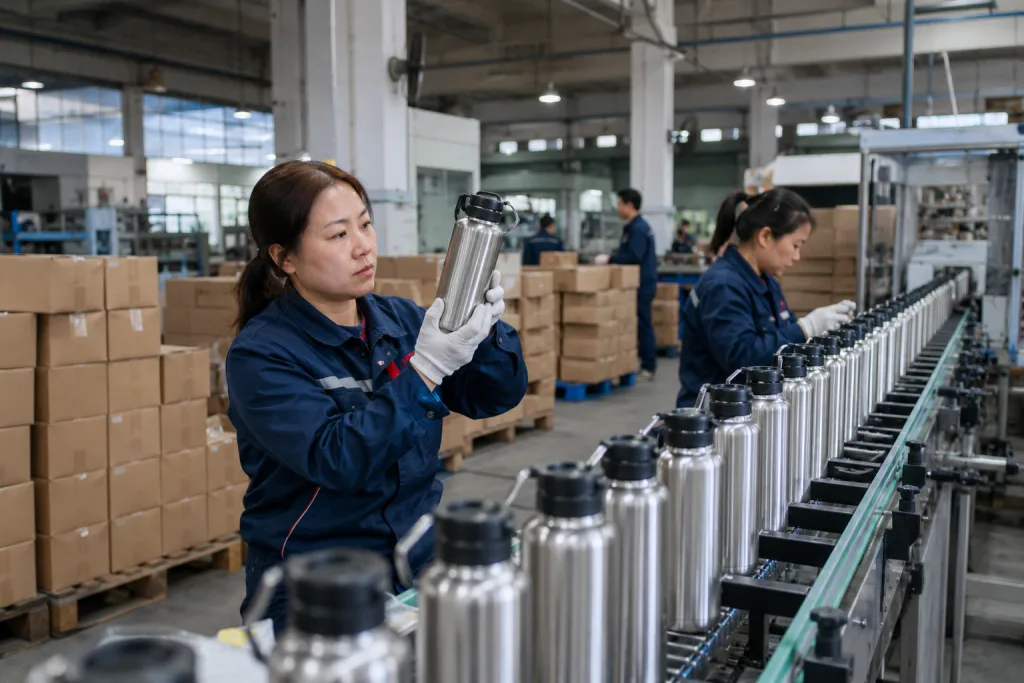
There is no perfect supplier type. A trading company makes sense if your PO covers 12 categories, like bottles plus tote bags plus pens, loaded in one 40HQ. For a drink bottle program, a canteen factory is usually the safer bet because the line can check the drawing, the leak test, and the lid fit without waiting two days for a subcontractor reply. We run in-house polishing, powder coating, and assembly, so if QC pulls a sample with a 0.4 mm mouth ovality issue, the mechanic can adjust the expanding mandrel the same afternoon. A pure exporter often has to ask three shops before answering one gasket question.
If you are a canteen distributor, or one of 6 canteen distributors sharing corporate accounts, your supplier needs to understand repeat orders. Stable item numbers matter. So do saved AI artwork files, retained Pantone panels, carton marks, and revision records with dates. We have seen this go sideways: a buyer reordered a canteen customized in 2025, then flagged the 2026 shipment because the lid gasket changed from 2.8 mm to 2.5 mm to save USD 0.03. The math doesn't work when one cheap gasket creates 300 customer complaints.
Ask direct questions: Who owns the mold? Is coating done in-house or 18 km away? What is the monthly capacity for this exact bottle, not the whole factory? What is the MOQ for reorder? Can you keep Pantone color records with a signed color chip? Can you apply Amazon-style FNSKU labels without covering the barcode corner? Can you support FOB Ningbo or FOB Shanghai? Can you provide product photos before inspection? A serious canteen suppliers list should drop from 10 names to 3 after these questions. If it doesn't, the questions were too soft.
BottleForge Industrial is based in Zhejiang, China, close to Ningbo and Shanghai export routes. That matters for freight choices and factory visits: Hangzhou to Ningbo port is usually a same-day truck, while Shanghai works better for some LCL bookings. Whether you buy from us or another canteen supplier, choose the partner that gives numbers and writes them into the PI, including MOQ, packing method, lead time, and lid version. We once caught a PO typo that changed “matte black” to “mate black” before printing the carton label. Promotional drinkware is not complicated, but vague buying gets expensive fast.
Send Your Bottle Specs For A Factory Quote
Share capacity, material, logo, quantity, and delivery market. We will reply with MOQ, FOB pricing, lead time, and sampling options.
Frequently asked questions
What MOQ should I expect for a promotional products drink bottle?
For stock shapes with one logo, a realistic MOQ is usually 500-1,000 units. If you need a special Pantone coating, custom lid color, strap, or private mold feature, expect 3,000 units or more. A fully custom canteen with new tooling can require 5,000-10,000 units to make unit cost sensible. Some canteen vendors will accept 300 units, but setup charges and domestic freight often make the landed cost unattractive. Ask for MOQ by component: bottle body, lid, coating, box, and logo. That is more useful than one blended MOQ.
How long does production take after I approve the sample?
Standard production is typically 25-35 days after artwork and sample approval. Pre-production samples usually need 7-10 days for normal logo work, and more if you request a custom growler cap, molded silicone part, or retail color box. Add lab testing time if you need LFGB, REACH, FDA-related food-contact checks, or Prop 65 review. For peak China production periods before major holidays, build in another 7-14 days. If your event date is fixed, tell the canteen manufacturer before quoting, not after deposit payment.
Which logo method is best for customized drinkware?
For simple one-color logos, silk screen printing is cost-effective and fast, especially from 1,000 units upward. For stainless steel bottles and premium customized drinkware, laser engraving is more durable because it cannot peel. For full-color artwork, gradients, or retail designs, heat transfer or UV printing can work better, but you should approve a physical sample and run adhesion checks. On curved bottles, keep logo width realistic; 50-70 mm is often safer than forcing a wide horizontal mark across a tapered body.
Can a canteen factory handle retail or distributor packaging?
Yes, but you need to specify it early. Individual kraft boxes, color boxes, hang tags, UPC labels, FNSKU labels, carton marks, inserts, and pallet requirements all affect price and lead time. A distributor canteen order for North America may need different carton labels than a European retail order. Ask for carton dimensions, gross weight, units per master carton, and CBM before confirming freight. For e-commerce or marketplace inventory, we usually recommend stronger 5-ply export cartons and a drop-test review for glass or vacuum bottles.
How do I compare quotes from canteen manufacturers fairly?
Make every canteen manufacturer quote the same specification: capacity, material grade, wall thickness, lid material, coating, logo method, packaging, inspection level, trade term, and lead time. A USD 0.40 cheaper quote may use thinner steel, weaker coating, lighter cartons, or no inspection allowance. Ask whether the price is FOB Ningbo, FOB Shanghai, EXW, or CIF. Also ask about sample cost, mold cost, color setup, and reorder MOQ. For B2B buyers, the best quote is the one with fewer assumptions, not the lowest first number.