Key Takeaways
- A 64 oz promotional products beer growler is still the default, but 32 oz and 64 oz are the two sizes that move fastest in B2B programs.
- For China sourcing, expect MOQ 300-500 pcs for standard stock specs and 1,000 pcs for custom color or special packaging.
- Laser engraving is the most durable decoration on stainless steel; full-color wrap works better on coated or glass surfaces.
- A Zhejiang canteen factory with about 80,000 units per month can usually deliver 25-35 days after sample approval on normal orders.
A promotional products beer growler looks simple until we quote it as custom drinkware. Material grade, lid thread fit, wall thickness, and decoration method move the landed cost fast; last month QC pulled a 64 oz sample with a 0.6 mm wall where the PO said 0.8 mm, and the buyer flagged dent risk before we packed the carton. Wrong spec, real claims.
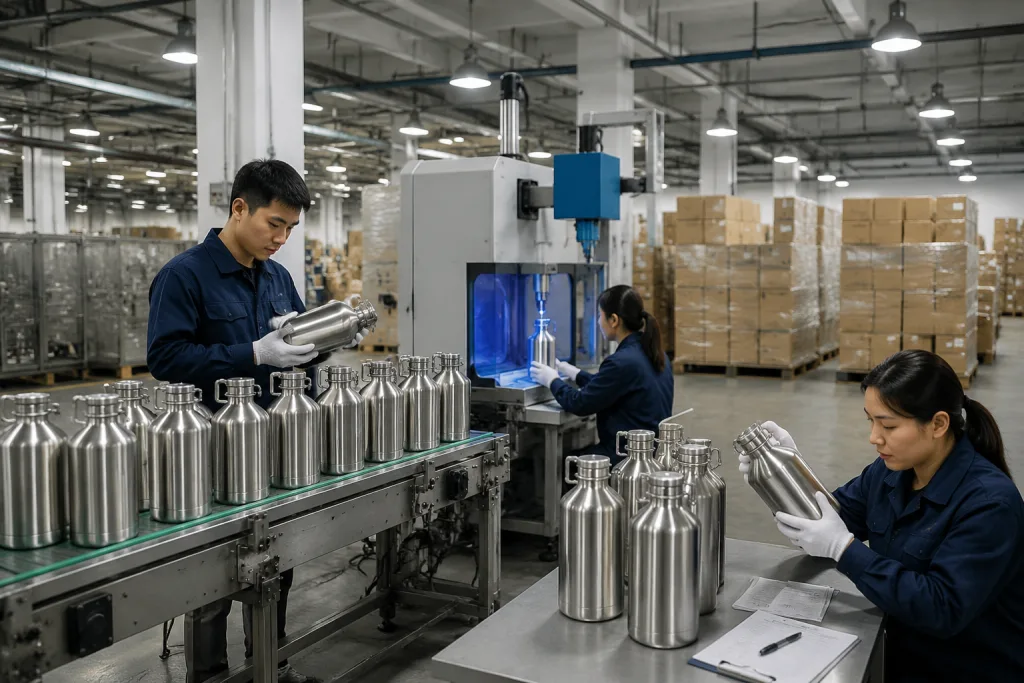
In China, especially around Zhejiang, we run into the same 3 requests every week: samples in 7 days, MOQ under 500 pcs, and gift-box packaging that looks ready for retail. The missing part is the use case. A growler for refill stations is not built the same as a custom growler for gift sets or a customizable growler for e-commerce; once capacity, finish, and compliance are fixed, the line can quote cleanly and we ship with fewer surprises.
Start With The Use Case
Before you compare prices, pin down the job of the growler. This is the wrong question to ask first: “What is your cheapest 64 oz?” A brewery promo piece sitting behind the bar, a distributor growler sold at retail, and an event giveaway all run through different decisions on wall thickness, cap fit, carton drop test, and logo position. We run a 0.5 mm feeler gauge around the cap seat during sample review because a “looks fine” lid can still leak after three closures. Decide first: display item, refill container, or carry vessel built for repeat use.
Most B2B programs land on 32 oz or 64 oz. The 32 oz size packs cleaner for mailers, 12 pcs per inner carton is common, and it keeps freight under control when the buyer is shipping gift kits. The 64 oz format feels closer to a classic beer growler and matches what beer buyers expect on a retail shelf. We had one PO typo last year where “32 oz” became “64 oz” after artwork approval; QC pulled the sample before mass production, but the carton dieline was already wrong by 18 mm. If you are building a wider custom drinkware line, the same buyer may also take a canteen custom or canteen customizable piece for outdoor or gym retail, so keep the bottle body, lid color, and finish family consistent.
Watch the neck, closure, and handle geometry before you fall in love with the artwork. A wide mouth fills faster on the line, but the cap can look cheap if the top surface is thin or the thread flashes after polishing. A swing-top closure is easy to sell in photos, while a threaded cap with a silicone seal gives better repeat closure control when the customer opens it 30 times. We test gasket compression with a simple caliper check, usually looking for 0.8 mm to 1.2 mm squeeze after tightening. For distributor drinkware, shelf presence matters as much as function; we have seen buyers flag a handle gap that looked uneven even when the bottle passed leak testing.
- Choose 32 oz for lower freight, mail fulfillment, and gift kits under tighter carton limits.
- Choose 64 oz when the buyer wants the classic retail growler feel and stronger shelf weight.
- Lock the closure type before artwork, because cap diameter changes the printable safe area.
- Ask for a pre-production sample with the exact lid and gasket, not a “similar” stock cap.
If you source both a custom growler and a customized canteen from the same canteen supplier, align the use case first and the cost model second. The math doesn’t work when the sales team quotes a light event giveaway for a refill program that needs repeat closure control. On our side, we mark the sample tag with channel, MOQ, lid code, and target carton weight before quoting, because one missing lid code can turn a 12-day sample into 18 days.
Material Drives The Margin
Material choice is where 7 out of 10 quoting mistakes start on growler projects we see. Stainless steel is the safer default for a promotional products beer growler because it handles dents better, feels more premium in hand, and gives the buyer a cleaner reorder path. For a stainless body, 18/8 or 304 stainless is the standard buyers should ask for. Wall thickness usually sits around 0.5 mm to 0.7 mm for single-wall builds, and we check it with a digital thickness gauge before the line moves to polishing. A double-wall vacuum version makes sense when the brief includes cold beer sitting in a car trunk for 3 hours.
Glass still has a job. It looks closer to the old brewery counter style, and taprooms that fill on site often like seeing the liquid level. The pack-out gets touchy fast: last April QC pulled 12 cracked necks from a 500 pcs pre-shipment lot after a 60 cm carton drop, and the buyer flagged the inner divider spec. If you ship through Amazon, distributor warehouses, or mixed pallets, stainless cuts breakage risk and return claims. The math doesn't work if the carton saves USD 0.18 but creates 3% damage.
From the factory side, 26 Zhejiang and China canteen manufacturers we know run growlers, custom canteen orders, and other customizable drinkware on shared body-forming and coating lines. That helps because the tooling, powder booth, and AQL 2.5 inspection routine are already set. A solid canteen manufacturer should tell you whether the body is single-wall or insulated, the shell thickness in mm, and whether the finish is powder coating or raw metal. Ask for the answer in writing. We once had a PO typo saying “matt pain,” and production held the sample 2 days until the buyer confirmed matte paint.
Buy the material around the channel, not the catalog picture. If the product will be carried, dropped, and reclosed, stainless usually beats glass on landed cost.
For cold retention, ask for a fill test, not a loose hours claim. We run it with 4°C water, a calibrated probe, and a room at 25°C; a decent vacuum growler might read 8°C after 12 hours, while a thin single-wall body is already near room temperature. The lid seal matters. So does the neck. If the silicone gasket is 0.3 mm undersized or the thread has burrs from trimming, the buyer will see leaks before they see any “premium” branding.
Decoration Must Survive Handling
Decoration is part of durability. A logo that flakes after 5 wash cycles makes even a cheap custom growler look bad, and the buyer flags it fast. On our line, we check the coating with a cross-hatch knife before we release the batch. For stainless steel, laser engraving is usually the safest choice because it cuts the surface and does not depend on ink sticking. If the customer wants a two-tone look, laser on a coated body is the cleanest compromise.
Silk screen works when you need tight color control and a clean unit price, especially on larger flat panels. UV print and heat transfer handle detailed art and multi-color jobs better, but they need tighter control at the jig and oven. For a customized growler used in retail or brewery gifts, full-wrap graphics can work if the file is set up right and the artwork stays clear of a seam or a deep curve. We have seen a 1 mm shift turn a sharp wrap into scrap.
Ask the canteen factory for the actual decoration method, not the effect name. A canteen custom program can run the same logo file four different ways, and the wear result changes a lot between laser, pad print, screen print, and transfer. If you already buy from canteen manufacturers, you know the logo approval step matters more than the mockup. This is the wrong question to ask: "Does it look good?" The better question is, "What will still look good after 30 hand washes and a truck ride?"
- Use laser engraving for repeat wash durability.
- Use screen print for simple spot-color branding.
- Use UV or transfer print for full-color retail graphics.
- Always approve Pantone values, logo size, and placement on a physical sample.
If the buyer is a canteen distributor or a distributor growler program, ask for one print test on a production body, not on a smooth sample cup. That shows how the logo behaves on the real curvature and coating, and we have seen that test save a 500-piece order more than once.
Price, MOQ, And Lead Time
After the spec is locked, pricing stops being a guessing game. For a standard promotional products beer growler made in China, a simple stainless version with one-color branding usually sits around FOB USD 2.80 to 5.20, based on capacity, body thickness, and cap style. We run the quote off a 0.5 mm or 0.6 mm body sheet, then check the cap gasket cost separately because buyers often miss that line. Glass looks cheaper on the first sheet, but the math doesn't work if the 5-layer export carton needs foam inserts and QC starts finding corner chips after the drop test.
MOQ depends on how standard your request is. On a normal factory line, 300 to 500 pcs is realistic for a stock body with basic logo work. Custom color, unique packaging, or a special closure can push you to 1,000 pcs. A Zhejiang canteen factory with around 80,000 units per month will usually quote short runs if the finish is standard and the carton spec is simple. We ship small lots like this, but only when the logo film, Pantone number, and barcode file are clean before the pre-production sample. If the supplier says 100 pcs is fine for everything, ask where the real cost sits: sample fee, setup charge, or air freight.
Lead time is usually 25 to 35 days after sample approval for a standard production order. Add 7 to 10 days for sample confirmation if the art needs revision. File errors burn days. Last month QC pulled the sample because the PO said matte black, but the artwork sheet had PMS 426C with a gloss varnish note. For a seasonal promotion, lock the print file early and leave room for carton testing, especially when the program includes distributor drinkware with retail-ready packing.
Freight changes the landed margin fast. A 64 oz stainless growler packed in an individual box can ride well by sea, but air freight can double the unit cost. We usually quote FOB Ningbo or FOB Shanghai first, then compare sea freight and DDP after the approved sample is weighed on the 30 kg bench scale. This is the wrong place to chase a cheap unit price if the carton size pushes the shipment into a bad CBM count.
Compliance For Europe And North America
Compliance is where a sharp buyer spots the difference between a real factory and a trading layer. For Europe, ask for REACH and LFGB if the growler touches beer or any other beverage. For the United States, ask for FDA food contact confirmation and California Proposition 65 screening when the logo coating, paint, or liner calls for it. If the program uses coated handles, printed bodies, silicone gaskets, or colored lids, cover each part; our QC desk has rejected reports that tested only the 304 stainless shell while the buyer’s PO listed a black powder-coated lid.
A food-safe sentence on a quotation is not enough. Ask for material declarations, test reports, and batch traceability tied to the exact model number. A BSCI audit helps with social compliance, and ISO 9001 shows the plant has a quality system, but neither replaces product testing. We run into this every season: the buyer sends a 2022 LFGB report for a 64 oz growler, then the order is for a 1.9L wide-mouth version with a different gasket. The math does not work. A serious canteen supplier in Zhejiang or elsewhere in China should tell you which lab ran the test, the sample date, and whether the report matches the item on your PO, typo included.
For incoming inspection, use AQL 2.5 for major defects and 4.0 for minor defects unless your own vendor policy is stricter. On a growler, major defects usually mean leakage, coating failure, incorrect capacity, or a lid that does not seal. We test leakage on the line with a torque wrench and 100% water fill for promo orders over 3,000 pcs, because one loose thread can turn into 200 wet cartons. Minor defects are usually cosmetic, such as a 1 mm logo scratch or a small dust point under coating. If you are selling through a distributor canteen program or retail channel, define these limits before mass production so the factory knows what gets rejected.
If the packaging is part of the offer, test it too. A tight carton spec with inner support and drop protection cuts loss faster than a prettier gift box. We ship growlers through 3 warehouses often enough to know this goes sideways when the insert is 2 mm too thin or the master carton is under 5-ply. Ask for a drop test, carton dimensions, gross weight, and photo record before mass packing starts.
Spec The Order Clearly
The cleanest quote starts with one spec sheet, not a logo file and “64 oz growler” in the email subject. We need capacity, 304 stainless or other body material, wall thickness in mm, closure type, finish, logo position, Pantone colors, pack-out, and selling market. Our sales desk still sees 7 RFQs a month where the PO says “black logo” but the artwork is Pantone 426 C, and the buyer flags the pre-production sample after silk screen setup is already done. Say it upfront if the logo goes on both the bottle and the color box. If the same program includes canteen customized and customized drinkware items, use one master template so the cap color, warning label, and approval photos match across SKUs.
For a canteen manufacturer, a clear file usually cuts 1 or 2 revision rounds. That is not small. One artwork revision can move sampling from 12 days to 18 days once the UV printer queue is full and QC pulled the sample for a lid torque check. If the campaign includes a customized canteen or custom canteen, align carton size, barcode position, and master carton count. We ship smoother when the warehouse can receive 24 pcs per carton across the line instead of 18 pcs for one item and 30 pcs for another. We have seen this go sideways on promo launches.
- State the exact fill capacity in ounces and milliliters, measured to the usable fill line, not just brim capacity.
- Specify stainless grade, lid type, and gasket material, including 304 stainless if that is the buyer requirement.
- Confirm decoration method and proof approval rules, including who signs off on laser, silk screen, or powder-coat logo placement.
- Define carton count, master carton size, and pallet limits, with max kg per carton if your 3PL has a rule.
- Ask for compliance documents before mass production, not after, especially FDA or LFGB files for drink-contact parts.
A direct factory should give straight answers on capability, MOQ, and lead time. If a vendor only sends catalog photos and says “no problem” to every finish, the math does not work. For promotional products beer growler orders at 1,000 pcs or 5,000 pcs, you need a canteen vendor that can repeat the same weld line, powder coating color, and carton marking on reorder, not just win approval with one polished sample from the sample room.
Request Your Custom Growler Quote Today
Send capacity, logo file, target market, and compliance needs. We will return FOB pricing, sample timing, and packaging options within 24 hours.
Frequently asked questions
What is the best size for a promotional products beer growler?
For most B2B programs, 64 oz is the default because buyers recognize it immediately and it gives you better perceived value. If your channel is mail order, event kits, or budget-led distributor programs, 32 oz is easier to ship and can cut carton weight by roughly 20% to 30%. In metric terms, 32 oz is about 946 ml and 64 oz is about 1.9 L. If the customer cares about premium feel, choose 64 oz stainless. If the customer cares about freight and bundle economics, 32 oz is usually the safer buy.
Should I choose stainless steel or glass?
Choose stainless steel if the product will be carried, shipped in volume, or used as a premium promo item. A 304 stainless body around 0.5 mm to 0.7 mm thick gives better impact resistance and lower breakage risk. Choose glass only when the buyer wants a traditional brewery look and can tolerate higher carton protection costs. For Europe and North America, stainless is usually easier to manage in distributor drinkware programs because returns from breakage are lower. If you need temperature retention, go with double-wall vacuum; if not, single-wall keeps MOQ and price lower.
What MOQ should I expect from a China factory?
For a standard custom growler, expect 300 to 500 pcs if the body is already in production and you only need a logo plus standard packaging. If you want a custom color, special lid, or retail box, 1,000 pcs is more realistic. A Zhejiang factory with stable output may produce around 80,000 units per month, but that does not mean every model is available at tiny quantities. Sample lead time is usually 7 to 10 days, and mass production is often 25 to 35 days after approval. Shipping time is separate.
Can I use full-color artwork on a growler?
Yes, but the method matters. For stainless steel, full-color print usually means UV print, heat transfer, or a wrap label on a coated surface. For glass, you can also use screen print if the artwork is simple. If you want a full-wrap design, keep the file vector-based, avoid tiny type below 3 pt, and expect a small cost increase, usually around 8% to 12% over a one-color decoration. For best durability, approve one physical sample and run a wash or rub test before mass production.
What should I prepare before asking for a quote?
Send the capacity, material, finish, closure type, logo file, Pantone colors, packaging requirements, target market, and any compliance needs such as FDA, REACH, or LFGB. If you sell on Amazon, include carton labels and FNSKU requirements at the start. If you need a distributor growler program, state whether the order is for retail shelves, brewery taprooms, or promotional kits. The more exact your file, the faster the quote. A good factory in China can usually respond with FOB pricing, sample timing, and packing options within 24 hours.