Key Takeaways
- For Britain promo orders, expect MOQ from 3,000 pcs for stock PP bottles and 10,000 pcs for custom mould colors
- A practical FOB China range is USD 0.55-1.45 per PP bottle depending on capacity, cap, print, and packing
- Ask for EU 10/2011, LFGB or REACH-related declarations, plus AQL inspection before shipment
- Normal production lead time is 25-35 days after artwork approval, excluding sea freight to the UK
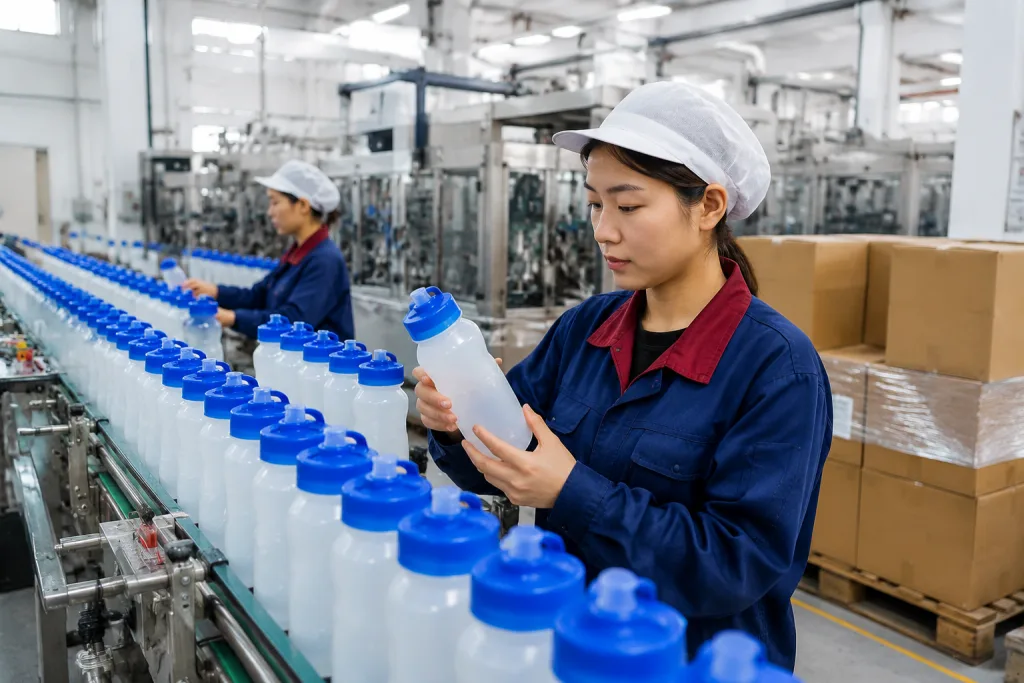
If you are buying a promotional polypropylene bottle Britain customers will keep, shape is the easy part. The harder job is locking food-contact paperwork, print rub resistance, carton strength, landed cost, and ship date before a cheap giveaway turns into a claims file. We run into this on 5,000–20,000 pcs promo jobs: QC pulled the sample after 30 tape pulls because the logo edge lifted near the 0.8 mm radius.
Polypropylene looks simple. It is not. A canteen supplier in Zhejiang may quote USD 0.72 FOB Ningbo, while another China canteen factory quotes USD 0.58 with thinner 1.1 mm walls, loose caps, and no UKCA-ready documentation. The buyer often asks, “Can we just match the lower price?” Wrong question. The math does not work if 3 cartons fail a drop test or the PO says 750 ml but the artwork brief shows 700 ml.
Start with the actual use case
A promotional polypropylene bottle Britain buyer usually comes to us with one of four jobs: 3,000 bottles for a school campaign, 8,000 for a weekend sports event, a workplace wellness kit, or a retail-style giveaway for a brand activation. Same shape on the PDF. Different risk on the line. Last month our sample room used the same 68 mm body mould for a school bottle and a gym bottle, but QC pulled the school sample because the cap tether snapped after 37 pull tests.
For a one-day race event, a 500 ml bottle with a simple push-pull cap and single-color silkscreen logo often works, and deleting the individual polybag can cut roughly 6 kg of plastic waste per 10,000 units. For a school or youth campaign, cap retention, bite-valve safety, odor control, and color migration testing matter more than shaving USD 0.03 from the quote. For a distributor drinkware program, we check repeatable Pantone color, barcode labels with 0.3 mm quiet-zone print tolerance, and master cartons that survive pallet handling in Britain. We have seen this go sideways when the buyer approved the bottle but forgot the Amazon-style carton drop test.
PP is popular because it is lightweight, lower cost than stainless steel, and more impact-resistant than many rigid clear plastics. Typical wall thickness is around 0.7-1.2 mm for a basic sports bottle, depending on capacity and mould design; on our Mitutoyo gauge, thin spots near the shoulder are where trouble shows first. The catch is simple. PP is not crystal clear, and cheap resin can feel waxy or show flow marks after injection. If you want a premium retail look, do not pretend a USD 0.60 PP bottle will behave like a double-wall stainless tumbler. The math doesn't work.
At BottleForge Industrial in Hangzhou, Zhejiang, we ask buyers to define capacity, cap style, logo method, carton limits, and compliance market before quoting. Our monthly output for plastic and metal drinkware programs is about 420,000 units, but a rushed custom drinkware order still creates risk; one PO came in with “PP sports battle” instead of “bottle,” and the cap color was missing. We ship better when the brief is boring and complete. The best canteen distributor is not the one who asks for the lowest price first; it is the one who explains how the bottle will be used, packed, stored, and handed out.
Material and compliance checks
Polypropylene drink bottles are usually marked PP with recycling code 5. For Britain and Europe, “food grade” on a quote is not evidence. Ask for a food-contact declaration tied to the exact PP resin, masterbatch color, gasket material, and use temperature. We run this check against the BOM line by line; last month QC pulled a PP sample where the cap liner was TPE, but the supplier declaration only covered the bottle body. UK buyers still ask for EU-style files because the labs, importers, and distributor QA teams are already set up around those test reports.
The file pack depends on the order, but for a normal promotional bottle project we ask for EU 10/2011 migration testing for plastic food-contact material, LFGB if the end customer is strict, REACH/SVHC declaration for chemical restrictions, and BPA-free statement if the artwork or listing says BPA-free. If the bottle is aimed at children, check whether ASTM or EN-related mechanical safety checks apply to the cap, spout, or strap. Small parts matter. We once had a buyer flag a 6 mm strap pin because it loosened after a drop test, even though the bottle passed migration. A canteen manufacturer that cannot explain these documents clearly is not ready for serious distributor canteen business.
Color causes trouble. Natural or white PP is safer because fewer additives sit in the food-contact system. Bright red, neon green, black, and metallic-effect masterbatch need closer checking, especially when the Pantone callout is written into the PO. A canteen customized with a special Pantone body color is not just a design choice; the colorant becomes part of the compliance file. If the order is 3,000 pcs, the line will often use stock color resin. For exact Pantone matching, the math usually starts at 10,000 pcs or more because the resin mill has its own MOQ and we need one clean purge run before molding.
Temperature claims need discipline. Many PP bottles can handle warm filling, but they are not vacuum flasks and should not be sold as boiling-water bottles unless the test report says so. This is the wrong place to be brave with marketing copy. We normally tell Britain buyers to specify “cold drinks and warm drinks up to 60°C” unless the lab report supports a higher figure. It sounds less punchy, but we have seen “boiling water safe” go sideways after a lid warped by 1.5 mm in a kettle-fill complaint.
Cost drivers beyond unit price
FOB unit price is one line on the costing sheet, not the landed cost. We see UK promo bottle POs look fine at first, then the buyer flags print screens, thicker export cartons, instruction inserts, pallet labels, SGS inspection, and Felixstowe-to-warehouse handling. A basic 500-650 ml PP sports bottle can sit around USD 0.55-0.85 FOB Ningbo or Shanghai for 5,000-10,000 pcs. A larger 750 ml or 1 L bottle with better cap, strap, measurement scale, and two-color logo may move to USD 0.95-1.45 FOB. Last month our carton scale showed 13.6 kg gross on a 100 pc master carton; the UK forwarder charged by volume anyway, so the “cheap” quote lost its shine fast.
Logo method changes cost and scrap rate. One-color silkscreen is still the lowest-risk choice on PP when we run flame treatment and check surface tension with a 38 dyn pen before printing. Multi-color silkscreen can work, but registration tolerance matters; skip tiny text below 6 pt on a curved bottle because QC pulled 32 samples from the line where the small charity URL blurred near the radius. Heat transfer looks cleaner for complex artwork, but we run 3M tape pull and 60°C water soak before signing it off. Laser engraving is the wrong question to ask for PP; save that for stainless steel custom growler or customized growler projects.
Packing is where quotes go sideways. Bulk pack in egg-crate dividers may be fine for a canteen promotional event, but retail distribution often needs individual kraft box, barcode, FNSKU label, or carton marks. A single kraft box can add USD 0.08-0.18 depending on paper gauge and print. For ecommerce, ask for the drop-test rule before you approve the lowest carton; we had one Amazon buyer reject a 3-layer B-flute carton after a 76 cm corner drop split the tape seam. The math doesn’t work if you save USD 0.04 and then repack 8,000 pcs in the UK.
Tooling is usually not needed for a standard customizable canteen shape. If you want a new bottle profile, a custom cap, or embossed body grip, tooling can range from USD 2,000 to USD 8,000 for common PP blow or injection components. That makes sense for a 30,000 pc annual program, not for a one-off 2,000 pc giveaway. On our floor, a new cap insert means CNC electrode work, T0 samples, and at least 12 days vs 18 days if the first trial leaks at the silicone gasket. A practical canteen vendor should say no when customization is commercially silly.
MOQ and lead time reality
For stock PP bottle shapes, we run a practical MOQ of 3,000 pcs per color with one logo. Some canteen suppliers will take 1,000 pcs, but the unit price goes up and the line gets pushed behind larger runs. For custom resin color, MOQ is commonly 10,000 pcs per color because the injection team must purge the barrel and match the Pantone chip under a light box. For a new mould, the first production run is often 20,000 pcs or more because the factory needs to cover mould fitting, trial shots, and QC checks on wall thickness in mm.
Lead time starts from final artwork and deposit, not from the first inquiry email. We see buyers get this wrong. A normal schedule from our Zhejiang team is 3-5 days for quotation and artwork layout, 5-7 days for pre-production sample if needed, and 25-35 days for mass production after approval. Peak months before summer events can add 7-10 days. Sea freight to the UK may take 30-45 days port-to-port depending on route and congestion; last May, a Felixstowe booking sat 6 days before vessel release.
About 6 in 10 Britain promotional buyers underestimate artwork approval time. If your client spends two weeks debating whether the logo should be 38 mm or 42 mm wide, the factory cannot hold the original delivery date. For distributor drinkware orders, set a hard artwork freeze date and put it in your purchase order. We have seen this go sideways when the PO says “blue bottle” but the email chain says PMS 286C. Agree whether approval is based on a digital mockup, photo sample, or physical sample. Physical samples are safer, but they cost time and courier fees.
Payment terms change the schedule too. For new buyers, 30% deposit and 70% before shipment is normal in China. Letter of credit is possible for larger orders, but it adds bank cost and paperwork; our bank usually asks for one extra document check before release. If a canteen manufacturer offers loose terms on a first order, ask what is being traded away. The math doesn't work unless the quote hides margin elsewhere or production is being subcontracted without control.
Branding choices that survive use
Promotional bottles fail in public when the logo scratches off on day 6, the cap seeps in a gym bag, or the blue lands two Pantone steps away from the buyer’s campaign guide. We specify branding like an engineering line item, not a decoration wish list. The buyer usually flags the photo first.
For PP, silkscreen printing with surface treatment is still the regular route we run. Ask the canteen factory whether they use flame treatment or corona treatment before printing, and ask for the dyne pen reading after treatment. Below 38 dynes, ink adhesion on PP gets risky. QC pulled one sample last month where untreated PP passed the showroom photo but failed a cross-hatch tape test after 24 hours of curing. For heavier use, request a 3M 600 tape pull test and a 500 g abrasion rub test for 200 cycles on the printed area.
Logo size has to match the curve. On a 650 ml bottle, a safe single-side print area might be 70 x 90 mm, but we still check it against the actual body drawing in mm, not the catalogue render. Wraparound designs sell well in presentations and go sideways on the line if nobody agrees the seam tolerance, usually plus or minus 1.5 mm. If your artwork has fine gradients or small QR codes, ask for a print proof. A QR code below about 20 x 20 mm on a curved PP surface is the wrong question to ask if the buyer expects clean scanning at a trade show.
There is also a vocabulary problem. Buyers use canteen custom, canteen customizable, canteen customized, custom canteen, customizable drinkware, and customized drinkware to mean different things. In factory language, split these into four levels: stock product with logo, stock product with custom color, stock product with custom accessories, and new mould. Each level changes MOQ, sample time, and defect risk. We have seen a PO say “customized lid” when the buyer meant only a printed lid logo; that typo added 12 days vs 18 days to sample approval because tooling was quoted by mistake.
If your company also buys customizable growler or distributor growler lines, do not copy decoration standards from stainless steel. PP has different ink behavior, heat tolerance, and surface energy, so the math does not work the same. On our line, a stainless growler laser mark can pass AQL, while a PP bottle needs flame treatment, curing time, and a rub check before we ship. Treat it as its own product category.
Inspection before shipment matters
AQL inspection is not paperwork for the sake of paperwork. It catches fixable defects while the cartons are still in China, before we book the vessel out of Ningbo. For promotional PP bottles, we usually run general inspection level II with AQL 2.5 for major defects and 4.0 for minor defects, unless the buyer’s retail manual says tighter. Critical defects stay at zero. QC pulled 200 pcs from a 10,000 pcs PO last month and found 3 leaking flip caps on the sealing jig; that was cheap to fix on the line, expensive to argue about in Britain.
Major defects include leakage, cracked caps, strong odor, blocked spouts, wrong logo color, severe print peeling, sharp edges, carton quantity errors with the wrong inner pack count, and anything that makes the bottle unsafe or unsellable. Minor defects include small flow marks under 8 mm, light scratches outside the logo area, slight color variation within agreed tolerance, or print position shift of 1 to 2 mm. Define these before production. We have seen this go sideways when a PO says “blue logo” but the approved artwork is Pantone 2935 C and the buyer flags the shade after delivery.
A proper pre-shipment inspection covers carton count against the packing list, product count by inner bag, appearance under a 6500K light box, function test on caps and spouts, leak test, print adhesion check with 3M tape, barcode scan if applicable, carton drop review, and packaging verification. For leak testing, inspectors fill bottles to the marked capacity, invert them for 30 minutes, then apply light squeeze pressure by hand. It is not a laboratory test. It catches bad cap fit fast, especially when the injection mold parting line leaves a 0.2 mm burr on the thread.
Retained samples save arguments. Ask your canteen vendor to keep two signed production samples and send you two, with PO number, date, and carton mark written on the sample bag. If a dispute comes up in Britain six weeks later, everyone checks the same reference instead of zooming into phone photos. This matters for canteen distributors selling to 12 or 20 end clients, because the wrong question is “who is blaming whom”; the right question is whether the bottle matches the signed sample from the packing table.
At BottleForge in Hangzhou, Zhejiang, we keep inspection records by PO and carton mark, including AQL sheet, defect photos, carton weight, and the final packed quantity. China export work repeats every week, and repetition only pays when the records are clean. If your canteen manufacturers resist written QC criteria, expect arguments later; we have seen one buyer lose 18 days because the PO had a carton mark typo and nobody caught it before loading.
Choosing the right supplier
You do not need the biggest canteen manufacturer in China. You need a supplier that understands UK event dates, food-contact files, and why a 62g PP bottle feels different from a 48g cheap handout. Ask direct questions. We run into this every March: the buyer wants delivery before a London race pack-out, but the artwork approval sits for 6 days and the sailing schedule is already tight.
Useful questions include: What is your MOQ for stock color, and what is the MOQ for a custom Pantone color? Which food-contact report matches this exact PP resin, not a similar bottle from last year? What is the wall thickness in mm, and what is the bottle weight in grams? What cap leak test do you run, such as 30 minutes upside down after filling to 90%? Can you pack by FNSKU or client SKU? What is the carton size and gross weight? Which port is used for FOB? Can you support BSCI or ISO-related factory audit requests? QC pulled one sample last week because the cap thread was 0.3mm shallow; that is the kind of answer you want before placing 8,000 pcs.
Be careful with canteen vendors that only send a product photo and a price. A proper quote should list capacity, material, cap type, logo method, print colors, packing, carton quantity, MOQ, sample time, production lead time, FOB port, payment term, and quote validity. If you are comparing 5 canteen manufacturers, normalize the quote line by line before choosing. The cheapest offer often removes something you assumed was included, usually inner bags or a 1-color logo plate charge. We have seen this go sideways when a PO said “blue bottle” but the buyer expected Pantone 286C.
For repeat programs, treat the supplier as a production partner, not a search result. Share your annual forecast, target ship windows, and compliance expectations with real dates, such as artwork by 5 April and shipment by 26 April. A canteen distributor with 4 seasonal campaigns can often get better pricing and priority than a buyer who hides volume until the last minute. Same for buyers ordering custom drinkware across PP bottles, stainless bottles, glass bottles, and custom canteen items. On the line, we can reserve injection machine time 12 days ahead; asking 3 days before mass production starts is the wrong way to buy.
Britain buyers can source safely from China, but only if the purchase order is specific. Put the boring details in writing: resin grade, Pantone color, logo size in mm, packing method, testing standard, inspection level, and shipping terms. Boring paperwork is cheaper than replacing 8,000 leaky bottles after the event date has passed. The math does not work. One missed cap gasket in a 100 pcs pre-shipment check is a warning, not a small issue.
Send your PP bottle brief for a factory quote
Share capacity, quantity, logo, packing, and delivery date. We will return a practical FOB China quote with MOQ and lead time.
Frequently asked questions
What MOQ should I expect for a promotional polypropylene bottle Britain order?
For a standard stock mould, expect 3,000 pcs per body color with one logo print. Some factories in China may accept 1,000 pcs, but the unit price can rise by 15-35% and production priority is weaker. For a custom Pantone body color, 10,000 pcs is more realistic because resin and color masterbatch setup have minimum batch sizes. If you want a new cap or bottle mould, plan for 20,000 pcs or more on the first run, plus tooling cost.
Is polypropylene safe for UK promotional drink bottles?
Polypropylene can be safe for drink bottles when the resin, colorant, and cap components are tested for the intended use. Do not rely on the phrase “food grade” alone. Ask for EU 10/2011 migration testing, REACH/SVHC declaration, BPA-free statement if needed, and any LFGB report your customer requires. For children’s campaigns, review cap size, straps, and bite valves for mechanical risk. Also specify the temperature range, such as cold drinks and warm drinks up to 60°C, unless testing supports hotter filling.
How long does production and shipping to Britain take?
A normal PP bottle order takes 25-35 days for mass production after artwork approval and deposit. Add 5-7 days if you need a physical pre-production sample. Sea freight from Ningbo or Shanghai to a UK port often takes 30-45 days port-to-port, before customs clearance and inland delivery. Air freight is possible for urgent campaigns, but it can cost more than the bottle on low-value promo items. For event orders, build a 10-day buffer.
Which logo method works best on polypropylene bottles?
One-color silkscreen is usually the safest and most economical method for PP bottles. It works well for bold logos, simple campaign text, and print areas around 70 x 90 mm on many 650 ml shapes. Multi-color silkscreen is possible, but registration tolerance and curved surfaces limit fine detail. Heat transfer can handle more complex graphics, but adhesion must be tested. Ask for surface treatment before printing and run a tape pull test after curing.
Can I use one supplier for PP bottles and other custom drinkware?
Yes, but check whether the supplier actually controls those categories. A good custom drinkware partner may coordinate PP sports bottles, stainless thermos bottles, glass bottles, and a custom growler line, but the QC points are different. PP needs ink adhesion and leak checks. Stainless steel needs vacuum performance and rust checks. Glass needs thermal shock and breakage packing. Ask for category-specific inspection criteria, not one generic QC sheet for every product.