Key Takeaways
- Plan 1,000-3,000 units MOQ per SKU for most stainless promotional drinkware orders
- Ask for LFGB, REACH, and food-contact declarations before approving artwork
- Use laser engraving for 5,000+ handling cycles; use screen print for strong campaign color
- Budget 30-45 production days plus 30-38 sea freight days to Hamburg or Bremerhaven
If you buy promotional drinkware for Germany campaigns, finding a bottle is the easy part. The risk sits in LFGB paperwork, logo rub tests, carton marks, delivery windows, and landed cost after EU duty plus inland freight. We have seen a USD 0.18 cheaper lid fail migration testing, then QC pulled 80 cartons for rework because the buyer’s PO had “Hamburg” typed as “Hambrug” on the side mark. Cheap is not always cheap.
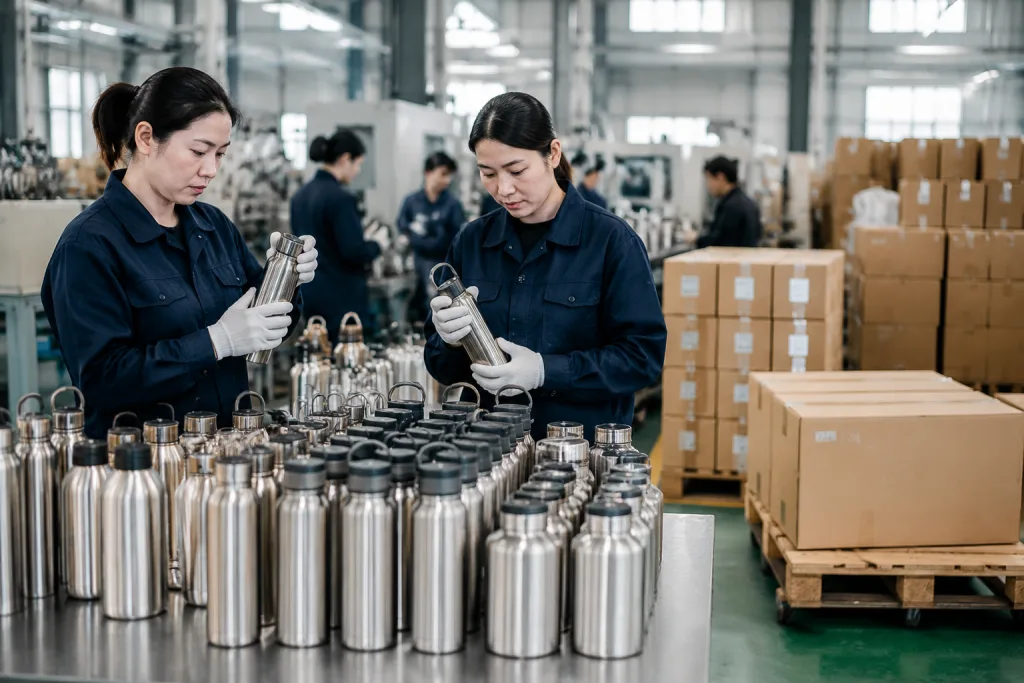
BottleForge Industrial works from Hangzhou, Zhejiang, and exports custom drinkware for distributors, agencies, and brand owners. Our Zhejiang production partners can handle about 450,000 stainless steel units/month, with typical MOQ from 1,000 units per SKU and 30-45 days lead time after sample approval. On the line, we check powder coating with a cross-cut tester and run logo adhesion before mass packing; one German buyer flagged a 2 mm logo shift on a pre-production sample, and he was right to do it. You need fewer surprises, not prettier promises.
What German Buyers Usually Miss
German promotional programs look clean on a spreadsheet: quantity, color, logo, delivery date. The trouble sits behind those four cells. We ship for trade fairs in Köln, employee onboarding packs, automotive dealer kits, and beverage giveaways where the handout date is fixed by the event hall, not by the factory. If the product lands 14 days late for a Messe order, it is not late stock. It is dead stock. We have seen 3,000 bottles miss a Monday dealer launch because the PO said “mat black” and the approved sample was matte black, so QC pulled the sample and stopped the line for half a shift.
For promotional drinkware Germany orders, start with the use case. A 500 ml vacuum bottle for office gifts does not run the same spec as a 1.2 L custom growler for beer retail. A 750 ml sports bottle for events takes more lid abuse than a custom canteen sold through outdoor clubs. Wall thickness, lid material, coating type, print process, and carton strength all move with the handling route. We normally check body thickness with a digital caliper at the rim and base; 0.38 mm versus 0.45 mm looks small on paper, but the dent rate changes fast once cartons get stacked 6 layers high.
New buyers often ask for the lowest FOB Ningbo price first. Wrong first question. The better RFQ asks for 304 stainless steel inner wall, 201 or 304 outer wall, powder coating grade, leak test method, AQL inspection level, packaging, master carton dimensions, HS code, and compliance documents. Push for test details too: do they run 100% air pressure leak testing, or only random water filling on the packing table? On one Germany quote, the buyer flagged a 0.18 USD gap, but the cheaper factory used thinner cartons and no PE bag; the math did not work after 2.7% transit scratches.
Separate a canteen promotional campaign from retail-grade customized drinkware early. Promotional goods can be cost-efficient, but they still need food-contact safety and branding that survives handling. Retail packaging, barcode labels, FNSKU stickers, and German instruction sheets add cost and time. If you are a canteen distributor or distributor drinkware buyer, decide whether the shipment goes to one warehouse or several fulfillment centers before artwork approval. Amazon-style prep is another route. We run different carton marks, pallet height limits, and inspection timing for each route; a 1.6 m pallet might pass a forwarder check, then get rejected by a fulfillment warehouse dock.
Choose The Right Product Format
There is no universal best bottle. For Germany promo buyers, this is the wrong question to ask; start with gift value, who carries it, and whether they refill at a desk, in a car, or on a train. Stainless steel vacuum bottles are our safest corporate-gift format because they feel solid in hand, hold temperature for 6-12 hours, and take laser engraving cleanly on a rotary jig. A standard 500 ml double-wall bottle with 0.4 mm inner wall and 0.5 mm outer wall usually sits in the best cost-performance band; QC pulled the sample last week and checked the mouth ID at 43.2 mm before we approved the lid fit.
A canteen custom order fits outdoor, school, military-style, hiking, and festival programs better than a desk bottle. Define the shape first. The word canteen can mean a round military canteen, a flat hip-flask style bottle, an aluminum hiking bottle, or a stainless single-wall bottle with carabiner cap. Send a drawing or a physical sample if you have one, because we have seen this go sideways when a PO says “canteen” and the buyer expects a flat body while the factory quotes a round mold. A canteen customizable project with a silicone sleeve, compass cap, or textile strap may require a new component MOQ of 3,000-5,000 pieces, and the line will need a separate sleeve gauge to control stretch within 1.5 mm.
Growlers are not just bigger bottles. A custom growler or customized growler, usually 1.0 L to 2.0 L, needs stronger sealing and better pressure awareness if used for carbonated drinks. We normally recommend swing-top or threaded lids only after testing with the actual beverage use; plain water tests miss gas pressure, and the math doesn't work if 2% leak in a retail display. For one German craft beer buyer, QC flagged foam residue under the gasket after a 24-hour upside-down test, so we changed the silicone ring hardness before mass production. A customizable growler for craft beverage promotion can look premium, but freight cost per unit is higher because the carton volume is large.
- Office campaigns: 350-600 ml vacuum bottles or travel tumblers, usually packed 24 pcs per export carton for easier warehouse handling.
- Sports events: 650-1,000 ml single-wall bottles with carry loop, with lid torque checked on the line before packing.
- Outdoor promotions: customized canteen formats with matte coating, especially when the buyer wants a less glossy retail look.
- Beverage retail: distributor growler programs with stronger cartons, often 5-layer boxes after drop-test feedback.
If you are comparing canteen manufacturers, ask whether the canteen factory has existing molds. Existing molds keep tooling at USD 0-300 for logo plates or accessories. New body molds can run USD 1,500-6,000 and add 20-30 days. We run this check before quoting because one typo on a PO, such as “750 ml” instead of “700 ml,” can push the job from an existing mold into new tooling.
Compliance For Germany And EU
Germany is not the market for guessing on compliance. For stainless steel drinkware, ask for food-contact files on the 304 stainless body, PP or Tritan lid parts, silicone seals, powder coating, and printed ink when the logo touches a drinking area. We usually see 4 documents on a clean RFQ: LFGB test report, REACH SVHC screening, BPA-free declaration for plastic parts, and heavy-metal check for coating or ink. Big retailers ask for more. Last March, QC pulled a powder-coated tumbler sample from the line because the ink supplier name on the report did not match the PO; the buyer flagged it before booking inspection.
ASTM fits North American programs more often. European buyers look first at LFGB and REACH, then EN 14350 when the item is for children. Kids bottles are not adult bottles with cute artwork. This is the wrong question to ask. Pull-force, detachable small parts, straw design, cap ventilation, and German-language packaging warnings all affect approval. On one 350 ml kids bottle, our lab jig recorded a straw valve coming loose under a 70 N pull test, so we changed the lid mold before the buyer paid for retail cartons.
Factory social compliance also comes into the quote. BSCI, Sedex, or ISO 9001 audits are not magic shields, but procurement teams use them as a starting line. BottleForge Industrial, based in Zhejiang, China, can quote from audited production lines when your retailer or distributor canteen program requires it. Tell us at RFQ stage, not after the deposit. Switching factories after sample approval wastes 10-15 days, and we have seen this go sideways when the PO says “BSCI factory only” in line 18 but the artwork approval already went to a non-audited line.
For inspections, we recommend AQL Level II for most promotional orders, with critical defects at 0, major at 2.5, and minor at 4.0. Critical checks include leaks, sharp edges, odor, wrong material, wrong logo, and carton marking errors. AQL is not a promise that every unit is perfect. It is a sampling rule. On a 5,000-piece Germany-bound order, SGS may open 200 cartons and QC may reject the lot if 1 critical leak shows up on the vacuum leak tester. Pre-shipment inspection is cheaper than arguing after arrival in Bremen or Hamburg.
Logo Methods And Real Durability
Decoration is where a 3,000 pcs promotional drinkware Germany order either feels like a proper brand gift or like stock we rushed through Line 2 on Friday night. Unit price is the wrong first question. We choose the logo process by surface curve, artwork line width, packing abrasion, and how the cup will be washed or handled after delivery.
Laser engraving is still our safest option on stainless steel. It cuts through the coating or marks the metal, so there is no ink layer to peel; on our 20W fiber laser, we normally reject artwork with strokes under 0.25 mm because the edges start to close up after scaling. Use it for one-color logos, small legal text, and premium corporate gifts. Color is the trade-off. On powder-coated bottles, the logo usually comes out silver stainless or a darker burn mark, depending on coating thickness and the laser speed we run.
Silkscreen printing keeps cost under control for simple logos and 2,000 pcs+ runs. It works cleanly on straight cylindrical bottles when the print width stays inside the safe wrap area; once the artwork gets too wide, the squeegee pressure starts showing distortion near the curve. For curved canteen customized bodies, setup takes more care. Heat transfer and water transfer can handle gradients, but abrasion is where we have seen this go sideways, especially after cartons rub during sea freight. UV print gives sharp color on small panels, though we do not like it for dishwasher claims unless the buyer approves extra testing.
For German B2B buyers, we run a practical test set before mass production: 3M tape pull, 500-cycle rub test, alcohol wipe, and a 24-hour water soak around the printed area when the logo sits near the mouth or lid. QC pulled one sample last month where the print looked fine, then lifted after the alcohol wipe. If the item will go retail, add dishwasher testing only when you plan to print “dishwasher safe” on the pack. Do not make that claim casually; the math does not work if returns start at 2%.
For most 1,000-5,000 unit campaigns, one-position laser engraving or one-color silkscreen gives the best balance of cost, speed, and failure control.
For customized drinkware with multiple logos, number every artwork position in the tech pack. “Logo on front” is not enough. We need size in mm, distance from bottom, Pantone code, and facing direction: toward the drinker or outward for shelf display. One PO came in with “front logo” typed twice for opposite sides, and pre-production stopped for 12 hours while the buyer confirmed the layout.
MOQ, Pricing, And Lead Time
MOQ is not one number. It changes with body shape, color, finish, and packaging. For standard stainless bottles, practical MOQ is often 1,000 units per SKU for existing colors and 3,000 units for custom powder coating. On our line, a color change means cleaning the spray booth, swapping powder, and checking the first 20 pcs under a D65 light box. For a custom canteen with existing mold, 2,000 units is usually workable. For a new lid, strap, or body mold, expect 3,000-5,000 units minimum because component factories also have their own MOQ. Asking for 500 pcs with a new PP lid is the wrong question to ask; the mold shop will not even open the tool file.
FOB China pricing varies with steel grade, capacity, lid structure, coating, and logo method. As a working reference, a 500 ml double-wall stainless bottle may quote around USD 3.20-5.80 FOB Ningbo at 3,000 units. A 750 ml sports bottle may range from USD 2.40-4.20 depending on single-wall or double-wall construction. A 1.9 L customized growler can sit around USD 7.50-12.50 because material weight and carton volume are both higher. QC pulled one 1.9 L sample last month at 612 g before coating, and the buyer flagged carton CBM after seeing 6 pcs per export carton. These are not promises; they are sanity checks for budget meetings.
Lead time works best in stages. Digital mockup is usually 1-2 days. Pre-production sample is 7-12 days for existing molds and standard decoration. Bulk production is 30-45 days after sample approval and deposit. Sea freight from Ningbo or Shanghai to Hamburg or Bremerhaven often takes 30-38 days port-to-port, then add customs clearance and truck delivery. We run sample approval with a signed PPS label, Pantone code, and logo position measured in mm, because one PO typo like “mat black” instead of “matt black” can cost 3 days of back-and-forth.
If you are a canteen vendor or distributor growler buyer working on a fixed event date, build backward from the date. A safe Germany schedule is 90-110 days from RFQ to warehouse for sea freight. Air freight can rescue small urgent orders, but drinkware is bulky. Paying USD 3-6 extra freight per bottle often destroys the promotional budget. The math doesn't work on a giveaway bottle. The better fix is approving samples within 24 hours, locking artwork before deposit, and not changing the gift box after the line has printed the first 1,000 sheets.
How To Vet China Suppliers
China has over 2,000 drinkware exporters on Alibaba and Global Sources, but only a smaller group controls the line. Some are trading companies with clean English and 3 borrowed factory photos. Some are solid factories that still send messy export documents, like a PO where “Hamburg” was typed as “Hamberg.” Neither one is automatically a problem. The real check is whether your canteen vendor can run the order from CAD drawing and steel spec through LFGB files, logo proof, inner box packing, AQL 2.5 inspection, and vessel booking.
Ask blunt questions. What is the monthly capacity for this exact item: 80,000 pcs or 300,000 pcs? Which steps are under your roof? Is powder coating sprayed on your own line with a 60–80 μm film gauge reading, or sent to a nearby coating shop? Can you show material certificates for 304 stainless steel? What AQL standard do you use? Can you send carton drop test photos from 76 cm? How many units fit in a 40HQ container? A serious canteen factory answers with numbers, photos, and test names, not “good quality.”
For German distributor programs, communication discipline matters as much as the weld. If a canteen supplier cannot lock Pantone, logo size in mm, EAN-13 barcode format, and carton marks in one production file, the buyer will flag it later. We run a simple approval chain: quotation with item code, artwork proof, sample approval, signed order confirmation, production file, mid-production photos, pre-shipment inspection, shipping documents. Boring is good. QC pulled one sample last month because the carton mark missed the campaign code by 1 digit, and that is exactly the kind of small miss that delays a promo launch.
Do not chase five quotations with loose specs. This is the wrong question to ask. Send the same RFQ sheet to every canteen vendor: capacity in ml, 304 stainless steel thickness, finish type, logo process with print size, retail box style, LFGB or FDA test requirement, Incoterm, delivery port, and target delivery date. If one price is 18% lower than the rest, check the steel grade, wall thickness, lid material, gasket smell, and inspection scope. We have seen this go sideways: a quote looked cheap because the supplier removed the individual polybag and changed the lid from PP to PS without saying it.
BottleForge Industrial in Hangzhou, China, works as an export sales engineering team, not just a catalog sender. If a design is risky, we say so before sampling, even when the buyer wants a quick render for Friday. A 0.4 mm wall on a tall canteen looks nice on screen, but the math does not work after vacuum forming and polishing. Saying no early saves both sides sample cost and 12 days of back-and-forth.
Packing And Shipping To Germany
Packing is not glamorous, but it decides whether your promotional goods arrive sellable. For bulk promotional drinkware, we run the usual setup as one bottle in a 0.03 mm polybag or tissue wrap, then white box or egg-crate divider, then 5-layer export master carton. For retail customized drinkware, plan the color box, German manual, EAN barcode, recycling marks, importer address, and plastic-free packing if the buyer’s ESG team asks for it. QC pulled a sample last month because the “Grüner Punkt” mark was missing on 3 box artworks. Small miss. Big delay.
Germany buyers should lock carton marks before mass packing starts. Include item number, PO number, quantity, gross weight, net weight, carton size, and destination warehouse code if the receiving site uses one. For marketplace or fulfillment shipments, FNSKU or SKU labels need a clean scan from 30 cm and the same position on every carton. Do not leave label placement for the warehouse to guess. We have seen this go sideways when a PO had “WH-BER01” typed as “WH-BRE01” and 86 cartons were relabeled by hand.
Carton strength matters because drinkware is heavy. A 24-piece carton of 500 ml stainless bottles can weigh 9-13 kg, and the line will feel it when cartons start bulging after taping. For growlers, carton quantity may drop to 6-12 pieces to avoid crushed boxes. We normally recommend 5-layer export cartons for heavier canteen promotional orders and palletization when the German receiving warehouse requires it. Pallets add cost and reduce container loading efficiency, but they cut handling damage. The math does not work if you save USD 0.18 on a carton and lose 40 gift boxes at inbound inspection.
Incoterms should match your logistics setup. FOB Ningbo or FOB Shanghai works well if you already have a forwarder. CIF Hamburg looks easy on paper, but destination charges need checking line by line before you approve the PI. DDP Germany works for certain promotional campaigns, but confirm VAT handling, importer of record, and documents before production starts. If you are new to China sourcing, FOB is the cleaner first step because the cost split is visible. One buyer flagged a EUR 420 “documentation fee” after arrival; at that point, nobody enjoyed the call.
Before shipment, request final photos of product, logo, inner packing, master carton, pallet if used, and container loading. It takes the supplier about 1 hour with a phone, a tape measure, and the carton scale. It can prevent 30 days of arguments. We ship smoother when the buyer signs off photos before the container door closes.
Send Your German Drinkware RFQ For Review
Share quantity, deadline, logo, compliance needs, and delivery port. We will flag cost risks before you pay for samples.
Frequently asked questions
What MOQ should I expect for promotional drinkware Germany orders?
For standard stainless steel bottles, expect 1,000 units per SKU if you use an existing mold, existing coating color, and one-position logo. Custom powder coating usually starts at 3,000 units because the coating line needs minimum batch efficiency. A canteen customized project with a special strap, lid, or silicone part may need 3,000-5,000 units. For a custom growler, MOQ is often 1,000-2,000 units if the mold exists, but carton volume makes smaller orders expensive. If a supplier offers 100 units at factory pricing, check whether it is stock decoration rather than true factory production.
Which compliance documents are needed for Germany?
For Germany, ask for LFGB food-contact test reports on the product or similar material family, REACH SVHC documentation, BPA-free declaration for plastic parts, and coating safety reports if the surface is painted. For children’s drinkware, add age-grade review and relevant child safety checks. Large retailers may also request BSCI, Sedex, ISO 9001, or their own restricted substance list. Reports should show the tested material, not just a random bottle from three years ago. If you change lid plastic, silicone seal, coating, or ink, the old report may no longer cover the final product.
Is laser engraving better than silkscreen printing?
Laser engraving is better for durability and a premium look on stainless steel, especially for corporate gifts handled for several years. It does not peel, and it avoids Pantone matching disputes. Silkscreen printing is better when your campaign needs a strong color logo, large visual impact, or lower cost at 1,000-10,000 units. For powder-coated bottles, both can work. For curved custom canteen bodies, artwork distortion must be checked on a real sample. If the product may go through dishwashers, do not assume any decoration is dishwasher safe unless the supplier tests it and you approve the result.
How long does shipping from China to Germany take?
For sea freight, plan 30-38 days port-to-port from Ningbo or Shanghai to Hamburg or Bremerhaven under normal conditions. Add 3-7 days for factory delivery to port, export customs, and vessel loading, plus 3-10 days for import clearance and inland truck delivery in Germany. Production usually takes 30-45 days after sample approval. A realistic full timeline is 90-110 days from RFQ to German warehouse if you need sampling, bulk production, inspection, and sea freight. Air freight can arrive in 5-10 days, but drinkware volume makes it costly.
Can one supplier handle bottles, canteens, and growlers together?
Yes, but check whether the supplier is managing compatible production lines. Stainless vacuum bottles, single-wall canteens, and growlers can share some processes, but lids, welding, polishing, leak testing, and packing may differ. A canteen manufacturer may not be strong at vacuum insulation, while a bottle factory may not have good growler lids. For mixed custom drinkware orders, we recommend one export team controlling several qualified production lines, with one inspection plan and one shipping file. MOQ still applies per SKU, color, and logo, so combining categories does not automatically reduce minimums.