Key Takeaways
- Plan 1,000 units per color as a realistic MOQ for custom stainless drinkware
- Ask for REACH, LFGB, food-contact documentation, and AQL inspection terms before deposit
- Laser engraving is stable for premium gifts; silk screen is better for large flat logo color
- FOB China lead time is normally 30-40 days after artwork approval, not after first email
If you buy promotional drinkware deutschland programs, finding bottles is the easy part. The hard part is locking the details that decide whether the campaign ships on time, passes EU checks, and matches the signed mockup. We have seen this go sideways: a buyer approved a low quote, then QC pulled the sample and found 0.38 mm body steel instead of the quoted 0.45 mm, powder coating that scratched under a 3M tape pull, and cartons that split after a 76 cm distributor drop test.
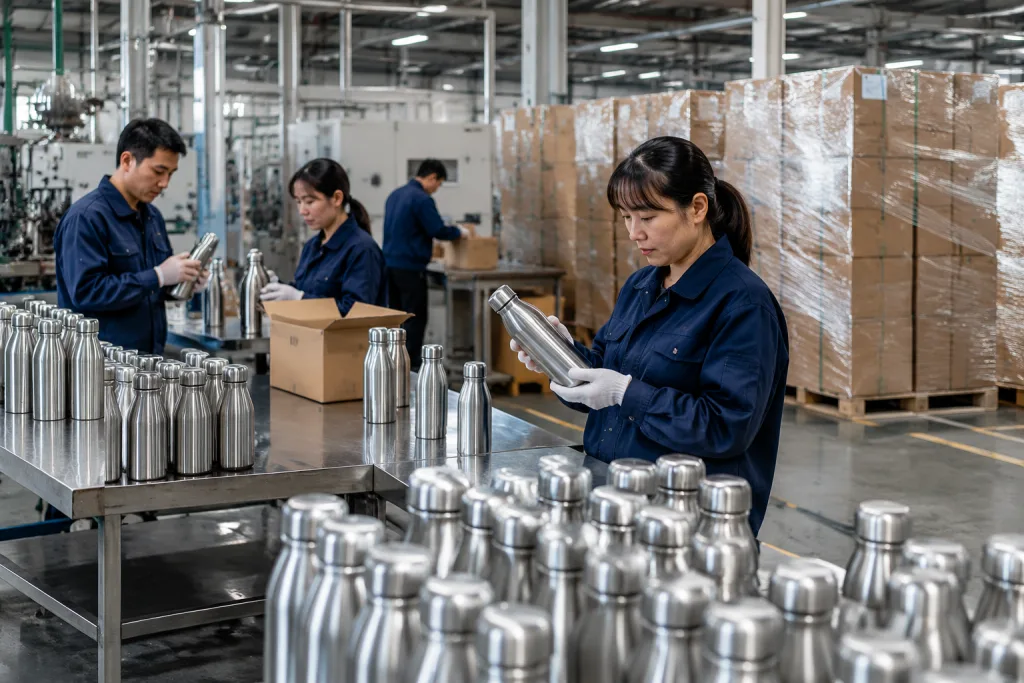
BottleForge Industrial manufactures custom drinkware in Hangzhou, Zhejiang, and we ship from China to European and North American buyers. For a normal stainless bottle project, our MOQ starts at 1,000 units per color, sample lead time is 7-10 days, and mass production is usually 30-40 days after deposit and artwork approval. On the line, we run calipers, color cards, and a torque gauge before packing; one German PO last month even had the Pantone code typed as 186U instead of 186C, and the buyer flagged it before the first logo film was made.
Start with the real use case
German promotional buyers often send us a PO line that says “bottle with logo.” Too thin. A canteen factory, or any serious canteen manufacturer, cannot build a clean quote from that. Start with the channel: 3,000 pcs for a Messe giveaway is a different job from 800 pcs for an employee onboarding kit, and both are different from a paid outdoor club item. Last month QC pulled a pre-production sample where the buyer’s brief missed the lid color; the artwork said black, the PO said silver.
For a low-cost event handout, a 500 ml single-wall stainless bottle with 0.45-0.50 mm body thickness can pass if the buyer accepts a lighter hand feel. For a corporate gift that must feel solid, we run double-wall vacuum stainless steel, 304 interior, 201 or 304 exterior, and a wall thickness around 0.40 mm per layer. For a distributor drinkware program sold through regional dealers, packing matters more than buyers first think: straight walls and standard caps keep master cartons under 15 kg, which warehouse teams actually like handling. The math doesn't work if a fancy shape adds 0.08 cbm per 100 pcs.
If you are comparing custom canteen, custom growler, or travel tumbler options, write the brief in commercial terms: target FOB price and target retail or campaign value, order volume with split by color, lid type with leakproof requirement, decoration method with logo size in mm, packaging, delivery date, and compliance market. A canteen supplier in Zhejiang can quote accurately with those details. Without them, most canteen vendors quote the cheapest similar item and wait for revisions. We've seen this go sideways when the buyer flagged “wrong gift box” after mass production, but the original file only said “individual box.”
For promotional drinkware deutschland orders, I would rather see a buyer choose one proven model in three colors than five new molds with unclear demand. Tooling for a fully customized bottle body can run USD 2,000-8,000 and add 20-30 days. For most campaigns, customized drinkware using an existing mold is faster, cheaper, and less risky. On our line, an existing 750 ml mold can move from logo approval to mass production in about 12 days vs 18 days for a revised cap insert, before sea freight even enters the schedule.
Materials that matter in Europe
For Germany and the wider EU, material choice is not just about how the cup feels in hand. It is a compliance risk. For stainless steel drinkware, we specify 304 stainless on the inner wall, and QC checks it with an XRF gun before mass production starts. Some budget canteen factories use 201 stainless on the outside shell to cut cost by about USD 0.18-0.35 per piece. That can work if it is declared and the surface is protected well. Do not allow 201 on the liquid-contact side. The math doesn't work if one failed food-contact test blocks a 2,400 pcs shipment in Hamburg.
Plastic parts catch buyers out. Lids, straws, gaskets, and handles can involve PP, Tritan, silicone, ABS, or TPE, and each one needs a clear material line on the BOM. Ask your canteen supplier for material declarations and test scope before you approve production; we have seen POs where “silicon” was typed instead of “silicone,” and the buyer flagged it during document review. For EU distribution, common requests include LFGB food-contact testing, REACH SVHC screening, BPA-free declaration for plastic parts, and sometimes German packaging law data from the importer side. Get the paperwork before the deposit, not after the line is packed.
Paint and coating cause more complaints than steel thickness. Powder coating usually gives better hand feel and scratch resistance than basic spray paint, but it costs more. On a 1,000-3,000 unit order, the difference may be USD 0.25-0.60 per unit depending on bottle size and color. We run a 3M tape test and check coating thickness around the shoulder, usually 60-80 μm for powder coating. If the bottle will go into field sales kits or outdoor promotions, pay for powder coating. For a short exhibition campaign, spray paint is often enough. We’ve seen this go sideways when the buyer saved USD 300 and then rejected 11 cartons for scuffed matte black bottles.
For a custom growler or customized growler, check the cap seal like you mean it. A 1.9 L growler carries more liquid weight and puts more leverage on the lid during transport, especially when cartons are stacked 5 layers high. We normally run leak tests, vacuum retention checks, and random torque checks during production in China; QC pulled the sample at 8 N·m last month because the cap thread felt loose. Put those checks into the purchase order. An email note is too easy to miss when production is already on the line.
Decoration choices and hidden limits
Logo decoration is where about 4 out of 10 promotional drinkware orders start to drift. A flat PDF looks clean, then QC pulls the sample from the line and the same logo breaks over a curved bottle shoulder, ribbed body, or 80-micron powder-coated surface. For customizable drinkware, we usually run laser engraving or silk screen for simple branding, then heat transfer, UV printing, or full-wrap sublimation when the artwork needs photos, gradients, or edge-to-edge coverage on coated blanks.
Laser engraving lasts. It looks premium on 304 stainless and powder coating, but this is the wrong question to ask if the buyer wants exact Pantone color; engraving gives metal or coating contrast, not ink color. A normal logo engraving area might be 40 x 60 mm on a 500 ml bottle. Larger engraving is possible, but the math changes fast because machine time rises from 18 seconds to 42 seconds per piece on our fiber laser. Silk screen printing works better for a one-color or two-color logo at lower cost. Expect around USD 0.08-0.18 per color per position for simple screen printing at normal MOQ.
Heat transfer and UV printing handle complex artwork, gradients, or multi-color graphics, but they punish lazy files. Send vector artwork, Pantone references, exact print size, and placement tolerance before sampling; “logo centered” on a PO is not enough, and we once had a dealer reorder delayed 12 days because “60mm” was typed as “90mm.” For distributor canteen or distributor growler programs, I prefer one standard decoration zone across models, such as 35 x 55 mm front center with ±1.5 mm tolerance. Reorders stay cleaner that way.
Do not approve a canteen customized sample under office light only. Check it under daylight, photograph it beside the Pantone card, then rub the printed area with a dry cloth and a wet cloth. For serious customized canteen orders, use 3M tape adhesion checks and alcohol rub checks as part of your internal approval. We’ve seen this go sideways when a buyer skipped the rub test and flagged peeling after goods reached Hamburg; a good canteen vendor will not object, because those tests prevent arguments later.
MOQ, price, and payment reality
“Can we do 100 units?” We hear this at least 8 times a month. Yes, but the math doesn’t work for a direct China factory order. At 100 pcs, you are buying decorated stock through a trader or a local print shop in Germany, not running a canteen line in Hangzhou. For direct production, we run 1,000 units per color for stainless steel bottles and tumblers, 3,000 units for custom plastic parts, and 5,000 units or more for a new cap color matched in PP or Tritan material. Last month QC pulled a 100 pcs inquiry where the setup cost for the laser jig was higher than the bottle value.
FOB China pricing depends on size and specification. As a working range, a 500 ml single-wall stainless bottle may run USD 1.80-3.20 FOB. A 500 ml double-wall vacuum bottle may run USD 3.20-5.80 FOB. A 1.2 L insulated sports jug or custom growler can move into USD 6.50-12.00 FOB depending on lid structure, handle tooling, powder coating, and carton CBM. These are not promises. They are guardrails. If one quote is 28% under the other 3 suppliers, check wall thickness in mm, 304 stainless grade, and whether the carton passed a 60 cm drop test.
For promotional drinkware deutschland programs, first-order payment terms are normally 30% deposit and 70% before shipment. Repeat importers with clean payment history may get 20/80 or balance after pre-shipment inspection, but open account from a new canteen manufacturer in Zhejiang is the wrong question to ask. The factory pays for steel coils, lids, color boxes, master cartons, and line labor before your customer receives one bottle. We once had a PO typo showing “Net 60” instead of “TT before shipment”; the buyer flagged it, and we stopped material booking until both sides corrected the PI.
At BottleForge Industrial, our monthly capacity is about 600,000 units across stainless bottles, travel tumblers, and sports bottles. Capacity only helps when the schedule is real. China drinkware export peak season runs March to August, and the line fills fast after Canton Fair inquiries land. If you need delivery in Germany before September events, artwork should be approved no later than late June for sea freight; late approval can turn a 12-day decoration slot into 18 days once the powder coating booths are full. We ship better when the buyer locks artwork, barcode files, and carton marks in one clean approval round.
Compliance and inspection before shipment
For EU buyers, compliance belongs before the line starts, not when cartons are already sitting in Hamburg or Duisburg. Ask every canteen supplier for food-contact test reports that match the actual material set on your PO. A report for another lid or another silicone gasket does not cover your order. If your bottle uses a new PP lid, test that lid. If the coating changes from powder coat to rubber paint, confirm the coating chemistry before we run the first 300 pcs color trial. QC pulled a sample last month where the gasket was 0.6 mm thinner than the approved drawing; that is exactly the kind of change that makes an old report useless.
Common documentation for Germany includes LFGB food-contact testing, REACH SVHC declaration, BPA-free statement where plastic is used, and sometimes BSCI or social audit information from the factory. Some buyers also request ISO 9001 process documents. Fair request. The wrong question is “can you send everything after balance payment?” The math doesn’t work if shipment is booked for Friday and the buyer asks Tuesday night for a missing REACH file, a signed BPA-free letter, and the factory audit page with the address matching the PI. We’ve seen this go sideways over one typo on a PO: “Hangzou” instead of “Hangzhou,” then the forwarder asked for a corrected document pack.
Use AQL inspection terms in the purchase order. A practical level is AQL 2.5 for major defects and 4.0 for minor defects, with critical defects at 0. Critical defects include unsafe sharp edges, contamination inside the bottle, serious leakage, wrong material, or carton labeling that blocks customs or warehouse receiving. Major defects include wrong logo size, poor print adhesion, visible dents, lid mismatch, or vacuum failure. Minor defects include small coating specks within an agreed visual limit, for example 1 speck under 0.5 mm outside the logo area. On the line, we check rim burrs with a cotton wipe and run a 30-minute inverted leak test after lid assembly; if cotton catches on the mouth edge, the sample fails.
For Amazon or marketplace-related promotional kits, add barcode and labeling rules. FNSKU labels, suffocation warnings for polybags, carton marks, and mixed-SKU packing need checking at pre-shipment inspection. We ship these kits often, and the buyer usually flags label position first: 10 mm too close to the carton seam is enough to scan badly after strapping. A good canteen distributor should care about this because rework in Germany costs more than inspection in China; opening 80 cartons in a warehouse near Cologne is not cheaper than catching the issue at our packing table.
Shipping to Deutschland without surprises
Shipping is where the cheap unit price starts lying. Drinkware eats space, especially insulated bottles packed in gift boxes. A 500 ml vacuum bottle in a color box may pack 24 pieces per master carton, with carton dimensions around 48 x 33 x 28 cm and gross weight near 10-12 kg. On our last 500 ml run, the line used a 5-ply K=A carton and QC measured 47.8 x 32.6 x 28.4 cm after taping. For air freight, volume weight can beat actual weight, so the math doesn't work if you only compare EXW unit prices.
For Germany, most B2B buyers choose FOB Ningbo or FOB Shanghai when sourcing from Zhejiang, China. Sea freight to Hamburg is the cleaner route for orders above 3,000 units, but do not cut the calendar too tight. Factory production may take 30-40 days, vessel transit may take 30-38 days, and customs plus inland delivery can add 5-10 days. We had one buyer flag this after their PO said “Hamburg by 18 May” while artwork approval landed 12 April. Too late. If your campaign date is fixed, count backward from the event date, not from the quotation date.
Rail freight from China to Europe works when sea freight misses the window and air freight kills the margin, but space and price move week by week. Air freight fits samples, urgent top-up orders, or 200-500 cartons when the distributor has enough margin to absorb it. For distributor drinkware and distributor growler programs, we run split shipment often: 5-10% by air for launch stock, then the balance by sea. Last quarter, QC pulled 36 cartons from a rush air lot because the buyer changed the barcode on the PO but forgot to update the carton label file.
Packaging needs to be written on the PO, not guessed in the packing room. Bulk pack is cheaper and works for local kitting. White box or kraft box is common for promotional drinkware. Full-color gift box adds cost and carton volume; we have seen a 420 ml tumbler jump from 36 pcs/carton to 24 pcs/carton after the buyer approved a 350 gsm printed box. If cartons go to several canteen distributors, ask for neutral carton marks plus customer SKU stickers. Warehouse teams do not enjoy opening 300 identical brown cartons with a cutter just to find the right logo.
How to brief a factory
A clean RFQ saves back-and-forth and stops the factory guessing. Send one file with model type, capacity, material, color, decoration method, logo file, packing, quantity by color, destination port, compliance requirements, and target delivery date. We prefer it in Excel, not five WhatsApp screenshots. If you ask 4 canteen suppliers to quote, use the same brief for all 4. Otherwise you end up comparing a 304 stainless bottle with a 201 stainless bottle and call it a price gap. The math doesn’t work.
For canteen promotional work, add photos of the real use case if you have them: event booth, employee kit, retail shelf, or outdoor club merchandise. We run better checks when we know where the bottle will sit. QC pulled one 750 ml sample last month with a carabiner cap that looked smart in the render, but the hook punched the gift box during a 1.2 m drop test. A matte white coating looks clean on a sales deck, then shows black rub marks after 2 cartons slide across a warehouse floor. A narrow mouth can cut cost by a few cents, but if a 35 mm bottle brush cannot fit, the buyer will hear about it from end users.
Sampling should cover the product and the decoration. A blank sample checks hand feel and lid function, but it does not prove your logo prints cleanly on a curved wall. For customized drinkware, approve a pre-production sample or at least a decorated sample panel before mass production. On our line, we check logo position with a simple height gauge and record the print area in mm, because “centered” means different things to a designer and a pad-printing operator. For canteen customizable programs with repeat orders, keep one signed golden sample at the factory and one in your office.
Assign one person to approve artwork. We have seen 9-day delays because marketing, procurement, and the distributor all sent separate comments, including one PO where “Pantone 286C” was typed as “268C.” The factory needs one final file, one final Pantone callout, and one written approval. Simple rule. Not glamorous. That discipline is how promotional drinkware deutschland orders ship on the booked vessel instead of turning into 12 emails about whose PDF was correct.
Send your drinkware brief for a factory quote
Share quantity, logo, deadline, and destination. We will reply with MOQ, FOB price, lead time, and compliance options.
Frequently asked questions
What MOQ should I expect for promotional drinkware deutschland orders?
For direct factory production in China, expect 1,000 units per color for most stainless steel bottles and tumblers using existing molds. Plastic color matching, custom caps, or new accessories often need 3,000-5,000 units. If you need only 100-300 pieces, a local decorator or distributor canteen source may be more practical, but the unit price will be higher. For a first B2B order, I suggest testing one model in 1-3 colors rather than spreading 1,000 units across too many SKUs.
Which decoration method is best for a German corporate gift?
For a premium corporate gift, laser engraving on powder-coated stainless steel is the safest choice. It is durable, clean, and does not depend on ink adhesion. If you need exact brand colors, silk screen or UV printing is better, but you should confirm Pantone references and run adhesion checks. For a 500 ml bottle, a 40 x 60 mm logo area is usually reliable. Very large curved prints need more testing and may require heat transfer instead of screen printing.
Can you make a fully customized canteen shape?
Yes, but it only makes sense at the right volume. A new stainless bottle body mold can cost around USD 2,000-8,000 and add 20-30 days before production. A custom plastic lid or handle can require higher tooling and longer testing. For most promotional campaigns, a customized canteen using an existing mold, custom color, logo, and packaging is the better route. Fully custom shapes are better for long-term retail lines or annual distributor drinkware programs.
What compliance documents should I request for Germany?
Ask for LFGB food-contact testing, REACH SVHC documentation, BPA-free declaration for plastic parts, and material declarations for stainless steel, silicone, PP, Tritan, or other components. If your company requires social compliance, request BSCI or similar audit information early. Make sure reports match the actual item you buy, especially the lid and gasket. Put AQL 2.5 major, 4.0 minor, and critical defects at 0 into the purchase order so inspection standards are clear.
How long does production and shipping to Germany take?
For an existing mold with custom logo, sampling normally takes 7-10 days. Mass production is usually 30-40 days after deposit and final artwork approval. Sea freight from Ningbo or Shanghai to Hamburg often takes about 30-38 days, plus customs and inland delivery. A safe total schedule is 75-95 days from confirmed brief to warehouse arrival. Air freight can save time, but drinkware is bulky, so costs rise quickly on orders above a few cartons.