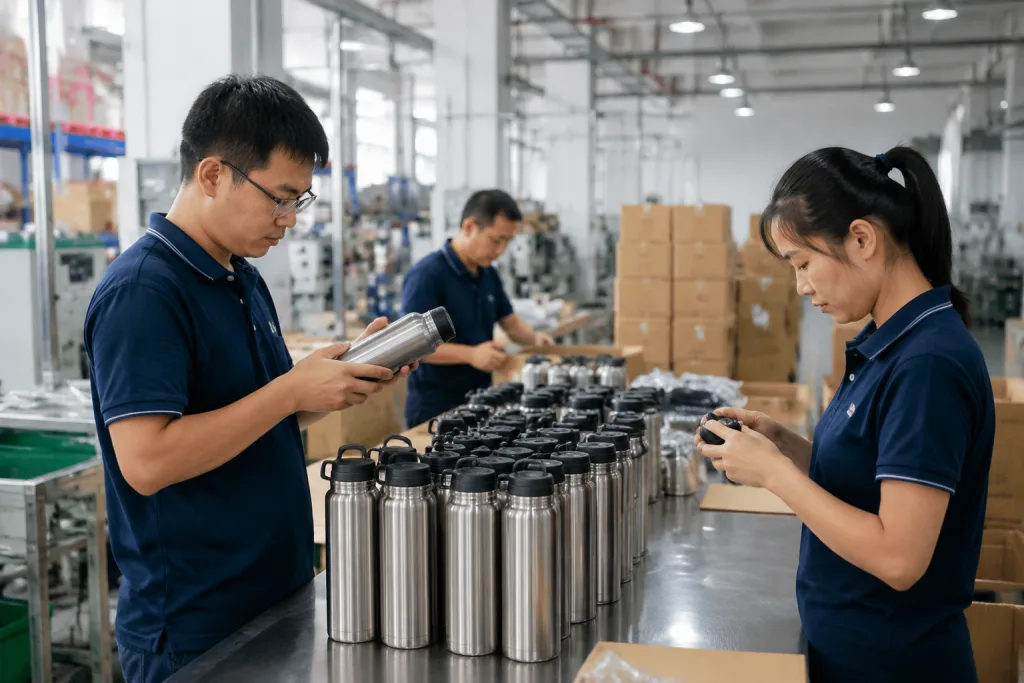
Key Takeaways
- Plan 30-45 days for standard OEM production after sample approval
- A practical first MOQ is 1,000-3,000 units per color for most custom drinkware
- Use AQL 2.5/4.0 inspection for function, appearance, and packaging checks
- Logo method, lid tooling, carton strength, and compliance documents affect real landed cost
A promotional drink bottle looks simple until the PO says 5,000 units, the retail launch date is fixed, REACH paperwork is due, the logo must sit within a 0.5 mm tolerance, and QC pulls 43 lids with weak thread bite during AQL 2.5 inspection. The bottle shape is usually not the problem. Vague specs, target prices that leave no room for proper sealing parts, and skipping the pre-production sample check are where we’ve seen orders go sideways.
At our Hangzhou, Zhejiang production base, we hear the same buyer questions every week: stainless or plastic, laser or print, factory or trader, FOB or DDP. The wrong question is “how much customization can we add?” For a first order, we run safer when the buyer locks the channel first: retail shelf, event giveaway, corporate gift, or Amazon carton-drop test. Last month a North American buyer flagged a PO typo that changed the lid color from PMS Black C to plain black, and that small line would have cost 12 days vs 18 days if caught after line setup.
Start With The Sales Channel
Do not open a promotional drink bottle project by asking for the cheapest bottle. That is the wrong question to ask. Start with the sales channel: corporate giveaway, Amazon FBA, retail shelf, or distributor catalog. Each channel changes the packing method, test plan, logo tolerance, and acceptable defect rate. Last month QC pulled a sample from line 3 because the pad-print logo shifted 1.2 mm; fine for an internal giveaway, not fine for a retail buyer staring at 24 bottles on a shelf.
For a one-time event, we run a stock body with silkscreen logo, 1-color carton mark, and 30-day lead time if the logo file is clean. For retail, plan on EAN or UPC barcode, hang tag, color box, 80 cm drop-test packaging, and a lid supply that will not disappear after the first PO. For an online bundle, FNSKU labeling, suffocation warning bags, and carton dimensions under the fee break matter because Amazon storage charges punish sloppy cartons. We have seen a 57 x 39 x 41 cm master carton get flagged because the PO said 57 x 39 x 14 cm. One typo, three emails.
Procurement managers often ask whether they should buy from a canteen supplier, canteen vendor, or direct canteen factory. The honest answer: if you need repeat orders and product changes, work as close to the canteen manufacturer as possible. If you only need 500 units for a local event, a domestic distributor canteen program can ship faster from stock. For 2,000-20,000 units, China direct sourcing gives you better control, but only when the specification sheet lists steel grade, coating code, logo size in mm, carton layout, and AQL 2.5 inspection level. Without that, the math does not work.
At BottleForge Industrial in Zhejiang, our typical monthly drinkware output is 450,000-600,000 units across stainless bottles, travel tumblers, sports bottles, and growlers. That scale helps when you need repeatable Pantone color, lid inventory, and carton consistency across three repeat POs. It does not replace clear AI or PDF artwork files, approved pre-production samples, and written testing requirements. The line can hold color, but it cannot guess whether your buyer wants 304 stainless or a lower-cost body until the spec says so.
Choose Materials Without Guesswork
Most promotional drink bottle projects we run end up in stainless steel, Tritan, PP, AS, aluminum, glass, or mixed construction. The material choice should follow the use case, not the buyer’s mood board. Stainless steel gives a higher shelf value and a service life we usually quote as 24-36 months under normal office use. Tritan works for clear sports bottles, especially when the buyer wants fruit infuser marks visible. PP is the budget pick for school campaigns and 10,000 pcs mass giveaways. Glass looks clean, but the math can turn ugly: our QC pulled 7 cracked samples from one 80 pcs drop-test carton when the insert tray was cut 2 mm too loose.
For stainless steel, ask for the grade and thickness, not just the capacity. A common vacuum bottle uses 304 stainless steel inner wall and 201 or 304 outer wall. Wall thickness often sits around 0.4-0.5 mm before forming, depending on shape. Thinner sheet can cut cost by a few cents, but dent resistance drops fast after spinning and stretching on the line. For corporate gifting, this is usually the wrong place to save money. We have seen buyers approve a 0.38 mm outer wall, then flag 23 dents during AQL 2.5 inspection because the bottle looked cheap under office lighting.
A custom canteen or customized canteen for outdoor promotions often needs a wider mouth, leak-resistant cap, and powder coating that survives normal abrasion. For a canteen promotional item used at festivals, a single-wall aluminum body may be enough, but do not market it as vacuum insulated. That claim gets buyers into trouble. A customizable canteen for retail outdoor channels should be tested for lid torque, strap pull, and coating adhesion; we run 3M tape cross-hatch checks and a 5 kg strap pull before packing. One PO last summer even had “vacuum aluminium canteen” typed in the spec line, and the buyer flagged it only after the pre-production sample landed.
For a custom growler or customized growler, capacity accuracy and sealing matter more than decoration. A 64 oz stainless growler with vacuum insulation uses more material and more carton space than a 500 ml sports bottle, so the FOB price and freight cost move quickly. A customizable growler can look profitable on paper, then lose margin because the carton only fits 12 units instead of 24. Big difference. On one 64 oz run, the empty carton hit 13.6 kg gross after adding molded pulp trays, and the forwarder billed by volume before the buyer noticed the freight line was 18% above estimate.
Branding Methods And Real Limits
Decoration is where about 2 out of 10 custom drinkware orders start to drift. A flat logo on a curved bottle is not the same as a logo on a paper brochure. We check logo height in mm, wrap angle, coating texture, and whether 0.25 mm lines will close up on the screen. QC pulled one sample last month because the buyer’s “thin leaf” icon turned into a black patch after curing.
Silkscreen printing is still the practical choice for 1-3 color promotional drink bottle orders, especially on straight cylindrical bodies. We run it with a mesh screen and a fixed jig, so repeatability is good when the bottle diameter stays within 0.5 mm. Laser engraving looks cleaner on 304 stainless and lasts longer, but it shows the base metal color, not your Pantone color. Heat transfer and water transfer handle full-color artwork, but the math gets worse once setup cost, defect sorting, and 12 days vs 18 days lead time are counted. UV printing works on some coated surfaces, but we still do a 3M tape pull test before approving mass production.
For canteen custom projects, we usually start with one logo position and one process unless the order is above 3,000 units. Simple wins. A canteen customized with 360-degree artwork can look good, but scrap risk jumps if the body has a seam, taper, or welded handle mount. We have seen this go sideways when the artwork crossed a 1.2 mm side seam and the buyer flagged a 3 mm registration shift. A canteen customizable program for distributors should use decoration methods that repeat across 4 or 5 SKUs without rebuilding every fixture.
Ask your canteen suppliers for a pre-production sample using the same coating, same logo process, and same lid color as mass production. A digital mockup is fine for layout, but it does not prove adhesion, registration, or color match. For Pantone colors, accept a workable tolerance, usually Delta E 2 to 4 depending on the surface. Powder coating and plastic injection will not match a paper Pantone chip perfectly under every light source, and this is the wrong question to argue after the PO is signed. We once had a lid color typo on a PO, “Black 6C” entered as “Black C,” and the line stopped for 6 hours while sales confirmed it.
MOQ, Price, And Tooling
MOQ is not a punishment; it is how the line runs. Before one bottle ships, we set coating line temperature, lock the silk-screen jig, confirm carton board, pull lid color chips, and write the QC checklist. For a standard promotional drink bottle with stock mold and custom logo, a realistic MOQ is often 1,000 units per color. For custom powder coating, 2,000-3,000 units is more practical because the spray booth loses about 6 kg of powder during color change and cleanup. For a new lid mold, expect tooling from USD 1,200-5,000 depending on thread structure, flip-top parts, and silicone gasket design.
FOB China pricing varies by material and specification. As a working range, a 500 ml single-wall stainless bottle may sit around USD 1.80-3.20 FOB Ningbo or Shanghai. A 500 ml vacuum insulated bottle may run USD 3.50-6.50. A 64 oz custom growler can move from USD 9.00 to above USD 18.00 depending on steel grade, handle type, cap design, coating process, and packaging. These are not promises. They are guardrails for early budgeting, the same way our cost sheet separates 304 stainless, powder coating, and 5-layer export carton before sales sends the PI.
If a canteen manufacturer quotes far below the market, ask what changed. Start with steel grade and wall thickness, then check coating adhesion, lid material, gasket hardness, carton strength, and inspection level. Last month QC pulled the sample after a tape test and the logo lifted on the second pull; that USD 0.22 saving was gone before mass production. Canteen manufacturers in China can produce sharp prices, but physics still applies. A bottle that must hold vacuum for 12 hours and survive export freight cannot be built like a disposable giveaway.
For distributors, a distributor growler or distributor canteen program should be priced with reorder logic. Saving USD 0.08 by using a nonstandard lid color is the wrong question to ask if the next reorder takes 20 extra days because the lid resin must be custom mixed again. We have seen this go sideways: the buyer flagged a PO typo for “navy PMS 2965” after we had matched “navy PMS 2956,” and the line sat idle for 2 days while the lid supplier rechecked chips.
Compliance For Europe And North America
Compliance is not a file you collect after production. It decides the steel grade, coating system, ink, lid resin, polybag text, and sometimes whether the factory can take the order at all. For the EU, buyers usually ask us for LFGB, REACH, and food-contact declarations. For North America, we normally check FDA food-contact conformity, California Proposition 65 review, CPSIA if children are involved, and ASTM testing for certain kids products. Kids items are not “small adult bottles.” Wrong question. On one 450 ml school bottle project, QC pulled the PP lid sample and the buyer flagged the silicone straw as a separate food-contact part, so we had to test it apart from the 304 stainless body.
BSCI, ISO 9001, and Sedex are not product safety certificates. They tell you how the factory is managed and whether social compliance will survive a retailer review. A canteen distributor selling to corporate clients in Europe often needs product test reports plus social audit documents in the same vendor pack. Public institution orders get tighter document checks; we have seen a €38,000 tender held because the audit name on the report used “Hangzhou” while the PO typed “Hanzhou.” Small typo. Big delay.
Test reports should match the actual material and coating. A 2021 report for a stainless bottle does not cover a new powder coating, new logo ink, or new plastic lid. For a canteen supplier in Zhejiang or elsewhere in China, ask for recent reports before you pay a deposit. That is fair. If new testing is required, budget 7-10 working days for lab turnaround after samples arrive, and add 1-2 days if the lab asks for extra coated panels from the line. We usually send 6 finished bottles and 3 loose lids by SF Express to the Shanghai lab.
Check packaging compliance too. Polybags may need suffocation warnings. Cartons need correct shipping marks, not just a logo and item number. Wood packaging, if used, must meet ISPM 15. We have seen this go sideways: 52 cartons passed bottle inspection, then warehouse receiving rejected the lot because the outer carton mark showed 24 pcs while the packing list said 25 pcs. The math does not work, and customs officers do not care that the bottle itself passed LFGB.
Quality Control Before Shipment
Build quality control into the production calendar, not after the vessel closing date. We run it as prototype sample, artwork sample, pre-production sample, mass production, internal QC, third-party inspection, then shipment. For standard custom drinkware, 30-45 days after sample approval is realistic; a 10,000 pcs order with laser logo and color box usually needs 12 days for coating, 3 days for printing, and 2 days for packing. Rush orders can ship, but the math often moves the risk from our line to your warehouse.
Use AQL inspection instead of a vague promise that “QC checked everything.” A common setting is AQL 2.5 for major defects and 4.0 for minor defects. Critical defects should be zero. Major defects include leaking, broken lids, wrong logo, poor vacuum performance, sharp edges, and serious dents; QC pulled one sample last month with a 0.8 mm burr on the mouth rim, and that carton was held. Minor defects include small coating specks, slight print variation, or carton rub marks within agreed limits.
For vacuum bottles and customized drinkware, inspection should cover leak testing, vacuum retention sampling, coating adhesion cross-cut test, logo rub test, lid fit, odor check, capacity check, and carton drop test where relevant. The line uses 3M tape for the cross-cut, a 60°C water fill for vacuum checks, and a digital scale for capacity spot checks. For a customized growler, focus on cap sealing, handle welding, base stability, and inner wall cleanliness; we have seen black polishing dust inside the shoulder after welding, and buyers flag that fast.
A good canteen vendor will not object to inspection. A weak canteen vendor may argue that inspection is unnecessary for promotional goods. That is the wrong question to ask. Promotional does not mean disposable, especially when your brand name is printed on every unit, and one PO typo on logo color can still turn into 5,000 rejected bottles if nobody checks the approved sample against the packing line.
Build A Repeatable Buying Program
Good buyers do not treat every promotional drink bottle order like a fire drill. They keep a 5-SKU approved range: a 600 ml budget bottle for giveaways, a 500 ml mid-range vacuum bottle for staff gifts, a 900 ml tumbler for retail promos, a custom canteen for outdoor programs, and one customized growler when beverage campaigns need higher perceived value. In our sample room, the fastest reorders are the ones with a signed golden sample and logo position marked in mm on the artwork sheet. No drama.
If you are a canteen distributor or one of several canteen distributors serving corporate accounts, ask your factory to hold a controlled component list. Lock the lid models by mold number, gasket material by hardness, coating code by Pantone or powder batch, carton strength by kg rating, and logo area by height and width. A canteen customizable range sells better when the choices are tight and repeatable. We have seen this go sideways when a buyer asked for “any sport lid that fits” and QC pulled the sample because the straw hole leaked during the 30-minute inversion test.
For distributor drinkware and distributor growler programs, review sales data every quarter. Cut slow colors. Keep the best two capacities. Standardize master carton size where the line can pack without changing inserts. If your MOQ is 1,000 units but you split it across five colors, the math does not work: setup cost rises, color matching takes longer, and inventory gets messy. Two colors at 1,500 units each usually works better than six colors at 500 units each, especially when a PO typo like “mat black” delays the coating shop for 2 days while everyone confirms matte black.
BottleForge Industrial in Hangzhou, Zhejiang supports OEM and ODM orders, but the cleanest projects start with the buyer sharing the target market, compliance requirement, packaging method, and reorder plan at the RFQ stage. Give us FDA or LFGB needs early, tell us if the bottle ships in a white box or color box, and say whether the reorder target is 3,000 or 30,000 units. A canteen factory can quote 60 versions. A serious canteen manufacturer pushes back and helps you choose the 6 options worth paying for.
Send your bottle brief for a factory quote
Share capacity, material, logo method, MOQ, target market, and delivery date. We will reply with practical options, not a vague catalog dump.
Frequently asked questions
What MOQ should I expect for a promotional drink bottle order?
For a stock mold with one logo, expect 1,000 units per color as a practical starting MOQ. If you need custom powder coating, special lid color, retail color box, or a canteen customized with multiple decoration areas, 2,000-3,000 units is more realistic. New mold development can require 5,000 units or more depending on tooling cost. Some China suppliers will accept 500 units, but unit price, setup cost, and defect risk usually rise. For a first B2B order, we often suggest one model, two colors maximum, and one approved logo method.
How long does production take after sample approval?
For standard custom drinkware, plan 30-45 days after written sample approval and deposit. Add 7-10 working days if new lab testing is required. Add another 5-7 days if retail packaging needs proofing and carton drop checks. A simple canteen promotional order using an existing bottle and silkscreen logo can sometimes finish in 25-30 days during a quiet season. Before Chinese New Year or peak summer export months, lead time can stretch by 10-20 days, especially for coating and lid injection capacity.
Should I use laser engraving or silkscreen printing?
Use laser engraving when durability matters and the bottle is stainless steel or powder coated. It resists washing and abrasion better than most print methods, but it will not reproduce Pantone colors. Use silkscreen printing when you need a clear brand color at lower cost, especially for 1-3 color logos. For a promotional drink bottle order below 3,000 units, these two methods cover most needs. Full-wrap heat transfer or UV printing is better for complex artwork, but you should approve a physical sample and test adhesion before mass production.
What documents should a canteen supplier provide?
At minimum, ask for a specification sheet, material declaration, recent food-contact test reports, and packaging details. For Europe, REACH and LFGB may be relevant. For the US, FDA food-contact conformity and Prop 65 review are common. If the bottle is for children, request CPSIA and applicable ASTM checks. If your client requires social compliance, ask for BSCI, Sedex, or ISO 9001 documents early. A serious canteen supplier in China should tell you which reports are current and which need retesting for your exact coating, ink, lid, or gasket.
How do I compare quotes from canteen vendors fairly?
Compare quotes only after the specification is equal. Check capacity, steel grade, wall thickness, lid material, gasket type, coating, logo method, packaging, carton quantity, FOB port, inspection terms, and payment terms. A USD 0.20 lower quote may disappear if the carton is weaker, the coating is thinner, or the logo is priced separately. Ask each canteen vendor to quote the same MOQ, such as 1,000 and 3,000 units, so you can see the price curve. For repeat business, also ask about reorder lead time and component availability.