Key Takeaways
- Plan 3,000 pcs MOQ for most stainless promotional bottle programs; 1,000 pcs is possible on selected stock molds
- FOB China pricing can move 8-15% depending on lid structure, coating, carton spec, and logo process
- Use AQL 2.5/4.0 inspection plus REACH or LFGB migration tests when selling into Europe
- Allow 35-45 days production after artwork approval for customized drinkware with color coating
If you search for promotional drink bottle american, you likely need a bottle that looks shelf-ready, hits the vessel date, and passes compliance after customs clearance. Finding a bottle is easy. Matching 304 stainless or Tritan, the logo process, carton strength, and FDA/LFGB paperwork to a real promo budget is where orders get expensive; last month we had a buyer flag a 0.6 mm wall bottle because the sample felt too light against their retail reference.
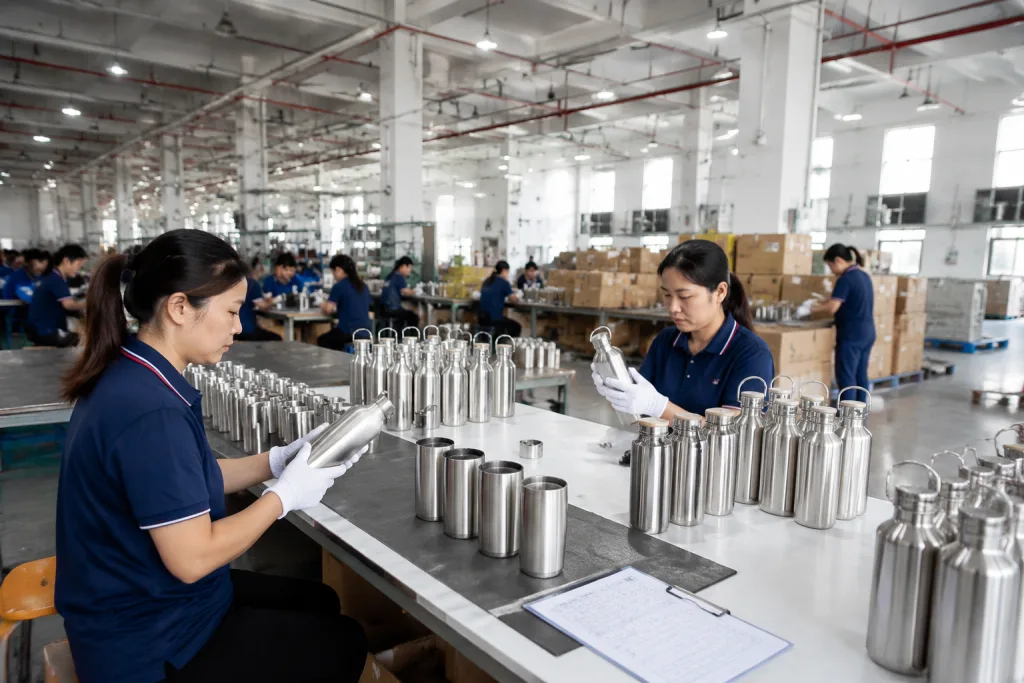
We run drinkware orders through Zhejiang partner lines, and the margin leaks usually start in small places: artwork quoted as 1-color silk screen but the PO arrives with 3 Pantone colors, a flip lid cracking after a 1.2 m drop test, or a 12 kg master carton getting crushed in U.S. LTL handling. The math doesn't work if you fix these after mass production. This guide covers the checks we use before releasing a custom drinkware order to the line.
Start With The Actual Use Case
A promotional drink bottle american program is not one product brief. Last month we had 4 RFQs with the same wording: 3,000 pcs trade show giveaway, 12,000 pcs gift-with-purchase for retail, 800 pcs university canteen order, and a distributor line planned for quarterly repeats. Start with use, receiver, and target service life. Color and logo come later. We once caught a PO typo that changed “matte black” to “mate black”; that small miss almost sent the wrong coating to the line.
For office and conference giveaways, we run 500-750 ml stainless single-wall bottles or plastic sports bottles when the buyer needs a clean logo area and a lower freight bill. For outdoor work, campus stores, and travel kits, double-wall vacuum insulation sells better because the bottle feels like a keeper, not a table-drop freebie. For brewery or camping merchandise, a custom growler in 1.0-1.9 L capacity often beats a standard bottle; the 1.9 L sample on our bench needs a wider carton and a stronger handle weld, so the math changes fast.
American buyers ask for 32 oz capacity, car cup holder fit around 72-76 mm base diameter, and dishwasher-safe claims. Be careful with that last claim. This is the wrong question to ask if the logo is the weak point. Powder coating can survive dishwasher cycles better than cheap spray paint, but printed logos still wear at the edge; QC pulled the sample after 10 wash cycles and the white logo had grey scuffing on the letter “A.” If the product will be sold, not handed out, we suggest testing those 10 wash cycles before any mass production claim goes on the carton.
For canteen custom projects, the same logic applies. A military-style customized canteen with a shoulder strap is judged on carry comfort and leak control, while a slim stainless promotional bottle for a software event is judged on logo finish and desk appeal. A canteen distributor should define strap load in kg, cap retention after repeated opening, leak test angle at 45° and 180°, plus outer coating thickness before asking any canteen supplier for a final price. Otherwise, 6 quotations from canteen manufacturers can look close on paper, then we ship goods that feel like different categories.
Choose Materials Without Guesswork
Material choice sets the quote before decoration even starts: cost, weight, compliance risk, and what the buyer feels in the first 5 seconds. In our Hangzhou sample room, buyers usually shortlist 6 materials: stainless steel, Tritan, PP, glass, aluminum, and borosilicate glass. Stainless is our safest pick for premium promotional bottle programs because we run laser logos cleanly, powder coat it in stable colors, and build it into vacuum bottles. Tritan works when the buyer wants a clear body and lower freight weight. Aluminum looks cheap on the proforma. The catch is the liner; the math doesn't work for acidic drinks if the spec is loose.
For stainless bottles, ask for the steel grade and wall thickness, not just “food grade stainless.” Common export specs are 304 stainless steel for the inner wall and 201 or 304 for the outer wall. A typical vacuum bottle wall thickness is 0.4-0.5 mm per wall, checked with a digital micrometer before polishing. Going thinner saves USD 0.08-0.15 per unit on some 10,000 pc orders, but dent resistance drops fast. QC pulled the sample last May after a distributor canteen arrived with shoulder dents from a 12 kg carton compression test. For large distributor canteen or distributor growler orders, that small saving can turn into a claims file.
Plastic bottles need tighter document control. For the U.S., buyers often request FDA food-contact compliance and BPA-free documentation before they approve artwork. For Europe, confirm EU 10/2011 and REACH first, then LFGB if the bottle sells into Germany or a stricter retail channel. We ask the resin supplier for the material declaration before sampling, and we match it against the PO line because one buyer once typed “PP lid” while approving a Tritan cap. If a canteen manufacturer or canteen factory cannot provide material declarations before sampling, do not assume the final production batch will pass.
Glass feels clean and premium, but it raises breakage and freight risk. If you choose glass for customized drinkware, specify borosilicate wall thickness, silicone sleeve hardness, and drop test height on the same spec sheet. A 1.0 m drop test on a packed carton is a useful baseline, and we run it with the carton at export weight, not an empty showroom box. For individual bottle durability, agree on a realistic internal test, such as 60 cm on wood surface. Glass is still glass. We have seen this go sideways when a buyer asked for a thin wall to cut freight, then flagged 3% breakage after UPS small-parcel handling.
Logo Methods And Real Cost
Logo decoration is where promotional budgets drift. We see 7 out of 10 RFQs start with the blank bottle price, then the buyer gets surprised when a USD 2.10 FOB Ningbo bottle lands at USD 2.85 after powder coating, 2-color silkscreen, custom box, and AQL inspection. Wrong question. Ask for the decorated unit price on day one, with the logo size, carton spec, and test requirement shown on the same quote sheet. Last month QC pulled a sample where the PO said “black logo,” but the artwork file called out Pantone 426C.
Silkscreen printing works well for 1-2 color logos on flat or mildly curved walls. Setup is usually USD 40-80 per color per position, depending on artwork and supplier policy. We run a mesh screen and positioning jig, so a 60 mm logo on a straight tumbler is simple; the same logo on a tapered bottle can shift 1.5 mm if the fixture is loose. Heat transfer handles gradients and larger graphics, but the unit cost is higher and surface cleaning matters. Laser engraving is clean and permanent for stainless drinkware, but it only shows the substrate color. If your brand needs exact Pantone color, laser is the wrong method.
For a canteen customized project, check the logo area before confirming the mold. Curved bodies, fabric covers, straps, and caps all cut down decoration space, and we’ve seen this go sideways after tooling was already paid. A canteen vendor may say “logo available,” but that can mean only a small 35 x 25 mm print on one side. The buyer flagged this once when the approved sales mockup showed a full front mark, while the actual PP sample only allowed 42 mm between the seam and strap rivet. If your brand needs a large front graphic, ask for a 1:1 artwork mockup with dimensions.
Color matching is another hidden cost. For powder coating, a custom Pantone color usually needs 3,000-5,000 pcs MOQ per color. Stock colors can reduce MOQ to 1,000 pcs on selected models. At BottleForge Industrial in Hangzhou, Zhejiang, our standard stainless bottle lines run about 450,000 units/month, but custom color coating still needs line scheduling. The math does not work if a buyer wants 600 pcs in 4 custom colors; the coating line loses half a shift just on cleaning the spray booth and checking ΔE with the color meter. In China, the coating line is often the bottleneck, not bottle forming.
Good artwork approval includes Pantone code, logo size in mm, print position, process name, and one signed pre-production sample. A JPG mockup is not enough for mass production; we ship from the signed sample, not from a pretty email image.
MOQ, Lead Time, And Pricing
MOQ starts with the mold and material, then the lid and decoration method. For stock stainless promotional bottles, 1,000 pcs is workable when the buyer accepts our open colors, standard white box, and the lid already sitting in the bin. For fully customized drinkware with Pantone body color, private label box, and a matched lid color, 3,000 pcs is the cleaner starting point. Below that, the line wastes time changing powder, flushing the spray gun, and sorting mixed cartons. For a new mold, quote from 10,000 pcs or more, plus tooling cost; we had one PO last March where the buyer wrote 1,000 pcs for a new flip lid, and the math did not work.
Typical FOB China price ranges are broad, but they still help with first-round budgeting. A single-wall stainless bottle may run USD 1.60-2.60 at 3,000 pcs. A 500 ml double-wall vacuum bottle may run USD 2.40-4.20. A large customized growler can range from USD 6.50-12.00 depending on capacity, handle design, cap seal, and coating spec. Tritan sports bottles often sit around USD 1.20-2.80, while glass with silicone sleeve may be USD 2.00-4.50. Watch the steel thickness. QC pulled one sample that looked fine on the table, but the wall measured 0.38 mm with a micrometer instead of the quoted 0.45 mm.
Lead time needs discipline. For stock color with simple 1-color logo, 25-30 days after deposit and artwork approval is possible. For custom powder coating and retail packaging, plan 35-45 days. For a new mold, add 25-40 days for tooling and sample correction before production even starts. If you are buying for a holiday campaign, build in 10-14 days for inspection, booking, and port congestion. The wrong question is “Can you ship faster?” Ask what process gets cut. We ship cleaner when the buyer approves the AI file, carton mark, and pre-production sample before the line is booked.
Payment terms for new B2B orders are usually 30% deposit and 70% before shipment after inspection. Larger repeat buyers or established canteen distributors may negotiate better terms after 3 clean shipments with no claim, no late balance payment, and no last-minute PO typo. We have seen this go sideways. If a canteen supplier offers unusually low pricing with no deposit discipline, check what disappeared from the quote: steel thickness, carton strength, gasket material, or QC steps. A 5-layer export carton costs more than a soft 3-layer carton, but the buyer flagged fewer dented bottles after ISTA-style drop testing from 76 cm.
Compliance For US And Europe
Plan compliance before we cut the first sample. For U.S. promotional drinkware, the usual file includes FDA food-contact compliance, California Proposition 65 where applicable, CPSIA if the bottle is intended for children, and ASTM checks for some kids’ products. For Europe, buyers often ask for EU 1935/2004, EU 10/2011 for plastics, LFGB for Germany, and REACH for restricted substances. On our sample bench, QC marks each contact part with a sticker before the BOM goes to the lab: cup body, lid, gasket, straw, and coating zone.
Old test reports are where we see buyers get burned. A black powder coating report from 2023 does not cover a new red coating in 2026, even if the steel body is still 304 stainless. A Tritan body report does not cover the silicone gasket, PP lid, straw, ink, or packaging. The right way is to split the bottle into contact and non-contact components, then match each material and color to the report. We had one PO last year with “silicon ring” typed as the body material; the buyer flagged it, and the lab refused the submission until we corrected the component list.
For kids’ bottles, tighten the gate. Small parts, sharp edges, straw bite valves, and paint adhesion matter more than the bottle shape. If the order is for schools or youth sports, ask about CPSIA, ASTM F963 where relevant, and lead/cadmium limits in coating. A customized canteen with a detachable compass, clip, or decorative badge can create avoidable risk if the accessory is not tested. We’ve seen this go sideways: QC pulled a 500 ml sample after a 3M tape adhesion check lifted the badge paint at the edge.
Factory social compliance matters too. About 6 out of 10 North American and European importers we quote ask for BSCI, Sedex, ISO 9001, or customer-specific audits before they release the deposit. Our Zhejiang, China export programs usually include document packs with material declarations, audit certificates, and test planning before mass production. Ask early. A fresh lab test can take 7-10 working days, and a failed coating or gasket result can push a shipment from 12 days of buffer to 18 days of delay once the line is already booked.
Quality Control Before Shipment
Inspection is not paperwork. It is the last workable gate before the container leaves Ningbo: wrong Pantone color, weak pad printing, leaking lids, short quantity, dusty polybags, or cartons that crush under a 14 kg stack. For most promotional drinkware orders, AQL General Inspection Level II with Critical 0, Major 2.5, Minor 4.0 is a reasonable baseline. If the bottle is high value or going into retail, tighten the sampling plan; we had QC pull 200 pcs from a 5,000 pc run last month because the buyer flagged a 1.5 mm logo shift on the gold sample.
A solid drinkware inspection checks capacity, coating adhesion, logo rub, leakage, vacuum insulation, lid torque, barcode readability, carton drop, and packing accuracy against the PO. On our line, QC uses a 3M tape test for coating, a torque meter for screw lids, and a handheld scanner for UPC/FNSKU labels. For vacuum bottles, a basic insulation test checks hot water temperature drop over 6 hours. For leak testing, bottles sit upside down and sideways for at least 2-4 hours, depending on lid design. Straw lids and flip lids get more time than screw caps. We have seen this go sideways when a buyer approves the body sample but skips the lid test.
Cartons need real attention. Export cartons are commonly 5-ply corrugated, but paper grade and burst strength vary; two cartons can look the same and fail differently after a 60 cm drop. For Amazon FBA or distributor warehouse programs, carton dimensions, gross weight, FNSKU labels, suffocation warnings, and master carton barcodes must be confirmed before packing. QC once caught a PO typo where the outer carton label said “24 pcs” while the packing list said 36 pcs. The bottle was fine. The warehouse still would have rejected it.
For canteen vendors and canteen distributors, strap and cap testing should be written into the QC checklist. A shoulder strap should handle at least 8-10 kg static load for basic outdoor use; we hang the filled sample on a simple hook fixture and leave it loaded for 30 minutes. A cap tether should survive repeated opening cycles, not just one clean pull in the showroom. These tests cost little, and the math does not work if a $0.18 strap failure creates 80 complaints for a school or outdoor program.
Work With The Right Supplier
The right canteen supplier or drinkware factory is not the cheapest name on the spreadsheet. Ask a sharper question: can they quote after checking liquid capacity in ml, 304 stainless thickness, coating type, logo process, carton drop-test requirement, compliance market, AQL 2.5 level, and shipment date? We run into this weekly. If a quotation lands in 10 minutes with no drawing, no Pantone code, and no carton CBM, the supplier is not fast; they are guessing. Last month QC pulled a 750 ml sample and found the actual fill line at 720 ml on the graduated jug. That would have been a complaint in the U.S. promo channel.
Canteen manufacturers, trading companies, and canteen vendors do not carry the same risk. A factory controls the line, welding fixtures, leak-test pressure, and packing table, but its catalog may cover 80 strong items instead of 600 loose SKUs. A trading company can source 12 categories from 8 workshops, yet daily QC often depends on phone photos from someone else’s floor. A serious export manufacturer in China should say plainly what is made in-house and what is sent out, such as powder coating, silicone parts, gift boxes, or rotary printing. We’ve seen this go sideways when the buyer flagged a lid color shift because the outsourced silicone shop changed material without updating the PO.
If you are a canteen distributor building a repeat line, ask for a stable BOM, not just a good-looking sample. The BOM should lock the steel grade, lid material, gasket hardness, coating supplier, carton spec, and logo method, with part photos and tolerance notes where needed. Small stuff matters. A 0.3 mm gasket change can pass a quick leak shake and still fail after a hot-water test on the bench. Without a signed BOM, the second shipment can look like the first shipment but perform worse after 30 days in warehouse stock. For a promotional one-off campaign, you can allow some flexibility, but you still need a signed golden sample with date, PO number, and buyer stamp.
At BottleForge Industrial in Hangzhou, Zhejiang, we ask buyers to send target price, required delivery date, market, and expected order quantity in the first email. That lets us judge whether a stock mold, customizable canteen, custom canteen, or new tooling route makes sense before anyone wastes 3 days on artwork. For example, a 3,000 pcs order with a 12-day ship window usually fits stock bodies and laser logo; a new mold with custom lid geometry is closer to 35–45 days after deposit and drawing approval. The math doesn’t work if the box says premium vacuum bottle but the budget only covers a thin single-wall body. A good supplier protects your budget and also says no when the claim on the box will create trouble at inspection.
Send Your Bottle Spec For A Factory Quote
Share quantity, market, logo file, target price, and delivery date. We will return a practical FOB China option with risks flagged.
Frequently asked questions
What MOQ should I expect for a promotional drink bottle American order?
For most stainless promotional drink bottle American projects, plan on 3,000 pcs per model and color. If you use a stock mold, stock coating, and simple 1-color logo, some suppliers in China can support 1,000 pcs. Custom Pantone powder coating usually pushes MOQ to 3,000-5,000 pcs because the coating line has setup loss. New mold projects are different; 10,000 pcs plus tooling is a more realistic starting point. If your quantity is under 500 pcs, you will usually pay a high unit price or need to buy from local decorators rather than direct FOB China production.
How long does customized drinkware production take?
For a standard custom drinkware order, allow 35-45 days after deposit and final artwork approval. A simple logo on stock bottles can sometimes finish in 25-30 days. Custom color coating, retail boxes, multiple logo positions, and lab testing add time. A new custom growler or custom canteen mold can add 25-40 days for tooling and sample revisions before mass production. Shipping is separate: ocean freight to the U.S. West Coast may take roughly 18-25 days port to port, while Europe is often 30-40 days depending on route and season.
Which logo method is best for canteen promotional products?
It depends on the surface and brand requirement. Laser engraving is the most durable on stainless steel and works well for premium canteen promotional orders, but it does not print Pantone colors. Silkscreen is cost-effective for 1-2 color logos, usually with USD 40-80 setup per color and position. Heat transfer is better for gradients or larger artwork but costs more per unit. For fabric-covered or strap-based canteen customized designs, embroidery or woven labels may be better than printing. Always approve a physical pre-production sample before mass production, especially on curved bodies.
What compliance documents should a canteen manufacturer provide?
A serious canteen manufacturer should provide material declarations, recent food-contact test reports, and audit documents where relevant. For the U.S., ask about FDA food-contact compliance, Prop 65 risk review, and CPSIA if the product is for children. For Europe, ask for EU 1935/2004, EU 10/2011 for plastic parts, LFGB when selling into Germany, and REACH for coatings or accessories. Check that reports match the actual steel, plastic, silicone, coating, and ink used in your order. A report for a different lid or coating color may not protect your shipment.
Can a distributor growler order use Amazon FBA packing?
Yes, but specify it before pricing. Distributor growler and distributor drinkware orders for Amazon FBA need FNSKU labels, carton labels, barcode scan checks, individual polybag or box requirements, and carton weight control. Many buyers keep master cartons under 15 kg to reduce handling damage. You should also confirm drop test requirements, suffocation warnings for polybags, and whether the product needs a ready-to-ship retail box. These packing details can add USD 0.15-0.60 per unit, so they must be included in the quotation, not added after production starts.