Key Takeaways
- Plan 35-45 days production after artwork approval for most stainless custom drinkware orders
- A realistic MOQ is 1,000 units per SKU for stocked molds and 3,000-5,000 units for new color runs
- For America-bound orders, check FDA food-contact, CPSIA for kids items, and Prop 65 risk early
- FOB Ningbo or Shanghai pricing only matters after decoration, carton specs, and AQL level are fixed
If you buy for a promotional drink bottle America program, finding a bottle is the easy part. The hard part is picking one that ships on the booked vessel, passes compliance checks, prints a sharp logo, and still has margin left after freight, duties, and distributor markup. We have seen a USD 0.18 “saving” disappear when QC pulled the sample and found a 1.2 mm lid gasket gap, chipped powder coating on 7 of 80 checked bottles, and cartons sized wrong for Amazon FBA labels. Cheap gets expensive fast.
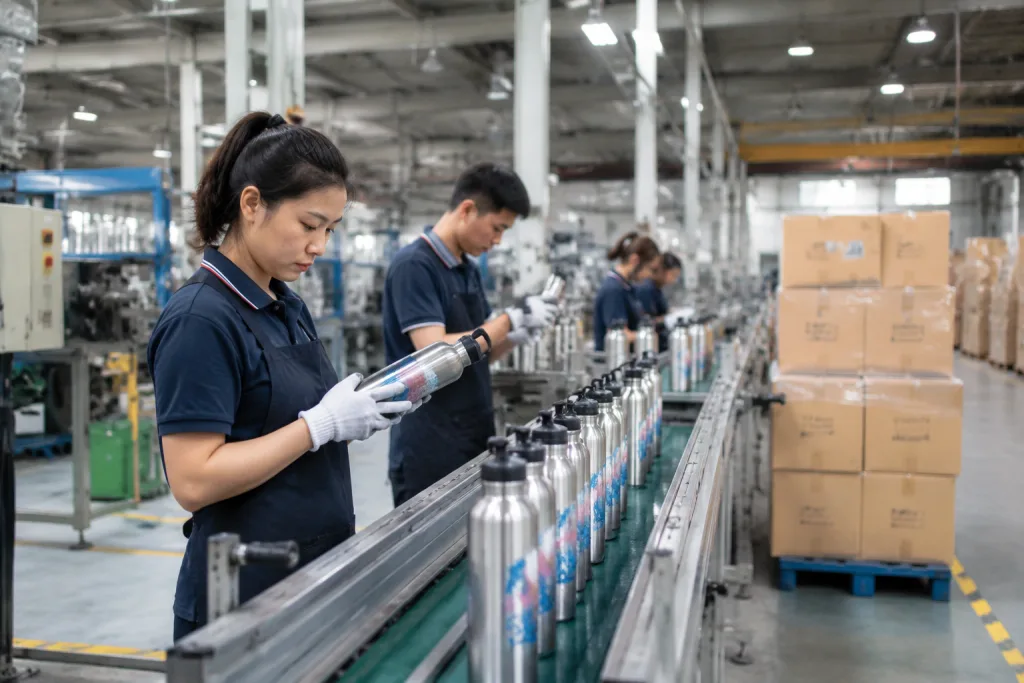
BottleForge Industrial manufactures custom drinkware in Hangzhou, Zhejiang, China for importers, canteen distributors, brand owners, and promotional product buyers. We run about 850,000 units per month across stainless bottles, tumblers, growlers, kids bottles, and glass ranges, with typical MOQ from 1,000 units per SKU for standard models. On the line, our team checks logo position with a 0.5 mm ruler before mass printing because buyers have flagged crooked artwork more than once, including one PO where the Pantone code was typed as 186C instead of 168C.
Start With The Sales Channel
I’ll rewrite the four paragraphs to sound like a sales engineer, keep the HTML intact, and strip the AI-ish phrasing. Then I’ll do a quick consistency pass for numbers, channel fit, and factory-floor details.A promotional drink bottle America order starts with the sales channel, not the bottle drawing. A corporate giveaway, retail private label bottle, distributor drinkware program, school fundraiser, and Amazon FBA launch all want different specs. Mix them up, and you either pay for features the buyer never asked for or miss the details that trigger returns.
For a conference handout, a single-wall stainless sports bottle with a screw lid and silkscreen logo usually does the job. Around 0.45 mm wall thickness is common on low-cost single-wall bodies; we check that with a caliper on the line. For retail shelves or employee gifting, we ship vacuum insulation, 18/8 stainless steel, powder coating, tighter packaging, and a lid that passes leak checks. A 500 ml or 20 oz vacuum bottle often runs 0.5-0.6 mm inner and outer walls, depending on the shape and how the tube is drawn.
If you sell canteens into schools, outdoor programs, or government accounts, the spec needs tougher caps, bigger carry loops, and less decoration risk. For distributor growler orders, the buyer cares about insulation time, cap seal, handle strength, and carton drop results. We have seen a 64 oz custom growler come back with a cracked handle after one drop test, so this is the wrong place to cut corners.
Tell your canteen manufacturer where the bottle will be sold before you ask for a price. The same 24 oz custom canteen can land at FOB USD 2.40, USD 3.20, or USD 5.80, and the math changes fast once you add steel grade, coating, lid design, print method, packaging, inspection level, and compliance paperwork. A serious canteen supplier in China should ask those questions before quoting; if they wait until QC pulled the sample, you are already late.
Choose Materials Without Guesswork
About 8 out of 10 America-bound promotional bottles we quote fall into four material groups: stainless steel, Tritan, aluminum, and glass. Each has a job. None wins every order. A practical canteen factory should show the trade-offs on the quote sheet, not push the line that happens to have 3 idle polishing wheels on Tuesday.
Stainless steel is the safest default for mid-range and premium custom drinkware. For food contact, 304 stainless steel, often marketed as 18/8, is the normal choice for the inner wall; we run 0.4 mm to 0.5 mm inner shells on common 500 ml and 750 ml vacuum bottles. For lower-cost outer walls, some canteen manufacturers use 201 stainless steel. We prefer spelling that out, because buyers in Europe and North America now ask for REACH, LFGB, or FDA support documents before they release the deposit. Vacuum bottles cost more than single-wall bottles, but the math works when the item goes into employee gifts, outdoor retail, or loyalty programs.
Tritan works when you need a clear sports bottle and lower weight. It is usually BPA-free and easier to color match; last month QC pulled a transparent blue sample because the Pantone 2925C cap was fine, but the bottle body shifted green under the light box. It can scratch and it does not insulate. Aluminum bottles are cheap and light, but they normally need an inner liner, so liner adhesion and migration testing become the real food-contact issue. Glass fits wellness and home programs, but we have seen this go sideways when the buyer saves USD 0.08 on cartons and then gets 4 broken pieces in a 24-piece drop test.
- 304 stainless steel: best for vacuum bottles, travel tumblers, custom canteen programs, and premium gifts where buyers expect 6 to 12 hours of heat retention claims.
- Tritan: good for transparent sports bottles and kids bottle programs where a 120 g weight saving matters more than insulation.
- Aluminum: acceptable for low-cost canteen promotional orders when liner testing, wall thickness, and cap fit are controlled before mass production.
- Glass: strong shelf appeal, but higher freight weight and breakage risk; the carton spec matters as much as the bottle shape.
If a canteen vendor cannot confirm the material grade on the mill sheet, coating type on the BOM, lid resin from the injection workshop, and gasket material from the silicone supplier, do not treat the quote as complete. The cheapest number is often missing the parts your compliance team will ask about later. We once saw a PO typo list “PP lid” while the approved sample used Tritan; the buyer flagged it 2 days before inspection, and the shipment sat for 12 days instead of the planned 6.
Decoration Drives Real Cost
Decoration is where 6 out of 10 promotional drink bottle America projects start losing money. Buyers compare bottle body prices, then the logo method changes the real cost, lead time, scrap rate, and shelf impact. This is the wrong question to ask. On our line, QC pulled a sample last month with a 0.3 mm logo drift; the bottle was fine, but the promo item looked cheap.
Silkscreen printing works best for one or two colors on a straight cylindrical wall. For 1,000-5,000 units, we run it most often because the math is clean. Expect setup charges around USD 40-80 per color, depending on artwork and factory policy. Laser engraving costs more per unit, but it holds up on powder coating and bare stainless steel after the 3M tape test. Heat transfer and water transfer handle full-color graphics, but the artwork file needs sharper checking and the MOQ is often higher. UV printing is flexible for short runs and gradients, but we test curved surfaces and coating adhesion before quoting firm mass-production yield.
For a canteen customizable program, confirm the printable area in millimeters before the PO is issued. Do not send only a logo file and assume it can wrap around the bottle. We have seen this go sideways. A 24 oz tapered bottle may look large, but the stable print zone may only be 70 mm wide by 90 mm high when locked in the rotary jig. On a custom growler, the flat area may take a bigger mark, but text near the shoulder can stretch after the screen rolls over the curve.
Color matching needs discipline on the factory floor. Powder coating can hit a Pantone target within a workable tolerance, but it is not paper printing, and the buyer flagged this twice in 2024 on matte black bottles. For customized drinkware, we recommend a pre-production sample when the brand color matters. It adds about 7-10 days, but it beats receiving a full container of almost-right bottles. A serious canteen vendor in Zhejiang should document approved samples with photos, Pantone references, signed artwork, and the actual sample number before mass production starts.
Compliance For America-Bound Orders
I’ll rewrite just the prose inside the existing HTML, keep every tag and the blockquote structure intact, and make the language sound like a real factory-side sales engineer.For America, compliance is not optional paper. It shapes the bottle body, cap resin, carton copy, and sometimes whether the shipment can move at all. If a supplier treats compliance like a PDF sent after packing, you are holding the risk.
For adult drinkware, buyers usually ask for FDA food-contact compliance on stainless steel, plastic parts, coatings, silicone gaskets, and any inner liner. California sales often trigger Prop 65 review. For kids bottles, CPSIA and ASTM checks matter more, with lead, phthalates, small parts, and age grading all on the table. If the same SKU also goes to Canada, bilingual labels and packaging review come up fast. Europe-bound stock may need REACH and LFGB, so tell the factory up front if one model is crossing markets.
A test plan beats a folder of old reports. Ask your canteen manufacturer whether the report matches the exact material, color, coating, and lid in your PO. A black PP lid report from 2022 does not cover a new transparent AS lid in 2026. Same story for silicone gaskets, straws, paint, and printed inks. We’ve seen this go sideways on the line when the buyer flagged a lid change after QC pulled the sample.
For private label and distributor canteen orders, we lock the bill of materials before lab testing. Change the lid resin after testing and you save five cents; the report can be dead.
At BottleForge in Hangzhou, Zhejiang, we line up BOM, artwork, carton marks, and test scope before production starts. The factory can run fast, but fast is not the same as controlled. A 3-day delay at approval is cheaper than a rejected shipment in Los Angeles, Vancouver, Hamburg, or Rotterdam.
MOQ, Pricing, And Lead Time
MOQ is not a punishment. It is the break point where the math starts working: steel coil purchasing, line setup, powder booth cleaning, logo fixture setup, AQL 2.5 inspection, and export cartons. For standard stainless bottles and travel tumblers, our MOQ is usually 1,000 units per SKU with one body color and one logo. Below that, the line still needs the same spray gun washout and pad-print plate, so the unit price jumps. For a fully customized canteen with a new mold, custom lid, or special coating, MOQ commonly moves to 3,000-5,000 units. For a new stainless mold, tooling can run from USD 2,500 to USD 8,000 depending on structure, and QC pulled one sample last month because the lid thread was off by 0.35 mm.
FOB price depends on more than capacity in ounces. A 20 oz vacuum bottle might quote at USD 3.10-4.80 FOB Ningbo for a standard shape with powder coating and one-color print. A premium 32 oz bottle with handle lid, straw cap, laser logo, and individual color box may sit around USD 5.20-7.90 FOB. A customizable growler at 64 oz can move higher because steel weight, vacuum processing time, cap sealing, and carton strength all increase. We run carton drop tests at 76 cm for heavier items, and if the buyer asks for a thin mailer box to save USD 0.18, this is usually the wrong place to cut cost.
Production lead time is normally 35-45 days after deposit, artwork approval, and pre-production sample approval. In peak season, especially before Q3 promotional campaigns and Q4 retail shipments, plan 50-60 days. Sea freight to the U.S. West Coast can add 18-28 days port-to-port, while East Coast routing can be 30-40 days. Add customs clearance, truck delivery, and warehouse receiving time. If your event date is fixed, your purchase order should not arrive late; we have seen a PO with the Pantone code typed as 186C instead of 185C lose 3 days before the sample room even made the first spray panel.
For distributor drinkware programs, split shipments work when the numbers support it. You may ship 30% by air for the launch and 70% by sea for replenishment, but air freight destroys margin on heavy stainless goods. Use it only when the campaign value justifies it. A reliable canteen supplier should show carton dimensions, gross weight, and CBM before you calculate landed cost. We ship a typical 24-carton pallet with measured gross weight from the floor scale, not a guessed spreadsheet number, because buyers flag freight surprises faster than logo defects.
Quality Control Before Shipment
Drinkware defects feel boring until a customer uploads 6 photos of leaking lids or scratched bottles. Build QC into the order before the line starts, not after 240 cartons are taped shut. For B2B buyers, we run AQL inspection before shipment, with defect definitions locked on the PI and artwork approval sheet. QC pulled one sample last month with a logo 3 mm off center; the buyer flagged it before loading, which saved a messy claim.
For promotional and retail drinkware, our U.S. buyers usually set AQL 2.5 for major defects and AQL 4.0 for minor defects. Critical defects should be zero tolerance. No debate there. Major defects include leakage, poor vacuum performance, wrong material, sharp edges, loose handles, wrong logo, serious coating damage, or carton label errors such as “Botttle” typed on a PO label. Minor defects include small dust points under 0.5 mm, slight print variation within the approved Pantone range, or tiny coating marks inside the agreed viewing distance.
Vacuum performance should be tested by batch, not guessed from one nice sample on the sales desk. For stainless thermos bottles, the factory should run 95°C hot water temperature checks after vacuum processing and again before packing, usually with 13 samples pulled from each production lot. Lid leakage testing should include inversion and 30-second shaking, especially for straw lids and flip lids. Large-mouth custom canteen designs need extra attention at the thread gauge. For a customized growler, thread fit and gasket compression matter because buyers often transport it full; we have seen this go sideways when a soft silicone ring was 0.4 mm too thin.
Packaging deserves the same attention. A bottle that passes inspection but arrives dented is still a failed order, and the math does not work if you save USD 0.18 on cartons but lose 2% in transit damage. We normally recommend a 5-ply export carton for heavier bottles and growlers, with inner dividers or individual boxes based on the sales channel. For Amazon FBA drinkware, carton weight, FNSKU labeling, suffocation warnings on polybags, and master carton labels must be checked before shipment. China export packing can be excellent, but only when the buyer and factory agree on the standard in writing; we ship smoother when the packing spec includes carton size in mm, gross weight limit, and drop-test requirement.
Work With The Right Factory
I’ll rewrite the prose in place, keep the HTML exactly intact, and tune the copy to sound like a factory-side sales engineer.The best canteen factory for your order is not the one with the lowest unit price. It is the one that understands your market, asks hard questions early, and repeats the same quality across 5,000 units, then the next 5,000. For North America and Europe, that means export paperwork, compliance checks, stable decoration, and a lead time that holds after PO approval.
Ask direct questions. How many units per month can the line push out? What is the MOQ by process? Which parts run in-house, and which parts come from outside canteen vendors? Can the factory support BSCI, ISO 9001, or customer social audits? What AQL standard do they run? Can they send product liability support docs, material declarations, and packing specs before deposit? We had a buyer flag a PO once because “carton mark” was typed as “carton mrk”; small typo, big delay.
A good canteen manufacturer will also tell you when your idea is too expensive or risky. A full-wrap gradient print on a heavily tapered bottle may look clean in a render, but it can push reject rates up on the spray line. A matte white coating with a dark logo can look sharp, but it shows rub marks fast in transit. Soft-touch coating feels good in hand, but if the chemistry is off it fails abrasion testing; QC pulled a sample at 200 rubs and the finish was already gone.
BottleForge Industrial is based in Zhejiang, China, close to stainless forming, coating, lid molding, and export logistics around Ningbo and Shanghai. That location matters because custom drinkware is a supply chain product, not just an assembly job. When you compare canteen suppliers, canteen vendors, or canteen manufacturers, look for process control and straight communication. The math does not work any other way. The right partner helps you protect margin before the first container leaves China.
Send Your Bottle Brief For A Factory Quote
Share capacity, material, logo, target price, market, and delivery date. We will return a practical FOB China option with MOQ and lead time.
Frequently asked questions
What is a realistic MOQ for a promotional drink bottle America order?
For standard molds, a realistic MOQ is 1,000 units per SKU with one body color and one logo. If you need a special Pantone powder coating, expect 3,000 units to be more practical because coating lines need batch efficiency. For a new lid, custom shape, or fully customized canteen, MOQ is usually 3,000-5,000 units, plus tooling. Some factories offer 300-500 units, but the unit price is often high and decoration choices are limited. If you are testing a distributor canteen program, start with a standard mold and customize color, logo, and packaging before investing in tooling.
How long does production take for customized drinkware from China?
For most stainless customized drinkware orders from China, plan 35-45 days after deposit, artwork approval, and sample approval. Add 7-10 days if you need a pre-production sample with exact coating and logo. During peak season, 50-60 days is safer. Ocean freight to America adds about 18-28 days to the West Coast and 30-40 days to the East Coast, excluding customs and inland trucking. If your promotion has a fixed event date, work backwards from the delivery date, not the factory ship date. Late artwork approval is the most common buyer-side delay.
Which logo method is best for custom canteen programs?
For most custom canteen programs, one-color silkscreen is the most cost-efficient option at 1,000-5,000 units. It works best on smooth cylindrical areas and simple logos. Laser engraving is better for premium stainless bottles and powder coated products because it is durable and does not peel. Heat transfer or UV printing is useful for full-color artwork, but adhesion testing is important. Ask the canteen supplier for the exact print area in millimeters and request a decorated sample if the logo is detailed. A nice digital mockup does not prove production stability.
What compliance documents should America buyers request?
For adult drinkware sold in America, request FDA food-contact support for stainless steel, plastic lids, silicone gaskets, coatings, inks, and liners where applicable. For California distribution, review Prop 65 exposure risk. For kids bottles, ask about CPSIA, lead, phthalates, small parts, and age grading. If the same SKU may go to Europe, add REACH or LFGB planning early. The key is matching reports to the actual bill of materials. A report for a different lid resin, coating color, or gasket compound may not protect you if a retailer or marketplace asks questions later.
Should I buy from a trading company or a canteen manufacturer?
A trading company can be useful for mixed small orders, but a direct canteen manufacturer is usually better when you need stable repeat production, controlled decoration, and clear technical answers. Ask whether stainless forming, vacuum processing, powder coating, printing, and packing are in-house or outsourced. Many good factories still use outside canteen vendors for certain lids or coatings, but they should manage inspection and traceability. For distributor drinkware programs above 3,000 units, direct factory communication usually reduces mistakes. The lowest quote is less important than BOM control, AQL inspection, and on-time shipment.