Key Takeaways
- A practical MOQ for a coffee mug customized travel tumbler is 1,000 units per color for most OEM orders
- 304 stainless steel inner walls, 0.4-0.5 mm gauge, and copper vacuum insulation are worth specifying
- Normal production lead time is 25-35 days after artwork approval and deposit
- Use AQL 2.5/4.0 inspection, REACH/LFGB/FDA testing, and drop-test packing before shipment
A promotional coffee mug is not a cheap giveaway if your customer uses it every morning. For coffee brands and corporate-gift buyers, price is the wrong first question. Ask whether the tumbler holds 60°C coffee after 6 hours, passes a 90 cm carton drop test, prints your logo within a 0.3 mm registration tolerance, and reaches the campaign warehouse 12 days before launch instead of 2 days late.
We manufacture drinkware in Zhejiang, China, and we see the same issues on the line every week: 7 vague RFQs, artwork approved after mold sampling, target prices that miss the steel cost, and buyers comparing a 201 stainless liner with a true 304 stainless travel tumbler. QC pulled one sample last month where the PO said “matte black” but the artwork file was named “gloss-black-final.ai.” That goes sideways fast. If you want coffee mug factory direct pricing without factory-direct surprises, specify the product properly from the first email.
Start With The Use Case
A promotional coffee mug for a coffee roaster is not the same brief as a bulk travel mug for an insurance conference. Coffee brands ask us about taste carryover, aroma, lid hygiene, and whether the cup gets used 40 times or tossed in a drawer. Corporate-gift buyers push harder on logo size, neutral colors, gift-box presentation, and the ship date. Same 16 oz travel tumbler, different spec. On our line, QC once pulled a sample because the silicone ring held coffee odor after a 60°C hot-water rinse; that mattered to the roaster, while the conference buyer only flagged the logo sitting 3 mm off center.
For coffee brands, we run 12 oz, 16 oz, and 20 oz sizes most often. The 12 oz coffee mug custom made tumbler feels right for flat white, latte, and office coffee. The 16 oz bulk coffee travel mug is the safer retail and subscription-box size. The 20 oz bulk coffee tumbler suits commuters and drivers, but the math changes fast: one 58 × 39 × 44 cm carton may hold 24 pieces instead of 36, so freight per cup climbs. We have seen buyers chase the bigger size, then cut the order from 3,000 pcs to 1,500 pcs after seeing the CBM.
Before asking a coffee mug supplier for a quote, decide where the item lives. Café retail shelf? E-commerce parcel? Trade-show handout? A glossy powder-coated cup looks sharp in a gift box, but matte coating hides fingerprints after 8 people handle the counter sample. A slim base around 70 mm fits more car cup holders. A leak-resistant screw lid works better for bags; a slider lid is easier on a desk. This is the wrong question to ask: “Which tumbler is cheapest?” Ask which failure the buyer will complain about first.
If you are building a coffee mug promotional products line, treat the tumbler like packaging with hardware attached. The buyer remembers the coffee and the cup as one item. A poor lid, metallic smell, or weak print makes your brand look careless, even when the coffee is excellent. We ship repeat coffee programs only after a quick 3M tape test on the logo and a nose check inside the cup, because one bad lid smell can kill a reorder.
Specify Materials Before Price
Quote problems usually start with the metal spec. We see this every week. The same 20 oz travel mug body can land at 4 price levels if the factory changes steel grade, wall thickness, lid resin, powder coating, or carton packing. If the RFQ says “stainless steel travel mug, logo, 5,000 pcs,” the lowest quote is often built on assumptions you did not approve; last month QC pulled a pre-production sample where the PO said “SS mug” and the supplier read it as 201 outside with a thinner inner wall.
For a promotional coffee mug that touches hot coffee, write 304 stainless steel for the inner wall. Some cost-driven orders run 201 stainless outside and 304 inside; we ship that structure when the exterior is powder coated and the inner wall passes food-contact testing. Do not accept an unknown liner. The math doesn’t work if you save USD 0.18 per cup and then fail buyer compliance. Ask for a material declaration and recent FDA, LFGB, or EU food-contact reports. For Europe, check REACH compliance on the coating and silicone too; one German buyer flagged a black silicone gasket because the report listed the wrong color code.
Wall thickness matters on the line and in the container. For common travel tumblers, 0.4 mm to 0.5 mm stainless gauge is normal. At 0.35 mm, cups dent fast when cartons take a corner hit during ocean freight or warehouse handling; we have seen 37 dented pieces in a 500 pcs drop-check carton after rough handling. At 0.6 mm, the cup feels solid, but your coffee mug in bulk gets heavier and the unit cost climbs for no good reason. Double-wall vacuum construction is standard for insulation. Copper plating between the walls improves heat retention, but add it only when the retail claim needs 6-8 hours hot performance.
Lids cause more complaints than steel bodies in bulk coffee mug orders. Ask whether the lid is PP, Tritan, or AS plastic, whether the seal ring is food-grade silicone, and whether replacement seals are available at 1% or 2% of order quantity. Small part, big headache. A tumbler body can pass inspection while the lid leaks after 20 open-close cycles on a torque tester. That is why experienced coffee mug manufacturers test assembled cups with hot water, inverted leak checks, and lid-fit gauges, not just polished steel shells.
Branding Methods That Actually Last
A coffee mug customizable project usually comes down to four logo options: silk screen printing, laser engraving, heat-transfer printing, or full-wrap sublimation on coated models. The right choice depends on artwork, coating, and how the mug will be handled after delivery. For one or two solid logo colors, silk screen is still the cleanest value. On a 3,000 pcs coffee mug promotional order, one-color silk screen often adds about USD 0.08-0.18 per unit, depending on size and position. We run a 60 mm wide logo on most 20 oz tumblers without trouble, but the buyer flagged a 92 mm logo last month because it wrapped too close to the seam.
Laser engraving lasts. It also looks sharper on powder coating, so we use it often for executive gifts and dealer programs. The laser removes the coating and exposes the stainless steel below. The limit is artwork: fine gradients, pale colors, and tiny slogan text will not reproduce the way they look on screen. For a coffee mug private label retail line, laser is often worth the extra USD 0.15-0.35 because it survives dishwashing abuse better than low-grade print. QC pulled one black powder-coated sample after 20 dishwasher cycles; the engraving was fine, but the printed care icon beside it had started to haze.
Full-color artwork needs tighter control. Heat-transfer or UV printing can reproduce complex designs, but adhesion depends on coating quality and curing time. Ask your coffee mug manufacturer for a cross-hatch adhesion test and alcohol rub test before mass production. We use 3M tape for the cross-hatch check, then rub the logo 50 times with 75% alcohol; weak coating shows up fast. For North American corporate gifting, check whether the imprint area stays visible when held in the right hand and placed in a car cup holder. This is the wrong question to ask: “Can you print any design?” The better question is whether that design survives packing, washing, and 6 months in a sales rep’s car.
Artwork timing is not a small detail. A coffee mug custom project can lose 5-7 days because the buyer sends a low-resolution PNG instead of vector AI, EPS, or PDF. We have seen this go sideways over one typo on a PO: Pantone 186C written as 168C, which turned a clean red logo into a muddy brown sample. For coffee mug private labeling, prepare logo files, Pantone codes, carton marks, barcode, and care instructions before sampling. If you need FNSKU or UPC labels for e-commerce, confirm placement before cartons are printed; reworking 120 cartons with sticker guns on the packing line is slow and the math doesn’t work.
MOQ, Pricing, And Lead Time
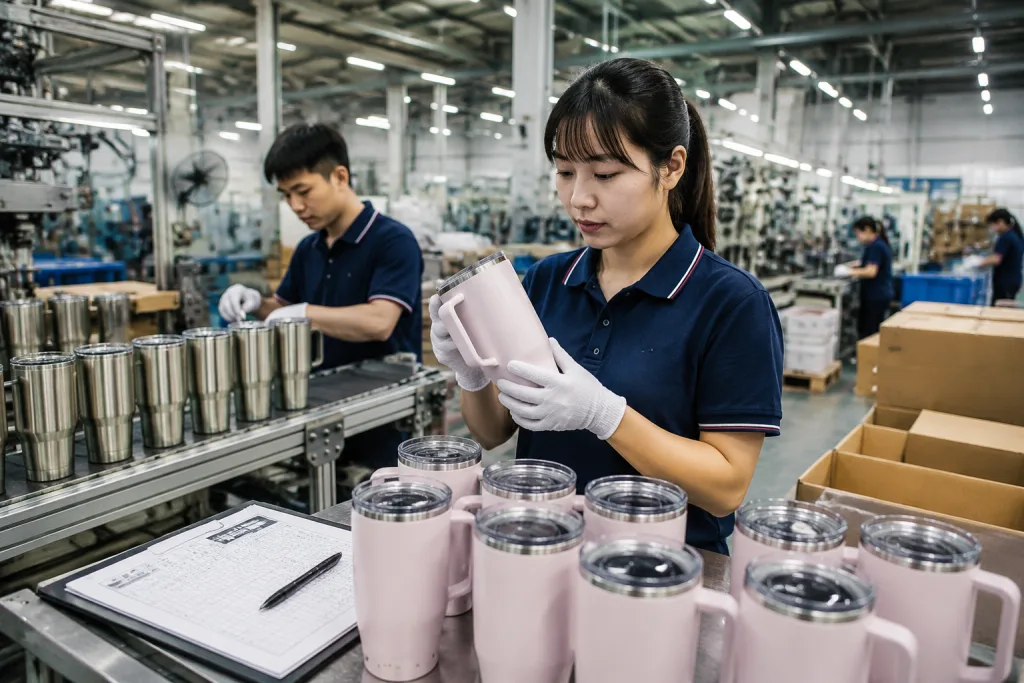
Factory math is plain once you stand beside the line. A bulk travel tumbler order goes through steel forming, welding, vacuuming, polishing, coating, logo work, assembly, AQL 2.5 inspection, and packing. One color change on the powder-coating line means flushing guns, checking the 18-22 μm film build, and signing off the first 12 pcs under a light box. At our Zhejiang facility, monthly drinkware capacity is about 600,000 units, but the line does not run cleanly for 87 pieces. We tried it once for a buyer’s “urgent VIP gift” request; the setup loss ate the margin before lunch.
For a standard coffee mug bulk travel tumbler, expect MOQ around 1,000 units per color for existing molds. For coffee mug custom made shapes, new tooling can push MOQ to 3,000-5,000 units, with tooling cost from roughly USD 1,500 to USD 8,000 depending on lid and body complexity. If you are testing a new campaign, use an existing mold first. Spend money on PMS color matching, logo placement, and a 350 gsm gift box before you spend it on a new silhouette. This is where we push back: a custom body for a 1,200 pc promo job is usually the wrong question to ask.
FOB Ningbo or Shanghai pricing for a 16 oz stainless travel tumbler commonly lands around USD 3.20-6.80, depending on steel grade, coating, lid design, branding method, and packaging spec. A low quote often removes copper plating, drops the inner wall from 0.5 mm to 0.4 mm, changes the lid gasket, or packs 24 pcs in a lighter K=A carton. QC pulled one competitor sample last April with a loose slider lid after 30 open-close cycles. Fine for a one-day event. Not fine for a coffee mug private label product expected to earn reviews.
Normal lead time is 25-35 days after deposit and artwork approval. Pre-production samples take about 7-10 days if no new mold is required. Ocean freight to Europe or North America can add 25-45 days port to port. If your campaign date is fixed, ask your coffee mug factory for a production schedule with sample approval, material purchase, coating, logo, final inspection, and vessel cutoff dates shown separately. We ship better when the PO is clean too; last month a buyer typed “matte black” on the PO but attached glossy black artwork, and that cost 2 days before the line could release material.
Quality Control For Bulk Orders
A coffee mug distributor or corporate buyer should not sign off from sample photos. This is the wrong question to ask. A sample can be hand-polished by one senior worker at the bench, while the line is running 1,200 pcs per shift with different operators and worn fixtures. For any bulk coffee mug or bulk travel mug order over 2,000 units, put the inspection standard in writing before we run material. AQL 2.5 for major defects and AQL 4.0 for minor defects is a common starting point. Critical defects, such as sharp edges, leakage, rust, contamination, or unsafe materials, should be zero tolerance; QC should pull those samples with a caliper, leak tester, and magnet check, not just a phone camera.
Define defects before production. Major defects include leaking lids, wrong logo position over 2 mm from the approved artwork, obvious dents, poor vacuum performance, exposed weld marks, color outside tolerance, and coating scratches longer than 10 mm. Minor defects include tiny dust points under 0.5 mm, slight carton scuffs, or small print specks that do not affect brand use. No list, no control. We have seen this go sideways when a buyer flagged “bad logo” during final inspection, but the PO artwork file had a typo in the Pantone note and nobody froze the approval sample.
Vacuum testing belongs in the checklist. A basic method is hot water filling and temperature drop checking after a set time, with the probe inserted the same depth each time, usually 30 mm below the rim. For example, a 16 oz double-wall tumbler may be checked after 3 hours or 6 hours depending on claimed performance. Leak testing should use assembled lids, with the silicone ring fitted, not just visual review on loose parts. Drop testing should be done on export cartons, usually from 76 cm on edges, corners, and faces, especially if the goods will move through parcel networks; one cracked inner tray can turn 24 good cups into a claims file.
Ask for production photos, but do not treat them as QC. Photos show the clean table, not the bottom of carton No. 47. For higher-value coffee mug customized orders, hire a third-party inspection company in China or send your own checklist to the factory with AQL level, logo tolerance, packing method, and barcode rules. A good coffee mug oem manufacturer will not object to inspection. We prefer it because QC can pull the sample before the container leaves Zhejiang or another China port, when a lid gasket swap costs 0.08 USD instead of a full shipment dispute.
Choosing A Factory Partner
A coffee mug supplier directory or coffee mug supplier list gives you 50 names in an afternoon, but it will not show how the factory reacts when artwork arrives 3 days late, 12 cartons fail a 76 cm drop test, or your forwarder moves the Ningbo vessel cutoff from Friday to Wednesday. That is where orders get messy. Qualify the supplier like the team that will stand on the line with you, not like a website listing.
Ask whether the supplier is a trading company, a coffee mug manufacturer, or a mixed operation with 2 sales offices and 1 factory behind it. Trading companies are not automatically a problem; some run projects better than small workshops. If you want coffee mug factory direct development, pin down who owns the mold, who controls powder coating thickness at 60–80 μm, and whose chop appears on the QC report. For repeat coffee mug distributors, factory transparency is not a nice extra. The math doesn't work when every color change has to pass through 3 middlemen.
Useful documents include business license, BSCI or Sedex audit if social compliance matters, ISO 9001 if available, food-contact test reports, material declarations, and past inspection reports with defect photos. Do not just collect certificates. Check the factory name, product scope, report date, and testing standard against the exact SKU on your PO; we once saw a buyer approve “black power coating” because of a typo, then QC pulled the sample before mass production. A 2021 report for a plastic lunch box does not prove your 2026 stainless tumbler coating is REACH compliant.
Communication is also a production tool. A good coffee mug factory direct partner will push back when your requested Pantone color shifts on matte powder coating after 8 minutes in the curing oven, or when your 300 gsm gift box crushes during courier shipping. That pushback feels annoying. It protects the launch. For coffee brands and corporate-gift buyers sourcing from Zhejiang, China, the best supplier is usually not the cheapest line item; it is the factory that tells you the bad news before the purchase order turns into 5,000 problem mugs.
Build your next coffee tumbler program properly
Send your target quantity, artwork, market, and deadline. We will quote a practical factory-direct specification, not a vague catalog guess.
Frequently asked questions
What is the best size for a promotional coffee mug travel tumbler?
For coffee brands, 12 oz and 16 oz are usually the safest sizes. A 12 oz tumbler feels closer to a café drink and works well for retail bundles or loyalty gifts. A 16 oz bulk coffee travel mug is better for corporate gifting, commuting, and office use. A 20 oz size gives more perceived value, but it increases carton volume and freight cost. If you are ordering 5,000 units for a campaign, ask your coffee mug supplier to quote at least two sizes with carton dimensions. Sometimes the larger cup looks only USD 0.45 more ex-factory but costs much more after ocean freight, warehousing, and parcel shipping.
What MOQ should we expect for coffee mug custom branding?
For existing travel tumbler molds, a realistic MOQ is 1,000 units per color for logo printing or laser engraving. Some factories may accept 500 units, but the unit price will be higher and color options may be limited. For coffee mug custom made body shapes or private molds, expect 3,000-5,000 units and tooling charges from about USD 1,500 to USD 8,000. If your order is a first test, use a stock mold and invest in good coating, gift box, and logo execution. That gives you a better read on customer response before committing to custom tooling.
How do we compare quotes from different coffee mug manufacturers?
Put every quote into the same format: size, capacity, inner steel grade, outer steel grade, wall thickness, coating type, lid material, logo method, packaging, MOQ, FOB port, sample time, production lead time, and testing included. A USD 3.10 quote and a USD 4.20 quote may not be for the same product. One may use 201 stainless inside, thinner cartons, and no copper plating. Ask for net weight per unit and carton drop-test details. Serious coffee mug manufacturers can explain the cost difference line by line instead of only saying “best price.”
Can we use the tumbler for Amazon or e-commerce gift sales?
Yes, but you need to design the packing for parcel handling, not only pallet shipping. For Amazon-style orders, confirm FNSKU labeling, suffocation warnings if polybags are used, barcode placement, carton size, and master carton weight. Keep master cartons under about 15-18 kg where possible for easier handling. A single gift box should protect the lid and coating from rubbing; many claims come from abrasion during transit, not factory defects. For a coffee mug private labeling project, also prepare care instructions, country-of-origin marking, and any required Prop 65 or EU compliance wording before mass packing.
Is factory direct always better than buying from a distributor?
Not always. Coffee mug factory direct sourcing gives you more control over materials, branding, inspection, and price, especially above 1,000-3,000 units. But a coffee mug distributor can be useful for rush orders, mixed small quantities, or local warehousing. If you need 200 pieces next week, buy locally. If you need a repeat bulk travel tumbler program with custom color, logo, gift box, and compliance documents, work with a factory in China directly or through a strong sourcing partner. The key is knowing whether you are buying inventory convenience or manufacturing control.