Key Takeaways
- Typical MOQ for a private labeling kids bottle is 3,000 units, with sample lead time around 7-10 days.
- A safe kids bottle spec usually starts with Tritan or food-grade PP, a leak test above 24 hours, and BPA-free documentation.
- Expect FOB China pricing from about USD 1.20-3.80 per unit depending on capacity, lid type, and print method.
- A Zhejiang factory with 200,000 units/month can support school-season replenishment if you lock artwork and packaging early.
If you are buying a private labeling kids bottle for a school district or an import program, the real issue is not the cute shape. It is whether the bottle survives daily use, passes safety checks, and still leaves room for your logo without turning the job into a rework headache. A 0.05 mm print shift on the lid or a weak pad print can eat a season of replacements fast.
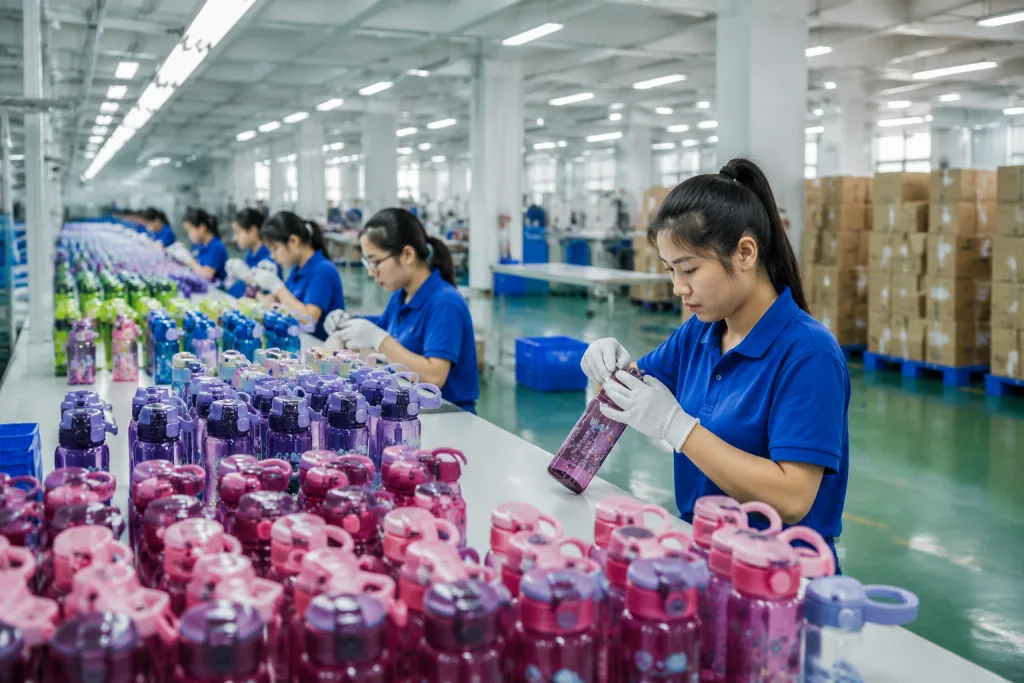
We run kids bottle programs in Zhejiang, China, and buyers keep coming back to the same three checks: spill control, compliance, and repeatability. That sounds simple until you ask for 5,000 units, a one-color logo, a 21-day sample window, and cartons that hold up on a school receiving dock. QC pulled the sample at AQL 2.5 last week; the buyer flagged a loose straw cap on the first round, and that is the right kind of problem to catch early. Here is how we judge a custom kids water bottle order like a buyer, not like a catalog shopper.
What you are really buying
I’ll rewrite the section in place, keep the HTML exactly as-is, and tighten the prose so it sounds like a factory-side sales engineer wrote it.When buyers ask for a private labeling kids bottle, they are usually buying four things at once: the bottle body, the closure, the decoration, and the pack-out. If you only approve the shape, you are not done. We’ve seen a sample pass on paper and fail on the line because the cap takes 18 N to open, the straw pops loose, or the print rubs after 20 washes.
For school buyers, function beats the sales pitch. A bulk school water bottle has to open with low force, fit a standard lunch bag, and survive dishwasher cycles if the district asks for them. For importers, the math is margin and fill rate. A children water bottle wholesale program can look cheap at the quote stage, then freight, carton size, and claim rate eat the savings. I tell buyers to write the brief around use case, not product name. State the age range, whether it must stay leakproof in a backpack, whether you want a straw cap or sports cap, and whether you need a custom logo kids bottle or a full-wrap print. One page is enough. It also stops the buyer flagged typo on the PO from turning into a 5,000-piece headache with any children water bottle supplier or children water bottle manufacturer.
- Age 3-6: lighter lid, 32 mm grip, lower opening force.
- Age 7-12: higher capacity, tighter leak control, tougher print.
- School program: fewer parts, faster washing, 1-2 SKU options.
Material choices that pass scrutiny
I’ll keep the HTML structure intact and rewrite the prose to sound like a factory-side sales engineer, with tighter specifics and fewer AI-style phrases.Material choice sets the hand feel and the compliance file. The usual three are Tritan copolyester, food-grade PP, and stainless steel with an inner liner or a single-wall body. If you need a clear body for logo visibility, Tritan is the common pick. If the order is price-led on a bulk children water bottle run, PP keeps the math under control. If the brief is a gift set or a children water bottle promotional item, stainless steel reads more premium, but it adds weight and pushes up the landed cost.
Do not accept a loose “BPA-free” claim and call it done. Ask for REACH paperwork for Europe, food-contact compliance for the target market, and migration test results from the right test conditions. On our line, we check wall thickness at 1.6-2.0 mm for a plastic kids bottle and run lid life to 10,000 open-close cycles. One buyer once sent a PO with the lid color code missing, and QC pulled the sample because the spec sheet did not match the carton label. For a custom made kids bottle, that is normal discipline, not extra fuss.
Good buyers ask for the test report before they ask for the mockup. Bad buyers do it the other way around and pay for it later.
If your market needs a children water bottle customizable with a printed name field, check whether the print zone is flat. A curved panel bends small text, and the school clerk will hate it when labels fail the scan. We have seen that go sideways on 50,000 pieces because the buyer approved artwork from a 3D render instead of the actual 1:1 panel.
Decoration that actually lasts
I’ll rewrite just the HTML prose, keep the tags and list structure intact, and make it sound like a factory-side sales engineer.Decoration is where a lot of private-label kids bottle jobs go sideways. A logo that looks sharp on a PDF can turn fuzzy after 30 days if the print method does not match the surface. For a plain 1-color logo, silk screen is still the cheapest route. If the artwork has thin lines, a metallic look, or small text, laser engraving holds up well on stainless steel and some coated bodies. For a custom children water bottle with school colors or a mascot illustration, UV print or heat transfer is the better call.
This is a production decision, not a design debate. A custom school water bottle for a district launch may run 3,000 units with a single-color mark, while a children water bottle customized for retail can carry a full-wrap print because the margin pays for the setup. We quote decoration separately in Zhejiang because the same bottle body can move 8-20% on cost once you change the print method. The buyer flagged a PO with “blue logo” and forgot the Pantone code; QC pulled the sample, and the match was off by a mile. That is why distributor quotes and direct factory pricing do not land in the same place.
- Silk screen: best for 1-2 colors and volume.
- Laser engraving: tough, clean, and better on metal, though the unit price is higher.
- UV print: good for detailed artwork and premium retail packs.
Ask for a decoration tolerance sheet. If your logo has strokes below 0.3 mm, some factories will quietly fatten the line and ship it anyway.
MOQ, price, and lead time
I’ll rewrite just the prose, keep the HTML structure intact, and make it sound like a real factory-side sales note.Most school programs and importer orders need a cost structure that stays flat. For private labeling kids bottle orders, 3,000 units per design is a normal MOQ if you want custom print and custom cartons. If you want a children water bottle custom mold, the MOQ often moves to 10,000 units or more, and tooling usually starts at USD 3,000-15,000 depending on the cavity layout. We run this every season. Most buyers take an existing shape first, then change the color, lid, or artwork. That is the safer call on day one.
FOB China pricing for a basic custom kids water bottle can start near USD 1.20-1.80 for PP, USD 1.80-3.20 for Tritan, and USD 2.50-3.80 for stainless steel, depending on capacity, lid design, and print coverage. If you need a bulk kids water bottle with individual retail boxing, add about USD 0.20-0.60 per set. Sample lead time is usually 7-10 days. Mass production from approved artwork to shipment is often 20-35 days. At our Zhejiang plant, the line turns out around 200,000 units a month, and QC pulled the sample twice last August because a 0.3 mm lid gap showed up on one batch.
Buyers sometimes chase the cheapest children water bottle vendor quote and then the shipping carton gets crushed. We’ve seen that go sideways. The better question is landed cost at 10,000 units with a 5% spare part allowance. That is the number finance will sign off on. One PO typo on “5000” versus “500” can change the whole math.
Packaging for schools and retail
I’ll rewrite the three paragraphs with tighter B2B sales-engineer language, keep the HTML unchanged, and bake in a few concrete factory-floor details without adding new tags.Packaging is not something you leave to the end when you sell to districts or distributors. A bulk children water bottle for school procurement may need a plain inner bag, a barcode sticker, and a master carton cut for pallet loading. A retail children water bottle wholesale order may need printed boxes, hang tags, FNSKU labels for Amazon, or inserts in the buyer’s local language. We write the packaging spec before sample approval, not after. QC once caught a PO typo on carton count before the line started, and that saved a messy rework.
For school districts, we usually run plain polybags or recyclable sleeves, then add a carton label for color, quantity, and carton number. That makes receiving faster and cuts waste. For importers, custom cartons can carry your brand, but we still test compression and drop performance. Ask for a carton that holds 5 layers on a pallet without buckling if the shipment is going long distance. We checked one 560 mm carton on the compression tester, and the buyer flagged it at 22 kg load because the side wall started to creep. A children water bottle manufacturer in China can change carton spec fast, but every change hits cube, freight, and breakage risk.
If you sell through distributors, keep the packaging spec consistent across SKUs. Fancy print does not solve warehouse problems. A children water bottle supplier that holds carton dimensions steady across sizes will save you headaches in North America and Europe. We’ve seen this go sideways when one 350 ml bottle shipped in a 48-piece carton and the next size came in 36 pieces, and the warehouse team had to re-slot the whole rack.
Compliance and testing checklist
I’ll rewrite the section in a sharper factory-floor voice, keep the HTML untouched, and preserve all compliance terms and numbers.Compliance protects the margin. For Europe, ask for REACH, food-contact declarations, and LFGB testing when your channel asks for it. For the U.S., we ship with food-contact safe materials and lab reports from a recognized lab. If the design uses a straw, silicone, or valve, each part needs its own traceability. One weak part ruins the set.
Before you green-light a bulk children water bottle run, book a pre-shipment inspection with AQL 2.5 for major defects and 4.0 for minor defects, unless your buyer wants tighter limits. We don’t accept “looks fine” on the line. Leak testing needs a defined sample size, not a glance from QC. Caps, straws, and seals must match the BOM exactly, and carton count has to match the PO. If you buy from a children water bottle factory in China, put the batch number on the cartons and keep that report tied to the same lot.
- Confirm material grade and color masterbatch.
- Verify logo placement and color tolerance.
- Check cap torque, leak resistance, and odor.
- Match carton marks to PO and SKU list.
That is not paperwork for its own sake. We’ve seen a 2% return rate wipe out a clean order.
How to choose your supplier
I’ll rewrite the section in-place, keep the HTML structure intact, and tighten the sales-engineer tone with a few concrete factory details.There are plenty of children water bottle suppliers and children water bottle distributors who can quote a low price. Fewer can tell you why a cap cracked, why a print drifted 2 mm, or why the second carton run matched the first while the first missed the sample. You want a vendor that thinks in production controls, not sales talk.
In practice, a solid children water bottle manufacturer will show the BOM, material traceability, QC checkpoints, and real lead times without hiding behind vague promises. Ask if they keep custom logo kids bottle work in-house or hand it off. We run cleaner color control when the line prints in-house, and handoffs are where mistakes creep in. Ask how many units per month they can actually ship, how many molds are on the floor, and what happens when a buyer pushes for a 12-day rush instead of 18. Zhejiang has a dense supply chain, so a good factory can source lids, straws, and cartons faster than a trading desk. If the supplier cannot answer basic production questions, that is your answer.
For school districts and importers, the best relationship is not with the loudest salesperson. It is with the children water bottle vendor who will put the spec, the tolerance, and the replacement rule in writing. QC pulled the sample at 8:30 a.m. and found the same problem on the third piece; that is the kind of shop you can trust.
Request a factory quote for your kids bottle
Send your target age range, quantity, logo file, and carton spec. We’ll quote FOB China pricing, lead time, and compliance documents within 24 hours.
Frequently asked questions
What is the usual MOQ for private labeling kids bottle orders?
For most private labeling kids bottle programs, MOQ starts around 3,000 units per design and color. If you only change print and carton artwork on an existing mold, some children water bottle suppliers can go lower, but your unit price usually rises. If you want a custom mold, expect 10,000 units or more and tooling costs in the USD 3,000-15,000 range. For school districts, I usually advise pricing at 5,000 units first because freight, cartons, and spare parts become more predictable at that level.
Which material is best for a custom kids water bottle?
If you need clarity and a premium look, Tritan is the most common choice. For the lowest cost in bulk kids bottle programs, food-grade PP is usually fine. For a premium or insulated custom kids water bottle, stainless steel makes sense, but it costs more and weighs more. For Europe, ask for REACH and food-contact paperwork; for the U.S., ask for food-safe test reports. The best material depends on whether your channel is school, retail, or promotional.
How long does production take in China?
For a standard children water bottle custom order, sample lead time is usually 7-10 days. After sample approval, mass production often takes 20-35 days. If you add custom packaging, special lids, or a busy season rush, plan on the upper end. A children water bottle factory in Zhejiang with about 200,000 units/month can usually keep schedule, but only if artwork, color chips, and carton specs are approved on time. Delays often come from buyers changing print files late, not from molding itself.
What should I test before approving shipment?
Check leak resistance, cap fit, logo placement, carton count, and odor. For a bulk school water bottle, I recommend AQL 2.5 for major defects and 4.0 for minor defects as a baseline, unless your contract says otherwise. Confirm the bottle, lid, straw, and seal all match the approved BOM. If you are selling into retail, verify barcode quality and carton labels too. A simple 24-hour upright and inverted leak test catches more problems than most buyers expect.
Can I get a children water bottle customized with school branding?
Yes. A children water bottle customized for schools usually means one-color logo, school name, mascot, and sometimes a numbered inventory label. If you need full-color graphics, ask whether the print area is flat enough for clear registration. For a custom school water bottle, keep the artwork simple if the audience is K-5; younger kids do better with larger logos and fewer small details. Many school buyers also request a custom logo kids bottle in 12 oz or 16 oz sizes because those fit lunch bags and lockers better.