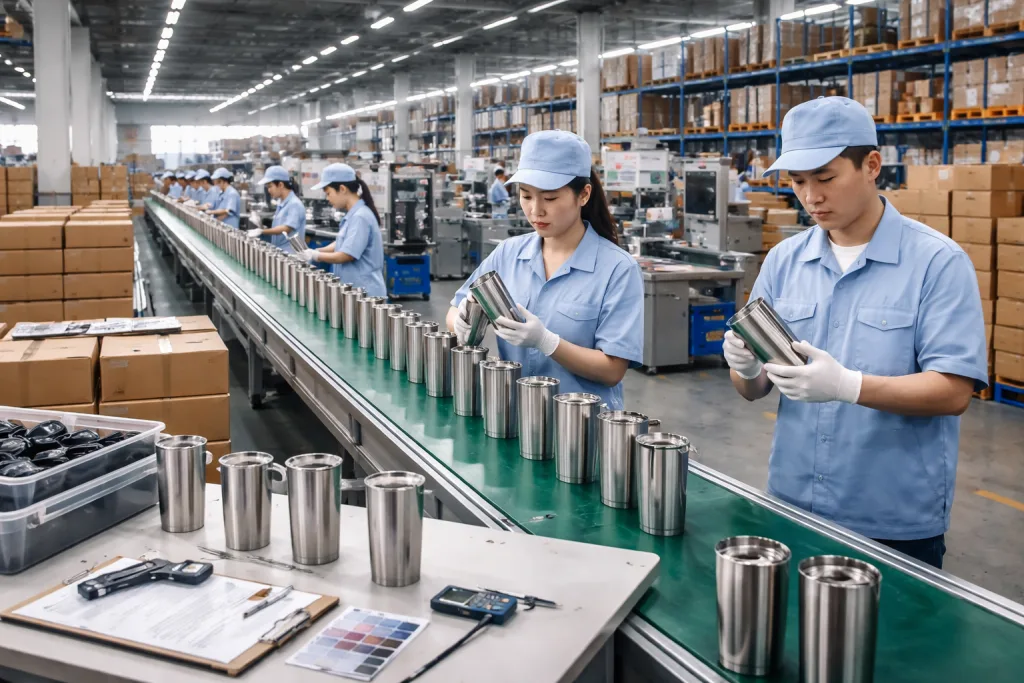
Key Takeaways
- A private labeling insulated tumbler usually lands at $2.80 to $6.50 FOB in China, depending on 304 steel, lid type, and decoration.
- A 1,000-piece MOQ is realistic for standard SKUs from a canteen factory in Zhejiang, but custom molds raise that floor fast.
- For retail-ready quality, ask for 0.5 mm to 0.7 mm stainless steel, REACH-compliant coatings, and AQL 2.5 inspection.
- Lead time is usually 25 to 35 days after sample sign-off; add 7 to 12 days for sea freight to major export ports.
- If you need custom logo, color, and box art together, confirm whether your canteen supplier can manage all three in one run.
If you are buying a private labeling insulated tumbler, the hard part is not putting a logo on a cup. The hard part is locking down wall thickness, powder coat adhesion, lid fit, print wear, and carton packout before the SKU starts eating margin. We’ve seen a 0.3 mm wall change turn into a dent claim. That is where B2B drinkware wins or blows up.
Most buyers in Europe and North America open with a price target and then find out a $2.80 FOB tumbler and a $4.20 FOB tumbler can both look clean in a listing, yet ship and test very differently. QC pulled the sample, the lid leaked at the 45-degree shake test, and the buyer flagged the carton as too loose. At BottleForge Industrial in Zhejiang, we run 120,000 units/month, keep a 1,000-piece MOQ on standard tumbler builds, and ship normal production in 25 to 35 days after sample approval.
What you are really buying
I’ll keep the HTML structure intact and rewrite the prose to sound like a real factory sales engineer, with sharper buying language and a few concrete factory details.When you source a private labeling insulated tumbler, you are not buying “a cup.” You are buying a stack of choices we run on the line: 304 or 18/8 steel, vacuum pull, lid fit, print process, coating formula, and carton spec. If one link is weak, the SKU comes back to bite you. A buyer who only checks capacity and color usually gets burned later by leakage claims, print rub-off, or a temperature curve that misses the catalog copy.
For most private label programs, the base spec is plain enough: 18/8 stainless steel inner and outer walls, 0.5 mm or 0.6 mm shell thickness, double-wall vacuum insulation, and a lid matched to the target market. North American retail often asks for a slider or flip lid; Europe often wants a cleaner press-fit or threaded lid. If you are building custom drinkware for Amazon, DTC, or offline retail, the master carton and barcode spec matter as much as the tumbler. We’ve seen one crushed carton turn a good order into a loss, and the math does not work.
You also need to split cosmetic work from structural work. A logo, Pantone body color, and gift box artwork are standard. A new lid shape, new handle, or embossed body is tooling. That is the line between a normal customizable drinkware order and a project that needs engineering time, extra sampling, and a higher MOQ. QC pulled the sample with a 1.2 mm lid gap once, and the buyer flagged it fast; that is why the best factories in Zhejiang tell you the real cost upfront instead of pretending every idea is cheap.
Price, MOQ, and margin logic
I’ll rewrite the prose only, keep the HTML intact, and make it sound like a factory-side sales engineer with tighter pricing language and a few concrete shop-floor details.Good buyers price from the factory backward. For a standard 20 oz or 30 oz tumbler, a realistic FOB China range sits at $2.80 to $6.50. On our line, the low end is plain steel, a simple powder coat, one-color logo, and bulk pack. The higher end comes from 0.5 mm steel, premium lids, laser engraving, gift boxes, and a 24-hour leak test. If someone quotes $1.90 for a “fully customized” insulated tumbler, something is missing: coating quality, carton strength, or the vacuum spec.
MOQ depends on how much of the product you are changing. A straight private-label order with existing molds can start at 1,000 pieces per color. A custom canteen or custom growler style body with new tooling often needs 3,000 to 5,000 pieces, and a three-color lid can push it higher. We had one buyer flag a PO typo on “3,000 pcs” versus “3000 pcs,” then ask for free tooling; that math does not work. A reliable canteen manufacturer in Zhejiang will usually price the sample at $30 to $120 depending on the logo process, then deduct part of that cost from the first bulk order. That is normal. What is not normal is a supplier promising low MOQ and no tooling fee while also offering every feature under the sun.
Margin planning should include freight, duty, cartons, and returns. A buyer shipping 5,000 units by ocean from China to the U.S. may see freight add $0.35 to $0.90 per unit depending on season. A retail-ready pack with barcode, insert card, and color box can add another $0.20 to $0.60. QC pulled the sample and found a lid torque issue at 18 N·m, which is the kind of thing that turns into chargebacks later. If you are a distributor drinkware buyer, the math only works when you protect landed cost, not just FOB.
What to inspect before approval
I’ll rewrite the section in-place, keeping the HTML exactly as-is and tightening the language so it sounds like a factory-side sales engineer wrote it.Before you approve production, ask for the numbers that drive real field performance. Start with wall thickness; on our line, 0.4 mm and 0.6 mm do not behave the same in hand feel, dent resistance, or heat hold. Check the vacuum seam, lid seal, and coating adhesion next. A solid factory will hand over a sample report with temperature loss data, salt spray notes if metal shows through, and package drop-test results. For export orders, ask whether the coating is REACH-compliant for Europe and whether the material declaration is ready for your file.
Quality control should be specific. Ask for AQL 2.5 for major defects and AQL 4.0 for minor defects if you sell retail. We run leak tests on every lot, especially for backpacks and commuter channels; the buyer flagged one lid gasket on a 500-piece pilot because it passed dry but failed upside down. If the item is sold as a customized drinkware promotion piece, the print has to survive abrasion; if it is a premium SKU, the logo should hold up after repeated hand washing. Laser engraving is safer than silkscreen when durability matters, but it changes the look and the price. A practical canteen supplier will tell you that straight, not chase the cheapest decoration.
For a private label project, the sample is not just a sample. It is your production standard, your marketing photo reference, and your dispute evidence if something goes wrong.
Ask the factory to freeze three items in writing: color code, logo placement, and packaging spec. Those three lines prevent most fights. We once saw a PO typo swap 1 color code and 12 cartons got held at packing; that is the kind of mess paperwork stops. If you work with a canteen factory that ships 120,000 units per month, they know why this matters. If they shrug at documentation, keep looking in China or Zhejiang.
Choosing the right decoration
I’ll rewrite the section in-place, keeping the HTML tags and the existing emphasized terms intact, while tightening the sales language and adding a few factory-floor specifics.The decoration method has to match the channel, not your own taste. Silk screen works for one or two colors on a matte body. Heat transfer and UV printing take more complex graphics, but the line needs tighter control on registration and curing. Laser engraving gives a clean, permanent mark, which is why buyers keep asking for it on premium SKUs and corporate gifts. For a canteen promotional campaign, a simple one-color print usually wins because the unit price stays low and the sell-through stays healthy.
If you are building a customizable canteen line, split structure, color, and logo into separate modules. Then one buyer can order a navy body with a laser logo, while another takes white with a two-color print. That setup helps canteen distributors and distributor canteen buyers turn stock faster. It also lets a canteen vendor or canteen suppliers partner quote three tiers without rebuilding the product from zero. The base item has to stay stable. Too many SKUs with too many decoration variables slow the line and push defect risk up. QC pulled a batch of 200 pcs last month and the mix-up was all in the logo spec, not the bottle.
For premium retail or gift programs, add a matching box and insert card. That is where custom drinkware starts working as brand-building instead of plain sourcing. A fitted box also cuts damage in fulfillment. In our Zhejiang plant, we saw 30% fewer transit claims on SKUs packed in color boxes than on loose bulk pack, and the buyer flagged the carton size before launch because 0.5 mm too much headspace was enough to crush the lid. That is the wrong question to ask if you are only chasing decoration cost; the pack-out cost matters too.
Canteen and growler crossover
I’ll rewrite the section in place, keep the tags and headings intact, and tighten the prose so it reads like a factory-side sales engineer wrote it.Buyers often search one product name and source another. We see it all the time on the line. The same sourcing logic applies whether you are buying a tumbler, a custom canteen, a customizable growler, or a custom growler for beverage retail. Shape, closure, and use case decide the spec. A tumbler usually goes to coffee, commuting, and desk work. A growler is for beverage carry, outdoor use, and bigger fills. A canteen sits between the two and gets picked for sports, school, or promo programs.
Do not treat canteen custom work and tumbler work as the same SKU. We had a buyer flag a PO typo once—“sports cap” on a tumbler file—and QC pulled the sample before packing. A canteen customized with a sports cap and carry loop needs different drop and lid tests than a tumbler with a sliding lid. A customized canteen for corporate gifting may need a different coating gloss, while a customized growler often needs tighter cap retention and thicker steel; 0.6 mm versus 0.8 mm changes the feel fast. That is the wrong question to ask if you lump them together.
If you are a distributor trying to widen your line, ask the factory whether they can run both canteen distributor and distributor growler programs from one toolset. A steady canteen manufacturers or canteen vendors operation in China should quote multiple bottle families, but each SKU still needs its own QC sheet. We run this split with AQL 2.5, and it keeps the math from going sideways when you move from one market to three.
How to source from China properly
I’ll rewrite the three paragraphs in-place, keep the HTML tags unchanged, and tune the wording to sound like a real export sales person from the shop floor.China is where most insulated drinkware capacity sits, but factories are not all on the same level. In Zhejiang, we run into export plants with a 12-line schedule and loose trading desks that call themselves factories. Your job is to separate them fast. A real plant can show you the line, monthly output, coating records, and sample cabinets. A trading company can still work, but you need to know whether you are dealing with a canteen supplier or just a middle layer.
When you request quotes, send a clean spec sheet: capacity, steel grade, wall thickness, lid type, logo method, color reference, carton count, and target market. Ask for FOB terms, sample lead time, mass production lead time, and packing dimensions. If the supplier says “yes” to everything and never asks a follow-up, that is a red flag. QC pulled one PO here because the buyer wrote “matte black” on the sheet and “satin black” on the carton mark; the math does not work if the details stay loose. Better factories ask about your channel because Amazon FNSKU labels, retail barcodes, and pallet rules all change the build. That matters for North American importers who want one SKU to cover ecommerce, wholesale, and promotions.
Use a short vetting list: business license, factory audit, REACH or food-contact declaration, and sample confirmation. If you can, ask for photos from current production instead of catalog shots. A serious exporter in Zhejiang will not mind. We have seen this go sideways when a buyer approved a sample from a photo folder and never checked the real 304 stainless wall at 0.5 mm. The stronger factories usually like detailed buyers because the order runs cleaner and the repeat PO lands faster.
Request a factory quote with your exact spec
Send your target price, MOQ, logo method, and carton plan. We’ll quote the right insulated tumbler for your market, not a guess.
Frequently asked questions
What is the usual MOQ for a private labeling insulated tumbler?
For a standard private labeling insulated tumbler with existing molds, 1,000 pieces per color is common in China. If you change the lid, body shape, or add new tooling, MOQ often moves to 3,000 or 5,000 pieces. A simple logo-only run can sometimes stay at 500 to 800 pieces, but the unit price rises. For buyers in Europe and North America, the best approach is to lock one base SKU, then expand colors after the first sell-through.
How much should I budget per unit FOB China?
A practical FOB China budget is $2.80 to $6.50 per unit for most insulated tumblers. The lower end covers basic stainless steel, standard powder coat, and simple printing. The upper end covers thicker 304 steel, premium lids, laser engraving, gift boxes, and stricter packing. If you want a canteen customized for retail, add packaging, carton inserts, and test costs. Always compare landed cost, not just FOB.
What lead time should I expect from a Zhejiang factory?
After sample approval, normal lead time is 25 to 35 days for production. If you need new tooling, a special lid, or a busy season slot, allow 45 to 60 days. Shipping by sea to Europe or North America usually adds 7 to 12 days to major ports, plus customs clearance. A Zhejiang canteen factory with stable lines can often hit repeat-order timing faster because tooling and color codes are already fixed.
Which decoration method lasts longest?
Laser engraving usually lasts the longest because the mark is mechanical, not ink-based. It is a strong choice for premium custom drinkware, corporate gifting, and high-touch retail. Silk screen is cheaper and works well for one or two colors, but it can wear if the tumbler gets rough handling or repeated dishwasher cycles. If you want a canteen promotional item with a low unit price, print is fine; if you want a premium SKU, engraving is safer.
How do I avoid quality problems on my first order?
Set the spec in writing and freeze the sample. Ask for 18/8 stainless steel, wall thickness, logo position, coating code, and carton spec. Require AQL 2.5 inspection for major defects and leak testing for every lot. For Europe, confirm REACH-related compliance. For Amazon or retail, label each carton correctly and confirm FNSKU or barcode placement. A reliable canteen supplier in China will document these steps without hesitation.