Key Takeaways
- Typical MOQ for a private labeling coffee mug in stainless steel is 1,000 units, with 25-35 day lead time after sample approval.
- A 12 oz double-wall tumbler usually uses 18/8 stainless steel with 0.4-0.5 mm inner and outer wall thickness.
- FOB China pricing for a decent bulk coffee mug starts around USD 2.80-4.50 depending on finish, lid, and decoration.
- For EU and North America, ask for REACH, LFGB, FDA contact statements, and AQL 2.5 / 4.0 inspection terms.
If you are buying a private labeling coffee mug program, the real question is not whether the cup looks good on a sample desk. It is whether the line can ship 2,000 pieces this week and 20,000 pieces next month, with leak test results, print alignment, and carton count holding steady. For coffee brands and corporate-gift buyers, a travel tumbler is often the safer buy than a fragile ceramic mug, but only if the factory has lid-fit gauges, drop-test records, and a coating that does not scuff after 200 rubs. We have seen buyers fixate on the photo and miss the lid. That is the wrong question to ask.
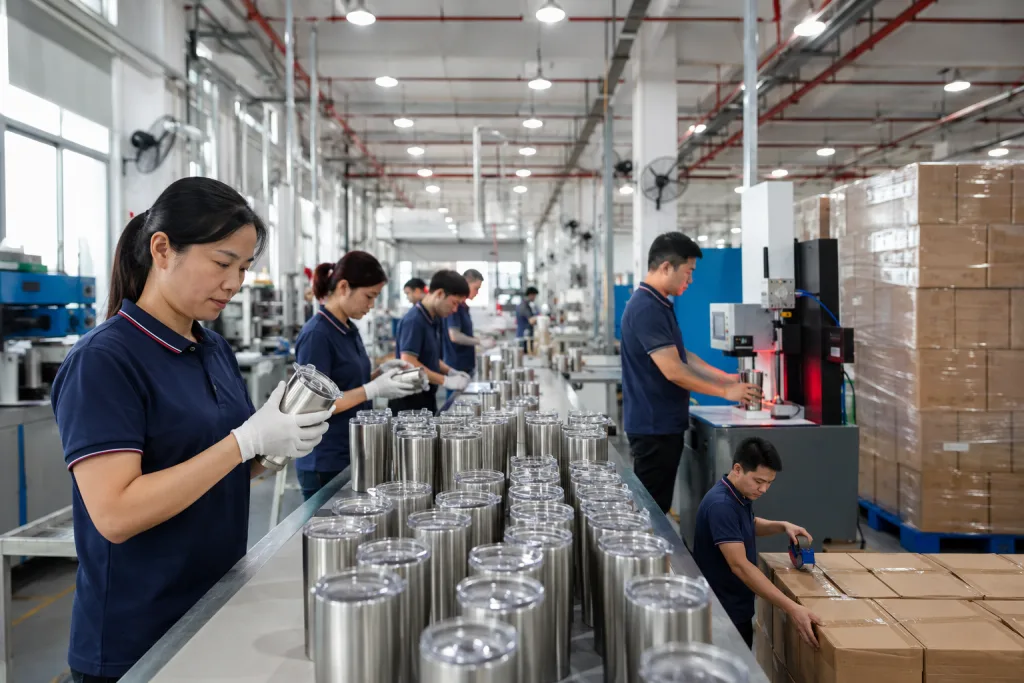
We build drinkware in Zhejiang, China, and the pattern is always the same: the buyers who do well treat the mug like a sourcing job, not a merch item. They ask for stainless steel grade, wall thickness in mm, coating spec, AQL 2.5, and FOB pricing before they talk artwork. Last week QC pulled a sample with a 0.8 mm print shift, and the buyer flagged it before packing. Good coffee mug factory work is numbers first, not slogans, and private label changes should not turn into a new fee every time.
What private label buyers actually need
I’ll rewrite the section in-place, keep the HTML tags and headings intact, and tighten the prose so it sounds like a factory-side sales engineer.When buyers search for private labeling coffee mug, they want one straight answer: can this item carry my brand and still make margin in bulk? Yes, if the mug fits the channel. A corporate-gift order needs a clean logo, a premium unboxing, and landed cost locked before PO. A coffee brand usually wants a coffee mug custom piece that can sit next to beans, subscription boxes, or a POS kit without looking out of place.
The common mistake is treating every mug like a promo throwaway. A coffee mug promotional order can live with a looser spec. Retail stock cannot. If you want a real coffee mug private label program, ask for the structure first: 304 or 316 stainless, PP or Tritan lid, powder coat or paint, laser engraving or silk screen, and 100% vacuum testing or sampling only. We had a buyer flag a PO typo once—“316” became “310”—and QC pulled the sample before the line ran. In Zhejiang, the better factories answer in spec language, not sales talk.
For a first run, we push one SKU, one lid, one decoration method. That keeps tooling under control and tells you if the market moves before you build a wider range of coffee mug custom made variants. Start with six sizes and four lids, and the math gets ugly fast. If the program has legs, add colors in the next round. Simple wins. Every time.
Choose the right tumbler structure
I’ll rewrite the section in-place, keep the HTML structure intact, and tighten the copy so it sounds like a factory-side sales engineer wrote it.Buyers often ask for a “mug,” but the shelf usually wants a travel tumbler. Ceramic works for desk use. A bulk coffee travel mug or bulk travel tumbler sells better for commuting, gifting, and resale because it looks more premium and survives shipping drops; we ship 5,000 pcs in one carton run with far fewer breakages than ceramic. For a premium coffee brand, 12 oz or 16 oz is the right call. It fits espresso, drip coffee, and most car cup holders without a fight.
Check the structure first. A real vacuum tumbler uses double-wall stainless steel, a copper or vacuum chamber, wall thickness around 0.4-0.5 mm, and a lid that still seals when the cup is tipped 180 degrees. If you want a hot-hold claim, ask for test data, not a slogan like “keeps hot for 8 hours.” We’ve seen that line go sideways when the buyer flagged a 72°C result at the 4-hour mark because the lid vent was too open. Fill volume, lid design, and room temperature all change the result. A narrower mouth usually holds heat better than a wide-mouth cup.
- 12 oz: best for premium merch and office use
- 16 oz: strongest all-around retail size
- 20 oz: better for long commute and outdoor use
- 30 oz: good for value-led bulk coffee tumbler programs
If you need a bulk coffee mug for corporate gifting, pick the model that looks clean at a 45-degree angle and still shows the logo on camera. If you need a coffee mug in bulk for fast-moving retail, choose the version with the fewest decoration steps and the most stable lid supply. That is the right question to ask. A pretty sample is nice; a lid that arrives on time is what keeps the PO moving.
Materials and compliance matter
I’ll rewrite the section in-place, keeping the HTML tags and the four strong tags intact while stripping the AI-ish phrasing and adding a few factory-floor specifics.Material choice hits price, compliance, and returns. For stainless drinkware, 18/8 stainless steel is the baseline for a serious coffee mug manufacturer. It resists corrosion, cleans up fast, and buyers in Europe and North America know what it is. If a factory drops the price too hard, check the wall thickness, lid spring, and inner liner grade. We’ve seen a 0.3 mm wall spec turn into 0.25 mm on the line, and that is where the math stops working. A coffee mug factory direct quote only matters when you know what sits behind the number.
For export markets, ask for REACH paperwork for coatings and accessories, LFGB for food-contact sales in Germany and nearby markets, and an FDA contact statement if you sell into the US. These are not showpiece files. Your distributor will need them when a retailer asks for proof or a marketplace flags the listing. QC pulled the sample, and one PO typo on the carton mark turned into a 3-day delay. A solid coffee mug oem manufacturer in China should know how to prep those files without hand-holding.
In Zhejiang, the stronger suppliers usually run cleaner welds, polishing, and surface treatment than the average coffee mug supplier listing online. That is why a factory audit matters more than a directory. A coffee mug supplier directory can start the search, but it will not show you whether the lid groove is cut at the right depth or whether the coating chips after 200 dishwasher cycles. We’ve had buyers flag a lid that rattled at 1.5 mm tolerance, and the whole batch had to be reworked.
Ask for the same compliance pack every time: material declaration, test report, carton drop test, and AQL inspection terms. If the factory hesitates, they are not set up for export.
Decoration choices change margin
I’ll rewrite the section in place, keep the HTML exactly as-is, and tighten the prose to sound like a factory-side sales engineer.Private label is not just a logo. It is a decoration stack. For a coffee mug custom program, the line usually comes down to screen print, laser engraving, UV print, heat transfer, and wrapped paper or gift-box branding. Each one carries a different setup charge, cycle time, and wear test result. A one-color print can work for a coffee mug promotional products order. Laser marking costs more, but it looks cleaner and takes abrasion better; QC pulled a sample with 50 rub passes last week and the print still held.
If you are testing a new brand, keep the art simple. A one-color logo on a matte powder-coated tumbler is easier to run than a full-wrap design with gradients. We’ve seen that go sideways fast. One buyer sent a PO with “Pantone 186 C” typed as “189 C,” and the first proof missed the mark. For most buyers, the real value of a coffee mug customized program is repeatability. You want the second order to match the first order within a tight tolerance, not a fresh interpretation of your brand color.
Typical decoration economics from a Zhejiang factory: screen print may add USD 0.15-0.35 per unit, laser engraving about USD 0.20-0.60, and full-color UV print can add more depending on coverage. If you are comparing coffee mug manufacturers, compare the finished delivered look, not just the decoration line item. The math does not work if the cheap print saves USD 0.10 and then flakes after one wash cycle. We run a tape test and an 80°C water soak on the line before shipment; that tells you more than a sales sheet.
For corporate buyers, a restrained logo often sells better than a loud one. A coffee mug promotional piece should still feel like a product, not a billboard. That is where private label and promo merch split paths. If the mug goes to clients in a boardroom, a 25 mm mark near the handle usually lands better than a full wrap across the body.
MOQ, pricing, and lead time
I’ll rewrite the section in place, keep the HTML structure intact, and tighten the language so it reads like a factory-side sales engineer.Let’s talk numbers, because that is where a deal gets decided. For a coffee mug private labeling run, 1,000 pieces per design is the usual MOQ on standard stainless tumblers. We do see 500-piece asks, but the math gets ugly fast: higher unit cost, less room on decoration, and less room on packaging. Mixed colors can stay near 500 units per color if the coating line is set up and the lids are already in stock.
FOB for a standard 12 oz or 16 oz insulated cup usually sits around USD 2.80-4.50 for a basic build, with premium finishes moving up from there. Custom boxes add another USD 0.30-1.20 a piece. A real coffee mug supplier should quote by spec, not by “good quality.” Ask for the sample fee, any mold fee, packing spec, and carton loading count. QC pulled a carton sample last week and found the buyer’s PO had “16oz” typed as “160z”; that kind of typo changes the whole quote.
Lead time usually runs 25-35 days after sample approval for stable orders, and special colors or imported lids push it out. A line with 300,000 units per month still waits for your artwork sign-off before it runs your order. That is normal. If someone promises a 7-day turnaround on a custom insulated tumbler, they are selling stock or skipping steps you will pay for later. We’ve seen that go sideways more than once.
If you are comparing a coffee mug factory with a distributor, look at the margin first. A coffee mug distributor can work for a 200-piece urgent buy, but once the design is stable, a factory gives you tighter control on branding, packaging, and landed cost. On our side, we run the line at a 1.5 mm rim tolerance and check lid fit before palletizing; that is the kind of detail a distributor usually cannot touch.
How to source without getting burned
I’ll rewrite the section in-place, keep the HTML exactly as-is, and make the prose sound like a real export sales engineer wrote it.Buying from a coffee mug manufacturer in China works best when you ask the awkward questions before the deposit lands. We run the line that way for a reason. Ask for production photos, a pre-production sample, and one QC standard in writing, then pin down the carton drop test, leak test method, and AQL level before PO confirmation. For export drinkware, AQL 2.5 for major defects and 4.0 for minor defects is a normal starting point, and we have tightened it to 1.5/2.5 when a buyer’s channel could not tolerate rework.
Do not trust a coffee mug supplier list by itself. We have seen it go sideways: factories, traders, and trading companies all sitting on the same page. A real coffee mug supplier directory can help you build a shortlist, but you still need to check who owns the tooling, who prints the logo, and where QC pulls the sample. One buyer flagged a PO typo on “304 stainess steel” after sampling, and that small miss would have cost a week if we had not caught it. In Zhejiang, some of the better export plants are plain on the outside. Fine by me. You are buying output, not a polished homepage.
If you are ordering bulk coffee mug or coffee mug bulk programs for distribution, use the sample stage to check cup-holder fit, lid noise, grip feel, and coating scratch resistance. We measure cup-holder fit in 2 mm steps because that is where retail returns start. These details decide repeat orders. The same applies to coffee mug factory direct sourcing: direct only matters if the factory can repeat the approved sample on the next 5,000 pieces.
One more practical note: if your market is Amazon or marketplace-driven, ask the factory to print FNSKU labels or handle polybag and carton marks before shipment. It saves labor and cuts warehouse rework. QC pulled the sample on one shipment because the carton mark was 8 mm off the spec line. Better to catch that on the line than at the fulfillment center.
Build your private label tumbler with real specs
Send your size, logo, and target price. We’ll quote MOQ, lead time, and packaging from our Zhejiang factory with clear export terms.
Frequently asked questions
What MOQ should I expect for private labeling coffee mug orders?
For most stainless travel tumbler projects, expect 1,000 pieces per design as the normal MOQ. If the factory has stock shapes and standard lids, 500 pieces may be possible, but unit price often rises by 10% to 25%. For mixed colors, some factories will ask for 500 units per color. In Zhejiang, export-focused plants usually prefer one design, one lid, and one decoration method for the first order because it keeps yield high and packaging stable. If a supplier promises 100 pieces with full custom branding, check whether they are a trader reselling stock goods.
How much does a custom travel tumbler cost FOB China?
A basic custom insulated tumbler usually starts around USD 2.80 to 4.50 FOB China, depending on size, lid type, finish, and logo method. A powder-coated matte body, standard slider lid, and one-color print sit near the low-to-mid range. Laser engraving, premium gift boxes, or special lids push the price up. If you want a retail-ready private labeling coffee mug program, budget another USD 0.30 to 1.20 for packaging. Real pricing should be tied to exact wall thickness, steel grade, and accessory list, not just the size printed on the quote.
What material is best for a bulk coffee travel mug?
For export markets, 18/8 stainless steel is the safest choice for a bulk coffee travel mug. It resists corrosion, is easy to clean, and works well for both hot and cold drinks. Most good factories use about 0.4 to 0.5 mm wall thickness on the inner and outer shells, with vacuum insulation between them. For lids, PP is common and economical, while Tritan can feel more premium. If a supplier offers a very low price, check whether they reduced steel thickness or replaced a real vacuum wall with a cheaper structure.
Which decoration method lasts longest on a coffee mug customized order?
Laser engraving usually lasts the longest because it removes surface material rather than sitting on top of the coating. It is a strong option for corporate gifts and premium retail. Screen print is cheaper and works well for simple logos, but it can wear faster if the mug sees heavy washing or abrasion. UV print is good for full-color branding, but you should confirm scratch resistance and dishwasher behavior before you approve mass production. For a private labeling coffee mug program, ask for a decorated sample you can wash 20 to 30 times before final approval.
How do I choose between a coffee mug supplier and a coffee mug factory?
If your order is small, urgent, or highly mixed, a coffee mug supplier or distributor may be convenient. If you want better control on price, packaging, and repeatability, go factory direct. A real coffee mug factory should be able to show production capacity, usually in the tens or hundreds of thousands of units per month, plus QC processes and export documents. Ask who owns the tooling, where printing happens, and whether the same team handles final inspection. If the answers are vague, you are likely dealing with a trading layer, not the source plant.