Key Takeaways
- A realistic private label vacuum flask MOQ is 3,000 pcs per color for most custom colors
- 304 stainless steel inner walls are standard; 316 is useful only for higher-corrosion use cases
- Laser engraving usually adds USD 0.08-0.18 per unit, while full-color print costs more
- AQL 2.5/4.0 inspection should cover vacuum loss, coating adhesion, leakage, and carton drop tests
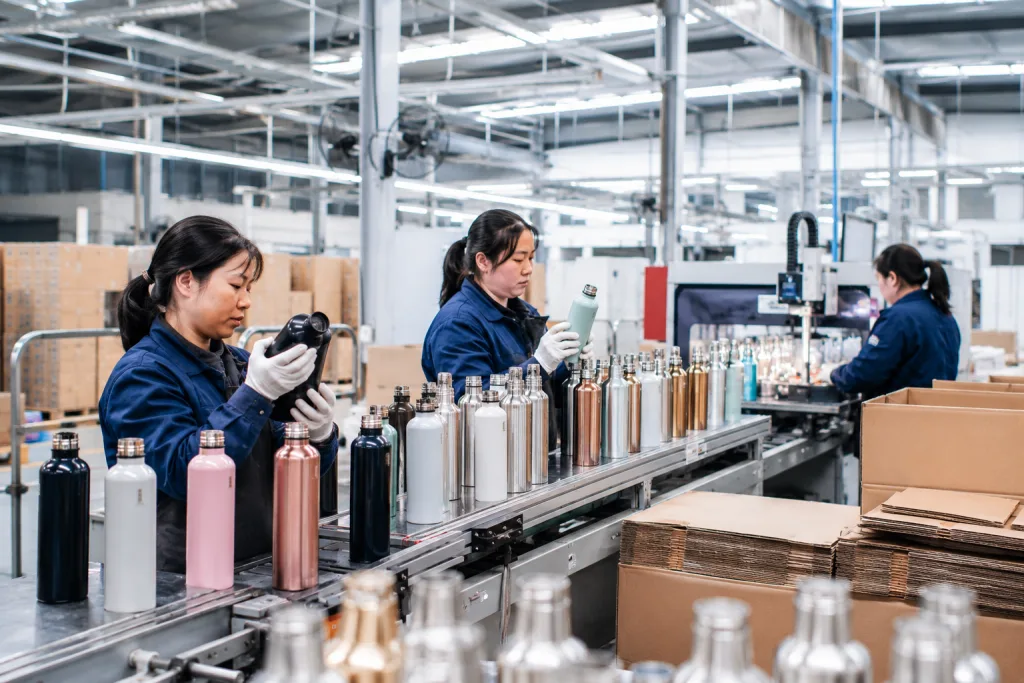
A private label vacuum flask can look plain on a shelf, but the purchase sheet behind it is not. We run steel grade checks, vacuum loss tests, coating cure, cap fit, logo method, packaging, compliance papers, and carton drops before a sample leaves the line. If you sell outdoor gear or promo thermos programs, one loose cap or a wrong print file turns into returns, chargebacks, or a launch delay.
From our thermos factory base in Zhejiang, China, we start with hard limits: 3,000 pcs MOQ per color for most stainless models, 25-35 days for mass production after sample approval, and FOB pricing that still leaves room for freight and duty. QC pulled a sample with a 0.3 mm lid gap last week, and the buyer flagged it fast. That is the right question to ask, not how to make the spec sound fancy.
Start With The Real Specification
The RFQs that slow us down usually miss the same basics: target capacity in ml, lid style with photo or reference code, coating finish, logo size in mm, packing method, and where the flask will be sold. Without that, we can only quote a spread. That is how one buyer gets USD 3.20 from one factory and USD 5.10 from another, then burns 14 days learning the cheap quote used a push lid, single-color box, and no drop test. We see this every month. Last Tuesday our merchandiser pulled an RFQ where the PO even typed “750 m” instead of “750 ml,” and the line stopped asking questions until QC flagged the sample label.
For outdoor retail, start with capacity. The common range is 500 ml, 750 ml, and 1,000 ml, but each size needs a job. A 500 ml flask fits commuter bags and promotional thermos campaigns where the buyer wants 24 pcs per carton. A 750 ml custom thermos sits better on hiking and camping shelves because the grip still feels manageable with gloves. A 1,000 ml model looks like stronger value on the shelf, but the math does not always work: steel weight goes up, carton CBM climbs, and the freight line on the quote gets ugly. We run carton checks with a 5 kg scale and a tape measure before giving a final FOB number.
Wall structure matters more than most buyers think. A typical manufacturer thermos uses double-wall 304 stainless steel, with inner wall thickness around 0.4 mm and outer wall around 0.5 mm. Some low-price thermos manufacturers cut the gauge to chase price. You may save USD 0.15 per unit, but dent resistance drops and vacuum stability suffers after transport vibration. Bad trade. For a distributor thermos line, we push back here because we have seen this go sideways: QC pulled the sample after a 1.2 m drop test and found a flat spot near the shoulder before the vacuum test even started.
Send thermos drawings if you have them, especially lid section drawings and logo placement in mm. A clean written brief also works. Include capacity, lid reference, powder coating color with Pantone code, logo process, packaging type, MOQ target, market destination, and testing requirements. A serious thermos factory in China will ask follow-up questions before quoting, such as whether the barcode goes on the color box or master carton. If they do not ask, they are probably guessing, and guessing is the wrong way to build a private label vacuum flask.
Steel, Vacuum, And Heat Claims
Heat-retention claims are where buyers get misled. This is the wrong question to ask if the spec sheet says “keeps hot 24 hours” with no test condition. A 750 ml narrow-mouth vacuum flask with a sealed screw cap will beat a wide-mouth bottle with a push-button lid on our line 8 times out of 10, because the mouth may be 42 mm instead of 58 mm and the lid has fewer plastic break points. More openings mean more heat loss. QC pulled one sample last month where the buyer flagged a 9°C drop after 12 hours; the issue was not the steel, it was a loose silicone gasket sitting 0.6 mm proud.
For private label vacuum flask programs, 304 stainless steel is the normal choice for both inner and outer shells. It is food-contact safe, stable, and keeps the cost where most retail programs need it. 316 stainless steel gets requested for premium outdoor ranges, but it can add USD 0.30-0.70 per unit depending on size and market steel pricing. The math doesn’t work for every brand. Unless the flask will handle salty liquids, marine use, or a top-shelf gift set, 304 is usually enough; we run 304 on most 3,000 pcs MOQ color orders and check wall thickness with a digital caliper before polishing.
Vacuum performance needs a test sheet, not a slogan. Fill with water at 95°C, close the lid, hold at 20-25°C ambient temperature, and measure after 6, 12, and 24 hours. A well-made 750 ml stainless flask should often stay above 65°C after 12 hours under this method, but the exact number depends on the mouth diameter and cap design. Ask your thermos manufacturer for the test method, not just the marketing number; we’ve seen this go sideways when a PO typo changed “12h ≥65°C” to “24h ≥65°C” and nobody caught it until pre-shipment inspection.
Cold retention is easier to claim, but it still needs a clean setup. Ice retention for 24 hours sounds strong, yet it depends on ice ratio and room temperature; 300 g ice in a 750 ml flask at 22°C is not the same test as half-fill ice in a 30°C warehouse. For North America, also check relevant food-contact requirements such as FDA/LFGB-style material declarations where requested. For Europe, REACH and food-contact documentation should be prepared before shipment. A supplier thermos partner should understand these files before you place thermos bulk orders, because customs will not care that the carton line was already sealed with 48 mm BOPP tape.
Logo And Finish Choices
Your logo method changes cost, look, and wear life. For stainless thermos custom jobs, laser engraving stays our safest pick. It burns away the coating or marks the steel, so there is no ink layer to peel. On powder-coated bodies, we usually quote USD 0.08-0.18 per unit, and that depends on logo size and exact placement. The line runs a 100W fiber laser for this work, and for outdoor retailers that is the cleaner answer.
Silkscreen printing fits one-color logos and bigger promotional thermos orders. It is cheaper than heat transfer for simple artwork, but ink adhesion and curing need tight control. Plate charge is usually USD 30-60 per color and position. We ran a 5,000 pcs batch last month, and the setup fee was fine; for a 500 pcs trial, the math does not work as well. The buyer flagged a small font on the PO, and we had to widen the stroke before printing.
Heat transfer and UV printing suit gradients or multi-color brand graphics. They look sharper on a customizable thermos, but the process has more risk. We ask for cross-hatch adhesion testing, alcohol rub testing, and tape pull testing on pre-production samples. QC pulled the sample after a 50-cycle rub test on one job, and the edge lift showed up fast. Do not approve artwork from a screen shot only. Ask for a physical sample shot under normal light.
Coating choice needs the same practical eye. Powder coating gives grip and a matte outdoor feel, so we push it most days. Spray painting costs less, but scratch resistance drops on the line after a few handling cycles. Stainless polish looks clean, though it shows fingerprints fast. From our Hangzhou, Zhejiang office, we usually steer buyers to powder coating for retail and laser engraving for logo life. It is not the flashiest mix, but it cuts down warranty arguments later.
MOQ, Price, And Lead Time
For a private label vacuum flask, a workable MOQ is usually 3,000 pcs per color for custom powder coating, or 1,000-2,000 pcs if you stay with stock colors and a standard lid. If you want a new mold, a new cap, or an exclusive silhouette, the order jumps to 10,000 pcs or more. Tooling for a new lid usually lands around USD 2,000 to USD 8,000, and we have seen buyers underquote that by half on the PO.
FOB China price moves with capacity, steel weight, lid structure, coating, and carton spec. A 500 ml stainless vacuum flask usually sits around USD 3.20-4.80 FOB Ningbo or Shanghai for normal private label work. A 750 ml model may be USD 4.20-6.20, and a 1,000 ml model may be USD 5.20-7.80. That is a buying range, not a commitment, because artwork, cartons, and compliance paperwork still change the math. QC pulled the sample last week and found a 28 g weight swing on one lid set; that kind of miss shows up in price fast.
Lead time is cleaner once the spec is locked. Sampling usually takes 7-12 days for logo and color samples. Mass production is commonly 25-35 days after deposit and sample approval. In peak season before summer and Q4 promo runs, add 7-10 days. Our Zhejiang line can push about 450,000 stainless drinkware units per month across flask, tumbler, and bottle runs, but the line still backs up when three big accounts book the same ship week. This is where buyers get burned by wishful timing.
If you are buying distributor thermos inventory, do not chase the lowest MOQ without checking repeat supply. A thermos vendor that ships 1,000 pcs once may not repeat the same color six months later. For private label, steady color, lid, and carton supply matters more than a one-time cheap buy. The buyer flagged it on a past order: same Pantone, different finish, and the reprint bill was ugly.
Quality Control Before Shipment
Quality control for a manufacturer thermos order belongs in the purchase order before we cut steel, not after the line has packed cartons. We run AQL inspection as the baseline. For most export orders, AQL 2.5 for major defects and 4.0 for minor defects is a practical standard. Critical defects, such as leakage, sharp metal burrs, wrong material, or unsafe packaging, should be zero tolerance. Last month QC pulled a 500 ml sample with a 0.6 mm burr on the inner rim; that carton failed, even though the outside looked clean.
The inspection list should cover vacuum performance, leakage, coating adhesion, logo position, lid fit, odor, capacity check, carton markings, and barcode scan, with each item tied to a photo or test record. For outdoor retail, add a drop test on the retail box and master carton, usually 1 corner, 3 edges, and 6 faces from 76 cm. For e-commerce and promotional brands, make sure FNSKU, UPC, or campaign labels scan before cartons are sealed. We have seen this go sideways: a buyer flagged one missing digit on an FNSKU, and re-labeling 300 cartons in a warehouse cost more than the final inspection.
Leakage testing should be simple but strict. Fill the flask, close it, invert for at least 30 minutes, then check the lid seal and thread with dry tissue. No guessing. For vacuum testing, factories often use hot water and temperature probes during production, then sample testing during final inspection; on our line, the probe sits in the cup mouth and records the temperature drop after 6 hours. Coating adhesion can be checked by cross-hatch and tape pull. Logo durability can be checked by alcohol rub or abrasion tests based on the printing method.
Ask whether your thermos suppliers operate under ISO 9001, BSCI, Sedex, or similar audit systems if your customers require them. These audits do not mean every flask is perfect, and this is the wrong question to ask if nobody checks daily records. The better question is whether the factory keeps signed IPQC sheets, pressure test logs, and final AQL reports by PO number. For China sourcing, documented process control is not optional if you want repeatable bulk thermos quality.
Packaging For Retail And Promotion
Packaging does more than dress up the flask. It cuts breakage, shifts freight weight, and decides whether the shelf copy looks clean or sloppy. For an event handout, a plain white box is enough. For retail, we usually push a color box with printed capacity, insulation time, 304 stainless, and care notes on the panel. That is the right question to ask first, because the line gets into trouble when packaging is treated as an afterthought.
For a private label vacuum flask, the usual pack-out is one piece in a polybag or tissue wrap, then a white box or color box, then 24 pcs per master carton for 500 ml or 12 pcs per carton for larger 1,000 ml models. We ran a 1.2 m drop test on a 5-layer carton last month, and the buyer flagged crushed corners after parcel handling, so carton strength needs to be set before print plates are made. If the goods ship by sea, standard export cartons often work. If they go into parcel networks or FBA-style handling, use heavier corrugated board and test it early.
Do not skip inserts. A care card saves a lot of complaints by telling users not to put the flask in a dishwasher, microwave, or freezer. We had one PO where the buyer missed the warning text on page 2, and QC pulled the sample before packing. For Europe, check the language mix with your distributor before we print. For North America, hot-liquid warnings are often expected. If you sell through a thermos distributor network, the outer carton should show SKU, color, quantity, gross weight, net weight, carton size, and country of origin.
Packaging also changes MOQ. Custom color boxes usually start around 1,000-3,000 pcs per design, depending on the print supplier and paper stock. We have seen this go sideways when a buyer wanted 8 colors on day one, then sat on slow-moving boxes for 6 months. A neutral box with color stickers is less polished, but it keeps stock moving and keeps the line from being stuck with dead inventory.
Choosing The Right Factory Partner
A good thermos factory does more than weld 304 stainless. It should push back on vague specs, call out where the math does not work, and put every key detail in writing. If a supplier says yes to everything without talking MOQ, tooling, lead time, or test limits, we walk away. On the line, a 500 pcs MOQ can turn into a 3,000 pcs carton plan fast, and that is where weak factories get exposed.
Ask for fresh production photos, not catalog art. We want to see the vacuum leak tester, coating oven, laser engraving machine, packing table, and the QC sheet from the last run. For a private label thermos order, we ask for a pre-production sample after artwork approval, then keep one signed sample at the factory and one in the office. QC pulled the sample against the Pantone card, and that is the only reference that matters when the buyer flags logo size or finish drift.
Payment terms tell you a lot. A normal first order is 30% deposit and 70% balance before shipment after inspection. For repeat buyers with steady volume, the terms can move, but only after the factory has seen clean payment history and a few smooth shipments. FOB Ningbo or Shanghai is standard for Zhejiang suppliers. If you need DDP, spell out duty payment, importer of record, and product liability paperwork before the PO goes out; we have seen that go sideways over one missing HS code.
For outdoor retailers and promo brands, the right supplier is not the cheapest thermos vendor. It is the one that holds the same steel grade, coating tone, cap fit, carton size, and lead time across repeat orders. That is how a one-off private label flask becomes a line you can reorder without drama. On a repeat run, even a 1.5 mm cap mismatch can cost a week, so we treat consistency as the real test.
Send Your Flask Spec For A Factory Quote
Share capacity, color, logo method, packaging, and target quantity. We will return practical MOQ, FOB pricing, sampling time, and production lead time.
Frequently asked questions
What MOQ should I expect for a private label vacuum flask?
For most stainless private label vacuum flask orders, expect 3,000 pcs per color when you need custom powder coating. If you use a stock body color and only add laser engraving or one-color printing, some factories can accept 1,000-2,000 pcs. New molds, exclusive caps, or special shapes usually start around 10,000 pcs because tooling and line setup need enough volume. For promotional thermos jobs with many small logo variations, it is better to keep one body color and change only the artwork. That keeps MOQ, lead time, and inventory risk under control.
How long does sampling and production take?
A normal logo sample takes 7-12 days after artwork confirmation. If you need a custom powder coating color matched to Pantone, allow 10-15 days because the coating sample needs mixing, spraying, curing, and approval. Mass production normally takes 25-35 days after deposit and signed sample approval. Add 7-10 days during peak periods, especially before summer outdoor retail programs and Q4 promotional campaigns. If packaging is custom printed, approve the dieline and barcode early. Many delays come from box artwork, not from the stainless flask itself.
Is 316 stainless steel better than 304 for thermos bulk orders?
316 stainless steel has better corrosion resistance, especially around salt, acidic liquids, and marine environments. But for most thermos bulk programs, 304 stainless steel is the practical standard and performs well for water, coffee, and tea. Moving to 316 can add roughly USD 0.30-0.70 per unit depending on capacity and market steel cost. If your audience is premium fishing, sailing, or coastal outdoor users, 316 may help positioning. If your product is for general retail or promotional use, invest the extra budget in better coating, cap design, or packaging instead.
Which logo method is best for a custom thermos?
For a custom thermos used outdoors, laser engraving is usually the safest logo method. It is durable, clean, and normally costs USD 0.08-0.18 per unit depending on logo size. Silkscreen printing is good for one-color promotional logos and large orders, with plate charges around USD 30-60 per color. Heat transfer or UV printing works for full-color graphics, but you should require adhesion and alcohol rub tests before mass production. If the flask has powder coating, always test the logo on the actual coating, not on a flat metal sample.
What inspections should I require before shipment?
Use AQL 2.5 for major defects and 4.0 for minor defects as a baseline. Critical issues such as leakage, wrong material, unsafe burrs, or failed vacuum should be zero tolerance. Your inspection checklist should include capacity, weight, lid fit, leakage after 30 minutes inverted, vacuum temperature test, coating adhesion, logo position, barcode scan, carton markings, and drop test. For retail orders, inspect both product and packaging. For e-commerce or distributor thermos orders, confirm FNSKU, UPC, SKU, color, and carton quantity before the balance payment is released.