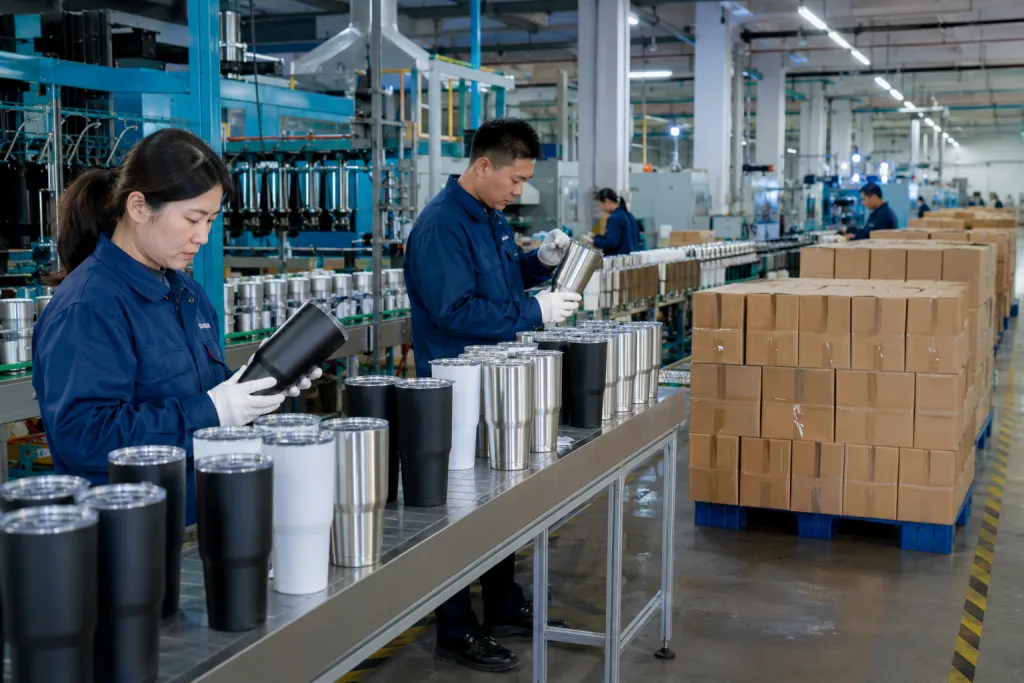
Key Takeaways
- A realistic MOQ for a private label travel tumbler is usually 1,000-3,000 pcs per color
- 304 stainless steel at 0.4-0.5 mm wall thickness covers most coffee and gift programs
- Expect 25-35 days production after artwork, color sample, and deposit approval
- Use AQL 2.5/4.0 inspection plus leak, coating adhesion, and barcode checks before shipment
If you sell coffee, manage corporate gifts, or buy promo drinkware, a private label travel tumbler looks easy until the first quote sheet lands in your inbox. One factory writes 304 stainless steel, another pushes 316, one quotes FOB Ningbo, another writes EXW Zhejiang, and the same 20 oz tumbler jumps from USD 3.20 to USD 6.80. The buyer flagged this exact spread last March; after we checked wall thickness with a digital caliper, one “20 oz” sample was 0.38 mm thinner on the inner liner.
You need a bulk travel tumbler that feels right in the hand, passes dishwashing claims if you print them, holds coffee hot for a real commute, and arrives with the logo centered, cartons clean, and barcodes scanning at the warehouse. BottleForge Industrial manufactures in Zhejiang, China, and here is our pushback: inspection is the wrong place to fix a weak spec. We run pre-production checks on logo position, lid fit, carton drop corners, and barcode print before the line starts; QC pulled one sample last week because the PO said matte black, but the artwork file named it “met black.”
Start With The Real Use Case
Do not ask for “your best travel tumbler” at the start. That gets you 38 catalog pages and no decision. Start with the use case: where the cup sits, who drinks from it, and how you plan to sell it. A coffee brand building retail bundles is not buying the same product as a corporate-gift buyer loading 5,000 pieces into a conference welcome kit. We had one PO last month marked “matte black 16 oz,” then the buyer’s artwork showed a 20 oz body; QC caught it before the coating line booked the wrong fixture.
For coffee brands, the questions are plain: Will it fit under common espresso machines with a 145 mm clearance? Does the lid feel right for sipping while driving? Will hot drip coffee create a burnt-lip complaint after the first week of reviews? A 12 oz or 16 oz private label travel tumbler usually works better for café retail shelves than a bulky 30 oz size. For corporate gifting, 20 oz is the safer middle ground because it feels worth giving without pushing carton weight past the buyer’s freight math. We run a simple fit check on the line with a cup-holder gauge and a height ruler before approving the pre-production sample.
If you are comparing a bulk coffee mug, bulk coffee travel mug, or bulk coffee tumbler, define the format before asking for price. A handle mug works better on office desks. A tapered travel tumbler fits car cup holders. A straight-wall tumbler gives the printer more room for full-wrap artwork, but the math does not work if the logo needs to cross a seam or sit inside a 3 mm tolerance band. These are not small details. They change tooling, printing setup, carton size, and landed cost. We have seen this go sideways when a buyer approved a straight-wall sample, then asked for a handle after the silk-screen plate was already made.
At BottleForge Industrial in Hangzhou, Zhejiang, we normally ask buyers for five inputs before quoting: capacity, lid style, coating finish, logo method, and sales channel. If you sell online, we also need FNSKU or barcode rules, including whether Amazon wants the label on the color box or the master carton. If you sell into Europe, REACH and LFGB concerns matter. If you sell into North America, FDA food-contact expectations and Prop 65 screening may be part of your compliance file. On our side, QC pulled the sample set at AQL 2.5 last week because 7 lids had a loose slider fit, so we would rather ask these questions early than fix them after packing.
Choose Materials Before Decoration
Most private label travel tumbler orders we run are double-wall vacuum insulated stainless steel. For the inner liner, 304 stainless steel is the normal call: food-contact safe, corrosion resistant, and still priced where bulk programs make sense. Some buyers ask for 316 stainless steel because it sounds premium on a spec sheet. For coffee, tea, and daily commuting, that is usually the wrong question to ask; unless the cup is going into a chloride-heavy use case, 304 is the honest spec. QC still checks the liner with an XRF gun before mass production, because one mixed-steel batch can ruin a shipment.
Wall thickness gets underplayed on too many catalog pages. For mainstream bulk travel mug programs, we usually see an inner wall around 0.4 mm and outer wall around 0.5 mm. Go thinner and the math looks good until dent complaints start after carton drop testing. Go heavier and the cup feels better, but freight changes fast. A 20 oz tumbler can move from roughly 290 g to 360 g depending on steel gauge, lid design, and coating; on a 3,000 pcs order, that difference shows up on the packing list, not just in your hand.
Lids need the same attention. Clear AS or Tritan-style lids show the drink level and photograph well, but the sealing structure does the real work. A sliding lid is convenient, not always leakproof. A screw lid with silicone gasket is safer for commuting, but do not print “100% leakproof” unless the model passes an inverted leak test for at least 30 minutes. We’ve seen this go sideways: QC pulled the sample, inverted it over kraft paper, and the buyer flagged two drops after 12 minutes.
Powder coating is the standard choice for a coffee mug customized with matte color. Good grip. Retail look. Paint quality should be checked by cross-hatch adhesion, usually ASTM D3359-style tape testing, and we like to see clean 1 mm cuts before the tape pull. If the order needs dishwasher-safe claims, ask for test evidence before it goes on the color box. Many coffee mug promotional products are hand-wash only, and that is fine if the PO, artwork, and manual all say the same thing.
Logo Methods And Brand Finish
A coffee mug custom job lives or dies on decoration control. On our line, laser engraving gives a sharp mark that holds up for corporate gifting, and the fiber laser head bites into the stainless layer or the base coat depending on the finish. It is the wrong call for multi-color logos. Silk screen is cheaper for one-color art and runs well on smooth powder-coated cups, while heat transfer or water transfer handles gradients and full-color graphics only if QC keeps the temperature and dwell time tight.
For a coffee mug custom made program, think about viewing distance. A café customer spots the tumbler from 1-2 meters away; a recipient in the office holds it at arm’s length. Fine text under 5 pt, thin lines below 0.2 mm, and gray-on-black logos often come back muddy after print. We had a buyer flag a logo file that was just a website PNG, and the edge came out soft on the sample. Send AI, PDF, or EPS from the start.
Private label is more than a logo hit. Coffee mug private label and coffee mug private labeling orders often include custom belly bands, color boxes, insert cards, barcode labels, carton marks, and QR-coded warranty cards. Each one needs approval. A wrong barcode on the outer carton can stall the pallet at a distributor dock, and we have seen that go sideways over a single PO typo.
At our China factory, we ask for a pre-production sample any time artwork changes. A digital mockup only shows layout; it does not show coating texture, laser depth, or ink opacity. Our sample lead time is usually 5-7 days after artwork confirmation, and the line checks it with a 10x loupe before release. If your event date is fixed, build that time in. Skipping the sample to save a week is the wrong trade.
MOQ, Pricing, And Lead Time
Real MOQ starts with color, decoration, and packaging, not the catalog photo. For an existing mold private label travel tumbler, we usually quote 1,000 pieces per color. Custom powder coating is 2,000-3,000 pieces per color because the coating line burns through 80-120 pieces during gun cleaning, oven setup, and color changeover. For a coffee mug customizable with a special lid color, silicone part, or molded accessory, MOQ can move to 5,000 pieces once the injection shop opens a dedicated material run.
FOB China pricing for a standard 20 oz double-wall stainless travel tumbler usually sits around USD 3.20-5.80 based on steel weight, lid design, coating, logo method, and packaging. A budget item with 0.4 mm inner steel, simple slide lid, and one-color pad print lands near the low end. A heavier tumbler with laser logo, retail color box, and better leak resistance costs more because QC pulls samples for vacuum testing and lid fit, not just visual checks. If a quote is 20-30% lower than the market, ask what changed: steel thickness measured by micrometer, vacuum pass rate, coating adhesion, inspection level, or 5-layer versus 3-layer carton strength. The math does not work otherwise.
BottleForge Industrial’s current travel tumbler capacity is about 450,000 units per month across standard models, with typical mass production lead time of 25-35 days after deposit and approved sample. Add 3-7 days for artwork sampling and another 3-5 days for final inspection, booking, and container loading. We run approved samples through the same logo fixture used on the line, then QC seals the sample bag with the color chip and signed artwork. Ocean freight to the US West Coast usually takes 18-25 days port-to-port; Europe needs 30-40 days depending on routing.
If you compare coffee mug factory direct quotes with offers from a coffee mug distributor, make sure the trade terms match. EXW, FOB Ningbo, FOB Shanghai, CIF, and DDP are different numbers. A cheap EXW price from Zhejiang, China looks good until inland trucking, export handling, documentation, and freight are added. We have seen this go sideways when a PO says “FOB China” but the buyer meant “DDP warehouse”; that typo can change the landed cost by USD 0.45-0.90 per unit on a 1,000-piece order. Procurement managers should compare landed cost per sellable unit, not just unit price.
Quality Checks Buyers Should Require
Travel tumblers usually fail in the same spots: weak vacuum, leaking lids, scratched coating, dented bodies, crooked logos, or dusty inner bags. We run in-line checks on the tumbler line, but buyers still need a written inspection sheet, not a “factory standard” promise. For most B2B orders, AQL 2.5 for major defects and AQL 4.0 for minor defects is a practical baseline. Critical defects, such as sharp burrs on the rim or black oil marks inside the cup, should be zero tolerance; QC once pulled 11 pcs from a 500 pcs pre-shipment sample for burrs above 0.3 mm, and that carton did not ship.
Ask for named tests, not vague “QC passed” wording. A vacuum insulation test can use hot water at about 95°C and check temperature drop over 6 hours with a probe thermometer. For a 20 oz double-wall tumbler, our common internal benchmark is water above 55-60°C after 6 hours, though lid structure and a 20°C vs 28°C test room will change the result. Leak testing should include 30 seconds of upright shaking and 10 minutes inverted if you plan to call the lid leak-resistant; we have seen this go sideways when a buyer wrote “leakproof” on Amazon while the approved lid was only splash-resistant.
Coating inspection should cover visual checks under a 600-800 lux light box, cross-hatch adhesion, and rub testing for printed logos. For coffee mug customized orders, logo position tolerance should be written clearly, for example ±2 mm vertical and horizontal from approved sample. Do not ask only whether the logo “looks centered.” That is the wrong question. The line needs a caliper reading from rim to logo edge, because a 3 mm drift on a slim tumbler is easy for the buyer to flag. Carton drop testing is worth doing for retail or e-commerce shipments. A 1A-style drop sequence from 60-76 cm is common for packed cartons, depending on carton weight.
If you sell through marketplaces or corporate fulfillment centers, packaging accuracy is quality too. FNSKU labels, UPC barcodes, suffocation warnings on polybags, carton marks, and mixed-SKU packing lists must be checked before shipment. We have seen 4 coffee mug distributors lose more money from warehouse relabeling than from actual product defects; one PO had “matte balck” on the carton mark file, and QC caught it only after scanning the barcode sheet against the packing list. Check the labels before booking the vessel.
Packaging For Retail And Gifts
Packaging has to fit the sales channel. A coffee brand placing a private label travel tumbler next to 250 g bean bags needs the box to sell from 1 meter away. We usually run a matte color box with product photo, capacity, care icons, EAN barcode, and a 3 mm bleed on the artwork file. A corporate-gift buyer often pushes back on full-color printing; a plain kraft box with a branded sleeve looks cleaner in a welcome kit and can cut box cost by about USD 0.18 per set.
For a bulk coffee travel mug order, our standard export pack is one tumbler in a polybag, then a white box, then 24 pieces per master carton. A 20 oz tumbler carton may measure roughly 55 x 38 x 48 cm and weigh 9-12 kg depending on product weight and box type. Air freight changes the math fast. If you ship 3,000 pieces for a trade-show date, carton volume matters almost as much as unit cost, and a bulky gift box can add USD 0.30-0.80 per unit in freight-equivalent cost. We check this with a carton drop test and a tape measure before the line packs the first 50 cartons.
Retail packaging needs a compliance review before plates are made. Do not print “BPA free,” “dishwasher safe,” “keeps hot 12 hours,” or “recyclable” unless you have support for the claim. For Europe, check REACH-related coating and ink issues, especially on soft-touch paint and metallic inks. For food contact, ask your supplier what test reports are available for stainless steel, plastic lid, silicone gasket, and coating. A coffee mug supplier that only sends a generic steel certificate is not giving you a complete file; QC pulled one lid sample last month where the silicone gasket report was missing from the buyer’s folder.
For gift programs, kitting details matter more than buyers expect. If your tumbler goes into a set with coffee bags, coupons, or notebooks, confirm insert sequence and carton labeling with a 1-piece approval photo before mass packing. We ship kits best when the warehouse job is boring: scan, pick, pack, ship. No relabeling. No repacking. No “which carton has the black logo?” email chain. We’ve seen this go sideways from one PO typo, where “matte black” became “black sleeve” on 800 sets.
How To Shortlist A Supplier
A coffee mug supplier directory can give you 200 names in an hour. It cannot tell you who will actually run your order. Ask for hard numbers: monthly capacity for this model, which parts we make on the line, which parts we buy out, BSCI or ISO 9001 files, recent audit reports, AQL 2.5, and FOB Ningbo or Shanghai with packaging broken out. We had a buyer flag a PO typo on lid color once; the factory that caught it early was the one we kept.
There is nothing wrong with a trading company or coffee mug distributor if they earn their keep. Some handle design, warehousing, and 300-piece mixed orders better than a factory. If you need coffee mug factory direct control, custom colors, repeat reorders, and tighter cost control, a coffee mug factory or coffee mug oem manufacturer is the cleaner route. We run a laser engraver and a pad-print station in-house, so logo changes do not bounce between three vendors.
Good coffee mug manufacturers will push back when your spec is a headache. Ask for a mirror-polished tumbler, a large wrap print, and a dishwasher-safe claim, and a serious supplier should tell you the trade-off. If every answer is “yes, no problem,” walk away. Manufacturing has limits. We have seen too many Europe and North America jobs start with a vague spec sheet, then QC pulled the sample and found the coating could not pass the abrasion test.
Before you place a bulk travel tumbler order, ask for a quote sheet that splits unit price, logo cost, packaging cost, sample cost, mold or tooling if any, lead time, MOQ, payment terms, carton details, and HS code. A buyer who skips that math gets burned later. Ask for the information your finance, logistics, and compliance teams will use. You are not just buying a tumbler. You are buying a supply process that has to repeat at 5,000 pcs or 50,000 pcs without drama.
Send Your Travel Tumbler Spec For A Factory Quote
Share capacity, logo, color, packaging, and target delivery date. We will reply with MOQ, FOB pricing, sample timing, and practical options.
Frequently asked questions
What MOQ should I expect for a private label travel tumbler?
For an existing BottleForge model, the practical MOQ is usually 1,000 pieces per color with a standard logo. If you need a custom powder-coated color, plan for 2,000-3,000 pieces per color because coating setup and line cleaning create waste. Custom lids, silicone colors, molded accessories, or exclusive shapes can push MOQ to 5,000-10,000 pieces. For first orders, many buyers choose one proven 16 oz or 20 oz model, one color, and one logo method. That keeps tooling risk low and lets you test sell-through before building a wider coffee mug private label range.
How much does a bulk coffee travel mug cost from China?
A standard 20 oz stainless steel bulk coffee travel mug from China often quotes around USD 3.20-5.80 FOB, depending on steel thickness, lid design, coating, decoration, and packaging. Laser engraving may add about USD 0.10-0.35 per piece. A retail color box can add USD 0.20-0.60 per piece depending on paper grade and print coverage. Very low quotes usually remove cost somewhere: thinner steel, weaker carton, cheaper lid material, or less inspection. Always compare landed cost per sellable unit, not only the FOB unit price.
Which logo method is best for corporate-gift tumblers?
For corporate gifts, laser engraving is the safest premium option because it resists rubbing and looks clean on matte powder coating. It works best for one-color logos, names, and simple marks. Silk screen printing is better when you need exact brand color and lower cost on 1,000-5,000 pieces. Heat transfer is useful for gradients or full-color designs, but it needs stronger approval control and abrasion testing. For coffee mug promotional products, we usually recommend approving one physical pre-production sample before mass production, especially when the logo is larger than 60 mm wide.
Can you make a coffee mug customized for Amazon or retail distribution?
Yes, but the requirements should be listed before sampling. For Amazon FBA or marketplace distribution, you may need FNSKU labels, carton labels, suffocation warnings, master carton weight below warehouse limits, and drop-tested packaging. For retail distribution, you usually need UPC barcodes, country-of-origin marking, care instructions, and compliant claims. A coffee mug customized for retail should also have consistent color boxes and scannable barcodes verified before shipment. We suggest checking barcode readability during final inspection and keeping carton gross weight under 15 kg when possible for easier warehouse handling.
How do I know if a coffee mug factory is reliable?
Ask for specifics, not slogans. A reliable coffee mug factory should tell you monthly capacity, normal MOQ, lead time, inspection process, available test reports, and whether it has BSCI or ISO 9001 documentation. You should receive a clear quote with FOB port, carton size, gross weight, packaging details, and payment terms. During sampling, watch response quality: good suppliers explain tolerances, coating limits, lid risks, and artwork issues. For a first private label travel tumbler order, use AQL 2.5/4.0 third-party inspection and compare the shipment against the approved sample before paying balance.