Key Takeaways
- Most private label thermos MOQs start at 3,000-5,000 pcs per color, with sample runs from USD 40-120
- A workable stainless thermos spec uses 304 inside, 201 outside, and 0.4-0.5 mm wall thickness
- Typical FOB China pricing for a plain bulk thermos is USD 3.20-6.80 depending on size, lid, and finish
- A serious thermos manufacturer in Zhejiang should quote 30-45 days lead time and monthly capacity above 60,000 units
If you are buying a private label thermos, the hard part is not finding a seller. It is separating a real factory thermos program from a glossy quote that falls apart after sampling. We see this go sideways when a buyer approves a clean render, then the first pilot run shows a lid gap or a weak ink hit. Outdoor retailers and promotional brands need a stainless thermos that holds temperature, takes a dent without popping the seam, and prints cleanly at scale. So we look at the dull stuff first: steel grade, vacuum pull, coating adhesion, lid tooling, and whether the line can repeat the same result on unit 5,000 as on the signed sample.
In Zhejiang and across China, strong factories can ship 60,000 to 120,000 units per month, but only when the spec is locked. One PO typo on `0.45 mm` versus `0.5 mm` can change the quote and the drawing, and QC will catch that mismatch before production if the buyer sends a sloppy file. A workable private label thermos program usually sits on `304 stainless steel`, `0.4-0.5 mm` wall thickness, `AQL 2.5` for critical defects, and a lead time of `30-45 days` after sample approval. If you buy thermos bulk without that discipline, the math does not work—you pay for rework, late freight, and refunds.
What private label thermos buyers need
I’ll rewrite the section in-place, keep the HTML exactly as-is, and tune the prose to sound like a buyer-facing factory note with concrete specs and floor-level detail.A private label thermos is not just a stainless bottle with your logo. You are buying a controlled product program: body construction, lid system, decoration, packaging, testing, and repeatability. We run that as a line item, not a guess. For outdoor retailers, the bottle has to survive drops, cap swaps, and hot-fill use. For promo brands, the thermos value comes from low complaint rates and a landed cost that still leaves room for margin.
Start with the use case. A 500 ml commuter thermos and a 1,000 ml trail thermos are different builds. A retail thermos custom program can justify a powder-coated body, laser logo, and color box. A promo thermos often stays simpler: one-color silk screen and standard carton. The wrong question is “can you make it better?” We need a spec. If you do not define insulation time, lid type, and finish hardness, every factory will quote a different product. QC pulled one sample last week with a 0.3 mm lid gap; the buyer flagged it on the first round.
Use this baseline for an initial RFQ:
- Material: 304 inner, 201 or 304 outer
- Capacity: 350 ml, 500 ml, 750 ml, or 1,000 ml
- Insulation: 12 hours hot, 24 hours cold minimum
- Finish: powder coat, spray paint, or brushed steel
- Decoration: silk screen, laser engraving, or heat transfer
If a thermos factory cannot answer those points clearly, keep shopping. We’ve seen PO typos on lid color and carton size turn into a 12-day delay, and the math does not work when the supplier shrugs at the details.
Stainless steel specs that matter
I’ll rewrite just the prose inside the existing HTML, keep every tag and number intact, and make it sound like a factory-side sales engineer.Buyers often ask for “food-grade stainless steel” and stop there. That phrase is too loose to protect you. For a proper custom thermos, the inner wall usually runs 304 stainless steel. If the outer wall is 201, that is normal for a lot of price points because it cuts material cost without touching food-contact performance. Premium lines may use 304/304, but price that from day one; the extra steel changes cost, and sometimes the weight too.
Wall thickness matters more than most buyers think. For a 500 ml vacuum thermos, 0.4 mm is a normal working range. Drop below 0.35 mm and dent resistance falls fast, and the welding gets touchy. For larger bottles, 0.45-0.5 mm gives better stiffness. We run this on calipers at the line, not by guesswork. Lid build matters too: PP lids are common, but if you want a higher-end feel, ask for Tritan or stainless caps. Ask for vacuum level, leak test method, and the insulation test setup. Good thermos factories in China should already work to REACH, LFGB, and FDA-related compliance requests, and if they export, they should know the paperwork cold.
Do not approve a stainless thermos sample just because it “looks nice.” Ask for cut-section photos, weight, wall thickness, and a 24-hour heat retention result at a defined fill temperature.
On compliance, a solid manufacturer thermos program should show salt spray data for coatings, food-contact declarations, and carton drop-test records. We’ve seen buyers skip this and then blame the factory after 2,000 cartons land with scuffed paint. That is the wrong question to ask. This is how you keep a container from turning into returns.
MOQ, price, and lead time realities
I’ll keep the HTML exactly as-is and rewrite only the prose, with more buyer-floor detail and tighter sales-engineer language. Then I’ll sanity-check that the heading, tags, and structure stay unchanged.Buyers often expect a custom thermos to price like a stock tumbler. It does not. Once we add logo tooling, Pantone color work, custom lid parts, or gift packaging, the math moves fast. For a standard private label thermos, a realistic MOQ is 3,000 pcs per style and color. Some thermos suppliers take 1,000 pcs, but we usually see a 10-20% premium and less room to change the box insert. If you need three colors, split the MOQ by color unless the factory agrees to a mixed run on the line.
Typical FOB China pricing for a simple 500 ml stainless bulk thermos sits around USD 3.20-4.50 at 3,000 pcs. A powder-coated body, laser logo, and upgraded lid can push that to USD 4.80-6.80. Add a retail box and color label, and the factory cost can climb another USD 0.35-0.90. We’ve seen buyers chase the lowest quote, then the buyer flagged a lid scratch rate of 3% after the first carton check. That is the wrong question to ask; freight, defect rate, and late delivery decide the landed cost.
Lead time matters just as much. A stable thermos factory in Zhejiang should quote 15-20 days for sample tooling or existing mold sampling, then 30-45 days for production after approval. If a supplier promises 15 days for a fully custom thermos program, that is usually a red flag unless they already have matching molds and stock materials. Ask how many units per month the factory can actually ship. We run 60,000-120,000 pcs monthly on a clean schedule, but only when the order book is steady and QC pulled the sample before bulk starts. One PO typo on a lid code can cost two extra days, and that hurts more than most buyers expect.
Logo methods and finish choices
I’ll rewrite the prose in place, keep the HTML tags untouched, and make the section sound like a factory-side sales engineer wrote it.Decoration is where a lot of private label thermos work goes off the rails. The bottle itself passes, then the logo looks like it came from a rush job. Match the method to the channel. We ship a lot of promo stock with silk screen because it stays cheap on 5,000+ pcs, while outdoor buyers usually push for laser engraving or a one-color print on powder coat because it reads tougher on shelf. If your artwork has thin lines or a gradient, ask the supplier’s thermos team how they hold registration on a curved 74 mm body. We’ve seen that fail fast.
Use the right rule and skip the hand-waving: if the logo has to survive scuffs, pick laser engraving or a baked-on finish; if it is a seasonal run with low unit cost, silk screen is fine. The math is plain. In China, silk screen usually adds USD 0.08-0.25 per unit, laser engraving USD 0.12-0.35, and heat transfer costs more once the art gets busy. For a thermos customizable program, ask for a proof on the real tube, not a flat PDF. QC pulled the sample on a 304 stainless cup once and the buyer flagged the logo shift at the shoulder.
Packaging changes how the buyer reads the product. A plain white box works for thermos distributors shipping B2B cartons, but a printed window box or kraft gift box sells better on retail shelves. Do not overbuild the pack. A box that adds USD 0.45 to a product with only USD 1.20 gross margin is the wrong move. We had one PO with a typo on the carton spec, and that extra insert pushed the line over budget before the first 1,000 pcs left the packing table.
Testing, compliance, and quality control
I’ll rewrite this section in-place, keep the HTML exactly as-is, and tighten the language so it reads like a factory-side sales engineer wrote it.If you import from China or Zhejiang, QC is where you protect the order. A thermos program should never depend on one pre-production sample. We run sample approval, keep one golden sample on the line, check during production, and do a shipment inspection before cartons leave. For normal consumer drinkware, AQL 2.5 for major defects and 4.0 for minor defects is common, though retail accounts often push us tighter. Ask if the factory works to ISO 9001 procedures, and if the QC log covers leak tests, insulation tests, coating adhesion, and drop tests.
For Europe, ask for REACH material declarations and, where needed, LFGB food-contact proof. For North America, the decoration inks, seals, and coatings need to match your market claims. A solid thermos maker should give batch traceability on lid parts and silicone seals; that is what saves you when the buyer flags a leak on the 2,000th piece. We have seen this go sideways on a PO where the lid SKU was typed one digit off, and the wrong gasket arrived.
Common checks for a bulk thermos order:
- Leak test at room temperature and after thermal cycling
- Vacuum retention and heat retention at defined fill temperature
- Drop test from 1.0 m or 1.2 m depending on channel
- Carton compression and transit vibration check
- Artwork and color consistency across the order
When a thermos quote looks too cheap, the missing cost is usually inspection. The math does not work. If the supplier leaves out a 24-hour hot-water hold test or skips carton drop checks, that saving shows up later in claims, not in margin.
Choosing the right China partner
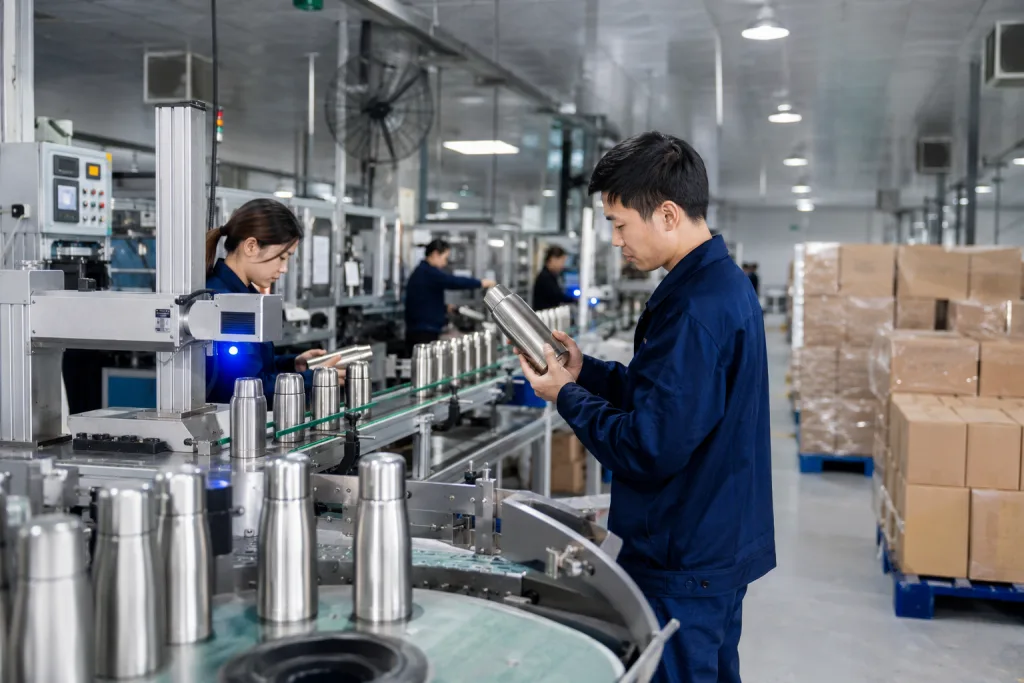
I’ll keep the HTML exactly as-is and rewrite only the prose, stripping the AI-ish phrasing while adding a few concrete factory details and sharper buyer language.There are plenty of thermos suppliers in China, but a good number are trading companies with polished sales reps and borrowed samples. That works for a 300-piece test order. It breaks down fast when you need repeat private label thermos supply. Check whether you are dealing with the actual factory thermos team or a middleman. A real manufacturer thermos partner should be able to show the line, the spot-welding station, the vacuum oven, and the QC room, not just a clean showroom with one sample on a shelf.
Zhejiang gives you better access to raw steel, cap makers, carton suppliers, and port logistics. That cuts weeks off the project. On one 316 stainless run, we shaved the next sample cycle from 18 days to 12 because the lid mold shop was 40 minutes away. If you are sourcing from a thermos factory in Zhejiang, ask who owns the tooling, how many spare lids they keep in stock, and whether they can lock the repeat-order spec for 6-12 months. Outdoor retailers need steady supply. Promo brands need fast replenishment. Distributors need both, and this is where the math starts to matter.
Use this short filter before you move forward:
- Factory audit or video tour available
- Monthly output above 60,000 pcs
- Clear MOQ by color and logo method
- Sample lead time under 20 days
- Written quality standard and pack spec
If a thermos distributor says yes to everything but cannot name the steel grade, walk away. We’ve seen that go sideways on the line more than once. A real Zhejiang supplier will answer straight and won’t dodge the steel question.
Build your private label thermos with factory control
Send your size, target price, and logo file. We’ll quote a real Zhejiang production spec, not a guess.
Frequently asked questions
What MOQ should I expect for a private label thermos?
For most private label thermos projects, expect 3,000-5,000 pcs per style and color. A simple stock mold with one-color logo may go down to 1,000 pcs, but pricing usually rises 10-20%. If you want multiple colors, printed cartons, or a custom lid, the factory will often keep the MOQ at 3,000 pcs because setup time does not change much. For sample orders, some Chinese suppliers offer 1-5 pcs, but those are inspection samples, not production pricing. In Zhejiang, a capable thermos factory will tell you the MOQ before sampling, not after.
How much does a custom stainless thermos cost FOB China?
A plain 500 ml bulk thermos usually lands around USD 3.20-4.50 FOB China at 3,000 pcs. Add powder coating, laser logo, or a better lid, and the price often moves to USD 4.80-6.80. If you want a retail box, add roughly USD 0.35-0.90. The biggest cost drivers are material grade, lid tooling, and decoration method. In China, a thermos manufacturer may quote lower for the body but hide the logo or packaging cost, so ask for a full breakdown. For North America and Europe, also budget for freight, duties, and inspection.
Which material spec should I request for a stainless thermos?
Request 304 stainless steel for the inner wall as the default. For the outer wall, 201 is common and cost-effective, while 304/304 is a premium upgrade. A practical wall thickness is 0.4 mm for smaller sizes and 0.45-0.5 mm for larger bodies. Ask for a leak test, insulation test, and cut-section confirmation from the supplier. If you are buying a customized thermos for retail, also request coating adhesion and scratch resistance data. Do not accept a vague “food-grade” description without the actual alloy callout.
How long does production usually take in China?
For an existing mold private label thermos order, production is usually 30-45 days after sample approval and deposit. Sampling can take 7-20 days depending on logo, coating, and lid changes. If tooling is new, add another 15-30 days. A serious thermos factory in Zhejiang should be able to explain each step clearly: material booking, body forming, welding, vacuuming, coating, decoration, and final packing. If a supplier promises a fully custom order in 10-15 days, that is usually unrealistic unless they are just reselling stock.
How do I verify a thermos supplier is a real factory?
Ask for a live video tour of the production line, welding area, vacuum ovens, QC room, and packaging line. A real thermos supplier should provide business license details, export history, and a monthly output figure, such as 60,000-120,000 units. You can also request ISO 9001, BSCI, REACH-related declarations, and recent inspection reports. Trading companies can still be useful, but if you want stable distributor thermos supply, a direct manufacturer is easier to control. The best China partners answer technical questions without delay and show process photos, not just catalog shots.