Key Takeaways
- Most private label thermos germany orders start at MOQ 1,000–3,000 units and 25–35 day lead time.
- For outdoor retail, 18/8 stainless steel and double-wall vacuum insulation are the baseline, not upgrades.
- A 500 ml thermos with 500–800 g weight usually performs better for retail than oversized, unstable bottles.
- Request AQL 2.5/4.0 inspection, REACH-ready materials, and logo samples before confirming any factory thermos order.
Sourcing private label thermos germany products is the wrong problem if the brief stops at “find a stainless bottle.” The hard part is a thermos that passes German retail checks, hits a fixed promo launch, and still leaves margin after sea freight. We see outdoor buyers ask for 12-hour heat tests at 6°C, while promo agencies push back on logo edges after 5,000 units. Fair pushback. Last month QC pulled a sample from the line with a 0.3 mm laser-logo drift, and the buyer flagged it before the carton artwork was even locked.
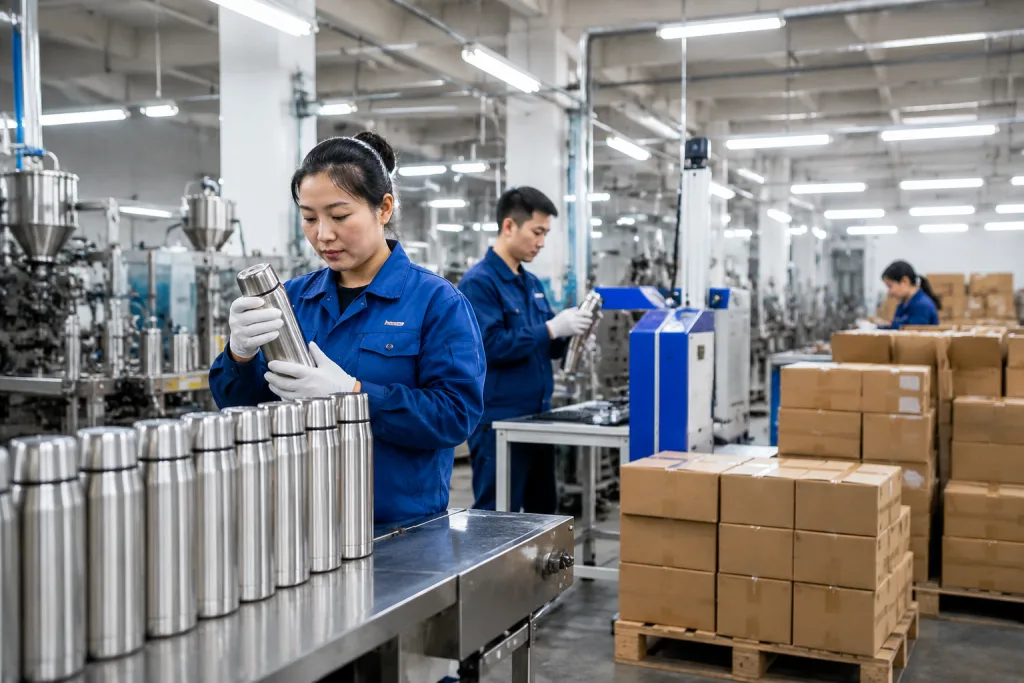
At BottleForge in Zhejiang, we run custom thermos and customizable thermos orders for buyers who need scale, not catalog talk. A workable private label job usually starts at MOQ 1,000–3,000 units, with 25–35 days for production after sample approval, depending on finish and packaging. For powder coating, we check adhesion with a cross-cut tester before packing; for gift boxes, we confirm barcode size in mm because one PO typo can hold 18 pallets at the warehouse. If you buy bulk thermos stock without checking steel grade, wall structure, and coating adhesion, the math does not work. The good China factories talk specs first.
What German buyers actually need
Sourcing a thermos distributor program for Germany is not just buying a bottle. You are buying a product that must look clean on a REWE-style shelf, stay dry inside a commuter bag, and survive daily knocks. German buyers check lid fit with less patience than US promo buyers; last March, one buyer flagged a 0.3 mm step between cap and shoulder on the golden sample. Fair point. If a thermos manufacturer cannot quote steel thickness, vacuum loss rate, salt-spray hours for the coating, and the lid torque we run on the line, the math doesn’t work for Germany.
For most private label projects, we run the best volume on 500 ml and 750 ml stainless thermos models: double-wall vacuum body, 18/8 inner and outer steel, powder-coated exterior, no strange custom neck unless the order is 3,000 pcs or higher. A standard wall thickness around 0.4–0.5 mm keeps the body stiff without turning the bottle into a brick; QC pulled a 750 ml sample last week at 382 g before carton, which is about right for retail. If you sell through shops, do not treat the box as afterthought. A plain white carton cuts cost, but a printed retail box often adds only USD 0.25–0.60 per unit and sells the product better than a 55 mm logo on the bottle.
- Outdoor retail: choose a grippy powder coat, a lid that passes a 24-hour upside-down leak check, and honest 12+ hour hot retention on the test bench.
- Promo campaigns: lock the logo area early, approve Pantone color under a D65 light box, and avoid shapes that push rework above 2%.
- E-commerce: use a stronger mailer carton, keep the barcode away from curved edges, and test the packed bottle at 1.2 m before the buyer’s warehouse does it for you.
Stainless thermos specs that matter
If you want a real manufacturer thermos quote, ask for the parts that affect quality. Start with steel grade. We run 18/8 stainless steel, also called 304, for food-contact inner walls on most German private-label programs. A 201 inner wall might cut USD 0.12–0.18 per piece, but the math doesn't work if QC later finds tea odor or rust dots after a 24-hour salt-spray check. The lid should use PP for value lines or Tritan when the buyer wants a clear drinking part, and the seal ring should be silicone, not mystery rubber from a mixed-bin supplier. QC pulled one 500 ml sample last month where the PO said “sillicone.” Small typo. Big question.
Pay attention to vacuum performance. A good double-wall thermos should keep drinks hot for 12–24 hours and cold for 24 hours, depending on volume and lid design. Do not let a supplier thermos quote hide behind one “heat retention” number with no test method. Ask for test conditions: 95°C initial water, 20°C ambient room, 100% fill level, and whether the lid was preheated for 3 minutes. We log this with a probe thermometer and a 0.1°C data sheet; if the answer comes back as “around 18 hours,” the buyer flagged it correctly. That is marketing, not engineering.
For bulk thermos orders, the finish changes defect risk. Powder coating is durable, but the line needs proper curing at 180–200°C and a cross-hatch adhesion test before packing. Mirror polish looks premium, then shows scratches and fingerprints after 2 handling rounds on the packing table. Brushed stainless is safer for heavy-use outdoor lines, especially at 1,008 pcs MOQ where rework kills the margin. For German retail, simple sells better than flashy. We've seen this go sideways when a buyer picked glitter coating from a showroom sample and then rejected 7% of the shipment for dust nibs under AQL 2.5.
Ask the thermos factory for sample test data, not just a catalog. If they cannot explain the test method, they probably did not run one.
Branding options without wasting money
Your logo method should match the bottle price, not the mood board. A customized thermos for a sports brand usually deserves laser engraving because it will not rub off after 5,000 bag-in-bag scuff cycles on our test jig. A promotional thermos for a trade show often works better with one-color screen printing when the buyer is chasing a EUR 3.80–4.20 landed target. Pad printing is fine for a 20–35 mm logo on curved cups, but fine lines below 0.3 mm can turn soft. Laser marking costs more per unit, usually by USD 0.10–0.40, but the finish looks cleaner and holds up better.
If you need a custom thermos program for retail, ask for print placement mockups before sampling. We see 2 or 3 buyers each month lose a week because the logo looked fine on a flat PDF, then looked too small on the actual 500 ml bottle body. QC pulled one sample last April where the logo center was 8 mm off the seam; the buyer flagged it before the pre-production meeting, which saved a reprint. For thermos customizable projects, a good factory can offer cap color changes, lid swaps, silicone ring colors, and carton inserts. That gives you a separated shelf line without paying for a new mold.
- Laser engraving: use it for premium branding, stainless steel logos, and retail items expected to stay in use for 2–3 years.
- Screen printing: use it for low-cost promotional thermos runs, simple artwork, and MOQs from 1,000 pcs per color.
- Embossing/debossing: use it when the brand wants a quiet mark on the lid or sleeve, not a loud front logo.
At BottleForge in Zhejiang, we usually recommend keeping the first order simple. Start with one body color, one logo process, and one gift box if the math works. Once you see sell-through, we run cap color variants or gift box upgrades on the next PO. The wrong question is “how many custom touches can we add?” We have seen this go sideways: five custom details on the first PO, a Pantone typo on the artwork file, then the buyer pays for every small correction before shipment.
MOQ, pricing, and lead time
For a serious thermos supplier relationship, MOQ is where the talk gets real. We usually run standard stainless thermos orders at 1,000 units per color for plain powder coat or brushed finish, and 3,000 units when the buyer asks for new tooling, a special lid, or two decoration processes. Below that, the math does not work. Last month a German buyer pushed for 200 units with a new flip lid; our tooling room quoted RMB 18,000 before one bottle came off the line. If a thermos vendor says yes to 200 units with a full custom setup, cost is hiding in the unit price, the steel gauge, or the mass production bottle will not match the approved sample.
As a reference point, a 500 ml vacuum bottle with single-color logo and standard carton can land around USD 3.20–5.80 FOB China, depending on finish, packaging, and order volume. Premium powder coating, gift box, and laser logo push it up fast; a 0.8 mm wall body, 350 g white card box, and individual polybag do not price like a thin export promo bottle. Lead time is usually 25–35 days after sample approval and deposit. If the product needs new tooling, add 15–25 days for mold work. In Zhejiang, the factories that stay competitive lock the BOM early and cut off change orders after PP sample sign-off; we have seen a lid color change on day 12 turn a 25-day order into 34 days.
For thermos bulk or thermos custom programs, ask for a breakdown by body, lid, decoration, and packaging. That is how you see where the money goes. A proper thermos manufacturer should explain why one version costs 18% more than another, not hide behind “better quality.” Ask for line items: 304 stainless body, PP lid, silicone ring, powder coating, laser logo, inner box, master carton. QC pulled one sample last quarter where the quote said laser logo, but the PO typo said “silk print”; the buyer flagged it only after the carton artwork was already approved.
Quality control for export orders
I’ll rewrite the section in place, keep the HTML exactly as-is, and tighten the language for a real export-sales tone.German buyers ask for paperwork that casual suppliers skip. For a proper export run, get material declarations, REACH-compatible parts, and a QC plan before we start the line. A solid thermos factory should cover incoming inspection, in-process checks, and final random inspection at AQL 2.5 for major defects and AQL 4.0 for minor defects. We run this every day. It is basic risk control.
Check the points that fail in real orders: vacuum seal integrity, lid torque, leak test, coating adhesion, print abrasion, and carton drop test. We saw one batch of seals sink a 3,000-piece order; the buyer flagged it after the first return wave, and the math did not work. A good factory thermos line also tracks batch numbers, so when a complaint lands 60 days later, QC can pull the sample and isolate the lot fast. If you sell through Amazon or another controlled retail channel, get barcode and label placement approved early. FNSKU placement can save an inbound. It can also stop a rejected carton.
For thermos distributors and distributors thermos programs, repeatability beats big claims. A bottle that is 2% less flashy but 30% more consistent wins the reorder. That is the wrong question to ask when buyers obsess over the sample only. We ship enough to know this: the line that holds spec on 10,000 units beats a perfect one-off sample every time.
Choosing the right China partner
Not every thermos manufacturer in China is ready for Germany, and Zhejiang factories are not all running the same standard. Ask for real daily output by line, the last 3 AQL reports, and photos from final inspection, not just a clean showroom video. At BottleForge, our stainless drinkware lines handle roughly 300,000 units per month across multiple bottle categories; on a normal week we run 12,000 to 15,000 pcs per day through polishing, powder coating, laser logo, and packing. Scale matters when a buyer changes a launch from 8,000 pcs to 24,000 pcs after the first sell-in. Small shops can make a sharp sample. Repeating it for 18 cartons per SKU is where QC usually pulls the sample.
Look for a partner that understands both thermos suppliers and manufacturers thermos work: locked material sourcing for 304 stainless, trained workers who stay on the same line, and color control checked against a Pantone book under a D65 light box. If you need a thermos distributor setup for Europe, ask whether the factory can manage mixed SKUs, spare lid sourcing, and carton version control with printed PO numbers. We have seen this go sideways when a buyer’s PO had “mat black” instead of “matte black” and nobody checked before mass printing 6,000 color boxes. The best supplier thermos partner is not the lowest quote; it is the one that protects your brand when order 2 and order 3 need to match the first shipment.
China has enough low-cost factories. The useful Zhejiang partners can show exactly how they weld, vacuum-test, and pack your stainless thermos, right down to the 24-hour hot-water test and the 0.6 MPa air leak check before packing. This is the wrong question to ask: “Who is cheapest?” Ask who can keep defect rates under AQL 2.5 when the line is busy in October. That is what you should pay for.
Get your private label thermos quote today
Send your target volume, logo file, and carton spec. We will price your stainless thermos with clear MOQ, lead time, and branding options.
Frequently asked questions
What is the usual MOQ for private label thermos Germany orders?
Most private label thermos Germany orders start at 1,000 units per color for standard stainless models. If you want special lids, custom packaging, or a new mold, 3,000 units is more realistic. For small promo runs, some suppliers can do 500 pieces, but pricing jumps fast and unit consistency is usually weaker. Ask for separate MOQs for bottle body, lid, logo method, and carton so you can see where the real constraint is.
How much does a custom stainless thermos cost from China?
A normal 500 ml custom thermos with one-color logo and standard box often lands around USD 3.20–5.80 FOB China. Laser engraving, premium coating, or gift packaging can push it higher. If you need a very low-cost promotional thermos, you may get below that range on larger volumes, but only with limited decoration and simpler lids. Always compare FOB, not just ex-factory, so you do not miss packing and export charges.
What insulation performance should I request?
For a retail-grade stainless thermos, ask for 12–24 hours hot retention and about 24 hours cold retention, measured with clear test conditions. The test should state starting water temperature, ambient temperature, and fill volume. If a thermos manufacturer gives you a single claim with no method, treat it as marketing. For outdoor retail, a leak-proof lid and stable temperature retention matter more than exaggerated lab numbers.
Which branding method is best for promotional thermos products?
For short-run promotional thermos orders, screen printing is usually the lowest-cost option. If the product will be reused often, laser engraving gives better durability and looks more premium. Pad printing is fine for small logos and curved areas, but it is less robust than laser. For a distributor thermos program, ask the supplier to show a printed sample after one dishwasher cycle or abrasion test before mass production.
How do I check if a thermos factory is export-ready?
Ask for factory audit documents, QC flow, material declarations, and sample reports. A serious thermos factory should understand AQL 2.5/4.0, REACH-related material questions, and carton drop testing. You should also ask about monthly output, because a factory that makes 20,000 units a month may struggle with a 50,000-unit retail launch. In Zhejiang, the better thermos suppliers can explain production bottlenecks before you send payment.