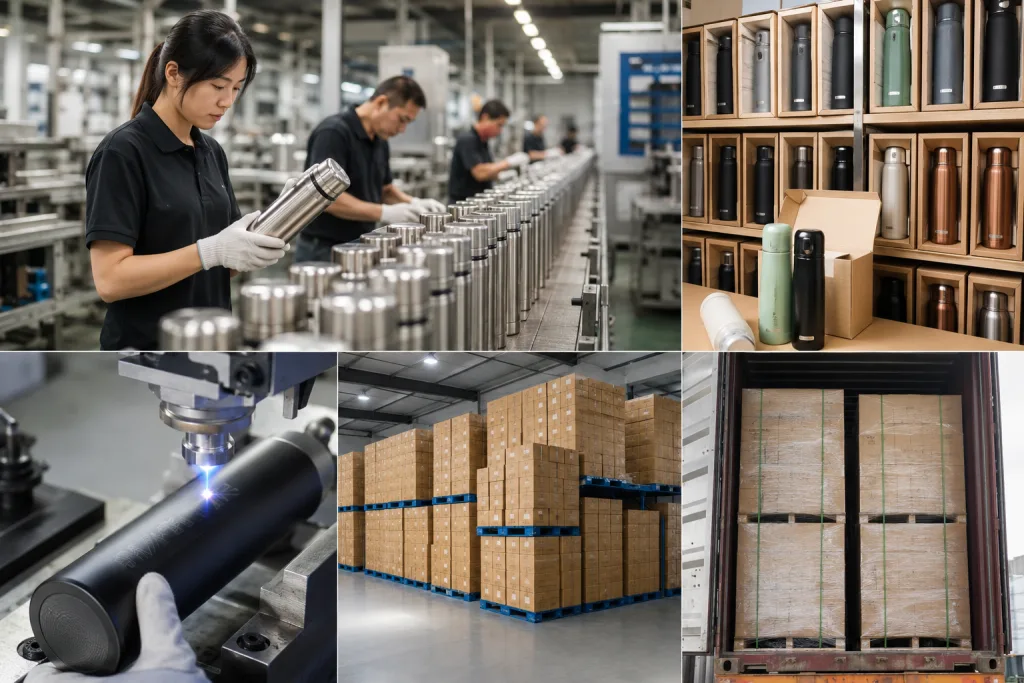
Key Takeaways
- Typical MOQ for private label thermos britain orders is 1,000 to 3,000 units per SKU, with factory lead time around 25 to 35 days after sample approval.
- Most 304 stainless steel thermos bodies use 0.4 to 0.5 mm inner and outer walls; 201 stainless cuts cost but is weaker on corrosion resistance.
- FOB China pricing for a 500 ml stainless thermos often starts around USD 2.20 to 4.80 depending on lid, coating, and print method.
- For retail and promo buyers, laser engraving, silk screen, and wrap print each behave differently; choose based on abrasion, logo size, and budget.
If you are sourcing a private label thermos britain order, the hard part is not finding a bottle. The hard part is getting a stainless thermos that passes retail drops, prints clean, and still leaves margin after freight, duty, and cartons. In Britain, buyers usually want UK-ready packaging, compliant materials, and a supplier who can handle 3,000 to 30,000 units without choking the line.
We run thermos programs in Zhejiang and ship to Europe and North America every month, so I’ll say it straight: the gap between a decent sample and a launch that makes money usually comes down to 0.5 mm wall thickness, lid seal performance, and the branding method you pick. QC pulled the sample on one run because the cap torque was off by 2 N·m. If you want a custom thermos for outdoor retail or a promo campaign, think like a buyer, not a designer.
What private label means in practice
Private label is not “put my logo on it.” For a thermos custom program, you lock the bottle body, lid structure, surface finish, carton artwork, insert wording, and compliance file as one buying package. On our Hangzhou sample bench, a 500ml body with a 72mm mouth and a PP flip lid already needs separate logo, leak, and carton checks. Serious buyers speak with a thermos manufacturer or thermos factory before the designer sends a final AI file, because a 0.3mm artwork line can disappear after powder coating.
For Britain, the target is plain: the flask must look like your brand, survive the shipment, and avoid returns from hikers complaining about dented lids or “doesn’t stay hot” reviews. A proper customizable thermos can be built with vacuum insulation, 18/8 or 304 stainless interior, powder coating, and a lid that passes 5,000 open-close cycles. QC pulled one UK retail sample last month after the lid thread felt rough at cycle 620, so we changed the mould polishing before mass production. For promo orders around 1,000 pcs, a lighter wall can make sense; for retail shelf stock, the math does not work after returns and spare-lid requests.
- Retail launch: prioritize ΔE under 1.0 on powder coat colour, 5-layer export cartons, and spare lids packed at 2%.
- Promotion: prioritize a 35mm front logo area, 18-day production speed, and a unit cost that fits the campaign budget.
- Outdoor use: prioritize 12-hour heat retention, silicone grip width over 28mm, and leak testing at 45° for every batch.
In Zhejiang, we see buyers mix those goals about 7 times out of 10. It gets expensive fast. We once received a PO marked “mat black” instead of “matte black,” and the buyer still wanted retail-grade coating, promo pricing, and a climbing-store lid on the same 3,000 pcs order. We’ve seen this go sideways: the sample looks good, then the line cannot hold cost or timing. Define the use case first, then choose the thermos custom spec.
Materials that justify the price
I’ll keep the tags intact and rewrite the prose to sound like a factory-side sales engineer, with tighter claims and a few concrete shop-floor details.The material stack decides whether your customized thermos feels worth the money or just looks polished. For a stainless thermos, we usually run 304 stainless steel on the body, food-grade PP or Tritan for lid parts, and a silicone sealing ring. If the buyer is pushing for a lower opening price, 201 stainless can cut cost by about 8% to 15%, but that is the wrong material for damp storage, coastal UK retail, or a long shelf life.
Most factory thermos builds use double-wall vacuum construction. A common spec on our line is 0.4 mm for the inner wall and 0.5 mm for the outer wall, with a copper-plated vacuum layer on better grades. QC pulled the sample last week and the cap seal was the first thing that failed, not the steel. With a tight seal, that build supports 12 hours hot and 24 hours cold in real use; if a supplier claims more, ask for the actual ASTM or internal test method, because the math does not work without it.
What to ask your supplier thermos team
- Is the inner liner 304, 316, or 201 stainless?
- What is the wall gauge in mm?
- What insulation test was used: 95°C fill at 23°C ambient, or something else?
- Are the silicone parts LFGB, REACH, and BPA-free?
For Britain and the EU, paperwork carries the same weight as the steel. A serious supplier thermos partner in China should hand over material declarations, basic test reports, and batch records that match the PO, down to the typo on the carton mark if the buyer flagged it. We see this every week in Zhejiang; it is standard shop-floor work, not a special favor.
Branding methods that survive use
I’ll rewrite just the prose, keep the HTML tags intact, and tune the tone toward a real factory sales engineer. Then I’ll do a quick pass to make sure the section still reads naturally and keeps the same structure.Your logo method decides how long the brand stays visible. If you are placing a promotional thermos order, screen print is usually the cheapest and fastest; we run that on the pad printer and it stays friendly for large thermos bulk jobs at MOQ 500. The catch is simple. If the thermos goes in rucksacks, gets scrubbed, or sees daily washing, the print starts to lose the fight.
Laser engraving costs more up front, but it stands up to abrasion. On brushed stainless, it gives a clean industrial look that outdoor retailers usually ask for. For full-color graphics, heat transfer or wrap print can work, but the alignment window is tight and the ink has to pass rub testing. A thermos customizable design only makes sense if the decoration matches how the bottle will be used, not how it looks on a mockup.
Here is the practical rule: if the buyer is a distributor, spend on consistent decoration; if the buyer is a brand owner, spend on shelf appeal. A distributor thermos program and a retail brand launch are different jobs, even if both start from the same bottle. We’ve seen this go sideways when the PO says “matte balck” and the buyer flags it after sampling; the math does not work if the logo spec changes after QC has already pulled the sample for AQL 2.5. That is where many thermos distributors and distributors thermos orders go wrong.
“The logo is not the product. It only works if the lid, finish, and print method can survive actual use.”
We get the best result when the buyer lines up 2 or 3 decoration samples in daylight, not just a PDF on a screen. One 12-day sample round saved a UK private label order last month because the laser mark looked fine in render but washed out on brushed steel after 50 abrasion cycles.
MOQ, pricing, and lead time
I’m rewriting this section in-place, keeping the HTML structure and the existing numbers intact while making the copy sound like a real factory sales note. Next I’ll tighten the phrasing, add a few floor-level details, and keep the list structure unchanged.If you need a usable private label thermos britain quote, start with the unit count. For a standard 500 ml stainless model, MOQ is often 1,000 units per color or logo version; some thermos suppliers will take 500 units, but the unit price moves up fast. For custom molds or special lids, 3,000 units is the number we use on the line.
FOB China pricing comes down to body finish, print method, lid structure, and carton spec. A plain brushed stainless model may sit around USD 2.20 to 2.90, while a powder-coated or laser-engraved version can land at USD 3.20 to 4.80. Gift boxes add another USD 0.35 to 0.90. We once had a buyer flag a PO that missed inner carton size by 5 mm, and the math did not work until we fixed the pack spec. Domestic shipping, duties, and UK warehousing are separate.
Lead time is where orders slip. Sample development usually takes 7 to 12 days. Mass production for a normal factory thermos order takes 25 to 35 days after sample approval and deposit. In our Hangzhou export workflow, one standard line can turn out 200,000 units per month across several thermos lines, so approval speed is the real bottleneck, not machine output. QC pulled a sample at 3.2 mm wall thickness last week; the run stayed on schedule because artwork was locked early.
- Sample lead time: 7 to 12 days
- Production lead time: 25 to 35 days
- Typical MOQ: 1,000 to 3,000 units
If your British retail season is tight, place the order early. A thermos manufacturer in China can ship fast, but only when artwork, carton copy, and compliance details are signed off before the run starts.
Compliance for Britain and export markets
British buyers don’t need drama; they need paperwork that matches the bottle on the bench. For stainless drinkware, we usually prepare food-contact declarations, REACH substance checks, and LFGB files when the same private label thermos will also sell into Germany or France. If the unit has powder coating, UV decals, PU glue, silicone grip rings, or soft-touch paint, list each material by supplier code; QC once pulled a 500 ml sample because the black coating code on the test request was “BK-02” while the PO said “BK-20”.
The paperwork package should follow the actual SKU. A competent thermos supplier or thermos factory in China should provide a spec sheet showing stainless grade, capacity, dimensions, coating type, packaging details, and test method. We run this as a 1-page control sheet before tooling: 304 stainless inner wall, 201 or 304 outer wall, mouth diameter in mm, carton weight in kg, barcode position, gift box material, and MOQ. If you are an outdoor retailer, keep claims plain and provable. If you are a promotional brand, don’t print “keeps hot for 24 hours” unless the test file backs that exact claim; we’ve seen this go sideways during buyer approval.
When buyers ask for “BSCI, REACH, and ISO” in one email, they are trying to reduce risk. Fair request. But this is the wrong question to ask if the product spec is still loose. Factory audit reports are not product compliance. A thermos manufacturer can pass an audit and still ship the wrong lid gasket if the purchase order says only “black lid” instead of silicone grade, gasket color, and drawing version. The safer route is a signed spec sheet and 2 sealed pre-production samples, one for the buyer and one kept on the line before mass production.
For Britain, carton markings, import labels, and barcode placement should be approved before printing. Basic, yes. Still where shipments get stuck. Last winter, a buyer flagged a PO typo on the UK importer postcode after 3,200 color boxes were printed in Hangzhou; the steel bodies were finished, but the line waited 6 days for replacement stickers.
How outdoor retailers should buy
Outdoor retailers should buy a thermos the way they buy boots: prove the performance first, then check whether the size actually moves off the peg. For a private label thermos britain range, we run a 24-hour hot-water check at 95°C, lid leak test at 0.3 MPa, and a grip rub on the powder coating before we talk packaging. The buyer flagged this once: “750 ml feels right online, but it is too tall for our daypack pocket.” Fair point. For hiking and camping, 350 ml to 750 ml still sells well because it keeps pack weight sensible without killing heat retention.
Do not over-spec the first run. The math doesn't work. A custom thermos with one body color, one lid color, and one decoration method is easier to reorder than a 9-SKU tree that leaves 2 colors stuck in the warehouse. On the line, we can switch from brushed stainless to matte black in about 40 minutes, but changing lid molds, silicone colors, and pad-print artwork eats time fast. If you need a seasonal launch, choose a brushed or matte black model and put the money into a paper sleeve or embossed carton instead of loading every feature into the bottle.
Retail buyers should also think about after-sales before the PO is signed. Ask your thermos distributor or thermos supplier whether replacement lids and gaskets can ship in the same container, packed in 50-piece inner cartons so the warehouse can count them without opening every bag. QC pulled a sample last month where the gasket was 0.6 mm thinner than the approved drawing; that is exactly the kind of small part that becomes a warranty headache. A brand that sells 10,000 units and cannot replace 200 damaged lids is not buying a product; it is buying complaints.
We tell outdoor accounts to test a sample in a rucksack, in a car cup holder, and with boiling water overnight. Simple test. One UK buyer once sent back photos after a 12-hour boot-room trial because the lid picked up dust around the hinge, and that feedback saved us from shipping 3,000 pieces with the wrong surface texture. Old-school checks still beat a bad season.
Request your private label thermos quote today
Send capacity, logo file, target price, and carton needs. We will quote the right thermos custom spec for Britain, with clear MOQ and lead time.
Frequently asked questions
What MOQ should I expect for a private label thermos in Britain?
For most stainless private label programs, expect 1,000 units per SKU as the practical MOQ, with 3,000 units common for custom lids, special colors, or packaging. Some suppliers will accept 500 units, but the price usually rises 12% to 25%. If you want multiple colors, each color may need its own MOQ unless the factory batches them in one line run. For a serious retail launch, 1,000 to 2,000 units is the range that usually balances cost and risk.
How much does a custom thermos cost FOB China?
A standard 500 ml stainless thermos usually lands around USD 2.20 to 2.90 FOB for a simple brushed body and basic print. Add powder coating, laser engraving, or better packaging and you may see USD 3.20 to 4.80. Premium gift boxes, extra accessories, or stainless 316 parts push it higher. Freight, duty, VAT, and UK fulfillment are not included in FOB pricing, so always cost the full landed number before you approve artwork.
What is the best branding method for a promotional thermos?
For a promotional thermos, screen print is usually the cheapest and fastest choice, especially for 1,000 to 10,000 units. If the bottle will be reused outdoors or washed often, laser engraving is more durable and keeps the logo visible longer. Full-color wrap print is useful for campaign graphics, but you should test alignment and abrasion. The right choice depends on whether your priority is low cost, premium feel, or long logo life.
Can you make a thermos custom to UK packaging and barcode needs?
Yes. A proper thermos custom order can include UK-style barcode placement, retail carton copy, warning text, and distributor labeling. If you sell through retail or Amazon, ask for space for FNSKU, SKU, and country-of-origin marks before the packaging is printed. Changing carton artwork after the production run starts can add 3 to 7 days and extra cost. Finalize the label proof with the supplier before deposit whenever possible.
What factory checks should I ask for before shipping?
Ask for pre-shipment inspection using AQL 2.5 for major defects and 4.0 for minor defects, plus leak testing, insulation testing, and logo position checks. A good thermos factory should also confirm carton drop resistance and verify that gaskets, lids, and vacuum bodies match the approved sample. If your order is large, request batch photos, packing counts, and a signed inspection report before balance payment. That is standard risk control, not extra caution.