Key Takeaways
- A workable private label thermos american MOQ is usually 1,000–3,000 units per SKU.
- Double-wall 18/8 stainless with 0.4–0.5 mm body thickness is the safer baseline for retail and promo use.
- Typical FOB China pricing for a 500 ml stainless thermos starts around USD 2.80–4.60 depending on lid and finish.
- For US buyers, plan 25–35 days production plus 30–45 days ocean freight, and test to ASTM or food-contact expectations.
If you are buying private label thermos american products for an outdoor line or a promo run, the hard part is not finding a factory. The hard part is finding a supplier thermos partner that keeps the powder coat clean, passes leak checks, and still fits your landed-cost target. We see a lot of buyers ask for “cheap and fast.” That math does not work. In Zhejiang and across China, plenty of factories can print a logo. Far fewer can build a custom thermos that survives US retail returns, Amazon carton drop tests, and distributor reorders.
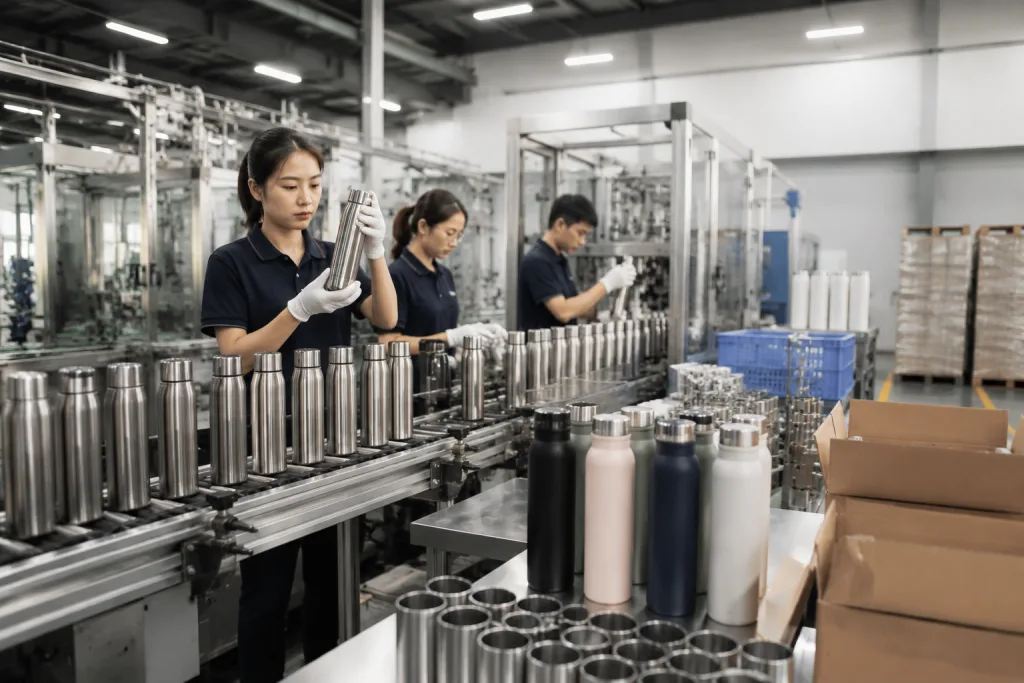
For American buyers, stainless thermos sourcing usually comes down to three numbers: MOQ, lead time, and defect rate. A serious thermos manufacturer should quote an MOQ of 1,000 to 3,000 units per SKU, a production lead time of 25 to 35 days, and an AQL plan the QC team can actually run on the line. At BottleForge in Hangzhou, Zhejiang, we run a monthly output of 300,000 units, and that matters because a bulk thermos program only works if the factory can repeat the same wall thickness, lid fit, and coating gloss from the first carton to the last.
What American buyers really need
I’m rewriting the section in place, keeping the tags and list structure intact, and tightening the sales language so it reads like someone who runs thermos programs every week.With a private label thermos american program, you are buying margin control, shelf appeal, and fewer returns. That is the math. Outdoor buyers ask for insulation and a body that survives a drop at the loading dock; promo buyers care about logo space and a landed cost that still works after freight. A customizable thermos that looks clean in a mockup but dents on the first carton test is dead on arrival.
Start with the use case. For camping and hiking, we often run a 500 ml or 750 ml stainless thermos with a screw lid and cup lid; QC pulled the sample on the line last month and the lid torque held fine. For executive giveaways, a slimmer 350 ml body packs better and fits gift boxes without wasted void fill. For thermos promotional campaigns, the buyer flagged it once: a lower unit cost is fine, but do not pretend it has premium coating if it does not. We ship a lot of these out of Zhejiang, and the spec sheet has to be plain: steel grade, insulation time, lid material, coating type, packing method. If the answer is vague, the product will be vague too.
- Outdoor retail: prioritize 12–24 hour insulation and a powder coat that survives abrasion.
- Promo use: prioritize logo visibility, carton efficiency, and a low breakage rate in transit.
- Private label use: prioritize repeatability and the same dye lot or coating batch across each order.
Spec the stainless body correctly
I’ll rewrite the prose in-place, keep the HTML exactly as-is, and tighten the language so it reads like a factory-side spec note.Most buyer problems start with the body spec. For a solid factory thermos, call out 18/8 stainless steel, also written as 304 stainless, for both inner and outer walls. We’ve seen buyers try to save a few cents with 201 on the outer shell. That is a cost move, not a performance upgrade. For U.S. retail, 18/8 is the safer call.
Wall thickness carries more weight than first-time buyers expect. A 0.4 mm body works for promo runs, while 0.5 mm gives a firmer hand feel and better dent resistance on the line. If you are ordering a customized thermos with a matte powder coat, ask for coating thickness too; 60–90 microns is the range we run for a durable finish. The lid should be PP or Tritan, depending on target price and temperature limits. For a hot-fill product, check that every contact material matches your market requirements, including REACH and FDA-related expectations where they apply.
Do not approve samples by photos. Approve them by cut section, weight, and leak test.
For a 500 ml bottle, a gross weight of 280–360 g is common, depending on the build. If the sample lands far below that, QC pulled the sample for a reason: you are probably missing steel or insulation performance somewhere.
Decoration options that hold up
I’ll rewrite the section in-place, keep the HTML exactly as-is, and make the copy sound like a factory-side sales engineer wrote it. I’m also tightening the claims so they read practical, with one concrete shop-floor detail per paragraph.Private label work lives or dies on decoration. A custom thermos for a retailer should not look like a generic commodity with a sticker. We run silkscreen, laser engraving, UV print, and heat transfer on the line, and each one behaves differently on 304 stainless. If the buyer wants a premium look, laser engraving is the cleanest call. If the order needs color branding on a custom thermos bulk run, silkscreen or UV print usually gives more room on cost and artwork.
The rule is simple: dark powder coat with laser engraving gives a strong premium signal; white body with one-color silkscreen keeps unit cost down and shortens setup; full-color UV print makes sense when the artwork is busy and the order size pays for the extra prep. We’ve seen this go sideways when a buyer approved decoration from a matte sample but the real body came in glossy, and the match was off by a mile. A serious thermos manufacturer should show decoration on the exact steel finish you plan to run, not a lookalike bottle.
- Laser engraving: durable, no ink, and a good fit for upscale retail.
- Silkscreen: efficient for one or two colors on larger runs, especially when the PO calls for a tight MOQ.
- UV print: useful for detailed branding and short-run custom campaigns.
If you are comparing customizable thermos options for a distributor program, ask how the decoration changes packing yield. QC pulled the sample and found one glossy print needed extra tray spacing, or the caps rubbed in transit. That 2 mm gap is the difference between a clean shipment and a claim. The buyer flagged it, and the math does not work if the factory ignores it. Small details like that decide whether your thermos distributor program scales or turns into a complaint machine.
MOQ, pricing, and lead time
I’ll rewrite the prose in place, keep the HTML untouched, and tighten it so it sounds like a factory-side sales engineer wrote it.For a bulk thermos order, the real money sits in the order setup. Most Zhejiang factories set MOQ by color and logo method. We run 1,000 units for one SKU with one logo as the clean baseline, and a more involved thermos custom job with three Pantone colors or a special lid usually moves up to 3,000 units. If a thermos factory offers 200 units on a fully customized insulated stainless line, ask how they plan to hold the line. The math does not work, and QC pulled the sample apart fast on a job like that last year.
For reference, FOB China pricing on a 500 ml stainless thermos usually lands around USD 2.80–4.60 for basic powder-coated models, and USD 4.80–7.50 for upgraded lids, premium finishes, or laser detail. Packaging adds USD 0.15–0.60, depending on whether you want an individual box, a mailer insert, or a retail shelf carton. Production lead time is usually 25–35 days after sample approval and deposit. Ocean freight to the US adds 30–45 days, depending on port and season. If your retail launch is tied to Q4, this is the wrong question to ask after the PO goes out.
A good manufacturer thermos partner should spell out the hidden costs up front: mold fee, sample fee, color matching fee, and carton test fee. That is standard. What gets buyers every time is the PO typo on the lid code or carton size, then the buyer flags it after we already cut the tool. We ship cleaner when those details are locked before production starts.
How to qualify a factory partner
I’ll rewrite the section in-place, keep the HTML exactly as-is, and tune the prose to sound like a real factory-side sales engineer. Then I’ll do a quick pass for banned filler and any tag/structure drift.You do not need the biggest thermos factory, but you do need one with discipline. Before you issue a PO, ask for the business license, BSCI if your channel calls for it, ISO papers if they have them, and the last 2 inspection reports. For food-contact goods, I want to see how they track 304 stainless coil lots, check weld seams, and record vacuum loss. A real thermos supplier answers that straight, no theater.
Inspection is where weak lines get exposed. Stainless drinkware can pass a quick look and still fail after 1 drop test or a 48-hour hold test, so do not skip the detail work. A normal pre-shipment plan runs AQL 2.5 for major defects and 4.0 for minor defects, unless your buyer wants tighter limits. Confirm the leak test, temperature retention test, and carton drop test before mass production starts. If you sell through distributors, tell the thermos distributors and distributors thermos customers the exact capacity tolerance, insulation claim, and carton spec. The buyer flagged this kind of mismatch before, and the math does not work in your favor.
From a sourcing angle, the right thermos vendor is the one that pushes back when the spec is off. If your AI file has a 0.2 mm line on a curved body, or your target price does not leave room for a better lid, a factory in China should say so. We have seen this go sideways on the line with a PO typo on the lid color and a sample that missed the print location by 3 mm. That is not a red flag; that is a useful filter.
Best fit for outdoor and promo channels
I’ll rewrite the section in place, keeping the HTML structure intact and tightening the prose to sound like a factory-side sales engineer.Outdoor retailers and promo brands buy on different terms, so we do not spec them the same way. Outdoor buyers want a bottle that feels solid in hand, takes field abuse, and still leaves margin after returns. Promo buyers want a clean price, fast artwork signoff, and a shipment that does not stall the campaign. We have seen one spec work for both, but only when the build is chosen with care.
For outdoor shelves, a 750 ml double-wall vacuum bottle with a wide mouth, powder coat, and laser logo usually moves better. For corporate events, a 500 ml straight-wall bottle with a one-color silkscreen logo is the safer pick. If you need a promotional thermos at scale, choose a lid that opens fast, washes clean, and does not go back together the wrong way. QC pulled a cap sample last week with a loose silicone ring, and that kind of issue turns into support email fast.
- Retail channel: push stronger insulation claims and carton protection.
- Promo channel: keep landed cost down and artwork approval quick.
- Distributor channel: lock one core SKU, then vary logo and outer carton.
In Zhejiang, plenty of factories can make both, but few run both channels at the same QC level. The better thermos distributor play is to standardize the bottle and change the branding, not chase a new body every order. We shipped a 10,000-unit PO last month where the buyer flagged a carton typo, and the math still worked because the bottle stayed unchanged.
Sampling and approval that prevent surprises
I’ll rewrite the three paragraphs in-place, keep the HTML exactly as-is, and tune the copy to sound like a factory-side sales engineer.Sampling is where a lot of American programs go off the rails. Do not approve a custom thermos from photos alone. We ask buyers for two physical samples: a pre-production sample for structure and finish, then a golden sample for final sign-off. Check lid torque, venting, odor, coating rub resistance, and fill temperature retention. If you sell through Amazon or retail chains, get packaging samples too. QC pulled a carton test on one 500 ml bottle last month, and the buyer flagged the inner tray because the neck sat 3 mm too high.
For approval, write down the bottle weight, wall thickness, logo size, and carton dimensions. Once those numbers move, your thermos bulk order is no longer the same product. A solid thermos manufacturer will also keep photos of the first article and the final pack-out. That matters when you reorder six months later and want the next lot to land the same way. We’ve seen a PO typo on carton count turn a clean shipment into a mess.
If your business depends on repeat custom thermos supply, lock the spec in writing. Put the steel grade, coating, logo process, tolerance, test standard, and master carton count on one sheet. Keep the approved sample in your own file. The math does not work any other way. China factories change supervisors, the line gets adjusted, and one loose note can send the next run sideways if nobody has the original sample to compare.
Get a quote for your thermos program
Send your capacity, logo file, and target price. We’ll map the best bulk thermos spec for your channel and quote it clearly.
Frequently asked questions
What is a realistic MOQ for private label thermos american orders?
For most stainless programs, a realistic MOQ is 1,000–3,000 units per SKU. Basic logo work may start at 1,000 units, while multiple colors, special lids, or unique packaging can push it to 3,000. If a factory in Zhejiang offers much lower, check whether they are using stock bodies instead of true private label tooling. Low MOQ can be useful for testing, but the unit cost is often 15–30% higher.
How much does a custom stainless thermos cost from China?
For FOB China pricing, a 500 ml stainless thermos often lands around USD 2.80–4.60 for a simple powder-coated model with one-color logo. Better lids, laser engraving, or premium packaging can move it to USD 4.80–7.50. Add mold fees if you need a new lid or special body shape. Freight, duties, and domestic delivery are separate, so always compare landed cost, not just factory price.
What insulation claim should I ask for?
For a retail-grade double-wall vacuum thermos, ask for a tested claim such as 12 hours hot and 24 hours cold, then confirm the test conditions in writing. Some models can perform better, but the result depends on fill temperature, ambient conditions, and lid design. A credible factory should provide a test report or internal data sheet. Do not use a marketing claim that the factory cannot reproduce in a repeat test.
Which decoration is best for a promotional thermos?
For promo orders, silkscreen is usually the most cost-effective for one or two colors, especially on 1,000 to 10,000 units. Laser engraving gives a cleaner premium look and resists wear better, but it is usually better for darker coated bottles. UV print works when you need detailed artwork or multiple colors. The right choice depends on your artwork, budget, and whether the bottle will be handled daily or given away once.
How do I reduce risk when sourcing from China?
Use a written spec, approve a golden sample, and require pre-shipment inspection with AQL 2.5 for major defects. Ask for material traceability, leak test results, and carton drop test confirmation. If possible, work with a Zhejiang factory that already produces at scale; monthly capacity of 300,000 units or more usually means better process control. Also confirm the factory’s lead time, because 25–35 days is normal for production but peak-season delays can happen.