Key Takeaways
- A private label thermal bottle usually starts at 1,000-3,000 pcs MOQ and FOB pricing around USD 3.20-8.90 depending on capacity and finish.
- For reliable insulation, ask for 0.5 mm inner and outer 304 stainless with a true vacuum gap; thin 0.3 mm walls often fail on dent resistance.
- Custom logo methods change the selling price by USD 0.15-0.80 per piece and affect lead time by 5-10 days.
- A Zhejiang canteen factory with 300,000 units/month output can handle repeat orders faster, but only if your artwork, carton spec, and testing standard are locked early.
If you are sourcing a private label thermal bottle for retail, ecommerce, or a corporate program, finding a factory is the easy part. The real work starts before you cut a 3,000 or 10,000 unit PO. One wrong call on stainless grade, vacuum wall thickness, cap seal, or logo method can eat the margin and leave you dealing with returns. We have seen that go sideways more than once.
Most buyers start with a short brief and end up comparing canteen custom options, custom drinkware lines, and MOQ quotes from Zhejiang and other parts of China. Fine. What matters is whether the canteen factory understands thermal performance, decoration limits, and export compliance. If you are sourcing from a canteen manufacturer in China, ask about FOB price, 18/8 stainless, REACH, and whether the line can hold the same finish on a 20,000-unit run. QC pulled a sample with a 0.3 mm seam gap last week; that is the kind of detail that decides the order.
What buyers really need first
I’ll rewrite this section with tighter B2B sales language, keep the HTML intact, and make each paragraph sound like someone who ships these bottles every week.Before you compare canteen suppliers or canteen distributors, pin down the bottle’s commercial job first. Are you selling outdoor users, office buyers, gym channels, or gift programs? A 500 ml private label thermal bottle for retail is a different spec from a 750 ml custom growler for brewery merch. Skip that call, and the quote sheet fills up with polished options that do not help.
Start with five numbers: capacity, target retail price, target FOB price, MOQ, and thermal spec. A 500 ml 304 stainless bottle with powder coat, one-color silk screen, and a gift box can sit around USD 4.10-5.60 FOB China at 3,000 pcs. A 1,000 ml double-wall model with copper lining, laser logo, and color box often lands near USD 6.80-9.50. We run this math on the line all the time, and the wrong target cost gets exposed fast. A solid canteen factory in Zhejiang will say yes or no in the first round.
Channel rules matter too. Amazon buyers may ask for an FNSKU label area, drop-test packaging, and a carton count that fits a prep center. A distributor canteen program usually cares more about one master carton per SKU and repeat lead time than a fancy finish. QC pulled a sample once because the buyer flagged a 2 mm carton height mismatch, and that killed the schedule for 12 days. This is where the split between a canteen vendor and a real canteen manufacturer shows up.
Materials that affect margin
I’ll keep the tags intact and rewrite the prose to sound like a buyer-facing factory note, with tighter numbers and a few floor-level details.Material choice is where margin gets won or burned. For a private label thermal bottle, 304 stainless is the default we run on most export orders. It covers food contact, resists corrosion, and passes the checks buyers ask for in the first round. If your market is tougher or you need a premium claim, 316 stainless is the upgrade, but the math rarely works for mainstream custom drinkware.
Wall thickness moves the cost more than most people expect. Our common spec is 0.5 mm on both inner and outer walls; QC pulled the sample at 0.4 mm once, and the dent rate jumped on the drop test. That saved a few cents on paper, then cost us two rounds of buyer pushback. For a canteen customized for outdoor use, keep the shoulder and base simple. A thin bottle with a large logo can look sharp on a render and still get flagged on the packing line.
- 304 stainless: best cost-to-compliance balance for export orders
- 316 stainless: fit for higher-end positioning or harsher use
- 0.5 mm wall: safer default for retail, promo, and private label
- Powder coating: better grip, usually USD 0.25-0.60 extra
Do not oversell sustainability. A metal bottle is durable; that does not make it a certified environmental claim. If you are building a customizable drinkware line for Europe, ask for REACH declarations, food-contact documents, and batch traceability. We have seen PO typos on this part turn into delays fast. China has enough capable plants; the gap is usually paperwork discipline, not the line itself.
Logo methods and finish choices
I’ll rewrite the prose in place, keep the HTML exactly as-is, and tune it to sound like a factory-side sales engineer.Your branding choice changes both the look and the landed cost. Silkscreen is still the line workhorse for one-color and two-color logos on promotional orders. Laser engraving gives a cleaner mark, holds up better, and fits a premium customized canteen, but it gives you no color. Heat transfer, UV print, and full-wrap decoration are all on the table, though each one adds process risk and usually pushes lead time out by 3 to 7 days. If you are comparing canteen customizable options, ask for photos from last month’s production, not a render from the design team.
Here’s the rule we use on the shop floor: if the logo has 1 or 2 colors and the order is above 2,000 pcs, silkscreen is usually the best value. If the buyer wants a corporate gift, laser engraving on brushed stainless is a solid call. For matte powder-coat finishes, we run an adhesion test early, because a sample can look perfect and then start chipping at the edges after 20 wash cycles. One buyer flagged this after a PO typo moved the logo 8 mm to the left; that kind of miss is small on paper and ugly in hand. A good canteen supplier will call out the decoration limits before you sign off the proof.
“The cheapest bottle is expensive if the print fails after 500 dish cycles.”
For distributors, this matters more than for first-time brand owners. Distributor drinkware programs live or die on repeatability. If you need a canteen distributor program across 6 SKUs, keep the same logo position, the same carton spec, and the same lid family. We’ve seen this go sideways when one reorder came back with a 12 mm logo shift and a different inner box, and the math does not work when you sort it at the warehouse. That setup cuts mistakes when you reorder from China six months later.
MOQ, pricing, and lead time
I’ll keep the HTML exactly as-is and rewrite only the prose with a more field-tested sales tone. Next I’m tightening the numbers, adding a couple of factory-floor details, and cutting the AI filler.Most private label thermal bottle jobs we run in China start at a MOQ of 1,000 to 3,000 pcs per color or per design. If the buyer wants a new mold, the MOQ usually jumps to 5,000 pcs or more. For standard molds with custom artwork, a Zhejiang canteen factory can sample in 7-12 days and go to mass production in 25-35 days after approval. Pantone matching, special packaging, or two print positions usually add 5-10 days. QC pulled the sample on the 2nd floor line, and the buyer flagged one cap color typo on the PO before we cut steel.
Price comes down to size, finish, and how many parts sit on the cap. A plain 500 ml bottle may land around USD 3.20-4.20 FOB. Add powder coating, laser logo, and a gift box, and the same bottle moves to USD 4.80-6.10. A 750 ml or 1,000 ml model with better cap parts can reach USD 7.00-8.90. If a quote sits far below that, the math does not work; check steel grade, wall thickness, vacuum retention, box spec, and whether the factory is quoting EXW instead of FOB. We have seen that go sideways more than once.
- Sample lead time: 7-12 days
- Mass production: 25-35 days after sample approval
- Typical MOQ: 1,000-3,000 pcs
- Monthly output: 300,000 units from a strong Zhejiang plant
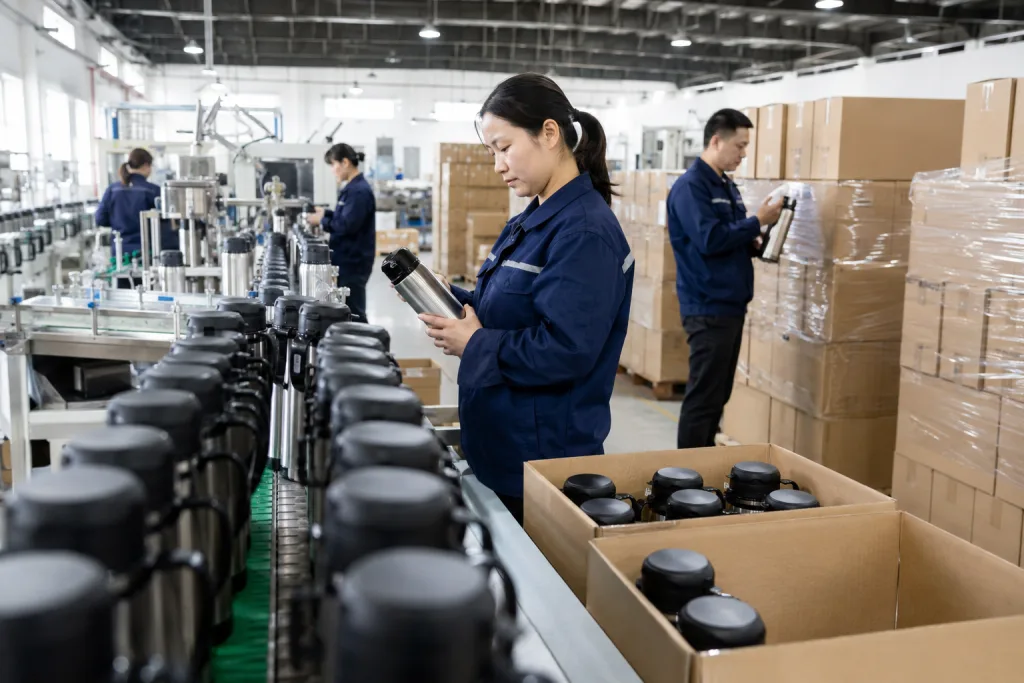
That output number matters because it tells you if the factory can keep up after the first order. A small canteen vendor may be fine for a pilot run. A plant that ships 300,000 units a month is the safer pick when the buyer needs repeat replenishment for a distributor program or a seasonal retail launch. We check the line speed, carton count, and cap assembly station before we trust that number.
Compliance you should not skip
I’ll rewrite the section in-place, keep the HTML tags intact, and make the copy sound like a seasoned factory-side sales engineer.Compliance is not a checkbox. It is what keeps your containers from getting stopped at customs or bounced by a retail account. For Europe, ask for REACH papers and food-contact declarations. For the United States, ask which test standard the factory uses for the coating, lid parts, and food-contact stack. If the bottle claims thermal insulation, ask for the test method and the retention hours at a stated ambient temperature.
Do not accept vague wording like “food safe” without paperwork. A proper canteen factory in Zhejiang should be able to hand over material certificates, migration test reports, and inspection records. We had one buyer flag a PO because the carton mark missed the origin line by 2 mm, and the whole pallet sat. If you want an insulated bottle sold as customized drinkware for corporate gifting, you may also need packaging compliance, barcode placement, and country-of-origin marking. Small details. They decide whether the load ships on time.
Inspection belongs in the quote, not at the end. AQL 2.5 for critical defects and AQL 4.0 for major defects is common, but premium programs often ask for tighter limits. If you import through a distributor drinkware channel, write down cap leak tests, vacuum retention checks, and drop-test requirements before the line starts. A canteen supplier that pushes back on basic testing usually costs more later. We run those checks with a torque meter and a leak jig, then QC pulls the sample before packing.
How to choose the right factory
I’ll rewrite the three paragraphs in-place, keep the HTML exactly as-is, and strip the AI-ish phrasing while adding a few concrete factory details and buyer-side reality checks.You do not need the biggest factory. You need the plant that fits your order profile. A canteen manufacturer in China with export paperwork, steady QC, and real production lines usually beats a trading desk posing as a factory. Look at process control, not the showroom. Ask how many units they run per month, who handles cap sourcing, and whether print and packing stay in-house or get pushed out to a subcontractor.
For private label thermal bottle programs, a Zhejiang plant with a clear custom drinkware focus is often the better fit. Zhejiang has short supply lines for lids, coatings, cartons, and stainless parts, so we can replace a failed component without waiting on three extra provinces. A serious canteen manufacturer will quote the material spec, finish spec, carton spec, test spec, and lead time in one sheet. A weak canteen supplier hides those details in the sample stage, then the buyer flags the gap after the PO is already issued.
When you compare canteen manufacturers, ask one direct question: if you change cap color or widen the logo by 3 mm, how fast do they send back the revised drawing and cost? A capable team turns that around in 24 hours. If it takes 7 days, your line will slip too. We’ve seen that go sideways on holiday launches, trade show drops, and Amazon stock plans. One PO typo on carton count can burn a week, so the math has to work before you place the order.
Launch planning for repeat orders
I’ll rewrite the three paragraphs in place, keep the HTML exactly as-is, and tighten the language so it sounds like a factory-side sales engineer.Once the first order is signed off, start planning the repeat order before the first carton ships. Save the Pantone code, artwork file, carton size, drop-test result, and the foam or pulp insert spec. If those details drift, the second run comes out like a different product. We’ve seen that happen on branded canteen custom programs and on distributor canteen accounts that reorder from China six months later.
Build the launch with room for variants. A 500 ml and 750 ml size family is easier to run than three unrelated models. Keep one cap system, then change the body finish. That works for canteen customizable ranges sold into retail, gifting, and corporate channels. It also keeps the tooling and assembly line cleaner, which is where margin gets protected.
If you are planning a broader line, look at adjacent SKUs such as a custom growler or a customized growler for craft beverage channels, or a canteen promotional set for seasonal campaigns. The same rule applies: fewer surprises, tighter specs, repeatable packaging. On the line, QC pulled the sample twice before first shipment. In Zhejiang and across China, the plants that keep long-term accounts are the ones that repeat a spec, not just make a nice sample once.
Get a quote for your bottle project
Send your target MOQ, capacity, logo file, and destination market. We’ll quote a private label thermal bottle with clear FOB pricing and lead time.
Frequently asked questions
What is the usual MOQ for a private label thermal bottle?
For standard molds, most factories quote 1,000-3,000 pcs MOQ per color or design. If you want a new mold, the MOQ can move to 5,000 pcs or more. A Zhejiang canteen factory with strong export flow may accept a lower trial run, but the unit price usually rises by 12-20%. For a first launch, many buyers start at 2,000 pcs to balance cost and risk.
How much does a custom drinkware bottle cost FOB China?
A basic 500 ml private label thermal bottle often lands around USD 3.20-4.20 FOB. With powder coating, laser logo, and gift box, the same SKU may reach USD 4.80-6.10. A larger 750 ml or 1,000 ml model with better cap components can run USD 7.00-8.90. Always confirm whether the quote is FOB, EXW, or DDP before comparing numbers.
How long does sampling and production take?
Typical sampling takes 7-12 days if the mold exists and the artwork is final. Mass production usually takes 25-35 days after sample approval. Add 5-10 days if you need special packaging, multiple logo positions, or Pantone color matching. If the canteen manufacturer is also sourcing packaging locally in Zhejiang, the process is usually faster than a fragmented supply chain.
Which logo method is best for a customized canteen?
Silkscreen is the best value for simple logos and high-volume promotional runs. Laser engraving is better for a premium look and better scratch resistance. UV print works for more complex graphics, but you should test adhesion carefully. Expect logo cost to add roughly USD 0.15-0.80 per piece depending on method and color count.
What compliance documents should I request?
For Europe, ask for REACH paperwork and food-contact declarations. For the United States, request material test reports, coating info, and migration testing. You should also ask for AQL inspection records, leak-test results, and carton drop-test data. A reliable canteen supplier in China should provide these without delay if the factory has real export experience.