Key Takeaways
- Typical MOQ for a private label sport bottle is 1,000-3,000 units per color.
- Standard lead time from Zhejiang is 25-35 days after sample approval.
- A usable quote should show FOB price, decoration method, material grade, and carton pack.
- For export, ask for REACH, LFGB, FDA, or ASTM support depending on market and material.
If you are buying a private label sport bottle for retail, ecommerce, gyms, or promo programs, the hard part is not picking a color. The hard part is getting a bottle that prints clean, passes compliance, ships on time, and does not chew up margin with tooling changes. A sane program looks simple on paper, but the numbers run the show: MOQ, wall thickness, lid cycle life, carton pack-out, and the defect rate after AQL inspection.
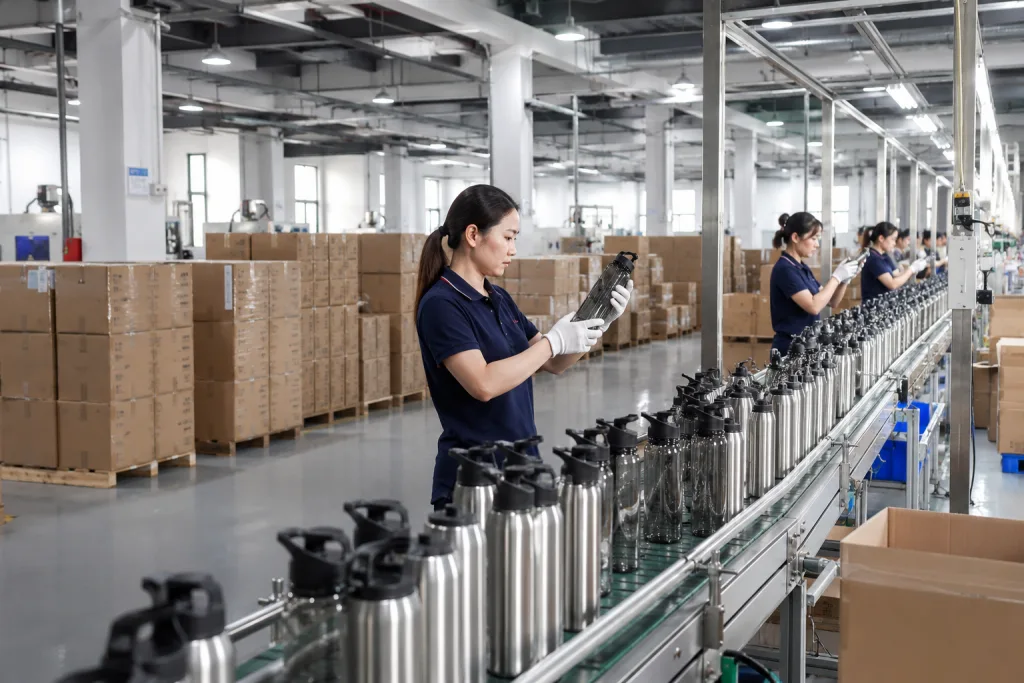
At BottleForge in Zhejiang, we see the same thing every week. Buyers open with a mood board, then need a line that can handle custom logo work, source-safe coatings, and repeat orders without drama. If you are comparing canteen suppliers or canteen distributors, judge the sample in hand, not the photo; QC pulled one cap last week at 18.9 mm when the PO called for 19.2 mm, and that is the kind of miss that turns into a claim. China gives you room on price and customization, but only if you lock the spec sheet before the line starts running.
What buyers really pay for
I’ll rewrite the prose in place, keep the HTML structure untouched, and tighten the pricing language so it reads like a factory-side buyer note.When you compare a private label sport bottle quote, you are not comparing bottles alone. You are comparing resin grade, mold wear, decoration setup, and how steady the line runs that week. A plain 750 ml PET bottle may land at USD 0.85-1.20 FOB China, while a Tritan or stainless version can move to USD 2.20-5.80 depending on lid complexity and surface finish. If a supplier throws out a low number and does not spell out the closure, coating, and print method, treat it as a placeholder, not a quote. We have seen buyers lose a week on that. The math does not work.
For B2B buyers, the spec points are plain. Wall thickness should be written in mm, not “thick” or “premium.” For stainless, ask for 0.4 mm or 0.5 mm inner and outer layers; for plastic, confirm whether the body is Tritan, PP, rPET, or PET. If you are buying a custom canteen or custom drinkware line, ask how many tooling steps are needed. A canteen manufacturer in Zhejiang should be able to tell you if the lid uses one-piece injection molding, overmolding, or separate gasket assembly. QC pulled the sample last Friday with a caliper, and the 0.4 mm wall was the difference between pass and scrap. That is where cost and failure rate live.
- FOB price should include decoration, not just a blank body.
- Ask for lid cycle testing: 3,000-5,000 open-close cycles is a sensible baseline.
- Request carton quantities that fit your warehouse or FBA plan.
Materials that survive retail
I’ll rewrite the prose only, keep the HTML structure intact, and make it sound like a factory-side sales engineer wrote it.Material choice decides whether a SKU turns into a repeat order or a service problem. For sports retail, PP and Tritan are the usual picks: light, impact resistant, and easy to mold into a customizable drinkware line with clear transparency. Tritan costs more than PET, but it holds up better against odor and cracking. If the buyer wants dishwasher use, that extra cost usually pays back. For insulated SKUs, 18/8 stainless steel is still the standard, especially for a custom growler or customized growler program where heat retention is on the line.
Do not stop at “food grade.” Ask for the test file. In Europe, REACH and LFGB come up all the time. In North America, FDA material declarations and CPSIA for kids' sizes may come up. If you are working with a canteen supplier or canteen vendors in China, ask for migration reports from SGS or another lab, not a slide deck. A serious Zhejiang canteen factory keeps that paperwork on hand. QC pulled one Tritan sample at 70°C last month because the gasket had a faint odor, and that is exactly the sort of thing you catch before the buyer flags it. Ask whether the silicone gasket is platinum-cured or standard too; the price gap is only a few cents, but the complaint rate is not.
If your line includes a canteen promotional piece, spend less on the body and more on the cap. That is where buyers feel value. For distributor drinkware programs, the math works better with a standard body, a better lid, and a logo that prints clean at 35 mm. No gimmicks.
Decoration that holds up
I’ve got the section and the constraints. I’ll rewrite the prose in-place, keep the HTML intact, and make it read like a factory-side sales engineer wrote it.Decoration is where private label programs get oversold. Silk screen is low cost and works for 1- or 2-color logos on flat or light-curved panels; on our line, the 80 mesh screen and squeegee pressure matter more than the mockup. Laser engraving looks clean on stainless and usually wins for a premium canteen customized for corporate gifts. UV print can take full color, but curved sports bottles need the jig set right or the image walks. Wrap labels look sharp on short runs, yet they are not factory print. Ask for a finish that still passes 50 dishwasher cycles, not just a sample that photographs well.
For a canteen distributor or distributor canteen program, we usually steer buyers to one stable decoration spec: one PMS color, one logo position, done. That keeps reorders aligned batch after batch. If you want a canteen customized with serial numbers, QR codes, or athlete names, send the data file early and ask who pays the setup for each artwork version. We had a PO last month with a typo in the engraving field, and QC pulled the sample before it reached packing. In Zhejiang, a proper factory will quote the extra setup and give you the added lead time in days, not vague promises.
Do not choose decoration by photo quality alone. Choose it by repeatability, abrasion resistance, and whether the reorder matches the first carton.
MOQ, lead time, and factory capacity
I’ll rewrite the section in place, keep the HTML unchanged, and tighten the sales-engineer voice with concrete factory details and sharper wording.MOQ is where buyers leak margin when they ask the wrong thing. A real canteen factory in China may quote 1,000 units for a standard body and 3,000-5,000 units if you want special lids, custom molds, or mixed colorways. If a canteen supplier says 300 pieces with full customization, the line is usually running stock bodies with print only. That can work. Just do not promise your sales team a wider program before you check the split between body, lid, and decoration.
Lead time needs two clocks: sample time and mass production time. A normal sample cycle is 5-10 days, and QC pulled the sample on the spray line before approval. Mass production is usually 25-35 days after sample approval and deposit when packaging is standard. Add 5-7 days for custom insert cards, separate gift boxes, or retail hang tags. At BottleForge in Zhejiang, we run about 180,000 units a month across sports bottles, insulated bottles, and related custom drinkware, so replenishment stays moving once the PO is clean. The buyer flagged a wrong carton count once, and that typo cost two extra days. Cheap unit price does not help if stockout hits first.
- Ask for production capacity in units per month, not vague “high capacity.”
- Confirm whether the factory runs one shift or two shifts during peak season.
- Check if the canteen vendors you are speaking with own molding, printing, and packing in-house.
Compliance for Europe and North America
I’ll rewrite the section in place, keeping the HTML tags and structure intact while tightening the compliance language and adding a few concrete factory-floor details.Compliance is not a box-ticking exercise. It decides whether the shipment clears customs or gets held up with a chargeback. For the EU, we ask buyers to get REACH paperwork for inks, coatings, and polymer compounds, and for stainless bottles we look for migration test results plus nickel release data where it applies. For the US, we need food-contact declarations, and kids’ lines need CPSIA and age grading checked line by line. If you buy through a canteen supplier or canteen distributors network, the paperwork must match the exact SKU, material, and color code; one PO typo on color once cost us a week.
One common mistake is treating a test report on a sample as coverage for the full order. It isn’t. If the factory switches resin source, pigment, gasket, or liner, the old report loses weight fast. We tell buyers to ask for a change-control note, then freeze the materials list before mass production starts. QC pulled the sample at the 3.2 mm wall-thickness check, and the buyer flagged it because the carton spec changed on the same order. If your product is a customized drinkware line for Amazon or retail, keep the carton dimensions, barcode format, and inner pack quantity fixed too; the math does not work if warehouse picks have to guess.
Some buyers also want a custom growler or customizable growler for beverage promotions. Same rule. Do not let “sample approved” replace a material and compliance checklist. We’ve seen that go sideways on a 304 stainless run when the liner spec was changed after sign-off. A full-color promotional design still needs the same supply chain discipline as a plain bottle.
How to brief your supplier
I’ll rewrite the section in-place, keep the HTML tags exactly as-is, and tighten the buyer guidance so it sounds like a factory-side sales engineer.The cleanest orders come from buyers who send a tight brief. State the use case, target retail price, color count, capacity, lid type, logo method, and pack target. If you are comparing canteen manufacturers, send one file with the exact shape, acceptable substitutions, and no fuzzy words like “premium” or “high-end.” Those words do not help a factory engineer in China. A good brief saves 1 or 2 sample rounds and usually cuts at least 10% of back-and-forth time; we see it on the line when QC pulls the first sample and the buyer flags a 2 mm cap gap.
For a private label sport bottle, ask the canteen vendor for a quote table with blank, printed, and packed pricing. That makes margin math clear. If the supplier offers a custom canteen and a canteen promotional variant, keep both on the same base mold where possible. Then you can sell one as a retail line and the other as a distributor canteen or distributor drinkware program with different decoration and pack-out. We run this every week. The wrong question is “Can you make it cheaper?”; the better one is “Can you keep the mold, change the print, and hold the same leak test?”
Here is the minimum brief I would send:
- Capacity: 500 ml, 750 ml, or 1,000 ml
- Material: Tritan, PP, PET, or 18/8 stainless
- Decoration: silk screen, laser, UV, or wrap label
- MOQ: target and acceptable range
- Packing: individual box, egg carton, or bulk pack
If you send that to a Zhejiang canteen factory, you will get a quote that is actually comparable across suppliers instead of 3 unrelated numbers. We ship faster when the PO is clean; one buyer once sent “1,000 pcs, blue, same as sample” and forgot the lid code, and that typo cost 4 days.
Send your spec and get a real quote
We can quote your private label sport bottle with MOQ, lead time, decoration, and compliance details in one clean sheet.
Frequently asked questions
What is the usual MOQ for a private label sport bottle?
For a standard private label sport bottle, MOQ is usually 1,000-3,000 units per color and per design. If you want a special lid, new mold, or multiple decoration methods, it can move to 5,000 units. A stock body with custom print can sometimes start at 300-500 units, but that is not true full customization. A serious canteen factory in China should state MOQ by body, lid, and packaging separately so you know what is actually flexible.
How long does production take from China?
Typical sample time is 5-10 days. Mass production is usually 25-35 days after sample approval and deposit. If your order needs custom gift boxes, barcodes, or color matching, add 5-7 days. Zhejiang factories with stable lines can often hold this schedule when raw material is confirmed early. If a canteen supplier promises much faster, ask whether they are using stocked bodies or just quoting optimism.
Which decoration method is best for custom drinkware?
For simple logos, silk screen is usually the most cost-effective. For premium stainless steel, laser engraving is durable and looks clean. UV print is better for full-color graphics, but it needs more careful setup on curved bottles. For a canteen customized for retail, the best method depends on abrasion resistance, not just appearance. Ask for wash and rub test results before you commit.
Can you support REACH or FDA needs?
Yes, but you should ask for the exact document set for your market. For the EU, REACH and often LFGB or migration testing are relevant. For the US, food-contact declarations are common, and kids’ drinkware may need CPSIA review. A canteen manufacturer should provide reports tied to the exact SKU, resin, coating, and gasket. Do not accept a report that only names a generic sample.
What should I ask before choosing a canteen distributor?
Ask for factory ownership, monthly capacity, lead time, defect handling, and whether they can support reorders without color drift. A good canteen distributor should explain whether they are a stock trader or a direct canteen supplier with factory links. You should also ask for FOB pricing, carton dimensions, and test documents. If you are building a distributor drinkware line, consistency matters more than the lowest quote by a few cents.