Key Takeaways
- A practical MOQ for a private label military canteen is usually 1,000-3,000 units per color
- 304 stainless steel at 0.5-0.6 mm wall thickness suits most retail and distributor canteen programs
- Expect 25-35 days for bulk production after sample approval and deposit
- Use AQL 2.5/4.0 inspection plus cap leak testing before shipment
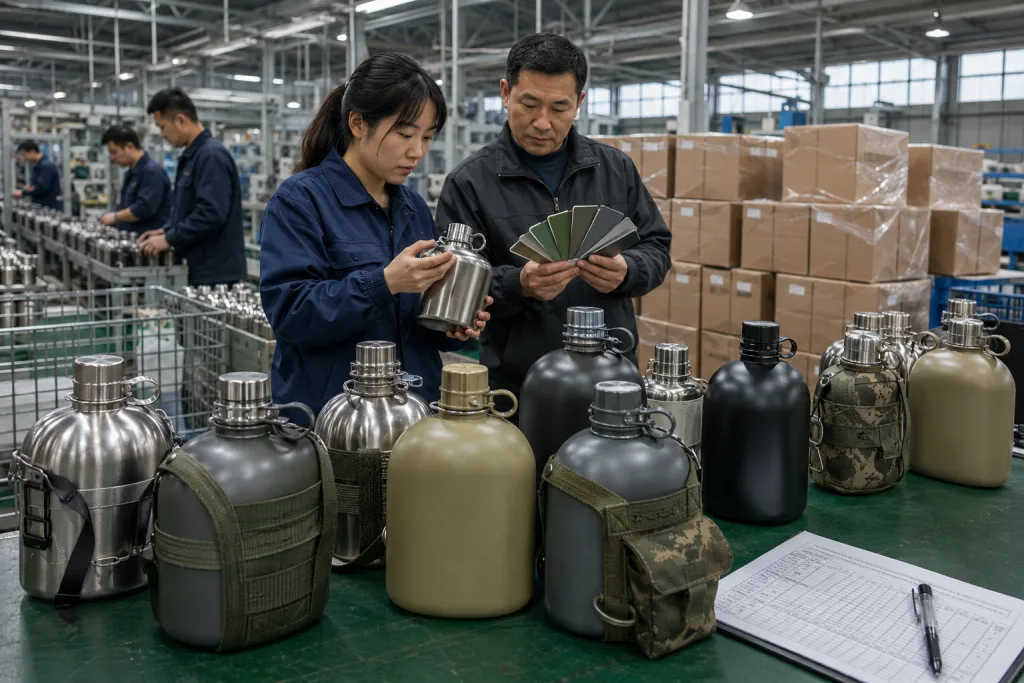
A private label military canteen looks simple until you buy it by the pallet. The trouble usually starts in small places: a cap thread off by 0.3 mm, wall thickness drifting from 0.55 mm to 0.48 mm, powder coating that fails a 3M tape pull, or a carton that splits on the second corner during a 76 cm drop test. Color is another fight. We run color checks against a Pantone card under a D65 light box, and holding the same olive drab across 5,000 units is harder than most first-time buyers expect. If you sell to outdoor retailers or uniform suppliers, these small misses turn into returns fast.
At our Zhejiang production base in China, we see buyers treat canteen promotional products the same as field-style canteens. That is the wrong question to ask. A giveaway canteen and a cadet-program canteen do not need the same test plan. Last month, QC pulled the sample because the buyer’s PO said “matte black” while the approved artwork file said “black gloss,” and that one typo would have delayed the line by 6 days. You do not need to overbuild every custom canteen, but you do need written specs, MOQ that matches the process, and a supplier who points out hidden cost before the purchase order is signed.
Define the canteen before pricing
Most sourcing mistakes start with a loose RFQ. Ask 5 canteen suppliers for “military canteen, custom logo, best price,” and you will not be comparing the same item. One canteen manufacturer quotes single-wall 201 stainless steel at 0.45 mm. Another quotes 304 stainless steel with powder coating. A third canteen vendor adds a canvas pouch, strap, and kraft retail box. The price gap is not magic. The product is undefined. We saw this last March: QC pulled the sample against the buyer’s PO, and the PO only said “army bottle green,” with no Pantone number, no coating type, and no cap drawing.
For a private label military canteen, start with where it will be sold and who carries it. Outdoor retail and uniform kit supply are not the same job. A school cadet program may need a lower MOQ and plain bulk packing; a heritage-style drinkware line usually needs cleaner brushing, tighter logo placement within ±1.5 mm, and a box that survives courier handling. A canteen promotional order can live with lighter packaging and simpler testing. A distributor canteen program for outdoor stores needs cap torque control, coating adhesion checks, and replacement cap stock. The wrong question is “what is your cheapest canteen?” Ask what failure the buyer will complain about first: dented body, leaking cap, scratched coating, or crushed box.
Put these specs in the RFQ before asking for FOB pricing:
- Capacity: 750 ml, 1 L, and 1.2 L are the regular commercial sizes we run; confirm brimful capacity and usable capacity, because some buyers flag a 1 L canteen that only fills cleanly to 940 ml.
- Material: 304 stainless steel for food contact; use 201 only when the target shelf price forces it and the destination market accepts it.
- Wall thickness: 0.5 mm is acceptable; 0.6 mm gives a firmer hand feel and cuts transit dents when cartons are stacked 6 layers high.
- Finish: powder coating, brushed steel, matte spray, or electro-polished interior; send a Pantone code or a physical swatch, not “military green.”
- Cap: PP, stainless outer cap, tethered cap, or screw cap with silicone gasket; we check fit with a torque tester before packing.
- Accessories: canvas pouch, shoulder strap, carabiner, cup, or gift box; list fabric weight, strap width, and whether the box needs a barcode sticker.
A proper canteen factory in China should quote against your written spec, not push the mold that is sitting idle that week. At BottleForge Industrial in Zhejiang, our normal monthly drinkware output is about 450,000 units across bottles, tumblers, growlers, and canteens, but a military-style canteen still gets its own spec sheet on the line. Capacity and finish set the first price. Packaging and inspection set the landed cost. We ship cleaner projects when the RFQ includes a drawing, target carton drop requirement, AQL 2.5, and the exact logo file name—one buyer once lost 12 days because “canteen_logo_final.ai” and “canteen_logo_final_NEW.ai” were both attached.
Material and construction choices
“Military” gets printed on too many drinkware quotes. It does not mean the bottle is built for combat use. In private label work, buyers usually mean a field-style body, matte army green or black powder coat, a tougher hand feel, and a strap or pouch option. Decide this first: does your brand need real dent resistance, or just the military look? We had one EU buyer flag this after the gold sample passed visuals but failed their 1.2 m shelf-drop check.
Stainless steel is the safer commercial choice. For Europe and North America programs, 304 stainless steel gives solid corrosion resistance and simpler food-contact compliance. If your market asks for LFGB, FDA food contact, REACH, or California Prop 65 documentation, the canteen supplier should show current reports and tell you what changes need retesting, such as a new powder coating, silicone gasket, or printed logo ink. On our line, QC checks incoming coil thickness with a digital micrometer before the first deep-drawing run.
Plastic canteens cost less, but the buyer questions come faster: odor after 48 hours, heat deformation in a car trunk, and whether the resin paperwork matches the destination market. Tritan or PP works for youth and promotion orders. For a private label military canteen, stainless steel usually sells better at retail because the weight feels serious in hand. Aluminum is light, but the inner lining is where orders go sideways. Once QC pulled a sample with two small lining scratches near the shoulder, we rejected the lot because taste complaints are not worth saving USD 0.18 per unit.
Construction matters more than first-time buyers expect. A 0.4 mm body saves cost, then dents during ocean freight and retail handling; we have seen 17 dented pieces in a 200-piece pre-shipment check after loose carton packing. A 0.5-0.6 mm stainless body is the better balance for distributor drinkware. Neck welding must be smooth, or the cap thread feels rough after three open-close cycles. The silicone gasket should be food-grade, easy to remove for cleaning, and tight enough not to fall out during filling.
If you are building a customized canteen for outdoor retail, ask for three sample checks: 24-hour water leak test, 1.2 m carton drop test after packed, and coating adhesion cross-hatch test. Basic stuff. These tests separate canteen manufacturers who run production from trading-only vendors who disappear after delivery complaints. We run the cross-hatch with a 1 mm cutter and 3M tape; if the coating lifts around the logo edge, the math doesn't work for a repeat order.
Logo and private label options
Private label is not just a logo on the side. For custom drinkware, most buyers need the full selling set to match the channel: logo placement, body color, barcode, insert sheet, carton marks, and sometimes a spare cap or chain packed in a 6 x 8 cm polybag. We see this split often: a retail canteen needs a cleaner front panel and box artwork, while an event-agency order usually wants a big imprint area that reads well from 2 meters away. Ask for the dieline early. We have had a PO arrive with the SKU typed as “MILTARY-750” and the carton mark repeated the same typo for 1,200 units before QC pulled the first packed sample.
Laser engraving is clean and holds up on bare stainless steel or coated surfaces when the metal contrast looks sharp. It will not give you exact Pantone color, so this is the wrong method if the brand team is chasing PMS 186C. Silk screen printing costs less for one-color artwork and works on flat or slightly curved panels, but a 42 mm logo wrapped too far around the body can make small text look bent. Heat transfer handles multi-color logos, but we run cross-cut tape tests on powder coating before bulk production. For large distributor canteen orders, we usually push laser or one-color screen printing because the math works: fewer process variables, fewer rejects at AQL 2.5 final inspection.
For packaging, you have three practical levels. The line will price them differently because packing speed changes, not just material cost.
- Bulk pack: lowest cost, suitable for institutional supply or kit assembly, often 24 pcs per export carton with dividers if the finish scratches easily.
- White box with label: good for canteen distributors using their own SKU systems, but send the label size in mm because a 60 x 40 mm sticker will not fit every box side.
- Full retail box: best for private label shelf programs, usually USD 0.35-0.90 extra per unit depending on print and board weight, and the buyer should approve one packed drop-test sample before mass packing.
Barcode and marketplace handling need to be settled before cartons are made. If you need FNSKU labels, suffocation warnings on polybags, or mixed-carton rules, put them in the packing instruction with photos of the label position. Do not assume the canteen vendor knows your warehouse routing guide unless you send it. We have seen this go sideways when a buyer flagged “carton label on short side only” after 86 cartons were already sealed with 48 mm tape.
Color is one place buyers should be strict. Olive drab, sand, black, navy, and gray are common for military-style drinkware, but “army green” means different paint codes in different factories. Ask for a physical color chip or sprayed sample, not just a Pantone number by email. Powder coating batch variation of 3-5% visually can happen if the canteen supplier is careless with paint lots, so we check the first 20 pcs under a D65 light box before the line keeps running. For repeat orders, keep an approved master sample at both your office and the factory in China.
MOQ, pricing, and lead time
For a private label military canteen, we quote a workable MOQ at 1,000 units for laser logo on a stock color, 2,000-3,000 units for custom powder coating, and 5,000 units or more for a new mold or special cap tooling. We run 1,000 pcs as one clean line slot; below that, the setup time on the laser jig and packing table eats the margin. Some canteen vendors advertise 300 units, but the unit price often kills distributor drinkware margins. Fine for a market test. Wrong for a wholesale program.
As a rough FOB Ningbo or Shanghai range from Zhejiang, a 1 L single-wall 304 stainless custom canteen sits around USD 3.20-5.80 depending on wall thickness, coating, logo, cap, and packaging. Add a canvas pouch and strap, and the cost adds about USD 0.80-1.80. A heavier gift box can add USD 0.50 or more, and we have seen buyers reject a 350 gsm box after QC pulled the sample and found corner crush in the drop test. Steel price, exchange rate, and order volume move the quote, but these numbers are good enough to spot a fake-low offer.
Lead time normally runs this way after the PO, artwork, and Pantone number are clean; one buyer once typed 19-4205 instead of 19-4005 on the PO, and that cost 4 days before spraying.
- Pre-production sample: 7-12 days after artwork and color confirmation, including logo position check on the curved body.
- Bulk production: 25-35 days after sample approval and deposit, assuming the coating line is not already booked with 20,000 pcs.
- Inspection and booking: 3-7 days depending on freight forwarder timing and whether AQL cartons are pulled before or after pallet wrapping.
If a canteen manufacturer promises 10-day production on a fully customized canteen during peak season, push back. It works for a stock body with quick logo work, not for custom coating, retail packaging, and AQL inspection. We have seen this go sideways: the first 500 pcs looked fine, then QC found color drift under the D65 light box. The honest answer is less exciting but safer for your launch date.
Payment terms belong in the cost discussion. For new buyers, 30% deposit and 70% balance before shipment is common. Larger canteen distributors with repeat volume may negotiate better terms after 2-3 successful orders, especially when we ship the same SKU every quarter. If you are buying for a tender, allow extra time for compliance documents, sealed samples, and possible third-party testing; the math does not work if the bid closes in 18 days and testing alone needs 12 days.
Quality checks that prevent claims
Drinkware claims usually start with small, boring defects and end with a debit note: leaking caps, scratched coating, wrong logo height by 3 mm, dented export cartons, gasket odor, or 2 colors mixed on one pallet. We saw QC pull 48 army-green samples last year because the PO said “matte black” on page 1 and “OD green” on page 3. A private label military canteen program needs a written inspection plan before the line runs, not after 86 cartons are taped shut.
Use AQL inspection for visual and functional defects. For most B2B orders, AQL 2.5 for major defects and 4.0 for minor defects is practical. Critical defects should be zero tolerance. Define critical defects in plain factory terms: leakage on the upside-down test, burrs that catch a cotton glove, wrong steel grade against the material sheet, missing FDA or LFGB food contact files, or a customer logo printed on the wrong side. Major defects can include serious dents over 5 mm, cap thread failure on the GO/NO-GO gauge, coating chips visible at arm’s length, or packaging that does not match the carton mark. Minor defects can include 1 small dust point in coating within the signed limit sample.
Cap testing is non-negotiable. We fill units with water, close them to the agreed torque using a digital torque meter, place them upside down for at least 4 hours, then run random shake tests from each packed batch. For a stronger program, use hot water at 60°C on selected samples to check gasket behavior after the silicone softens. If the canteen customized for your brand includes a tether, test the tether pull strength with a spring scale; 8 kg for 10 seconds is a common starting point. This is the wrong place to save time. A nice-looking cap that fails in the first week is a warranty cost, not a design feature.
Packaging should match the distribution route. E-commerce cartons need stronger drop resistance than palletized wholesale cartons. A normal export carton for stainless canteens may use 5-ply corrugated board, but the exact flute and carton weight should be checked against unit weight; we usually weigh the packed carton on a 30 kg bench scale before booking the forwarder. If your customer is a canteen distributor shipping single units, inner protection matters more than if the product goes to a central warehouse by pallet. We have seen this go sideways when a buyer approved the bottle but skipped the carton drop test, then 12 cartons failed at the corner after a 76 cm drop.
Ask your canteen factory for production photos, inline QC records, and final inspection availability with a booking window at least 5 days before ETD. On our line, QC records include first-piece photos, coating thickness readings in μm, leak-test counts, and carton-mark checks against the PO. Third-party inspection through SGS, Intertek, Bureau Veritas, or your own agent is reasonable for first orders above USD 10,000. Good canteen suppliers will not treat inspection as an insult. They know it protects both sides, and the math does not work when a USD 0.18 gasket issue turns into a full-container claim.
Choosing the right supply partner
Canteen suppliers differ less by press count and more by how they handle fuzzy specs, defects, and repeat orders. A solid canteen manufacturer asks the irritating questions before sampling: target market, FDA or LFGB need, Amazon or retail shelf, AI/PDF artwork, 80 cm carton drop test, and two-side carton labels for warehouse receiving. We had one PO where “matte army green” was typed as “mate army green”; QC pulled the powder-coated sample under a D65 light box before the line ran 3,000 pcs. That saved money.
If you are comparing canteen vendors in China, split factory capability from trading convenience. A trading company makes sense when you are bundling 12 unrelated SKUs into one container. A direct canteen factory is stronger when you need the same color batch after batch, TIG welds that do not wander, logo position held within 1.5 mm, and spare caps that still fit 18 months later. For distributor growler, custom growler, customizable growler, or customized growler programs, the same rule applies: drinkware looks simple on a quote sheet, but repeatability is the product. We have seen this go sideways when a buyer chased a USD 0.08 saving and got three shades of black lids in one shipment.
Ask for evidence, not promises. Useful documents include BSCI or social audit records, ISO 9001 if available, material declarations, food-contact test reports, REACH-related coating information, and previous inspection reports with customer names blocked out. On our floor, the QC file normally has caliper readings for mouth ID, coating adhesion cross-cut photos, and AQL 2.5 findings from pre-shipment inspection. If a canteen supplier cannot show even 2 recent QC documents, you are buying blind.
Check communication speed and technical accuracy. If you ask about 0.6 mm wall thickness and the sales reply says “quality good,” keep looking. You want a canteen vendor who can explain the cost gap between 201 and 304 stainless steel, why custom powder coating pushes MOQ from 500 pcs to 1,000 pcs, and why a logo breaks across a curved seam. The wrong question is “Can you make it?” Most factories will say yes; the better question is “Where will this spec fail on the line?”
At BottleForge Industrial in Hangzhou, Zhejiang, we run customizable drinkware for importers, brand owners, and canteen distributors who need usable answers before they issue a PO. We are not the cheapest option for every canteen custom project, and that is fine. Last month a buyer flagged a 12-day lead time request against an 18-day powder-coating schedule; the math did not work, so we changed the ship plan before deposit. The right order is the one where the spec, price, inspection level, and delivery date make commercial sense.
Send your canteen spec for a factory review
Share capacity, material, logo, packaging, and target market. We will return practical MOQ, FOB pricing, and lead time options.
Frequently asked questions
What is the best MOQ for a private label military canteen order?
For a serious private label military canteen order, 1,000 units is a practical starting point if you use an existing body shape, stock color, and laser logo. For custom powder coating, plan around 2,000-3,000 units per color because paint setup, line cleaning, and reject allowance become more efficient at that level. If you need a new mold, special cap, or unique pouch design, 5,000-10,000 units is more realistic. Smaller quantities such as 300-500 units can be done by some canteen vendors, but the FOB unit price and setup cost usually make wholesale margins weak.
Should I choose 304 stainless steel or aluminum for a custom canteen?
For most Europe and North America B2B channels, 304 stainless steel is the safer choice. It is corrosion resistant, does not need an internal lining, and supports common food-contact testing. Aluminum is lighter and can look authentic for some military-style designs, but it usually requires an inner coating. If that coating is scratched or poorly cured, buyers may complain about taste, odor, or safety. A 304 stainless customized canteen with 0.5-0.6 mm wall thickness costs more than a thin aluminum canteen, but it gives a better balance of durability, compliance, and retail value.
How long does a canteen customized with logo and color take?
A normal timeline is 7-12 days for a pre-production sample after artwork, color, and packaging details are confirmed. Bulk production usually takes 25-35 days after sample approval and deposit. Add 3-7 days for final inspection, carton marking, and freight booking. If you need third-party lab testing, add another 7-10 working days depending on the test scope. Stock color with laser engraving can be faster, but custom coating, retail box printing, FNSKU labels, or pouch sewing will extend the schedule.
What tests should I require from a canteen manufacturer?
At minimum, require material confirmation, leak testing, coating adhesion checks, visual inspection under AQL 2.5/4.0, and export carton drop testing. For food contact, ask whether the product can support FDA, LFGB, REACH, or Prop 65 documentation based on your selling market. For function, test filled canteens upside down for at least 4 hours and run random shake tests. If there is a strap or tether, include pull testing. For first orders over USD 10,000, a third-party inspection before shipment is a sensible cost, usually far cheaper than handling claims after arrival.
Can one supplier handle canteens, bottles, tumblers, and growlers?
Yes, but only if the supplier has real drinkware capability rather than just a catalog. Many buyers want one partner for custom canteen, customized drinkware, travel tumblers, sports bottles, and distributor growler programs. That can simplify artwork control, carton labeling, and freight consolidation. Still, check each product category separately. A factory that makes a good tumbler may not automatically control canteen cap leakage or pouch sewing. Ask for samples from each line, current capacity, MOQ by item, and inspection records before combining a multi-SKU order.