Key Takeaways
- Most private label kids bottle programs start at 3,000 pcs, with samples in 7-10 days.
- For school use, 350-500 ml and 1.2-1.5 mm wall thickness are the safest starting point.
- FOB China pricing often sits around USD 1.20-4.80 depending on material, lid, and print.
- Ask for FDA, LFGB, REACH, CPSIA, and AQL 2.5 documents before you approve production.
If you are buying a private label kids bottle for a school district, retail launch, or promo program, color is the wrong question to ask first. The real risk is a bottle that looks fine on a sample sheet, then leaks at the flip lid, cracks after a 1.2 m drop test, or fails compliance after you place a 5,000 pcs bulk kids bottle order. We had QC pull 32 samples last month because the straw gasket sat 0.6 mm proud of the groove. Cheap became expensive fast.
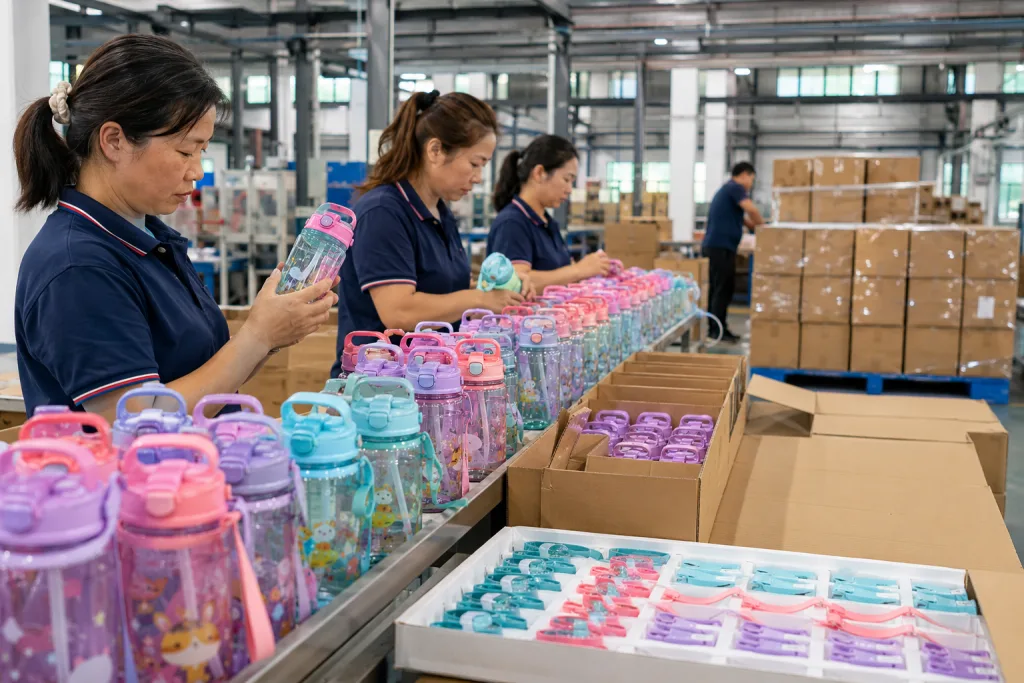
At BottleForge in Zhejiang, we see 8 to 12 kids bottle RFQs a week from buyers in Europe and North America. You need a custom kids water bottle that survives backpacks, dishwashers, and 12 kg export cartons, not a toy that only photographs well. If you source from a children water bottle manufacturer in China, define the use case, confirm the material grade with the supplier, lock the print method after a tape test, and write the test standard on the PO before asking for price. We’ve seen this go sideways when the buyer flagged “BPA free” only after the pre-shipment inspection.
Start With the Use Case
Before you put one custom kids bottle sample next to another, decide where it will be used. A bulk school water bottle for a primary school has a different job from a retail bottle sold through a children water bottle distributor. School buyers usually push us on two things: “Will it leak in a school bag?” and “Can a Grade 1 child open it in 5 seconds?” Retail buyers ask a different question: whether the bottle looks good on a 600 mm shelf and whether the gift box survives courier handling. QC pulled one sample last month because the flip lid needed 2.8 kg of force to open. Too much for a six-year-old.
The safest starting range is usually 350-500 ml. A 350 ml bottle fits most lunch bags; a 500 ml bottle feels heavy once filled, so the line checks the filled weight before we approve the body. For younger users, a wide mouth helps cleaning, but the cap must stay simple. No tiny silicone parts. For older kids, a straw lid or flip-top usually beats a screw cap because it is faster during class breaks. If you are planning children water bottle bulk purchasing for schools or clubs, set the age band first. Decoration comes after that, or the math doesn't work.
Practical rule: do not ask a children water bottle supplier for 10 shapes at once. Ask for 2 or 3 bottle bodies, 2 lid systems, and one packaging format. We run samples faster that way, usually 12 days instead of 18 days, because the mold room is not chasing too many drawings. It also gives you a cleaner quote from a children water bottle factory in China, and the buyer has fewer chances to flag small mistakes like “blue” on the PO while the artwork file says Pantone 2925 C.
Choose Materials That Hold Up
Material choice is where 6 out of 10 bulk kids bottle projects start to drift. PP keeps the quote low and the bottle light, so we run it for school giveaways and price-led promo orders, but it will not give that heavier shelf feel a retailer expects. Tritan is the safer pick when the buyer wants clear walls, drop resistance, and a cleaner retail look for a children water bottle customizable program; last month QC pulled a 480 ml Tritan sample after 1.5 m drop testing and the cap cracked before the body did. For stainless, 304 is the normal workhorse. 316 makes sense when the buyer needs a higher-end story and better corrosion resistance, but the math does not work for every private label line.
For plastic bodies, ask for wall thickness in the 1.2-1.5 mm range. Below 1.2 mm, the bottle feels cheap in hand, and we have seen bodies oval out after 18 kg carton stacking in the warehouse. For stainless steel, ask for 0.4 mm or 0.5 mm inner and outer walls depending on your price target; our line checks this with a digital thickness gauge before polishing. For lids, the seal is usually the failure point, not the shell. Use a food-grade silicone gasket. Saving 1-2 cents here is the wrong question to ask if your customer will return a leaking kids bottle.
- PP: lowest cost, better for children water bottle promotional projects where MOQ and unit price matter more than retail feel
- Tritan: clear body, better impact performance, stronger fit for custom children water bottle retail programs
- 304 stainless: balanced cost and durability for daily school-use bottles
- 316 stainless: higher spec for premium import programs with a corrosion-resistance selling point
If you are buying from China, ask the children water bottle manufacturer to confirm resin grade, metal gauge, and recycling code on the drawing, not just in email. We have seen this go sideways when the PO said “Tritan” but the drawing still showed PP code 5, and the buyer flagged it only after the pre-production sample. Put it on the 2D drawing before tooling or color approval starts.
Safety and Compliance First
For school districts and importers, compliance is a gate check, not a nice-to-have. We check a private label kids bottle against the destination market before the mold shop cuts steel or the pad-printing screen is made. For the US, buyers usually ask us for FDA food-contact declarations and CPSIA-related documents when the set includes kids accessories; one 2024 PO was held for 6 days because the buyer wrote “CPSA” instead of CPSIA on the compliance line. For Europe, REACH and LFGB are the files buyers keep chasing, especially on bottles with a straw, silicone spout, or printed grip band.
Material certificates are not enough. This is the wrong question to ask if the only question is “Is the resin safe?” Ask for migration testing on the finished product, because a safe resin does not automatically make the assembled bottle safe after color masterbatch, ink, silicone, and gasket contact are added. If your program includes a handle, lanyard, or character cap, we run a pull test on the line; QC pulled one unicorn cap sample at 68 N and flagged a break-off edge near the hinge. For cartons and mixed production lots, AQL inspection matters too. For most children water bottle wholesale programs, AQL 2.5 for major defects and 4.0 for minor defects is a sensible starting point.
At our Zhejiang factory, buyers often request BSCI, REACH, and a test plan before they approve artwork. Good order. Paperwork first, logo second. We’ve seen this go sideways when the artwork was approved 12 days before shipment, then the buyer asked for LFGB migration on the finished straw lid and the booking moved to 18 days. If you are sourcing from China, ask for traceable lot numbers on every master carton; our carton label printer puts the batch code beside the PO number, so a school recall or distributor claim does not turn into warehouse guessing.
Branding That Survives Use
A custom logo kids bottle should not lose its mark after 20 dishwasher cycles or 30 days in a school bag with keys, lunch boxes, and wet towels rubbing against it. Decoration choice matters as much as bottle shape. Silkscreen keeps cost down for a simple 1-color logo; we run it with a curved screen jig and check edge bleed at 0.2 mm. Pad print works better on tight curves and small mascot marks near the shoulder. Laser engraving is the cleanest option on 304 stainless steel, and it suits a custom logo kids bottle program that needs 18 months on shelf, not one back-to-school season.
For plastic bottles, keep artwork simple. Big filled blocks look fine on a mockup, then go sideways on a textured or tapered surface; QC pulled one Tritan sample last year because the navy ink broke around the grip ribs after tape testing. For stainless bottles, laser is durable, but it will not give you a bright Pantone match. If your brand depends on exact color, ask for a controlled silkscreen sample and confirm whether the line uses oven cure or UV cure, because the math changes when the MOQ is 3,000 pcs and the logo has four colors. A good children water bottle customized program should also lock lid color, straw insert color, and carton print code so the bottle and packaging do not fight each other.
Buyers often over-focus on logo size. This is the wrong question to ask first. Print durability and color consistency are what keep a private label kids bottle from looking cheap after three weeks.
If you need faster artwork decisions, compare one-color silkscreen against laser engraving on the actual bottle body, then ask for a print proof on real material, not a flat PDF. We ship proofs by DHL in 3–5 days after artwork approval, but the buyer must send vector AI or PDF files; a 72 dpi PNG from the PO will slow the line down.
MOQ, Price, and Lead Time
Price only makes sense after you lock the build sheet. A bulk kids water bottle in PP with one-color silkscreen may land around USD 1.20-1.80 FOB China at higher quantities; on our line that usually means a 0.8 mm print tolerance checked with a film ruler before mass run. A Tritan bottle with a better lid can move into USD 2.20-3.60. A stainless custom school water bottle with a polished finish and laser logo can easily run USD 3.20-4.80 or more, depending on capacity and packaging. Cheap first quotes cause trouble. We have seen buyers compare a PP push-button lid against a Tritan flip lid and wonder why the math does not work.
For MOQ, a real children water bottle supplier will usually quote 3,000 pcs per color or per design for a customized item. Promo orders can sometimes go lower, say 1,000-2,000 pcs, but the unit price jumps fast because the line still needs pad-print plates, color change cleaning, and first-piece QC. Our Zhejiang production line runs about 300,000 units per month, and standard lead time is 25-35 days after sample approval and deposit. If you need mixed SKUs, add another 7-10 days for packaging and carton allocation. Last month QC pulled the sample because the PO said blue lid but the artwork file named it “navy,” and that small typo cost 2 days.
Ask for a quote that separates bottle body, lid, print, packaging, and test fees. This is the right question to ask, not “what is your lowest price?” For school district buyers, ask whether the quoted price includes spare seals or replacement straws. Those parts are cheap, usually a few cents each, but they cut post-sale complaints when 24 children in one classroom pull straws out with teeth. We pack spare silicone seals in a 10 kg master carton when requested, and the buyer flagged missing spares once during AQL 2.5 inspection, so now we list them as a separate line item.
Write a Better RFQ
The fastest way to get a usable quote from children water bottle manufacturers is to send a short RFQ with real specs. Please don’t send only a logo and “back-to-school kids bottle”; QC can’t measure that with a caliper. Give the factory the target user age, capacity, material, lid type, decoration method, packaging style, and market destination. We run a clear request through costing in 24 hours; a loose request burns 5 to 7 days of back-and-forth, and the first price is still usually wrong.
Include these details:
- Capacity: 350 ml, 500 ml, or other, with target bottle height if shelf fit matters
- Material: PP, Tritan, 304, or 316, plus food-contact test market
- Decoration: silkscreen, pad print, or laser, with logo size in mm
- Packaging: bulk carton, color box, or hang tag, with barcode position
- Compliance: FDA, LFGB, REACH, CPSIA, BSCI
If you are comparing a children water bottle distributor with a direct factory, ask for the same data on both quotes. Then compare landed cost, not just FOB price. The math doesn’t work if one quote includes a 5-layer export carton and the other hides the color box cost; we’ve seen buyers flag this only after the PO says “500ml” but the artwork file says “550 ml.” A solid custom children water bottle program needs fewer surprises: one drawing with dimensions, one test plan, one carton spec, and one approved sample. That is the difference between a clean rollout and a warehouse full of rework.
Get a quote for your kids bottle program
Send capacity, material, logo, and market details. We will price your private label kids bottle plan with clear MOQ, testing, and lead time.
Frequently asked questions
What is the usual MOQ for a private label kids bottle?
For a real customized program, 3,000 pcs per color or per design is the most common starting point from a children water bottle manufacturer in China. Some children water bottle suppliers will accept 1,000-2,000 pcs if you use stock molds and basic printing, but the unit price usually rises 15-30%. If you need multiple school colors, ask for one body and several lid colors first. That keeps tooling simple and still gives you a useful bulk children water bottle program. Samples normally take 7-10 days, and full production usually needs 25-35 days after approval.
Which is better for school use: plastic or stainless steel?
For school districts, both can work, but the choice depends on age and abuse level. PP and Tritan are lighter, easier to carry, and usually cheaper for a bulk school water bottle order. Stainless steel is better if the bottle will take more impact and you want a premium retail story. If you choose plastic, keep wall thickness around 1.2-1.5 mm. If you choose steel, 304 is the standard starting point and 316 is the higher spec. For younger children, a simple straw or flip lid is usually easier than a screw cap.
What compliance documents should I ask for?
For North America, ask for FDA food-contact declarations and the relevant child-product paperwork if accessories fall under that scope. For Europe, ask for REACH and LFGB. If the bottle includes a toy-like cap, strap, or decorative element, request migration and mechanical safety testing on the finished product, not just the raw material. A good children water bottle factory should also provide lot traceability and an inspection report. For most bulk kids water bottle orders, AQL 2.5 for major defects is a practical baseline, with carton checks and sealing tests included.
How much should I budget for custom branding?
For a simple custom kids water bottle, one-color silkscreen is usually the lowest-cost option, often adding only a small amount per unit at scale. Pad print is similar, but setup can be higher if the artwork is detailed. Laser engraving on stainless costs more upfront but lasts longer and gives a cleaner premium finish. In practice, the decoration choice can change the FOB price by USD 0.08-0.60 depending on design and quantity. If your brand needs exact color control, ask for a print proof on the real material before production, not just a digital mockup.
Should I buy from a distributor or direct factory?
If you need speed and small quantities, a children water bottle distributor can help because they may hold stock or combine orders. If you need a custom children water bottle with your own mold, logo, and packaging, the direct children water bottle factory is usually the better route. You get clearer pricing, more control over compliance, and less markup. For importers and school buyers, the best approach is to compare both. Ask each seller for the same spec sheet, same test standards, same MOQ, and same carton counts. Then compare landed cost, not just unit price.