Key Takeaways
- A realistic private label infuser bottle MOQ is 3,000 units per color for factory direct production
- Tritan, borosilicate glass, and 304 stainless steel solve different price and positioning problems
- Logo method, filter mesh, gasket hardness, and carton drop strength matter more than catalog photos
- Plan 7–10 days for sampling and 30–45 days for bulk production after approval
A private label infuser bottle looks simple until we cost the filter fit, logo rub resistance, leak test, insert card, and repeat PO. We’ve seen this go sideways. A wellness buyer once sent a clean 3D render, then QC pulled the sample and found the fruit basket had 1.8 mm side play, so it rattled in every carton drop test.
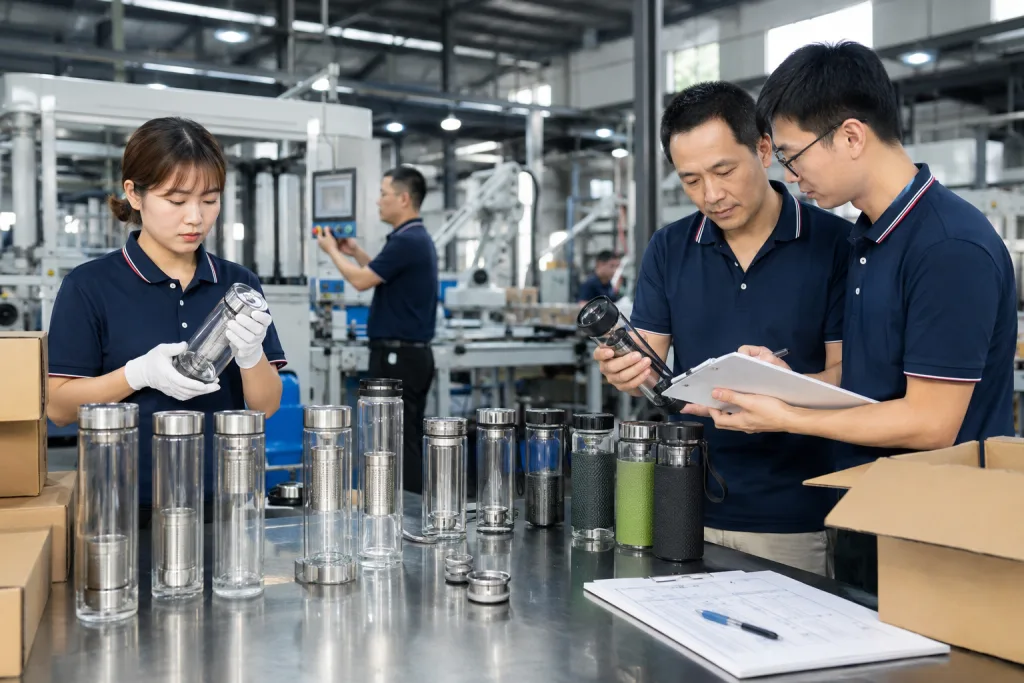
If you are sourcing from China, a catalog photo is not enough. You need to know which body material hits your target FOB, whether a new mold is actually needed, and how the line checks taste, odor, leakage, and decoration before packing. BottleForge Industrial in Hangzhou, Zhejiang runs infuser bottle programs from 3,000 units per SKU, with normal production lead time of 30–45 days after sample approval; we run 100% water leak checks on threaded lids before the bottles move to logo inspection.
Start with the bottle format
Before you ask for a quote on a private label infuser bottle, decide what the bottle must do on the shelf. Start there. A gym-focused custom fruit infuser bottle usually needs 650–900 ml capacity, one-hand opening, and a body light enough to pass a 1.2 m drop test without the flip cap popping open. A desk or spa bottle can sit closer to 500–750 ml, with a cleaner cylinder shape and a thicker base; we run 2.2–2.5 mm wall checks with a digital caliper on first-shot samples. A custom tea infuser bottle needs finer mesh, better heat resistance, and a lid design that lets users lift the infuser without burning their fingers.
For wellness brands, the common formats are Tritan plastic and borosilicate glass; stainless steel is a separate decision if insulation matters more than seeing the fruit or tea. Tritan is the volume choice for a bulk fruit infuser bottle because it is transparent, impact-resistant, and cost-effective. A 750 ml Tritan model with PP lid and stainless filter often lands around USD 2.10–3.20 FOB Ningbo or Shanghai at 3,000–5,000 units, depending on packaging and logo. Borosilicate glass looks more premium and handles hot tea better, but parcel breakage and weight must be priced in; last quarter QC pulled 32 cartons after finding corner crush on a 6-bottle mailer test. Stainless steel works for a bulk tea infuser bottle when you want insulation, but the infuser system costs more and the buyer loses the visual “fresh fruit” story.
The mistake is trying to make one custom made infuser bottle serve every use case. The math doesn't work. Fruit slices need a wide-mouth basket, usually 45–55 mm diameter. Loose tea needs tighter perforation or mesh, often 0.3–0.6 mm openings. Ice water users care about leak resistance and grip; hot tea users care about condensation, heat transfer, and lid threads. We’ve seen this go sideways when a PO says “tea/fruit bottle” but the drawing shows only a 38 mm basket, then the buyer flagged lemon slices getting stuck during sample review. Brief the use case clearly, and a China factory can quote without adding a safety margin for unknowns.
Materials buyers should compare
Material choice decides the compliance route, unit price, and how many complaint emails your CS team gets after launch. For a factory infuser bottle, “BPA free” is the wrong question to ask. Ask for the resin grade, food-contact reports, and a written note that mass production will run the same material as the approved sample; we have seen buyers approve Tritan sample cups, then flag the PO later because the grade line was missing. Tritan should be quoted with grade confirmation. PP lids and silicone seals should match food-contact requirements, and QC should check the seal OD with a digital caliper before packing. For Europe, REACH and LFGB are common buyer requests. For the United States, FDA food-contact documentation and sometimes California Proposition 65 screening may be needed.
A customized fruit infuser bottle in Tritan normally uses a 1.5–2.2 mm body wall, depending on shape. Too thin feels cheap. Too thick slows the injection cycle; on one 720 ml body, the line moved from 38 seconds to 52 seconds after the buyer pushed for a heavier hand feel. Borosilicate glass bodies are often 2.0–2.8 mm wall thickness. A glass custom infuser bottle feels premium, but every extra 100 g changes the freight math and raises breakage risk. For e-commerce, we usually recommend inner box plus 5-ply export carton, then a 76 cm drop test on corners, edges, and faces; if the carton corner opens after two drops, we change the paper spec before shipment.
For a customized tea infuser bottle, stainless steel filter quality matters more than the product photo suggests. 304 stainless steel is the normal baseline. Specify passivation or at least clean deburring, because sharp filter edges are a complaint source we can predict; QC pulled the sample last March after finding a 0.3 mm burr on the basket rim. If the infuser basket is plastic, check heat limits honestly. Some buyers ask for boiling-water use on a plastic body because it sounds good in marketing. The math doesn't work. A customizable tea infuser bottle intended for hot liquid should use borosilicate glass or stainless steel, not a low-cost plastic body.
China factories can build all three formats, but the right choice depends on your sales channel. Retail distributors infuser bottle orders care about shelf presentation and barcode cartons; one buyer rejected 24 cartons because the EAN sticker was 6 mm too low for their warehouse scanner. Online hydration startups care about FNSKU labeling, inner-box crush strength, and low defect rates after parcel handling. We ship both types, and the spec sheet should follow the channel. Not the mood board.
Logo and decoration choices
A custom logo infuser bottle can be decorated cheaply, or decorated so it survives real use. Different job. For Tritan bodies, we run one-color silkscreen first because it is still the lowest-cost choice for simple marks. At 3,000 units, a one-color print may add about USD 0.08–0.18 per piece, depending on print area. Our screen room usually checks a 35 mm logo height with a 3M tape pull before mass print. Multi-color printing adds setup cost and registration risk; QC pulled one sample last month with a 0.6 mm red-to-black shift, and the buyer flagged it immediately. If your logo has fine gradients, change the artwork instead of forcing a process that will not hold up.
Laser engraving is more common on stainless steel lids or insulated bodies. It is durable and clean, but it does not behave the same on clear plastic. Heat transfer and full-wrap labels can make a customizable fruit infuser bottle look retail-ready, but the line needs abrasion checks and dishwasher-claim testing before we put that promise on a carton. We use a wet rub test for 50 cycles first. If your bottle is sold through distributors fruit infuser bottle channels, shelf impact may justify the extra USD 0.20–0.60. If you sell direct-to-consumer bundles, a clean logo plus stronger packaging is often the better spend. The math does not work if decoration costs more than the buyer can see.
Color is another sourcing trap. A factory direct infuser bottle can be produced in custom Pantone colors, but plastic batch, wall thickness, and light booth angle will shift the result. We have seen Pantone mint look 2 shades darker on a 2.8 mm wall than on a flat color chip. For serious private label work, approve a physical color chip or pre-production sample, not just a PDF. Typical custom color MOQ is 3,000 units per color for plastic parts. For stainless steel powder coating, MOQ may start at 1,000–2,000 units per color if the coating line has matching powder available, but custom powder can push MOQ higher. Ask for the chip first.
Packaging is part of decoration. A private label infuser bottle in a plain white box feels unfinished for wellness retail, and buyers know it. A color box with matte lamination, instruction insert, and barcode usually adds USD 0.25–0.55 per unit. On the floor, we check carton print against the PO because one missing digit in an EAN code can hold 80 cartons at final inspection. If you need Amazon-style prep, specify FNSKU label position, suffocation warnings for polybags, and master carton weight below 15 kg unless your warehouse accepts heavier cartons.
MOQ and pricing reality
MOQ is not a punishment; it is the way we cover setup time, Pantone color mixing, printing jigs, carton setup, and QC labor on the line. For a bulk infuser bottle project, a workable MOQ from BottleForge Industrial in Zhejiang is 3,000 units per SKU for standard mold models, and 5,000–10,000 units if you ask for custom color, custom lid parts, or special packaging. A full custom made infuser bottle with new mold can require tooling from USD 2,000 to over USD 12,000, depending on body, lid, basket, and thread design. Last month QC pulled a 700 ml sample because the silicone ring groove was 0.4 mm shallow; that kind of fix still eats engineer time before mass production.
For standard factory fruit infuser bottle models, we usually quote three levels, but the buyer should not treat them as equal choices. Level one is stock shape with logo only, often 3,000 units and the fastest way to test a shelf. Level two is stock mold with custom colors and packaging, where we run a color chip check under a D65 light box before confirming the PP lid. Level three is modified or new tooling. Most startups should begin with level one or two, then move to tooling after they see repeat demand from at least 2 reorder cycles. This is the wrong question to ask if the first email is only “can you make my own mold?” The math often does not work yet.
FOB pricing for fruit infuser bottle bulk orders varies by material and decoration. A 700 ml Tritan customized infuser bottle may sit around USD 2.20–3.50 FOB China at 3,000–5,000 units. A borosilicate glass bottle with stainless infuser may land around USD 3.20–5.80. A stainless insulated tea infuser model can reach USD 5.50–9.50, especially if vacuum performance and powder coating are specified. These are working ranges, not promises; resin price, exchange rate, carton size, and decoration change the final quote. We have seen this go sideways when a PO says “matte black” but the approved sample was Pantone 426C powder coat with 70±5 gloss units.
Ask suppliers to separate the quote by bottle, logo, packaging, inland freight, and testing. If a factory infuser bottle quote is one vague number, you cannot see what happens when you change from color box to kraft box, or from one-color print to laser logo. Procurement managers do not need romance in a quote. You need a clean cost table and written assumptions, including carton size, estimated gross weight, test standard, and who pays if SGS finds a migration issue. We ship better when the PO matches the quote line by line; one buyer once typed “kraft box” on the PO after approving a color box, and the carton room caught it 12 hours before printing plates were made.
Sampling and approval workflow
A clean sample process saves money later. For a standard custom infuser bottle, expect 3–5 days for stock sample dispatch and 7–10 days for a logo sample if printing plates or color matching are needed. If you request custom color plastic parts, the sample period can move to 10–15 days because the line needs a small PP or Tritan color trial, usually 2–3 kg resin per color. New tooling can push first samples to 25–45 days. We’ve seen this go sideways when a buyer approved a render on Monday, then rejected the actual lid texture 18 days later.
Approve the right things in writing. For a customizable infuser bottle, sample approval should cover body material and capacity tolerance, lid fit and gasket hardness, infuser basket dimensions and logo position, plus packaging structure and carton marks. QC should measure the basket with a digital caliper, not just check whether it “looks right.” Capacity tolerance is often missed. A bottle sold as 750 ml should be tested to a defined fill line, not guessed from a render. For plastic bottles, a tolerance of ±3% is common. For stainless bottles, capacity can shift with the forming process, so check it before packaging artwork is locked. The math doesn’t work if the gift box says 750 ml and the line keeps filling at 728 ml.
Leak testing should be practical. We run inverted static testing for 4 hours, shake testing for 30 seconds, and pressure-style checks where the structure allows it. During assembly, a common internal check is 100% visual inspection plus random water leak testing, then AQL inspection before shipment. For export orders, buyers often specify AQL 2.5 for major defects and 4.0 for minor defects. Critical defects, such as broken glass or sharp burrs, contamination, and severe leakage, should be zero tolerance. Last season QC pulled the sample after finding 2 lids with gasket flash over 0.6 mm, and the buyer flagged the same issue in their incoming report.
If you are buying a distributor tea infuser bottle or distributor infuser bottle program, ask for a sealed golden sample and keep one at your office. The factory keeps the same approved sample in China, usually labeled with PO number, version date, and Pantone code on a paper tag. When production starts, both sides compare against the same physical reference. Old-school, yes. It stops disputes that screenshots cannot solve, especially when someone types “matte black” on the PO but the approved sample is satin black.
Quality checks before shipment
Infuser bottles usually fail at the same stations we check on the line: lid threads that cross at 0.3 mm off-center, silicone gaskets that twist after 20 open-close cycles, baskets that rattle in the neck, odor after sealing, weak logo adhesion, crushed gift boxes. A customized tea infuser bottle adds 90°C water, tannin stains, and buyer complaints about brown rings near the basket shoulder. A customized fruit infuser bottle brings pulp blockage, citrus oil attacking soft-touch coating, and cleaning pushback. We’ve seen this go sideways when the checklist is copied from a plain water bottle. Wrong checklist.
For plastic bodies, QC should pull samples under a 6000K light box and check black spots, flow marks near the injection gate, scratches over 10 mm, wall thickness with a digital caliper, and odor after sealing for 24 hours. For glass, check rim smoothness with a fingertip and cotton wipe, wall bubbles over 1 mm, annealing stress where possible, and carton protection after a 76 cm drop test. For stainless parts, run salt or humidity exposure if the bottle is sold for sports or outdoor use; 304 stainless still gets blamed if the buyer stores it wet. Filter baskets need clean deburring. If a mesh edge catches a fingertip, QC pulled the sample for a reason.
Logo durability needs testing before bulk, not after 18 cartons are already packed. Silkscreen can be checked with 3M tape pull, 95% alcohol rub for 50 strokes, and wet rub with a white cotton cloth. Powder coating needs cross-hatch adhesion and abrasion checks, with photos tied to the carton number. Do not claim dishwasher-safe unless the bottle body, logo, lid, gasket, and infuser pass a defined cycle test, such as 30 washes at 65°C. Around 7 out of 10 low-cost factory tea infuser bottle models we see are hand-wash only. That is fine if the care label says it clearly.
At BottleForge Industrial, our Hangzhou team works with partner lines in Zhejiang and nearby China production clusters, with monthly drinkware capacity around 450,000 units across stainless, plastic, glass, and infuser categories. That capacity only protects you when QC terms are written into the order before deposit. Put AQL level, inspection timing, carton drop requirements, and replacement terms on the purchase order; last month a buyer flagged a PO typo that said “AQL 4.0” instead of “AQL 2.5,” and the math did not work. A polite email after defects appear is not a quality system.
How to brief suppliers
A strong RFQ saves one week of back-and-forth; we usually cut 6–8 emails when the first brief is complete. If you want a factory direct infuser bottle, send capacity in ml, material preference, target FOB price, order quantity by color, logo file, packaging type, destination market, compliance requirements, and selling channel. Say whether you need a bulk tea infuser bottle, bulk fruit infuser bottle, or a hybrid design with a removable filter and ice rod. The supplier should not have to guess whether your bottle is for cold lemon water, loose leaf tea, gym retail, or subscription boxes. We had one PO last month where “blue” meant Pantone 292C to the buyer and our line read it as standard sky blue; QC pulled the sample before mass printing, but it still cost 2 days.
For wellness startups, target price is not rude. It saves bad quotes. If you need a custom logo infuser bottle below USD 3.00 FOB, the factory will guide you toward Tritan, standard mold, one-color logo, and a 300gsm simple color box. If your brand can support USD 6.00 FOB, you can consider borosilicate glass, stainless filter, textured sleeve, and premium packaging with molded pulp inside. Without a price target, suppliers often quote the safest version, which is too expensive for launch math. We run this check on a costing sheet with resin weight, logo process, carton CBM, and labor minutes per piece; if the MOQ is only 1,000 pcs, the math doesn't work for custom tooling.
Distributors tea infuser bottle buyers should share carton and pallet rules early. European importers may need REACH, LFGB, BSCI audit information, EAN labels, and mixed-SKU packing. North American buyers may need FDA food-contact documents, FNSKU labeling, and ISTA-style packaging expectations. If you ship to Amazon FBA, carton weight, scannable labels, and polybag warnings are not optional details. We ship 12 kg cartons for most 700ml Tritan bottles; once a buyer pushed for 18 kg to save freight, then the outer carton failed a 76 cm drop test at the corner seam.
The best supplier relationship is direct and slightly boring: clear drawings, written tolerances, real samples, signed PI, deposit, production updates, inspection, balance payment, shipment. China can produce excellent customizable tea infuser bottle and customizable fruit infuser bottle programs, but only when the buyer defines the job clearly. If you want BottleForge to quote, send your target capacity, order quantity, logo file, and market. We will tell you what is realistic, including when a standard mold is smarter than custom tooling. We've seen this go sideways when a buyer asks for a new 650ml shape, 4 colors, silicone grip, and retail gift box at 800 pcs; the mold fee alone eats the margin before the first carton leaves Hangzhou.
Send your infuser bottle brief for a straight quote
Share capacity, quantity, logo file, target FOB price, and market. We will recommend a standard mold or custom route.
Frequently asked questions
What MOQ should I expect for a private label infuser bottle?
For a standard private label infuser bottle using an existing mold, a realistic MOQ is 3,000 units per SKU or color. If you only need a custom logo infuser bottle with one-color silkscreen, some projects can be discussed around 1,000–2,000 units, but unit price and setup cost will be higher. Custom Pantone plastic parts, custom packaging, or a modified lid normally push MOQ to 5,000 units. A fully custom made infuser bottle with new tooling can require 5,000–10,000 units for the first order. For startups, we usually recommend starting with a factory infuser bottle standard mold and investing in packaging and brand presentation before paying for new tooling.
Which material is best for a custom fruit infuser bottle?
For most wellness and hydration brands, Tritan is the practical choice for a custom fruit infuser bottle. It is clear, BPA-free when sourced correctly, lighter than glass, and handles daily cold-water use well. A 700–800 ml Tritan bottle with PP lid and stainless or plastic infuser basket usually sits around USD 2.20–3.50 FOB China at 3,000–5,000 units. Borosilicate glass looks more premium and is better for hot drinks, but it adds weight and breakage risk. Stainless steel is strong and premium, but users cannot see the fruit infusion, which weakens the visual appeal. If your main channel is gym retail or online bundles, Tritan is usually the best starting point.
Can one bottle work for both fruit and tea infusion?
Yes, but there are trade-offs. Fruit infusion needs a wider basket with larger openings so water can circulate around citrus, berries, cucumber, or mint. Tea infusion needs finer mesh, typically around 0.3–0.6 mm openings, so loose tea does not escape. A hybrid customized infuser bottle can use a removable stainless mesh basket, but it may be slower for fruit and harder to clean. If you market it as a custom tea infuser bottle for hot drinks, avoid low-cost plastic bodies unless the temperature limit is clearly stated. For a premium hybrid, borosilicate glass with a 304 stainless steel basket is safer, though FOB cost may be USD 3.50–6.00 depending on packaging.
How long does sampling and production take?
For an existing factory direct infuser bottle model, stock samples can usually ship in 3–5 days. Logo samples need about 7–10 days after artwork confirmation. Custom color samples often take 10–15 days because plastic color matching or coating trials are required. After you approve the sample and pay deposit, bulk production is normally 30–45 days for 3,000–10,000 units. Peak season, custom packaging, third-party testing, or full inspection can add 5–10 days. Ocean freight to Europe or North America is separate and often takes 25–40 days port-to-port. If you have a launch date, work backward from delivery, not from production start.
What quality documents should I request from the factory?
Ask for food-contact material reports that match your selling market: FDA-related documentation for the United States, and REACH or LFGB where relevant for Europe. If your retailer asks for social compliance, request BSCI or equivalent audit information early, not after production. For the product itself, request a specification sheet listing material grades, capacity, dimensions, carton packing, logo method, and care instructions. Before shipment, use AQL inspection, commonly 2.5 for major defects and 4.0 for minor defects, with zero tolerance for sharp edges, contamination, broken glass, or severe leakage. For e-commerce, add carton drop testing and barcode or FNSKU verification to the checklist.