Key Takeaways
- Most private label hip flask programs start at 300 to 500 pcs, while new tooling usually needs 1,000 pcs or more.
- A solid 304 stainless flask body should sit around 0.5 to 0.6 mm wall thickness for retail-grade durability.
- Typical FOB pricing from China runs about USD 1.20 to 3.80 depending on finish, decoration, and packaging.
- Ask for AQL 2.5 major and 4.0 minor checks, plus 100 percent leak testing before shipment.
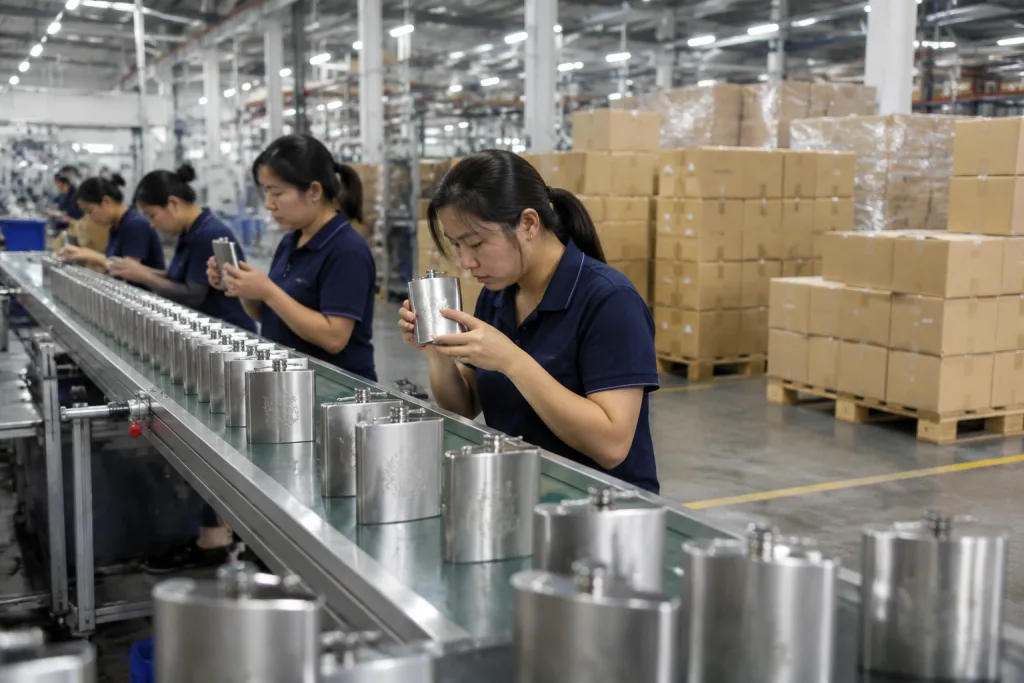
Buying a private label hip flask is straightforward once you know the spec. The common miss is treating it like a gift box item instead of a metal product that needs stable tooling, clean polishing, and leak control. On our line, QC pulled the sample for a 24-hour water test before we even talked decoration, because a flask that sweats or leaks will come back as a claim, not a reorder.
A solid partner in Zhejiang or elsewhere in China should quote real MOQ, wall thickness in mm, finish limits, and a lead time that fits the line, not a showroom promise. We ship plenty of 304 stainless programs with MOQ 3,000 pcs and a 25- to 30-day production window, and the buyer flagged a PO typo on capacity once that would have blown the carton plan. If you are sourcing custom drinkware, canteen custom, or custom growler programs, the math is the same: control the spec or pay for it later.
Choose the Right Flask Format
The first call is size. A private label hip flask usually moves best in 4 oz, 6 oz, 8 oz, or 10 oz, and on our line the 6 oz and 8 oz cartons are the easiest to sell through because they fit gift boxes, wedding sets, and promo packs without bulking up the shelf. Go too small and buyers say the value looks thin. Go too large and the stainless cost jumps, plus the flask starts sitting awkward in a pocket.
Shape matters too. A curved flask is still the safest pick for leisure buyers, while a flat square body packs cleaner in a shipper and stacks better on a pallet. I push 0.5 to 0.6 mm 304 stainless steel for the body; below that, dent claims show up fast, and above 0.8 mm the forming press slows down and freight gets ugly. The cap needs a clean seal, a gasket that holds, and a shake test that passes after 30 cycles. QC pulled one sample last month that leaked at the hinge, and the buyer flagged it before we even packed the PO.
If you also buy custom canteen or customizable canteen SKUs, use the same rule: pick the shape the end customer gets in one glance. A flask should feel familiar. Do not force a fancy angle that makes the mold cost climb by $300 and the order harder to move.
Materials and Finish That Hold Margin
For the body, 18/8 stainless steel is still the safe spec for a retail-ready private label hip flask. We run 0.45 mm sheet on most 6 oz and 8 oz bodies because it forms cleanly in the hydraulic press and gives the TIG weld a stable edge. If a canteen supplier quotes 201 stainless to cut USD 0.18 per piece, ask what channel the flask is going into. It can pass for a price-fighting canteen promotional order, but the math doesn't work for a premium brand when QC pulls 3 samples with tea-stain rust after the salt-spray check.
Finish is where margin lives. Brushed steel sells a clean gift-box story, mirror polish shows every fingerprint under the packing lamp, powder coat needs a 60 to 80 micron film check, and PU wrap or leather wrap moves the item closer to executive gifting. Laser engraving looks more premium than a one-color screen print because it cuts into the surface instead of sitting on top of it. For canteen customizable or customizable drinkware programs, match the finish to the channel. A distributor drinkware pack for retail shelves should feel sharper than a bulk giveaway item; we have seen buyers flag a flask because the wrap seam sat 2 mm off center.
Ask for material declarations, food-contact statements, and for Europe, confirm REACH and LFGB expectations before the PO is signed. In Zhejiang, a good canteen factory will have these files named by material grade and gasket supplier, not buried in a random PDF folder. In China, the weak ones say, “no problem,” then send a test report for a different lid gasket. You should worry. QC pulled one batch last year because the PO said 304 stainless, but the factory packing list had a 201 typo that nobody wanted to explain.
- Body: 304 or 18/8 stainless, with sheet thickness confirmed before sampling
- Finish: brushed, polished, coated, or wrapped, checked against a signed color panel
- Seal: food-grade gasket with leak test, 24 hours upside down for pre-shipment samples
- Decoration: laser, silk screen, emboss, or deboss, with artwork size locked in mm
Private Label Decoration and Packaging
Private label is not just a logo on the flask. It is what the buyer sees when 24 pcs come out of the master carton and what the customer photographs after opening the gift box. We have seen 7 canteen customized and customized canteen programs miss repeat orders because the PO said “print logo only” and left the inner tray to chance. Bad call. If your hip flask sits beside custom growler, customizable growler, or custom canteen lines, the box needs to defend the shelf price before anyone touches the stainless body.
For the flask itself, pick one main decoration method and run it across the line. Laser engraving is clean, and QC checks it with a 10x loupe for burrs near the logo edge. Silk screen makes sense when you need a solid color logo on a coated body, usually with a 0.15 mm artwork tolerance on curved parts. Debossed leather wraps can look premium if the artwork stays simple. Tiny text and gradients go sideways on curved metal; the math doesn't work once the logo crosses the shoulder radius. Canteen vendors, canteen distributors, and canteen suppliers all learn the same lesson: fewer decoration tricks mean fewer rejected samples.
Packaging needs the same detail level as the flask. Specify insert material, 350 gsm vs 400 gsm box board, master carton size, and a 1.2 m drop-pack test before mass production. If we ship to Amazon or a U.S. distributor, we ask for barcode placement and FNSKU-ready packing before the pre-production sample, not after cartons are printed. The buyer flagged this last month when the FNSKU sat 8 mm too close to the box seam. A clean private label hip flask package can add USD 0.25 to 0.60 per unit, but it often moves stock better than adding a second logo.
MOQ, Lead Time, and China Sourcing
Real sourcing starts with capacity. A Zhejiang factory that we would trust should state monthly output, decoration choke points, and sample timing in one call, not after 3 follow-up emails. On our flask line, the planner checks the laser engraving queue on the MES screen before we promise dates. A metal drinkware plant running about 200,000 units per month can usually push private label hip flask programs faster than a trading company, as long as the logo file is clean and the export carton is confirmed at 24 pcs per master.
Typical numbers matter. Stock shapes usually start at 300 to 500 pcs per logo; new tooling or a special curved body can move to 1,000 pcs or more. Sampling usually takes 3 to 7 days, while bulk production lands around 25 to 35 days after sample approval and deposit. Simple job. Still, if your order mixes canteen custom or custom growler items in the same shipment, add 5 to 8 days for decoration queueing because canteen manufacturers in China often batch matte black, powder coating, and mirror polish runs together. We have seen this go sideways when a buyer approved the flask sample on Monday but changed the growler Pantone on the PO from 426C to 462C.
Ask for the trade terms up front. FOB Ningbo and FOB Shanghai are common for Zhejiang sellers, and they make comparison easier across canteen manufacturer and canteen vendor quotes. The wrong question is “how fast can you ship?” Ask which process is on the critical path: body forming, logo engraving, polishing, or carton printing. If a supplier cannot give you a clear lead time, QC hold point, and loading port, you are not speaking to a factory ready for export work.
QC and Compliance You Should Demand
QC is where a buyer either protects margin or pays for it later. For a private label hip flask, we run appearance checks, leak tests, dimensional checks, and pack-out verification on the line. I would ask for AQL 2.5 on major defects and 4.0 on minor defects, plus a simple go/no-go gauge for the cap thread and a 5 mm ruler check on logo placement. That is the math that keeps a canteen distributor from getting stuck with returns and rework.
Leak testing is not optional. We check each flask with water or air pressure, depending on the build, and the cap should stay dry after 10 open-close cycles. If the finish is coated, ask for rub testing with a cloth wheel; if the part is plated or has metal accessories, ask for salt spray data or at least a signed surface inspection sheet. We keep batch records, one retained golden sample, and photo logs because a buyer flagged a 2 mm dent on a PO last year and the fix was faster with records in hand.
Do not accept a quote that saves USD 0.08 and adds a 3 percent return rate.
For market access, check REACH for Europe, LFGB where needed, and any retailer-specific compliance sheet. We ship this every week, so the better buyers ask for the actual test report number, not a vague promise. The weak ones skip that step and then chase us later when customs or a retailer auditor asks for the file.
Price It Like a Program
If you want a profitable private label hip flask line, price it like a program, not one SKU. A plain brushed stainless flask from a capable China supplier may land around USD 1.20 to 1.80 FOB. Add laser engraving, 350gsm carton board, and a printed insert, and we usually see the quote move into the USD 1.90 to 2.80 range. Leather wrap, premium box work, or a 3-piece gift set can push you toward USD 2.80 to 3.80 and beyond. The line tells the truth: once QC pulled a sample with a 0.4mm gap at the cap thread, the cheap quote stopped looking cheap.
That range is normal. The better question is whether the landed cost still works in your channel. A distributor drinkware business needs room for freight, duty, warehouse handling, and retailer margin. If you are also managing distributor canteen or distributor growler items, use the same sheet. Ask your supplier for carton count, gross weight, master carton size in cm, and units per master carton so you can calculate landed cost before you approve samples. We ship 100pcs per master carton on some flask programs, but one buyer flagged the 14.8kg gross weight because his warehouse charged extra above 12kg.
For canteen promotional orders, buyers often chase the lowest unit cost and then lose money on soft packaging or dented goods. We have seen this go sideways. Ask a canteen manufacturer for three quotes with real specs: entry with bulk pack, mid with color box, premium with insert tray and better outer carton. That is how you see where the value sits and decide whether to order a customized drinkware set, a custom canteen bundle, or a private label hip flask program that can scale from 1,000pcs to 10,000pcs without changing the whole BOM.
Get a real flask quote from Zhejiang
Send your size, logo, and pack spec. We will price the private label hip flask properly and flag the weak points before you waste a sample run.
Frequently asked questions
What MOQ should I expect for a private label hip flask?
For a stock shape with one logo, many China factories will quote 300 to 500 pcs MOQ. If you want new tooling, a special cap, or a fully customized canteen-style body, expect 1,000 pcs or more. Sampling is usually 3 to 7 days, and bulk lead time is often 25 to 35 days after approval. If a canteen vendor gives you a tiny MOQ but no clear production schedule, ask how they are controlling line capacity.
Is 304 stainless steel enough for a premium flask?
Yes, 304 or 18/8 stainless is the right baseline for most private label hip flask programs. It is the same grade many canteen manufacturers use for custom drinkware and custom canteen items. I would target 0.5 to 0.6 mm wall thickness for a retail-grade body. If the seller offers 201 stainless as a cheaper substitute, treat it as a budget option, not a premium one.
Which decoration method sells best?
Laser engraving usually wins for premium retail because it is durable and looks clean on brushed steel. Silk screen works when you want a bold color logo on coated bodies, while emboss or deboss fits leather wrap or gift-style packaging. For canteen promotional or customized drinkware bundles, keep artwork simple. A one-color logo with a strong box often outperforms a complicated print that raises scrap and slows production.
Can one factory handle hip flasks and other drinkware?
Often yes, especially in Zhejiang. A strong canteen factory or canteen manufacturer may also run custom growler, customizable growler, and canteen customizable lines on the same metal forming and decoration equipment. That is useful if you want one supplier for mixed orders. Just make sure they can separate quality records by SKU and do not mix private label hip flask packaging with lower-grade promotional stock.
What should I check before confirming the order?
Check the sample against the drawing, confirm logo size, verify carton count, and ask for AQL 2.5 major and 4.0 minor inspection. Also confirm REACH or LFGB needs if you sell into Europe, plus barcode and FNSKU placement if you ship to Amazon. A good canteen supplier will also send production photos, leak-test records, and finished carton dimensions before shipment.