Key Takeaways
- A practical private label growler bottle MOQ starts around 1,000 pcs per color for standard bodies
- 304 stainless steel at 0.5-0.6 mm outer wall thickness is the safe B2B baseline
- Powder coating usually adds 7-10 days versus plain stainless steel production
- Use AQL 2.5/4.0 inspection and cap leak testing before paying the balance
A private label growler bottle looks simple on a quote sheet: 64 oz capacity, one logo, Pantone color, 24 pcs per carton. The problem starts when two factories quote against different steel gauges, cap builds, print processes, and AQL rules. We’ve seen this go sideways. One buyer pushed us on a USD 0.32 lower FOB offer, then QC pulled the sample and found a 0.38 mm body wall, powder coat chips at the shoulder, and a lid that leaked after 6 minutes on the tilt test.
If you buy custom drinkware for retail shelves, promo programs, or wholesale stock, ask for shop-floor numbers before you send the PO. From our Zhejiang line, a realistic MOQ for a private label growler is usually 1,000 pcs per color, not 300 pcs, unless you accept shared coating and higher unit cost. Buyers ask us the same 3 questions every week: which logo method survives dishwashing claims, whether 5,000 pcs can ship in 35 days, and where the real risk sits. Short answer: the math doesn’t work if the cap tooling, carton drop test, and pre-shipment inspection are treated as afterthoughts.
Define the Growler Before Pricing
Before asking any canteen manufacturer or canteen supplier for a quote, freeze the basic spec first. A growler is not just a big bottle. In our RFQs, buyers usually mean a 32 oz, 40 oz, or 64 oz stainless steel bottle for beer, kombucha, cold brew, water, or outdoor refill programs. Capacity changes the mold, the carton cube, the freight bill, and the wall strength needed after a 1.2 m drop test on the QC table.
For private label growler bottle sourcing, we normally run 304 stainless steel on the inner wall, with 201 or 304 stainless steel outside depending on the shelf price. If the bottle will hold acidic drinks, saving USD 0.18 on the inner liner is the wrong question to ask. The math doesn't work when a buyer flags rust spots after 3 weeks. For a 64 oz bottle, 0.5-0.6 mm outer wall and 0.4-0.5 mm inner wall is a workable range; anything thinner can look clean under the sample room lamp but dent when QC pulled the sample from a packed 12 kg export carton.
You also need to choose single-wall or vacuum insulated construction. Single-wall growlers cost less and weigh less, but they sweat and lose temperature fast. Vacuum insulated custom growler bottles usually keep cold drinks below 10°C for 12-24 hours when we test them at room temperature with a probe thermometer and 4°C starting water. For European and North American retail, vacuum construction gives safer premium positioning because the buyer can print a clear performance claim on the hangtag.
Be clear whether you need a custom canteen shape or a stock mold. Stock molds cut cost and usually allow MOQ around 1,000 pcs. New tooling for a fully customized growler can run USD 2,000-8,000 and adds 25-40 days before mass production. We have seen this go sideways when the PO says “64 oz growler” but the drawing shows a 68 mm mouth, while the stock lid on the line is 63 mm.
MOQ, Pricing, and Real Lead Times
Last quarter, 7 buyers asked for 300 pcs split into three powder colors, two logo positions, plus printed gift boxes. We can do that for salesman samples or local decoration, but the math doesn't work on a China production line. For a standard private label growler bottle, we run MOQ at 1,000 pcs per model, and powder coating is usually 1,000 pcs per color because the coating booth needs a full color change, gun cleaning, and oven setup. Laser engraving can drop to 500 pcs if you take stock black or silver and use a plain export carton; QC pulled one 500 pcs sample run last month because the logo height was 1.8 mm off the approved AI file.
FOB Ningbo or Shanghai pricing moves with capacity, finish, and the parts you choose. As a working range, a 32 oz stainless vacuum growler with one-color logo may sit around USD 5.20-7.80 FOB at 1,000 pcs. A 64 oz insulated customized growler with powder coating, handle lid, and retail box may land around USD 8.50-13.50 FOB at 3,000 pcs. These are filters, not promises. If a quote comes in 30% under the market, ask what was cut: steel grade and wall thickness, vacuum failure allowance, PP lid material, or whether the factory will accept AQL 2.5 final inspection. We have seen this go sideways when a PO said “304 stainless” but the supplier quoted 201 body steel in the cost sheet.
Lead time needs the same discipline as price. Our Zhejiang canteen factory ships about 450,000 stainless drinkware units per month across bottles, tumblers, and growlers, and the growler line shares polishing wheels and vacuum ovens with 40 oz bottle orders. For standard growler orders, plan 30-35 days after deposit and artwork approval. Add 7-10 days for special powder coating, 10-15 days for custom packaging, and 20-30 days if you need a new lid mold. Small detail, big delay: one buyer’s PO had Pantone Black C with two spaces in the artwork note, and our prepress team held the carton film for 2 days until they confirmed it.
For canteen distributors and distributor drinkware programs, split shipments can save a launch. We ship 30% by air for launch inventory and 70% by sea when the retail date is fixed, but price it before you sign the margin sheet. Air freight on 64 oz growlers is painful because one master carton can hit 14-16 kg chargeable weight, and the buyer usually flags it only after the vessel cutoff is missed.
Logo Methods That Actually Last
Decoration is where a private label growler either looks retail-ready or looks like a rush promo job. On stainless growlers, we usually quote laser engraving, silkscreen printing, heat transfer, water transfer, or powder coating with a separate logo step; the right choice depends on the selling price, carton packing, and how rough the bottle will be handled. Last month QC pulled 12 matte-black samples from the line, and 3 had logo rub marks after the dividers were packed too tight.
Laser engraving is the most durable method for a private label growler bottle. It cuts through the coating or marks the steel directly, so it holds up better than ink against dishwashing, abrasion, and warehouse rubbing. The trade-off is simple: you usually get a silver or dark metal mark, not a bright Pantone logo. For premium outdoor, brewery, and corporate programs, laser is the safe call; we run it on a rotary laser jig, and a 70 mm logo can stay clean even when the bottle body has a slight taper.
Silkscreen printing is cost-effective for one- or two-color logos on straighter bottle walls. It works for canteen promotional campaigns when the artwork is simple and the body curve does not distort the screen; once the logo wraps past about 90 mm wide, the math doesn't work as well. Expect a logo setup cost around USD 40-80 per color and better pricing above 1,000 pcs. Heat transfer handles multi-color graphics better, but ask for adhesion testing after 3M tape pull and warm water soak; we have seen buyers flag peeling on day 2 when the ink cure time was cut short.
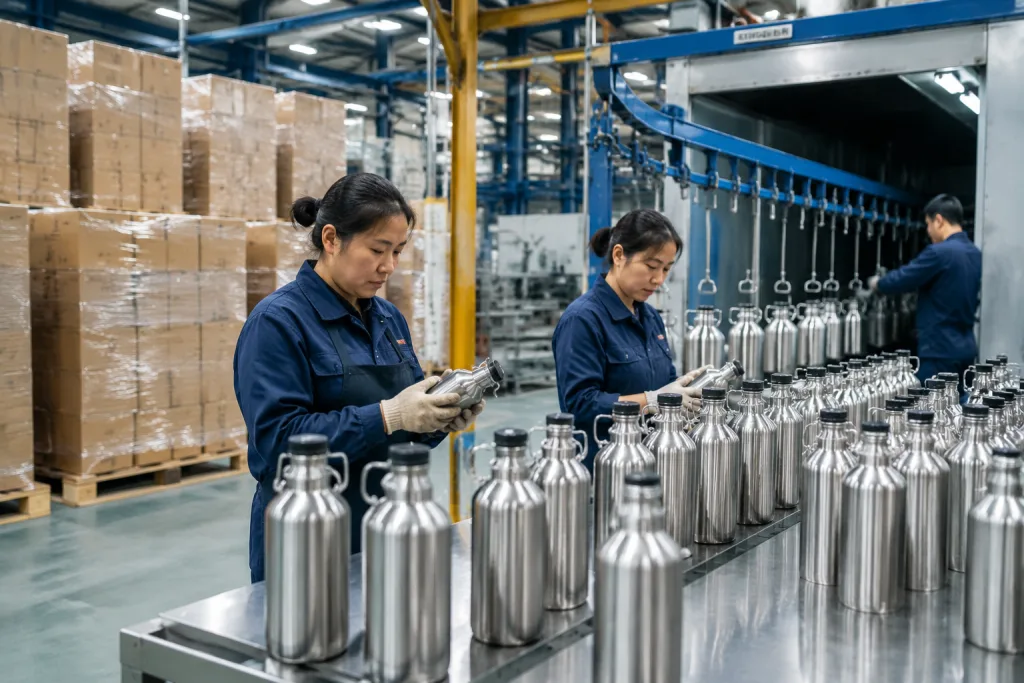
Powder coating is popular because it gives a retail-ready surface. Good coating thickness is often 60-80 microns. Too thin, it scratches. Too thick, threads or lid fit can suffer, and QC will catch it with a thread gauge before packing. If you need a canteen customizable program with several colors, use existing factory colors first. A new Pantone powder can require 50-100 kg of powder and push MOQ higher; we ship faster with stock black, white, navy, or army green because the powder booth changeover takes about 45 minutes per color.
Caps, Seals, and Leak Control
The lid gets handled 20-30 times in a normal refill week, and it is where complaints start. A clean bottle body with a loose cap still fails the order. We check cap structure before sample approval on private label growler bottle jobs: thread depth in mm, silicone gasket fit, handle pull strength, and whether the lid holds coffee smell after 3 wash cycles. QC pulled one sample last month where the thread looked fine by eye, but the thread gauge showed only 1.4 mm bite. It leaked on the bench.
Food-contact silicone is the standard gasket material. Ask your canteen vendor to confirm LFGB, FDA, or relevant food-contact compliance for your sales market. For the EU, REACH and LFGB documentation matters. For the US, FDA food-contact declarations and Prop 65 review may be needed depending on materials and claims. Do not accept soft wording like “eco material” or “safe grade” without documents tied to the actual PO; we have seen buyers flag this during pre-shipment review, and the math does not work when 3,000 pcs are already packed.
Leak testing belongs in the QC plan, not in a WhatsApp promise. A practical mass-production test is filling the growler with water, tightening the cap to normal hand torque, laying it sideways for 30 minutes, then inverting it for 5 minutes. For shipment inspection, test at least 80-125 pcs depending on order size and AQL sampling level. We run this on a stainless worktable with white tissue under the cap, because a 1 mm wet ring is easier to catch before cartons are sealed. Vacuum insulation should also be checked by hot water testing. If the outer wall heats quickly, the vacuum has failed.
For a distributor growler program, set replacement caps as a spare parts SKU from the first order. Ordering 2-3% extra lids is cheap insurance; on a 5,000 pcs run, that means 100-150 caps in a separate carton with the same gasket spec. Canteen vendors that cannot supply spare caps six months later are risky for long-term private label work. We have seen this go sideways when the buyer’s PO had “black lid” typed as “back lid,” then the spare cap color did not match the line sample.
Packaging for Retail and Freight
Packaging is not decoration. It controls container loading, breakage during inland trucking, and whether your warehouse can scan cartons without cutting tape. For custom drinkware, we run three layers on most growler jobs: inner PE bag or 35 gsm paper wrap, single retail box, and export master carton with the shipping mark printed on two sides.
For a 64 oz customized growler, a single kraft box or color box is common. Corrugated thickness must match the filled bottle weight; we have seen 11 out of 500 retail boxes crush at the bottom because the buyer picked 300 gsm paperboard to save USD 0.10. Bad math. If you sell through e-commerce or distributor canteen channels, use a 5-layer export carton with edge-crush strength set for stacking. Drop testing from 76 cm on corners, edges, and faces is a sensible baseline for heavier bottles, and QC should pull the sample after the carton has sat loaded for 24 hours.
Amazon-style prep brings tighter rules. You may need FNSKU labels, suffocation warnings on polybags, carton weight below 22.7 kg, and separate SKU cartons unless your receiving plan allows mixing. If your canteen suppliers say they can handle FBA, ask for photos of past carton labels and pallet layouts; last month a buyer flagged a 2 mm label shift because the barcode scanner missed one side of the carton. Experience shows in small details.
Retail packaging lead time is usually where schedules slip. A plain white box can be ready in 7-10 days. A printed color box with barcode, manual, warnings, and brand artwork usually needs 12-18 days after proof approval. If your design team takes 10 days to approve dielines, the factory clock has not started; the line is still waiting for a locked AI file and one clean PO, not a screenshot with “final_final” in the filename.
Factory Checks Before You Pay
A clean sample does not prove a stable factory. It proves the sample room can make one good unit, sometimes with the best welder and a hand-polished body. Before you pay a 30% deposit, check whether the canteen factory can repeat that sample 3,000 or 20,000 times on the line. We run 6 vacuum-test heads at the packing area, and the ugly failures usually show up after lunch shift change, not in the showroom sample.
Ask for the business license, export record, BSCI or Sedex audit if social compliance matters, ISO 9001 if available, and material test reports from the last 90 days. A serious canteen manufacturer should be able to talk through AQL, daily line capacity in pieces, vacuum testing pressure, coating adhesion by cross-cut tape, and carton drop tests by carton weight. If the sales reply is only “don’t worry, quality is good,” keep pushing. We have seen this go sideways when the buyer never asked who owns the polishing line.
Use a pre-production sample with signed specifications. Put the real numbers on paper: capacity tolerance in ml, steel grade such as 304 stainless, coating color by Pantone code, logo size in mm, lid type with gasket material, packaging layout, barcode placement, and carton marks. Small artwork differences on customized drinkware become expensive arguments later; one buyer flagged a 2 mm logo shift after 5,000 pcs were packed. The approved sample should stay at the factory and your office as the control standard, with QC pulling it before mass packing starts.
Payment terms for new buyers are usually 30% deposit and 70% before shipment after inspection. For larger canteen distributors, terms often get better after two or three clean orders, but the math does not work if you pay early to save 1 day and then fight a 40-foot container of wrong cartons. Do not pay the balance before QC if the order is new, the packaging is custom, or the delivery date is fixed to a promotion. Independent inspection in Zhejiang or nearby China production areas is usually cheaper than replacing a failed shipment overseas; a 1-day AQL 2.5 check near Hangzhou costs far less than airfreighting replacement lids.
Build a Repeatable Private Label Program
The strongest private label growler bottle programs we run are repeat orders, not spot buys. Lock the spec sheet first: 304 stainless thickness, lid thread tolerance, powder coat code, carton drop-test mark. Then test the market, fix the lid seal or finish, and reorder with cleaner numbers. Better pricing from canteen manufacturers comes from repeatable work on the line, not from pushing the factory until QC starts rejecting 1.8 mm scratches.
Start with one or two core sizes. A 32 oz and 64 oz range covers most retail and promotional demand. Hold the color card. Add colors only after sell-through proves the SKU. Every extra color adds coating MOQ, inventory risk, carton label versions, and one more checkpoint for the QC table. For a first order, three colors across 3,000 pcs gives most brand owners enough data; last month a buyer flagged that six colors made the math fail before the PO even hit our ERP.
If you need canteen customized programs for different regions, keep the bottle body common and change the logo, sleeve, or packaging. We can buy steel, lids, and cartons in cleaner lots that way, and the line does not lose half a shift swapping fixtures. A customizable canteen platform also gives canteen distributors an easier pitch to breweries and outdoor retailers without rebuilding artwork, molds, and carton specs each time. We have seen this go sideways when every country manager wants a new cap shape.
Share forecasts honestly. A canteen supplier can reserve production slots, coating capacity, and packaging material if you give a realistic 6-month plan. Inflated forecasts do not protect your price for long; they just make both sides plan badly, and purchasing ends up sitting on 2,400 spare lids. The practical approach is simple: approve one strong SKU, measure sell-through for 60-90 days, then place the reorder before your warehouse drops below 45 days of stock. QC pulled the sample once because the reorder PO had “matte black” typed as “mate black.” Small typo. Big delay.
Send your growler spec for a factory quote
Share capacity, finish, logo method, quantity, and market. We will return practical MOQ, FOB pricing, and lead time options.
Frequently asked questions
What is the best MOQ for a first private label growler bottle order?
For most B2B buyers, 1,000 pcs is the practical starting point for a standard private label growler bottle using an existing mold. If you need powder coating in multiple colors, expect 1,000 pcs per color or a higher unit cost. Laser engraving on stock colors can sometimes be arranged at 500 pcs, but packaging and freight become less efficient. For a serious retail test, 3,000 pcs across two sizes or three colors gives better FOB pricing and more reliable production planning. If a canteen vendor offers 100 pcs with full customization at factory price, it is probably workshop decoration, not normal mass production.
Which material should I specify for a custom growler?
Use 304 stainless steel for the inner wall as the default. It is the safer choice for water, beer, kombucha, and acidic drinks. For the outer wall, 201 stainless can reduce cost, but 304 outer is better for premium positioning and corrosion resistance. A normal vacuum insulated custom growler should use about 0.5-0.6 mm outer wall thickness and 0.4-0.5 mm inner wall thickness. Ask for material test reports tied to the batch, not a generic PDF from two years ago. For Europe, also request LFGB or relevant food-contact testing; for North America, ask for FDA food-contact support and any applicable Prop 65 review.
How long does production take after I approve the sample?
For an existing mold and standard finish, plan 30-35 days after deposit, artwork approval, and pre-production sample approval. Powder coating often adds 7-10 days, and custom color boxes add 12-18 days after dieline approval. New lid tooling or a unique customized growler body can add 25-40 days before mass production starts. Shipping is separate: sea freight to the US West Coast may take about 18-25 days port to port, while Europe is often 30-40 days depending on route. Build your timeline from the retail delivery date backward, not from the day you want to place the PO.
What quality inspection standard should I use?
Use AQL inspection with clear defect definitions. A common setup is AQL 2.5 for major defects and AQL 4.0 for minor defects, with critical defects not accepted. Major defects include leaking caps, failed vacuum insulation, wrong logo size, sharp edges, unstable base, serious dents, and incorrect carton marks. Minor defects include small coating specks, light scratches below an agreed size, or slight color variation within tolerance. For a 3,000 pcs order, an inspector may check around 200 pcs depending on the sampling level. Include leak testing, hot water vacuum testing, barcode scan checks, and carton drop review in the inspection checklist.
Can one factory handle growlers and other custom drinkware?
Yes, if the factory has the right production base and supply chain. Many Zhejiang and China drinkware factories handle stainless bottles, travel tumblers, sports bottles, kids bottles, and growlers using shared polishing, coating, printing, and packing lines. That helps if you need a broader customizable drinkware program for retail or distributor drinkware channels. Still, do not assume every canteen manufacturer is good at every product. A factory strong in simple single-wall bottles may struggle with large vacuum growlers or complex lids. Ask for monthly capacity by category, current production photos, and inspection records for similar 32 oz or 64 oz orders.