Key Takeaways
- A realistic private label MOQ is usually 500-1,000 pcs per color for stainless steel and 3,000 pcs for molded plastic parts
- Logo method matters: laser engraving survives 500+ dishwasher-style rub cycles better than basic pad printing
- A proper pre-shipment inspection should use AQL 2.5 for major defects and AQL 4.0 for minor defects
- Standard lead time from Zhejiang, China is 25-35 days after deposit and artwork approval for repeatable designs
Private label drinkware looks simple until the PO lands in our inbox with a missing Pantone code or the wrong lid drawing attached. A bottle is not just a bottle once your logo, retail margin, importer liability, and 9-week launch window sit on it. You need to decide what is safe to customize, what should stay standard, and where a USD 0.08 saving turns into rejected cartons after AQL 2.5 inspection.
From our factory base in Zhejiang, China, we run into the same 4 buyer problems every month: loose specs, packaging that adds 12 days vs 18 days to the schedule, logo tests approved from photos only, and inspections booked after the line has already packed 3,000 pcs. If you are sourcing custom drinkware for retail, promotional programs, Amazon, or distributor drinkware channels, control the variables before production starts. We’ve seen this go sideways.
Start with the sales channel
Before you ask any canteen supplier for a quotation, lock the sales channel first. A retail shelf needs a barcode sticker, shelf-ready color box, and clean front-facing logo placement. Corporate gifting buyers care more about logo accuracy and gift-box corners after a 60 cm drop test. Amazon FBA needs carton labels, polybag warnings where required, and carton weight usually kept under 15 kg so the warehouse does not kick it back. Outdoor distributors often accept a heavier build; we run 0.5 mm outer wall stainless bottles with powder coating and individual color box for that channel. Supermarket promotions are a different game: a lighter single-wall body, one-color logo, and bulk packing can save USD 0.18-0.35 per unit on freight and packaging. Ask the channel question first. Skipping it is where briefs go sideways.
If you are a distributor canteen buyer, keep the design easy to rebadge. Your customers will ask for logo positions, lid colors, carton marks, or a PO typo like “matte balck” that QC catches before carton printing. For distributor drinkware, we usually recommend one proven mold, 2-3 neutral colors, and a logo panel at least 45 mm wide so silkscreen, laser engraving, or UV print all fit without reworking the artwork. That lets you cover 300-piece repeat orders and 3,000-piece seasonal runs without sitting on slow inventory. The math does not work if every small customer gets a new lid color.
Brand owners can push customization further, but a new mold is not always smart buying. A custom canteen with a new lid shape, silicone handle, and molded grip may require USD 1,200-4,000 in tooling, plus 25-45 days before mass production even starts. We have seen buyers approve a 3D lid render, then reject the first T1 sample because the grip felt 2 mm too shallow in hand. If demand is still being tested, use an existing canteen factory mold and put the budget into finish, packaging, and product photography. QC pulled one sample last month where the coating passed cross-hatch, but the gift box made the product look cheap. Packaging sold the bottle short.
Our Zhejiang line can produce about 450,000 stainless drinkware units per month across bottles, tumblers, and growlers. Capacity helps, but it does not rescue a vague brief. Send target retail price, order quantity, destination market, required certifications, and preferred delivery term such as FOB Ningbo or FOB Shanghai. Add the real constraint too: “buyer capped landed cost at USD 5.20,” “carton cannot exceed 12 kg,” or “Amazon label must be applied before shipment.” Then a serious canteen manufacturer can quote the right construction instead of racing to the cheapest wall thickness. On the line, a 0.1 mm change in steel thickness is not a small detail; it changes feel, dent resistance, and sometimes the whole price logic.
Choose materials with compliance in mind
Private label drinkware usually lands in four builds: stainless steel, plastic, glass, or a stainless body with plastic and silicone parts. We steer most mid-range and premium programs toward stainless because it survives shelf wear, takes laser or screen logos cleanly, and supports vacuum insulation. For food-contact stainless, set inner 304 stainless steel as the baseline on the spec sheet. Some buyers ask for 316 stainless for salty drinks or a marine story, but the price difference is usually 8-15%; unless the channel pays for that claim, the math doesn't work. On our line, QC checks the inner grade against the material cert before the first 200 pcs move to polishing.
For a custom growler or customized growler, wall thickness matters, but it is not the whole answer. Most 64 oz vacuum growlers we run use an inner wall around 0.4 mm and an outer wall around 0.5 mm. Better steel and a stronger base design improve drop results more than adding metal everywhere. If your distributor growler customer sells into outdoor shops or brewery merch, test the handle pull, lid thread fit with a go/no-go gauge, and pressure relief behavior after hot-fill simulation. Small part. Big problem. A good-looking growler with a weak cap becomes a complaint machine after the first 1,000 pcs ship.
Plastic components take more work than first-time buyers expect. Lids need their own material callout; straws and bite valves need separate food-contact coverage; gaskets and handles often get missed on the PO. For Europe, ask about LFGB, EU 1935/2004, and REACH where applicable. For the United States, expect FDA food-contact questions, and California Proposition 65 may come up if the retailer has a strict compliance desk. For children’s bottles, ASTM and CPSIA requirements may apply. Do not accept a generic test report for a “similar lid” from two years ago; we have seen a buyer flag that at final booking and lose 9 days waiting for a fresh lab test.
Glass fits office gifts and wellness channels, but it is freight-sensitive and breakage-sensitive. A glass bottle with silicone sleeve can look premium, yet the sleeve adds hand assembly, sleeve alignment checks, and slower packing at the table. If you want customizable drinkware with 12 color options, powder-coated stainless is easier to control than glass sleeve colors; one recent sleeve color came back 1.5 mm short and QC pulled the sample before carton drop testing. Lead time tells the same story: stainless color change often runs 12 days vs 18 days for sleeve tooling and matching. A practical canteen vendor should push back when the design creates more risk than value.
Know what customization really costs
Customization has two bills: the quoted decoration charge and the rework risk on the line. A one-color silkscreen logo may cost USD 0.05-0.12 per unit depending on print area and order quantity; our screen room usually checks film at 0.2 mm line thickness before mass print. Laser engraving often costs USD 0.10-0.25 per unit and gives a cleaner, permanent result on stainless steel. Full-wrap heat transfer or 360-degree UV printing can run USD 0.35-0.90 per unit and needs tighter artwork control, especially around the seam and handle cutout. Cheap decoration on premium private label drinkware is false savings. We have seen buyers save USD 0.08, then lose the repeat order because the logo looked like a promo giveaway.
The phrase canteen customizable gets stretched too far. It might mean logo only. It might also mean color, lid, packaging, barcode, insert card, carton mark, and inspection standard, which is a different job for purchasing and QC. When you ask canteen vendors for prices, separate each option: base bottle price, coating price, logo price, packaging price, and inland freight if any. Last month a buyer flagged a PO typo where “custom carton” was written, but the artwork only showed a side mark, not a printed retail box. Bundled quotes hide problems, and the math usually breaks when the buyer asks for changes after deposit.
Color customization is where 6 out of 10 delayed drinkware orders start. Standard factory colors are normally faster because powder is already qualified and sitting near the coating line. A Pantone-matched powder coating may require 7-10 days for sampling and approval; if the buyer rejects the first spray panel under a D65 light box, the schedule moves again. Minimum powder quantity can also push MOQ higher. For most canteen customized orders we run, 1,000 pcs per color is more realistic than 300 pcs per color, especially if you need stable color across repeat orders. Asking for 8 colors at 300 pcs each is the wrong question to ask unless you accept higher coating loss.
Packaging can cost more than expected. A white box might be USD 0.12-0.25. A printed retail box with insert can be USD 0.35-0.80. A rigid gift box may exceed USD 1.20 before freight impact, and a 12 kg master carton can jump to 15 kg after thicker board and foam are added. If your product sells online, spend on ISTA-style drop testing and stronger cartons instead of overbuilt gift packaging. We ship Amazon FBA orders often, and QC pulled samples more than once because the FNSKU label position was missing from the packing file. For Amazon FBA, FNSKU labels, suffocation warnings for polybags, and master carton limits must be defined before production. Your canteen manufacturer should not guess these details.
Set MOQ and pricing expectations
For private label drinkware, MOQ is not one fixed number. It changes with material, decoration, color, and packing. We usually run existing stainless bottle models from 500 pcs per SKU for laser logo or simple silk print, and QC checks the first 20 pcs against the approved logo position in mm. For powder-coated custom colors, 1,000 pcs per color is the safer planning number because the line loses time during color change and oven temperature reset. Plastic injection parts and fully customized lids can require 3,000-5,000 pcs because mold setup, color masterbatch, and startup scrap are paid somewhere. The math does not work at 800 pcs.
As a rough FOB China price range, a 20 oz stainless travel tumbler may sit around USD 3.20-5.80 depending on lid, finish, and packaging. A 32 oz vacuum sports bottle may range from USD 4.50-8.50. A 64 oz custom growler can range from USD 8.50-15.00. These are not promises; they are guardrails we use before a formal BOM. Last month a buyer flagged a quote 30% under market, and the sample came back with a lighter lid, thinner color coating, and a carton that failed our 1.2 m drop test. If a canteen supplier quotes far below the normal range, ask what changed: steel grade, vacuum performance, coating thickness, lid material, carton strength, or inspection level.
Payment terms also shape the order. Common terms for new buyers are 30% deposit and 70% balance before shipment after inspection. Larger repeat buyers may negotiate better terms, but factories rarely extend credit on first orders. We have seen this go sideways when the PO says “net 60” by mistake and production waits 4 days for a revised stamp. FOB Ningbo is common for Zhejiang production because the truck from Hangzhou to Ningbo port is short and predictable, often one working day after warehouse loading. FOB Shanghai may also work, but inland freight can be higher depending on the factory location.
For canteen distributors, mixed-container planning matters. You may want 6 colors across 4 models, but the factory sees 24 SKUs. Every SKU needs artwork confirmation, Pantone control, packing labels, and inspection sampling under AQL 2.5 if that is written on the order. QC pulled the sample once because the hangtag showed “matte black” while the carton mark said “black matt,” and that typo stopped the line for half a shift. Fewer SKUs with deeper quantity usually give better pricing and fewer mistakes. A practical canteen factory will push back when assortment complexity is bigger than the order value can carry.
Control samples before mass production
Samples are not souvenirs. They are the contract model for mass production. For customized drinkware, approve three files separately: the physical sample with caliper-checked height, diameter, capacity, lid fit, and insulation; the logo sample with size, position, Pantone match, and curing result; the packaging sample with barcode scan, manual language, carton mark, and drop-test layout. We run a plain sample first to lock bottle shape and lid function. Then QC pulls a pre-production sample from the line to confirm coating, logo, color, barcode, manual, and box. Do not approve mass production from a digital mockup only. We have seen this go sideways when the 70 mm logo in the PDF prints at 62 mm on the bottle.
For stainless vacuum bottles, ask for insulation data. A common test is filling with 95°C water, then measuring after 6, 12, and 24 hours at room temperature with a probe thermometer, not a hand check. Performance depends on capacity, lid design, vacuum quality, and mouth diameter. A 32 oz wide-mouth canteen customizable for ice filling will usually lose heat faster than a 500 ml narrow-mouth bottle. That is normal, but it should be written on the sample report. If the buyer asks for “same heat retention as the slim bottle,” the math does not work.
Logo durability should be tested early. For powder coating, check cross-hatch adhesion with 3M tape, alcohol rub with a white cotton cloth, and scratch resistance using the agreed load. For printed logos, ask for the exact rub-cycle count under the agreed test method, such as 200 cycles or 500 cycles. If the product is marketed as dishwasher safe, be careful. About 8 out of 10 decorated bottle projects we ship are still hand-wash recommended, even when the base 304 stainless body passes. Overpromising here creates returns, and the buyer flagged it last year on a matte black bottle after the logo lifted at the rim.
Sampling time is usually 5-7 days for existing models with simple logo and 10-15 days for special coating or packaging. New mold samples take 18-25 days if the lid needs a new injection tool. In Zhejiang, China, component suppliers are close, so we can get gaskets, cartons, and coating powder fast, but buyer-side artwork approval still causes most schedule slips. One PO came in with “Pantone 186C” on page one and “Pantone 185C” on the logo file, and that cost 2 days. Give one person authority to approve samples, or the project will drift.
Inspect like an importer
QC is not only the factory’s job. If your logo is on the cup, write the inspection plan before mass production starts. For most private label drinkware orders, we run AQL 2.5 for major defects and AQL 4.0 for minor defects, with zero tolerance on critical defects. Put the list in the PO: sharp edges found by a cotton-glove wipe, leaking lids after a 3-minute inversion test, wrong food-contact material, broken glass, missing warning labels, or barcode failure. We once had a buyer flag “304 stainless” on the artwork while the PO said “201”; QC pulled the sample before packing, which saved 38 cartons from being relabeled.
Drinkware inspection needs more than a quick look under the line lights. Check appearance, capacity, leakage, insulation, coating adhesion, carton strength, and barcode readability with actual finished goods. For leak testing, fill random units to 90% capacity, invert them, shake 10 times, then leave them on their side for 30 minutes on dry kraft paper. For vacuum bottles, a hot water test or vacuum detector can catch failed insulation; our line usually checks outer-wall temperature after 30 minutes with a handheld infrared thermometer. For retail packaging, scan EAN, UPC, or FNSKU codes from finished cartons, not from the PDF artwork file. Artwork scans lie.
For canteen promotional projects, buyers sometimes skip inspection because the unit price is USD 1.20 or USD 1.80. This is the wrong question to ask. Promotional campaigns have fixed event dates, and a 5% defect rate on 10,000 pcs means 500 angry recipients, not a small “acceptable loss.” We have seen this go sideways when carton marks showed the old campaign slogan because one PO line had a typo. Even with a lighter inspection, check logo position in mm, packed quantity, carton marks, and leakage before shipment.
Third-party inspection in China usually costs around USD 180-320 per man-day depending on location and scope. That is cheap compared with airfreighting 600 replacement lids from Hangzhou to Hamburg. If you work with a canteen vendor or trading company, ask whether their internal QC report is independent enough for your risk level, and ask for photos of the checked cartons, not only a stamped summary sheet. The math does not work if balance payment is released before anyone opens the master cartons. For first orders, we prefer your own final random inspection before balance payment; one inspector with a barcode scanner, caliper, scale, and leak-test table can catch most painful mistakes in 1 day.
Pick suppliers by process, not promises
Good canteen manufacturers do more than say yes. They ask the awkward questions before quoting. Who is the target buyer, supermarket shelf or promo giveaway? Do you need REACH or LFGB? What AQL level will your inspector use, AQL 2.5 or tighter? Do cartons need pallet labels with SKU, PO number, and “Made in China” printed at 8 mm height? Are we shipping loose cartons, 1.2 m pallets, or direct to FBA? Last month a buyer sent us a PO with the logo color typed as Pantone 186C in one line and 185C in another. QC pulled the sample before printing. That saved 3,000 pcs from being wrong.
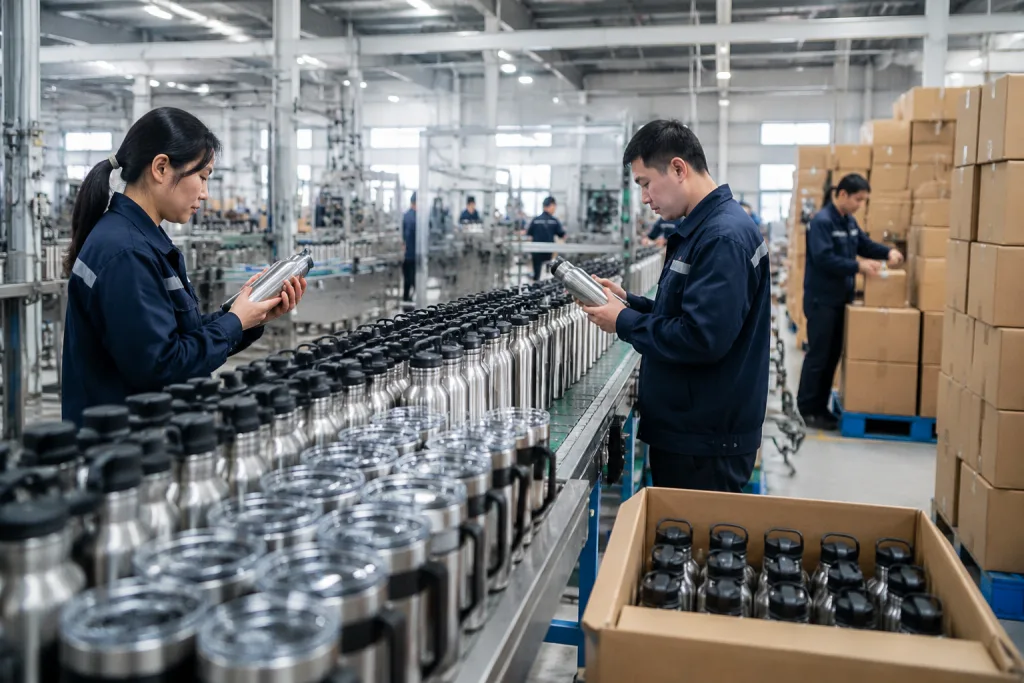
A capable canteen supplier should show the actual workflow: quotation with open items marked, artwork template with logo size in mm, sample invoice, sample approval, production schedule, in-process QC, final inspection, booking, and export documents. Ask for photos of the line, the powder coating booth, the assembly tables, the packing conveyor, and the finished-goods warehouse. We run a magnet check on incoming 304 stainless sheets, then record wall thickness with a digital caliper before forming. BSCI, ISO 9001, or audited social compliance matter for factory control. They do not replace product-specific testing for coating adhesion, heavy metals, or food-contact rules.
Be careful with canteen suppliers who quote in 10 minutes without asking wall thickness, steel grade, packaging, or compliance. Fast quotation feels nice. It is often guesswork. A 0.5 mm body and a 0.6 mm body do not cost the same, and a single white box is not the same as a 5-layer mailer with drop-test corners. Instant quote is the wrong thing to reward. The math does not work, and we have seen this go sideways when the buyer flagged dented bodies after arrival. A professional canteen manufacturer separates confirmed details from open items and writes both into the PI.
If you are comparing canteen vendors, send the same specification sheet to each one. Include capacity, material, finish, logo method, packaging, MOQ, inspection standard, destination port, and required documents, with drawings where the size matters. Then compare the same job. For example, ask all 4 factories to quote 5,000 pcs, 750 ml capacity, 304 stainless, 0.6 mm body, powder coating, 1-color logo, individual box, AQL 2.5, FOB Ningbo. The cheapest canteen factory is not always the worst. The expensive one is not automatically safer. The best partner is the one that repeats the agreed result across 3 purchase orders without making you chase every gasket, carton mark, and inspection photo.
Send your private label drinkware brief today
Share quantity, market, logo method, and target FOB price. We will check feasibility and return a practical factory quotation.
Frequently asked questions
What MOQ should I expect for private label drinkware?
For existing stainless steel models, plan on 500-1,000 pcs per SKU if you use standard colors and a simple laser or silkscreen logo. For custom powder coating, 1,000 pcs per color is more realistic because powder setup and color control take time. If you need a customized canteen lid, molded handle, or special plastic component, MOQ often moves to 3,000-5,000 pcs. Glass bottles can sometimes start lower, but freight and breakage risk increase. If a supplier offers 100 pcs with full customization, check whether they are using stock goods, manual decoration, or a trading warehouse. That can work for testing, but it is not always repeatable for retail programs.
How long does a custom drinkware order take from China?
For a standard private label drinkware order from Zhejiang, China, a practical timeline is 5-7 days for logo sample, 2-3 days for your approval, and 25-35 days for mass production after deposit. Add 3-7 days for final inspection, booking, and export paperwork. Sea freight to the US West Coast may take around 18-25 days port to port, while Europe can take roughly 30-40 days depending on routing. New molds, special coatings, or complex retail packaging can add 15-45 days. The fastest way to protect your launch date is to approve artwork, Pantone colors, carton marks, and compliance documents before production starts.
Which logo method is best for private label bottles?
For stainless steel private label drinkware, laser engraving is the most durable choice and usually costs around USD 0.10-0.25 per unit. It works especially well on powder-coated bottles because the laser reveals the metal below the coating. Silkscreen printing is cheaper, often USD 0.05-0.12 per unit, and works for simple one-color logos, but durability depends on ink and curing. UV printing is better for full-color artwork, but it costs more and needs careful adhesion testing. For premium retail products, we usually recommend laser engraving or high-quality UV print. For short-term canteen promotional orders, silkscreen may be enough if expectations are clear.
What certifications should I ask a canteen manufacturer for?
Ask for documents based on your market, not a random certificate list. For Europe, food-contact testing may include LFGB, EU 1935/2004, and sometimes REACH for coatings or components. For the United States, ask about FDA food-contact compliance and California Proposition 65 risk if you sell in that market. Children’s drinkware may need CPSIA and ASTM-related checks. For factory management, BSCI and ISO 9001 are useful signals, but they do not prove your exact product is compliant. The best practice is to test the final production material and decoration, especially lids, straws, gaskets, coatings, and printed surfaces that contact hands or mouths.
Can I use one canteen supplier for retail and promotional orders?
Yes, but only if the canteen supplier understands both cost structures. Retail orders need stronger packaging, tighter cosmetic standards, barcode accuracy, and repeatable color control. Promotional orders often prioritize unit price, event date, and logo visibility. A good canteen vendor can quote two versions of the same product: for example, a retail bottle with 0.5 mm outer wall, printed box, AQL inspection, and laser logo; and a canteen promotional version with bulk packing, standard color, and one-color print. Do not mix the standards. If you buy a promotional-grade product and sell it as premium retail, returns and reviews will punish the margin.