Key Takeaways
- A realistic private label MOQ starts around 1,000 units per SKU for logo and packaging customization
- FOB China pricing can range from USD 2.40 to USD 8.80 depending on steel grade, insulation, lid, and decoration
- Plan 35-55 days for mass production after artwork, sample, and deposit approval
- AQL inspection, REACH/LFGB/FDA material checks, and carton drop tests should be agreed before PO
If you search for private label drinkware USA, you are usually trying to hit two targets: a product that looks right on a U.S. shelf and a factory cost that still leaves margin after freight, duty, and Amazon or retail deductions. Start there. Branding, compliance, packaging, and logistics need to be split before pricing, or the quote turns into a guessing game; we had one buyer flag a 2 mm logo shift on the pre-production sample because the PO never said front-center or opposite the seam.
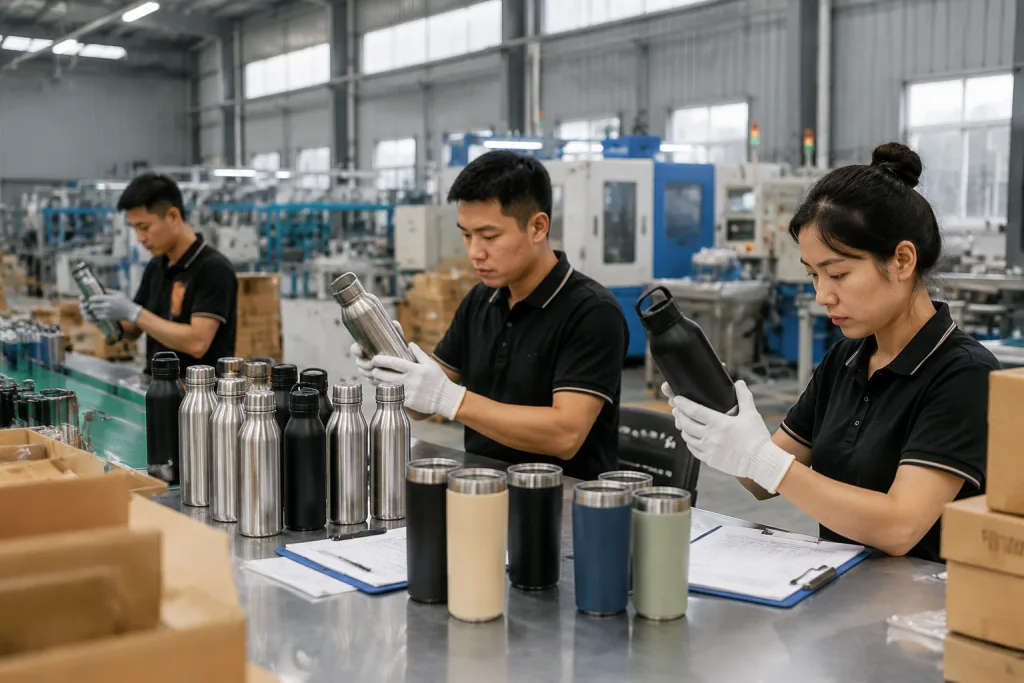
As a drinkware factory in Zhejiang, China, we see buyers lose 20-30 days when the first RFQ says only “custom drinkware with logo.” The line cannot price that cleanly. A serious supplier needs capacity targets, material specs, decoration method, carton rules, and your sales channel; QC pulled one tumbler sample last month because the buyer’s carton drop test rule was buried in an email, not the spec sheet. BottleForge Industrial runs stainless bottle and tumbler lines at up to 420,000 units/month, with typical custom MOQ from 1,000 units per SKU.
Define the USA sales channel first
Private label drinkware USA buyers often open with the bottle shape. Wrong starting point. Start with the sales channel, because that decides the packaging, barcode, testing, and carton layout before the line even books material. Last month our QC table had two 20 oz samples with the same powder coat, but the Amazon unit needed FNSKU space on a 38 mm side panel while the corporate gifting unit only needed a white mailer and a logo proof. A distributor drinkware order for corporate gifting does not run the same setup as an Amazon FBA tumbler, a retail shelf program, or a canteen promotional campaign for schools and outdoor clubs.
If you sell through retail, you need UPC placement, shelf-ready packaging, case pack consistency, and color control tight enough that QC does not pull 7 cartons for shade drift under the light box. If you sell through FBA, you need FNSKU labeling, polybag rules where required, carton weight kept near 15 kg instead of pushing 22 kg, and outer carton dimensions that do not punish you on storage fees. Canteen distributor work is different again. We run master cartons sorted by logo, event, region, or sales rep when the buyer flags split delivery on the PO.
For a basic private label stainless bottle, give your canteen supplier these details before asking for price: target capacity, retail price, sales channel, lid type, color count, logo size, packaging style, and annual forecast. Too many RFQs miss the lid spec; then the buyer sends “straw lid” later and the quote moves by USD 0.18. If your annual volume is 12,000 units but your first PO is 1,000 units, say that. A serious canteen manufacturer can quote tooling, mold amortization, and packaging with cleaner math when they see the full program.
Do not ask for “best price” before you define the route to market. This is the wrong question to ask. The cheapest quote often skips inspection, labeling, and carton work, and we have seen that go sideways when the USA customer rejects 32 cartons at receiving.
Choose the right drinkware platform
Most private label programs should start from factory platforms we already run, not from a fresh mold. This is the right move. On our line, a 500 ml stainless bottle with a 68 mm body, a travel tumbler, kids bottle, beer growler, or hydration canteen becomes customized drinkware through PMS color, logo process, lid swap, silicone sleeve, barcode label, and retail box changes. One buyer once pushed for a new 750 ml body just to move the logo panel 8 mm; the mold math did not work at a 3,000 pcs launch MOQ.
For stainless vacuum products, ask about 304 stainless steel on the inner wall and 201 or 304 on the outer wall. Common wall thickness is 0.4-0.5 mm for many bottles and tumblers, though heavier outdoor products may use 0.6 mm. A custom growler or customized growler for outdoor and brewery channels needs a stronger handle, larger cap thread, and better leak testing because returns are expensive at 64 oz capacity. QC pulled one 64 oz sample after a 30-minute inverted test showed two drops at the cap gasket; that is the kind of finding you want before mass production, not after FBA check-in.
A custom canteen is different from a fashion tumbler. Buyers care about carry comfort, cap retention, coating grip, and dent resistance. For a canteen customizable program, confirm whether the body accepts powder coating, spray paint, rubberized coating, sublimation, or laser engraving, then ask for one marked sample before approving bulk color. A wide flat area helps for canteen customized logos, while curved bodies need smaller artwork to avoid distortion; we have seen a 55 mm logo look clean on the AI file and stretched on a tapered 720 ml body.
If you are comparing canteen manufacturers in China, request a platform sheet with capacity, diameter, height, net weight, carton quantity, and available lids. Ask for the real carton data too: a 24 pcs carton at 13 kg ships differently from a 36 pcs carton at 18 kg, and the freight quote changes fast. At BottleForge in Zhejiang, we normally provide 2D artwork templates within 24-48 hours after platform selection. That cuts the usual artwork revision loop, especially when the PO has a small typo like “matte balck” and the buyer flagged it only after the first layout.
Understand MOQ and unit economics
MOQ is not a punishment. It is the break point where coil or sheet buying, line setup, Pantone matching, decoration fixtures, box printing, and AQL 2.5 inspection stop fighting the cost sheet. For private label drinkware USA programs, we run 1,000 units per SKU for logo plus color customization, 2,000-3,000 units for printed retail boxes, and 5,000 units or more if the buyer wants a new lid mold or a coating outside our standard powder booth. Below that, the math gets ugly. Last month QC pulled 80 samples from a 1,000-piece color run because the buyer flagged a 0.8 mm logo shift against the approved artwork.
FOB China pricing moves fast once the spec changes. A single-wall aluminum promotional canteen may sit near USD 1.20-2.20 at volume. A stainless vacuum canteen or travel bottle may run USD 3.20-6.50. A larger custom growler or customizable growler can reach USD 7.00-12.00 depending on capacity, cap, handle, and finish. These numbers are not promises; they are working ranges for early budgeting. We quote off the BOM, then check the sample with a digital caliper, scale, and vacuum tester before the price is treated as real.
You should also budget for one-time costs. A new retail box die line can cost USD 80-150. A new silicone part or plastic lid mold can cost USD 1,500-6,000. Laser engraving usually has low setup cost, while silk screen, heat transfer, and full-wrap print may need films, plates, or fixtures. If a canteen vendor says there is no setup cost at all, ask where it went. We have seen this go sideways when a PO said “matte black” but the approved sample was PMS Black 6C powder coating, which added 3 days on the spray line.
For distributor growler and distributor drinkware orders, margin is often won in carton efficiency, not product price alone. A carton that holds 24 units instead of 20 can reduce ocean freight cost per unit by several cents. On a 20,000-unit reorder, small packaging choices matter. The buyer usually pushes for thicker E-flute gift boxes, but if the master carton jumps from 13.5 kg to 16.8 kg and loses 120 cartons in a 40HQ, the math does not work.
Decoration methods and branding limits
Customizable drinkware has hard limits. Pick the wrong decoration method and the line loses 2–4 days on rework, or the logo just looks cheap. Laser engraving is clean and durable on 304 stainless finishes and powder coating; it cuts through with a fiber laser at around 0.08 mm line width, but it will not match bright Pantone colors. Silk screen works best for one- or two-color logos on straight walls, and we usually keep it under 90 mm wide before distortion starts showing. Heat transfer can carry gradients, but we run a 3-piece trial first because artwork area, curing temperature, and coating adhesion do not always behave the same batch to batch.
For canteen custom orders, body shape matters more than buyers expect. A straight cylinder is easy. A rounded shoulder, waist, or deep curve can stretch a large logo by 2–3 mm at the edge, and QC pulled the sample last month for exactly that reason. If your brand guide requires a 70 mm wide mark on a narrow customized canteen, ask for a printed pre-production sample before approving mass production. A digital mockup is not enough; we have seen this go sideways when the buyer approved the PDF but flagged the curved print after carton inspection.
Powder coating is popular for USA retail because it feels more premium than basic spray paint. It adds cost, and the math does not work if the order skips adhesion checks to save half a day. We normally recommend cross-hatch adhesion testing with a 1 mm cutter, hot water exposure at 60°C, and tape pull checks before mass production approval. For outdoor canteen promotional programs, matte black and dark green hide small handling marks from the packing table. Gloss white looks clean in photos but shows scratches, dust, and pinhole coating defects under the inspection lamp.
Private label packaging should be treated as part of the product. A plain white box with a sticker can work for launch MOQ, often 500–1,000 pcs when the buyer is still testing sell-through. A printed retail box helps shelf sales but can add 7–10 days and a separate carton artwork approval; one PO we received even had “matte lamination” typed as “mate lamination,” so our merchandiser stopped it before plate making. Hang tags, instruction cards, QR warranty inserts, and warning labels need to match the sales market, not just look nice. For USA orders, put care instructions and country of origin marking where the warehouse team can see them without opening every box.
Compliance is not optional
USA buyers often assume drinkware compliance is simple because the product has no battery or circuit board. Bad bet. Food-contact stainless, powder coating, UV ink, silicone O-rings, PP lids, straws, and even polybags can trigger a compliance hold. Your canteen factory should be able to talk through FDA food-contact expectations, California Proposition 65 risk, ASTM requirements for children’s products where applicable, and CPSIA if the item is clearly intended for children. We had QC pull 32 lids from the line last month because the gasket supplier changed silicone hardness from 50 Shore A to 60 Shore A without telling the merchandiser.
For European buyers, REACH, LFGB, and sometimes BSCI audit requests come up early. Even if your target phrase is private label drinkware USA, about 3 in 10 brand owners we ship for later ask about Canada, the UK, or the EU within the next 12 months. It costs less to choose compliant coating and lid resin before tooling than to rebuild the item after a retailer review fails. This is the wrong place to save USD 0.03. One German buyer flagged LFGB only after carton artwork was approved, and that pushed their ship date from 12 days out to 18 days out.
Ask your canteen suppliers for test reports tied to the actual materials in your order. A generic 2022 report for a different lid is not enough. For stainless steel vacuum bottles, check heavy metals, migration, BPA status for plastic components, and silicone food-contact status. For painted products, check lead, cadmium, and coating safety. For kids bottles, ask about small parts, straw pull force, and age grading. On our floor, QC pulled the sample against the BOM and found the report said Tritan while the approved lid drawing called out PP, a mismatch no buyer wants to explain to Target compliance.
AQL should be written into the PO. A common inspection level is General Inspection Level II with AQL 2.5 for major defects and 4.0 for minor defects, though premium retail orders may require tighter limits. Define critical defects as zero tolerance: leakage, sharp edges, wrong logo, wrong barcode, odor, rust, and unsafe contamination. China factories can run to these standards, but only if they are locked before production starts. We have seen this go sideways from one PO typo, “AQL 25” instead of “AQL 2.5,” so our sales team now checks that line before the deposit invoice is released.
Sampling and production timeline
A clean timeline protects both sides. For an existing drinkware platform, we usually need 3-7 days for blank samples if stock sits on the rack, 7-12 days for logo samples, and 10-18 days for color-matched samples after the Pantone chip is checked under a D65 light box. If you need a new mold for a lid, handle, or special cap, add 20-35 days before the sample is worth judging. First-shot lids often come back 0.2-0.4 mm off at the seal groove.
After sample approval, mass production for customized drinkware normally takes 35-55 days, shaped by season, finish complexity, carton packing, and order quantity. Peak season before summer and Q4 can add 10-15 days, especially when powder coating lines are full. Ocean shipping from Ningbo or Shanghai to the USA West Coast may take roughly 18-28 days port to port, while East Coast routing is closer to 28-38 days on many bookings. Air freight is possible for urgent launch quantities, but the math doesn't work on most stainless bottles; we once quoted 1,200 pcs by air and the buyer flagged freight higher than the bottle cost.
A practical schedule looks like this: RFQ and platform confirmation in 2-3 days, artwork template in 1-2 days, sample production in 7-12 days, sample transit in 3-5 days by courier, production deposit and material booking in 3-5 days, mass production in 35-55 days, inspection in 1-2 days, and export handling in 3-6 days. We run this backwards from the warehouse date, not from the PO date. QC pulled a sample last month where the buyer's PO said “matte black” but the artwork file said “soft-touch black,” and that one typo cost 4 days. That is why a serious private label drinkware USA launch should start at least 90 days before the product must be in your warehouse.
For reorders, timing improves. If the same canteen manufacturer keeps approved color panels, artwork files, packaging dielines, and QC criteria, a repeat PO can often move 7-10 days faster. Keep a signed golden sample in both your office and the factory in Zhejiang; we store ours in a labeled QC cabinet with the Pantone card, lid torque note, and carton mark printout clipped together.
How to compare supplier quotes
Do not compare canteen vendors by unit price alone. Put every quote into one sheet: material grade, capacity tolerance, wall thickness, lid material, gasket material, coating method, logo method, packaging, carton quantity, test reports, MOQ, sample cost, production lead time, payment terms, Incoterms, and validity period. We run this check in a 22-column quote table because one buyer once missed “EXW Yiwu” in row 17 and thought it matched FOB Ningbo. It did not. If one quote is FOB Ningbo and another is EXW China, they are not the same quote.
Ask whether the supplier is a trading company, a canteen factory, or a hybrid exporter with factory control. A trading company is not automatically bad, and a factory is not automatically good. The real test is whether they control the drawing, the line schedule, the AQL 2.5 inspection, and the reply when QC pulls a leaking lid sample at 4 p.m. BottleForge Industrial is based in Hangzhou, Zhejiang, close to stainless drinkware supply chains and export ports, so we can move samples to Ningbo in 1 day and consolidate cartons without adding a second inland truck.
Good canteen suppliers answer technical questions without drama. They can explain why a coating fails after 3M tape testing, why a lid leaks at the silicone gasket seat, why a 5-ply carton crushes under 18 kg, or why a logo must be reduced by 8 mm. Weak suppliers only say “yes” until the problem appears. We have seen this go sideways: the buyer flagged a logo blur only after 2,400 pieces were packed. For USA private label buyers, the safer partner is usually the one who pushes back early.
Before placing a PO, request a pre-production sample, a packing mockup, an inspection checklist, and a photo of the production line used for your order. Confirm whether spare lids, replacement gaskets, and mixed-color cartons are available. Small parts matter. We ship 2% spare gaskets on some canteen programs because retail customers lose them, and the math does not work if you airfreight 50 replacement lids after the first shipment lands.
Send your private label drinkware brief today
Share capacity, logo, target price, MOQ, and sales channel. We will return a practical factory quote with timeline and options.
Frequently asked questions
What MOQ should I expect for private label drinkware USA orders?
For an existing stainless bottle, tumbler, or custom canteen platform, expect 1,000 units per SKU for basic logo customization and standard carton packing. If you need a custom color, MOQ is usually still around 1,000 units, but Pantone matching may add 7-10 days. Printed retail boxes often require 2,000-3,000 units because box factories have their own setup requirements. New lid molds, special handles, or a customized growler shape can require 5,000 units or more to make the tooling cost sensible. If a canteen supplier accepts 100 fully customized units, check whether it is using stock goods with simple decoration, not real private label production.
Can I use a China factory for a USA private label brand?
Yes, many USA private label drinkware programs are produced in China, then branded, packed, and shipped according to USA retail or e-commerce requirements. The key is to specify compliance and logistics clearly. Ask for FDA-relevant food-contact material support, Proposition 65 risk review where needed, country of origin marking, barcode placement, and carton labeling. For Amazon FBA, provide FNSKU rules before packaging is printed. A factory in Zhejiang or another China drinkware hub can usually support USA programs well, but you should approve a physical sample and written QC checklist before mass production starts.
Which decoration method is best for custom drinkware?
There is no single best method. Laser engraving is durable and clean, especially on powder-coated stainless drinkware, but it is usually one-color because it exposes the base material. Silk screen is good for simple logos and lower cost, often practical at 1,000 units. Heat transfer or full-wrap printing is better for colorful artwork, gradients, or lifestyle graphics, but it needs more testing on curved bodies. For canteen promotional orders that will be used outdoors, we often recommend powder coating plus laser engraving or a compact silk screen logo because scratch resistance and readability matter more than complex artwork.
How long does a custom canteen order take?
For an existing customizable canteen design, allow 7-12 days for a logo sample after artwork approval and 35-55 days for mass production after deposit and sample sign-off. Add 3-5 days for courier sample shipping and 1-2 days for final inspection. If you need a custom color, add about 7-10 days for color panel approval. If you need a new lid or body mold, add 20-35 days before sampling. For USA delivery by ocean freight, build a total project calendar of about 90 days from RFQ to warehouse arrival.
How do I check if a canteen manufacturer is reliable?
Ask for evidence, not slogans. A reliable canteen manufacturer should provide material specifications, recent test reports, factory audit information such as BSCI or ISO where available, production photos, sample timelines, and a clear AQL inspection standard. Request the carton size, gross weight, units per carton, and defect definitions before PO. You should also ask technical questions: inner steel grade, outer steel grade, wall thickness, coating method, leak test process, and cap material. Good canteen manufacturers answer with numbers. Weak canteen vendors answer only with “no problem” and avoid written commitments.