Key Takeaways
- A realistic MOQ for private label stainless drinkware is usually 1,000-3,000 pcs per color or SKU
- FOB China lead time is commonly 30-45 days after sample and artwork approval
- American buyers should confirm FDA, LFGB, REACH, ASTM, Prop 65, and AQL inspection terms before deposit
- Logo method, carton plan, barcode handling, and color tolerance affect landed cost more than many buyers expect
If you search for private label drinkware american, you are usually trying to solve 1 of 2 jobs: build a U.S.-ready product line, or find an overseas factory that already knows retail, promo, and distributor rules. Those are different jobs. A nice bottle sample is easy. A repeatable private label program needs UPC placement, 5-layer export cartons, compliance files, and color control within about ΔE 1.5 on the color meter.
From our factory base in Hangzhou, Zhejiang, we see American buyers lose 12 to 18 days on vague quotes, weak logo proofs, and suppliers who price drinkware like gift boxes instead of distributor-margin products. We run into this weekly. China can still be the right sourcing base, but the wrong question is “can you make this bottle?” Ask whether the line can hold the same powder coat, carton mark, lid fit, and barcode position across 3,000 or 30,000 pcs. QC pulled the sample last month because the PO said “matte black,” while the approved artwork file said “soft-touch black.” That small mismatch gets expensive fast.
What American Buyers Actually Need
American private label drinkware is not just a logo slapped on a bottle. If you sell into Target-style retail chains, corporate gifting accounts, Amazon FBA, outdoor shops, school programs, or canteen distributors, you need the whole product set: bottle, decoration, packaging, compliance file, shipping marks, spare lid plan, and reorder control. We see 6 to 8 buyers a month get stuck because the PO says “black bottle” but the approved sample is Pantone 426C powder coat, measured under a D65 light box.
A custom canteen for a promo job can stay lean: one 32 oz size, one powder coat, one logo, bulk packed 24 pcs per carton. Easy order. A retail-ready customizable canteen takes tighter work: UPC or FNSKU labels, color box artwork, California warning text if needed, hang tags, 1.2 m carton drop test, and a master carton layout the warehouse can scan without turning the box 4 times. A distributor canteen often needs neutral packaging because their client may resell the same item under 3 different programs; QC pulled a sample last month where the factory carton still showed the end customer’s brand, and the buyer flagged it immediately.
For American buyers, asking only for the unit price is the wrong question to ask. Ask what sits inside that number. Is the quote FOB Ningbo or FOB Shanghai? Are inner boxes included, or only egg-crate dividers? Does the price cover laser engraving, silkscreen, or full-color heat transfer logo? Is the stainless grade 304 inside and 201 outside, or 304 both inside and outside? Is the lid PP, Tritan, or stainless-lined? We run into this on the line: a 0.40 USD cheaper lid can fail the leak test after 3 minutes on the tilt rack, then the math doesn't work.
At BottleForge Industrial in Zhejiang, China, we quote from the final sales channel, not just the bottle shape. A canteen promotional order for 2,000 pcs with bulk cartons is a different job from a retail private label program with 12 SKUs and quarterly replenishment. We ship both, but the risk is not the same; one missing FNSKU label can hold 96 cartons at the forwarder, and we have seen that go sideways over a single typo on the PO.
Choose The Right Product Platform
Before you ask a canteen manufacturer for tooling, pick the product platform first. This is the wrong question to ask on day one: “Can you open a new mold?” For 8 out of 10 American first orders we see, a proven factory platform with private label changes gives better timing, lower risk, and fewer QC surprises. Last month QC pulled the sample from a new-shape request and found the lid sat 0.7 mm off-center; the buyer lost 12 days on drawings before we even cut steel.
For stainless vacuum drinkware, common private label platforms include kids bottles at 12 oz, sports bottles at 18-24 oz, canteens at 32-40 oz, travel tumblers at 20-30 oz, plus 64 oz beer or water growlers. A custom growler or customizable growler needs thicker stainless than a lightweight promo bottle because dents show fast on a big curved body. We normally recommend 0.5 mm inner wall and 0.6 mm outer wall for many vacuum growler bodies, then adjust after the weight check on the digital scale and the target FOB. The math doesn't work if the buyer wants a 64 oz growler to feel premium but prices it like a thin 500 ml giveaway bottle.
If you are building a customized drinkware line, do not launch with too many sizes. Six colors across five bottle shapes becomes 30 SKUs, and every SKU needs MOQ, carton marks, photo files, color swatches, barcode labels, and QC records. We run into this often: the buyer flags “sage green” on the PO, the artwork file says “olive,” and the line stops while sales checks which Pantone chip is real. A practical first program is two body sizes, three colors, and two lid options. Enough to test. Not enough to trap cash in slow colors.
For canteen custom projects, ask which parts are shared before you approve samples: lid thread pitch in mm, silicone gasket size, straw length, handle mold, and carry loop material. Shared components cut reorder risk. If one lid fits three SKUs, your after-sales work gets easier because we can ship 500 spare lids with the next container instead of opening a separate small order. We've seen this go sideways when a distributor sold 3,000 bottles, then found the replacement lid only fit the 32 oz body, not the 40 oz. This matters for any canteen supplier selling into American outdoor, promo, or distributor channels.
MOQ, Price, And Lead Time
Real numbers sort canteen vendors fast. For existing stainless vacuum bottle molds, we run a normal MOQ of 1,000 pcs per SKU for standard colors and 3,000 pcs for a custom PMS powder coat color. For glass bottles, MOQ starts around 2,000 pcs because the line loses more pieces during packing and carton drop checks; QC pulled 17 cracked inner boxes on one 2,400 pcs glass order last May. For a fully new mold, expect tooling from USD 2,000 to USD 8,000 for a basic lid or body change, and more if the structure needs a new thread gauge or silicone seal groove.
Unit price comes from steel grade, capacity, cap structure, coating, logo method, and packaging. As a rough FOB China range, a 20 oz stainless tumbler runs USD 3.20-5.80, a 32 oz customized canteen runs USD 4.50-7.50, and a 64 oz customized growler runs USD 8.50-14.00. These are not promises; they are guardrails for early budgeting. We once had a buyer push back on USD 0.18 for a thicker retail box, but the math did not work after the 1.2 m carton drop test crushed two corners.
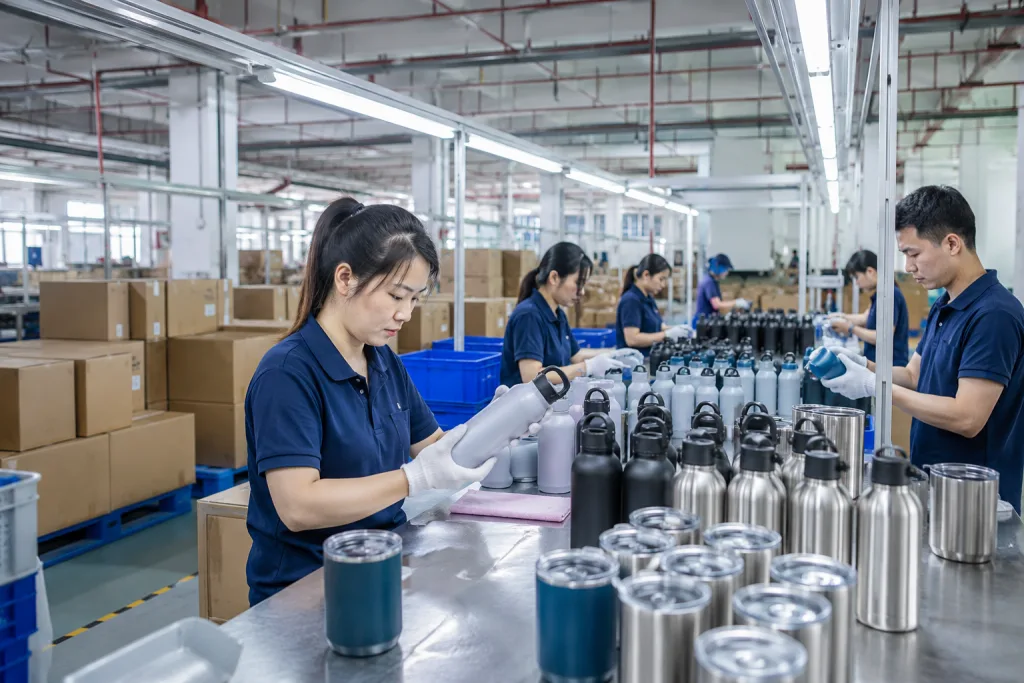
Our Hangzhou, Zhejiang production network supports about 450,000 stainless drinkware units per month across standard platforms. Normal lead time is 7-10 days for a logo sample, then 30-45 days for mass production after deposit, artwork approval, and color approval. Peak season before Q4 adds 10-15 days if you wait too long. The line books by welding capacity and powder coating slots, not by wishful PO dates; we ship faster when the buyer approves the laser logo file within 24 hours instead of sending a revised AI file three days later.
Be careful with any canteen factory that offers low MOQ, custom color, retail box, and 20-day shipment in one quote. One can be real. All together usually means a shortcut somewhere. We have seen this go sideways when the buyer flagged a PMS 7499C typo on the PO after 600 pcs were already powder coated.
Decoration And Branding Choices
Your branding method changes the look and the reject rate. For American private label drinkware, we usually run 7 options: laser engraving, one-color silkscreen, multi-color screen print, heat transfer, water transfer, UV print, plus embossed or debossed metal badges. Each one has a limit. Last month QC pulled 38 logo samples from the line because the print jig was 1.5 mm off-center on a tapered bottle.
Laser engraving stays clean on powder coat and bare stainless, so we use it for premium corporate orders and distributor programs where complaints are expensive. Silkscreen costs less for a simple one-color logo, but the artwork must be sharp and the print area needs enough flat surface for the screen frame. Heat transfer works for full-color graphics. Test it hard. We run 24-hour adhesion checks, 3M tape pulls, 500-cycle abrasion, and dishwasher cycles before approving a large wrap graphic; skipping that is the wrong place to save USD 60 on samples.
For a canteen customizable program, set artwork rules before the PO. Define minimum line width, logo placement tolerance, PMS color tolerance, and logo direction against the lid hinge or drinking spout. A 2 mm placement shift may pass on a giveaway bottle. It will get flagged on a retail shelf set where every front label has to face the same way. We once had a buyer mark up 12 cartons because the logo faced the handle instead of the flip straw.
Private label also means packaging. A color box can cost USD 0.25-0.80 depending on board grade, print coverage, inserts, and barcode labels. For Amazon FBA, confirm carton weight, FNSKU placement, suffocation warnings, and master carton limits before production starts. We ship cartons through a 1.2 m drop test and check barcode scan distance at 30 cm; fixing labels after packing is slow, messy, and the math doesn't work on a 3,000 pcs order.
Compliance For U.S. Programs
American buyers should not treat compliance as a PDF folder pulled together after the line finishes. Start with the material spec. For stainless drinkware, ask for food-contact test reports tied to 304 stainless steel, PP or Tritan plastic parts, silicone gaskets, and any powder coating or paint that touches the mouth area. We usually see U.S. buyers request FDA food-contact documentation first; buyers with EU channels add LFGB, REACH, BPA-free declarations, and Prop 65 review for California exposure risk. QC pulled one 20 oz tumbler sample last month because the lab report listed “201 stainless” in one table, even though the PO said 304 stainless steel. That typo stopped approval for 6 days.
If the product is for children, the bar moves up. You may need ASTM F963, CPSIA, lead and phthalate tests, tracking labels, plus a small parts review using the choke tube gauge on the cap and straw set. A kids bottle cap with a removable straw component carries a different risk than an adult 32 oz canteen customized for a hiking brand. We’ve seen this go sideways when a buyer treats a 12 oz school bottle like a normal sports bottle; the math does not work once testing, warning labels, and retail compliance checks are added.
Factory audits also matter. BSCI, ISO 9001, Sedex, or a client-specific social audit can be requested by large retailers and promotional agencies before they release the PO. Not every canteen vendor can support these files, and some trading companies only find that out after deposit. Ask before deposit. On our side, we keep audit PDFs, CAPA records, and last-inspection summaries in the sales folder because one U.S. promo buyer flagged a missing Sedex screenshot 48 hours before artwork approval.
Inspection terms should be written into the purchase order. We normally recommend AQL Level II with critical 0, major 2.5, minor 4.0 for about 80% of drinkware shipments, then adjust for the buyer’s retail or promo program. Inspection should check vacuum performance with a 95°C hot-water hold test, coating adhesion by 3M tape cross-cut, logo position in mm, leakage, odor, carton marks, barcode scanning, and random capacity measurement. In China, clear AQL standards prevent arguments because the factory, buyer, and inspector work from the same defect list. The buyer flagged it once when “logo centered” was written on the PO with no tolerance; now we run ±1.5 mm unless the artwork sheet says otherwise.
How To Vet Canteen Suppliers
About 8 out of 10 canteen suppliers can send clean photos. Fewer can explain 0.45 mm versus 0.55 mm wall thickness, batch vacuum failure rate, powder coating oven time, spare lid MOQ, or whether the export carton passes a 12 kg drop test. Ask production questions. Broad sales talk does not catch a weak weld line or a thin bottom cup.
Start with factory status. Are they a real canteen factory, a trading company, or a shop that runs both? A trading company is not automatically a problem; the wrong question is asking only for the lowest quote. Ask who controls the line, then request workshop photos, recent inspection reports with buyer names blacked out, and a 30-second sample packing video from the sealing table. For larger American programs, get a video call from the workshop, not the showroom with 200 sample cups on the wall.
Then test communication quality. A solid canteen supplier should ask about sales channel, MOQ, target FOB price, compliance market, logo method, and delivery deadline before quoting. If a vendor sends a price in 10 minutes with no questions, we treat it as a placeholder. We have seen this go sideways when the buyer later adds a color box, UPC barcode, spare gasket, or 70 μm coating, and the factory says the first PO missed those lines.
For distributor growler or distributor canteen programs, ask how reorders are handled. Will the factory keep color standards within a clear Pantone tolerance? Can they reserve molds for 18 months, keep spare parts on hand, and print mixed carton labels for 6 distributor accounts without mixing SKU stickers? Canteen distributors and distributor drinkware buyers usually win repeat orders through reliability, not the lowest FOB price by 3 cents.
In Zhejiang, our practical advice is simple: buy a paid pre-production sample, approve a signed golden sample, then inspect before balance payment. QC should pull the sample from the line, measure the mouth diameter with a caliper, and check coating adhesion before mass packing starts. It takes 12 days versus a 2-day photo approval, but the math works when it protects your margin.
Send your private label drinkware brief today
Share target price, MOQ, logo method, market, and deadline. We will return a practical FOB China quote and sampling plan.
Frequently asked questions
What MOQ should I expect for private label drinkware for the American market?
For existing stainless vacuum molds, expect 1,000 pcs per SKU for standard factory colors and 3,000 pcs per SKU for a custom PMS powder coat. If you need a canteen customized with a new lid, new handle, or new body shape, the MOQ may move to 5,000-10,000 pcs because tooling and line setup become more expensive. For a first American private label launch, we usually suggest two sizes and three colors rather than 15 SKUs. That keeps the first order manageable while still giving your sales team enough choice.
Can I make a canteen look American-made while sourcing from China?
You can design private label drinkware for American taste while clearly sourcing from China, but you must not mislabel origin. U.S. origin marking rules require accurate country-of-origin labeling. What you can control is the design language: matte colors, clean typography, retail packaging, ounce-based capacity marks, UPC labels, and instruction sheets written for American consumers. A Hangzhou, Zhejiang canteen manufacturer can produce this presentation, but cartons and product labels should still state the correct origin, such as Made in China, unless your legal counsel confirms another compliant marking.
Which logo method is best for custom drinkware distributors?
For distributor drinkware, laser engraving is often the safest method because it has strong durability and low complaint rates. It works well for powder-coated stainless canteens, tumblers, and growlers. One-color silkscreen is cheaper for larger canteen promotional orders, especially above 3,000 pcs, but it needs good artwork and adhesion testing. Full-color heat transfer is useful for retail graphics, yet it should be tested with tape pull, abrasion, and hot water exposure. If your distributor canteen order has many client logos, ask for a standard logo placement template before quoting.
How long does a custom canteen order take from sample to shipment?
A normal timeline is 7-10 days for digital proof and logo sample, 3-5 days for buyer approval, then 30-45 days for mass production after deposit and final artwork approval. Sea freight to U.S. West Coast may add roughly 18-25 days port to port, while East Coast can be 30-40 days depending on routing. Air freight is faster but often ruins the margin on stainless drinkware. If you are planning a Q4 promotional campaign, start sourcing at least 90-120 days before the required delivery date.
What should I check before paying the balance to a canteen factory?
Use a third-party or buyer-side inspection before balance payment. Check AQL results, quantity, carton marks, barcode scanning, logo position, color match, coating defects, leakage, vacuum performance, odor, cap fit, and packaging damage. For stainless vacuum drinkware, sample several units for hot water retention and external sweating. For a customized growler, inspect dents carefully because large bodies show small impacts. Your purchase order should define critical, major, and minor defects before production. If the canteen factory accepts AQL Level II terms before deposit, disputes are easier to solve.