Key Takeaways
- Start private label drink bottle projects with 1,000-3,000 pcs MOQ for most stainless steel styles
- Use 304 stainless steel at 0.4-0.5 mm wall thickness for mainstream insulated bottles
- Allow 7-12 days for pre-production samples and 30-45 days for bulk production after approval
- Set AQL 2.5/4.0 inspection terms before deposit, not after cartons are packed
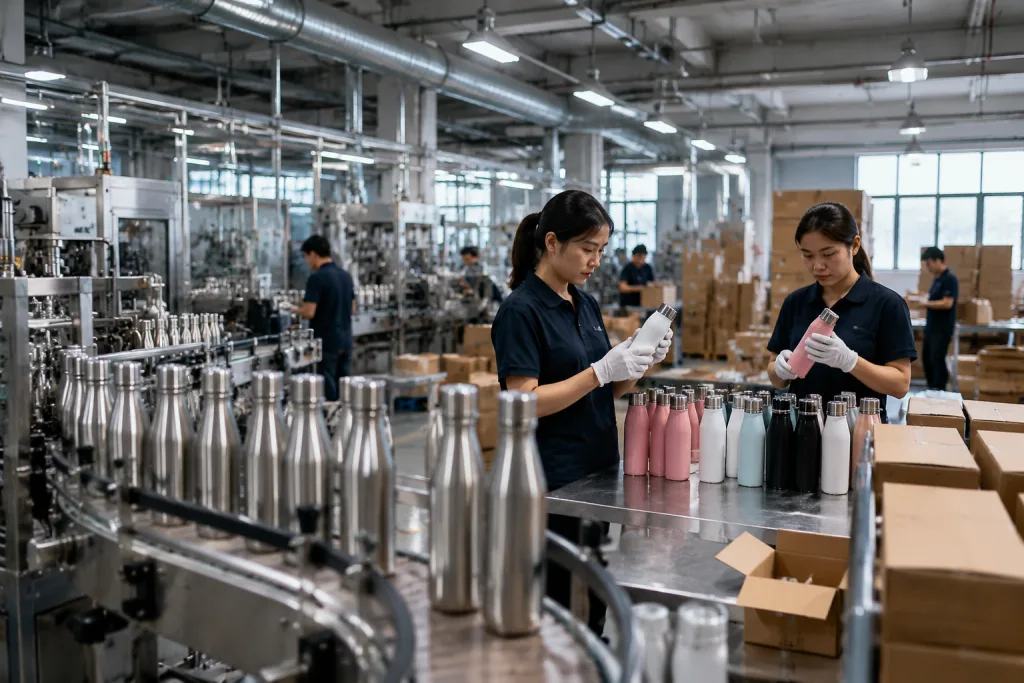
A private label drink bottle looks simple until you approve the wrong PP sample, miss the 1.2 m carton drop test, or find the cap color is 12 days behind the bottle body. For B2B buyers, unit price is the wrong question to ask first. The real risk is whether the bottle matches your brand Pantone, passes FDA or LFGB checks, ships before the promo window, and survives 6 cartons stacked in a distributor warehouse.
From our factory base in Zhejiang, China, we hear the same questions in RFQs every week: stainless or plastic, laser logo or silkscreen, 500 units or 5,000 units, FOB Ningbo or delivered warehouse. QC pulled one sample last month where the buyer’s PO said “matte balck” and the line followed the typo. This guide walks through the practical decisions behind custom drinkware sourcing, without pretending one bottle fits every retail shelf or corporate gift order.
Define The Bottle Before Pricing
About 7 out of 10 buyers ask for a price before the bottle is defined. Fair enough, we see it every week. The problem is the first quote can be off by 8-15% once the line confirms the real material, capacity, lid, coating, logo method, packaging, and test requirements. A private label drink bottle is not one SKU yet. Last month QC pulled a sample marked “750 ml” on the PO, but the buyer’s artwork called it 800 ml; that small typo changed the body height by 12 mm and killed the old carton plan. A 750 ml single-wall canteen custom project and a 1,000 ml vacuum insulated customized growler do not belong in the same price conversation.
Start with the sales channel. Retail shelf and corporate gifting make different decisions, and the math changes again for outdoor distributor canteen programs, Amazon FBA, or supermarket promotion. A canteen promotional order may accept a lighter body with a simple one-color logo, say 5,000 pcs MOQ and no spare lid. A distributor drinkware line usually needs stronger packaging, spare lids, repeatable colors from the powder booth, and a stable model available for at least 18-24 months. We ship both types, but mixing them in one RFQ is the wrong question to ask.
For stainless steel bottles, the common specification is 304 food-grade stainless steel inside, 201 or 304 outside, 0.4-0.5 mm wall thickness, and copper-coated vacuum insulation if temperature retention matters. For plastic sports bottles, ask whether the material is Tritan, PP, or PE, and confirm BPA-free declarations. For glass bottles, check borosilicate thickness, sleeve fit, and drop-test expectations. We run incoming material checks with an XRF gun on stainless coils; if the test sheet says 304 but the coil reads 201, the buyer flagged it before production starts. Cheap can turn expensive fast when your customer asks for REACH, LFGB, or California Proposition 65 documentation after the shipment is already moving.
Capacity also affects the mold and carton plan. A 350 ml bottle can ship 48 pcs per carton; a 1,000 ml custom growler may only ship 12-24 pcs per carton. Freight per unit moves with it. On one 1,000 ml growler order, changing the gift box from 350 gsm white card to 400 gsm kraft pushed the carton gross weight from 13.6 kg to 15.1 kg, and the buyer’s “lowest price” supplier lost the landed-cost comparison. If you are comparing canteen suppliers, require each quotation to show capacity, net weight, gross weight, carton size, packing ratio, and FOB port. Without those details, the lowest unit price is usually not the lowest landed cost.
MOQ, Tooling, And Real Lead Times
MOQ is where 6 out of 10 private label drink bottle projects slow down. At BottleForge Industrial in Hangzhou, Zhejiang, we run most existing 304 stainless steel private label models at 1,000 pcs per color, with mixed-color orders worth discussing from 3,000 pcs total. For a new mold, the MOQ usually starts at 5,000-10,000 pcs, because the CNC tooling fee, lid fixture, leak-test jig, and first-line adjustment all need volume. Below that, the math doesn't work.
You will see canteen vendors in China advertising 100 pcs MOQ. That can be real for blank stock plus a 40 mm laser logo on the body, but it is not a stable private label program. If you need Pantone powder coating, retail packaging with a barcode sticker, insert cards checked against your PO, and carton marks printed in 2 colors, plan higher. A canteen factory must buy coating powder by the kg, print packaging, arrange line time, and control rejects. Small runs carry more setup cost and a higher defect percentage; last month QC pulled 23 scratched lids from a 600 pcs trial because the buyer wanted mixed caps from leftover stock.
For normal projects, a realistic timeline is 7-12 days for sampling, 3-5 days for sample review and revision decisions, then 30-45 days for mass production after deposit and artwork approval. Peak season in China, usually August to November for holiday orders, can stretch this by 7-15 days. Chinese New Year can close production capacity for 20-30 days including upstream suppliers, even when sales offices reply to emails. We ship samples by DHL most weeks, but one wrong Pantone code on an artwork file can turn 7 days into 12 days fast.
Our Zhejiang facility can assemble and pack around 450,000 drinkware units per month across bottles, tumblers, canteens, and growlers, but capacity is not infinite for every coating color or lid type. A matte black bottle with a flip straw lid does not fight for the same line time as a gloss white canteen with a screw cap. If you are a canteen distributor planning a seasonal launch, book the production slot when the pre-production sample is approved, not when your customer finally sends a purchase order two weeks later. We've seen this go sideways: the buyer flagged a typo on the PO, waited 14 days for approval, then asked why the coating line was full.
Practical rule: if your retail launch date is fixed, count backward from warehouse arrival, not factory ship date. Ocean freight, customs, inspection, and local delivery can consume 35-55 days to Europe or North America; a random AQL 2.5 carton check at loading can still cost half a day.
Logo And Surface Options
Logo work is where a private label bottle starts to earn margin, and it is also where the buyer spots a mistake first. For customizable drinkware, we run six common options: laser engraving for 304 stainless bodies, silkscreen printing for simple color marks, heat transfer for large artwork, UV printing for small detailed graphics, embossing on selected plastic or silicone parts, and full-wrap powder coating for color coverage. Each choice changes cost, MOQ, durability, and artwork setup. Last month QC pulled a 500 ml sample because the logo sat 3 mm off-center from the placement drawing.
Laser engraving looks clean on stainless steel and survives daily handling. It suits corporate gifts, outdoor custom canteen projects, and distributor growler programs where buyers care more about wear resistance than exact logo color. The catch is simple: laser usually exposes the metal under the coating, so it will not match a Pantone ink logo. Silkscreen works better for one- or two-color logos, usually adding about USD 0.05-0.18 per unit depending on size and color count. Full-wrap heat transfer can carry gradients and large artwork, but approve the visual sample and the 3M tape adhesion test before mass production. We have seen this go sideways when a buyer approved only the photo and skipped the rubbed sample.
Powder coating is popular because it feels better than basic spray paint and gives stronger scratch resistance. For most private label drink bottle orders, we recommend matte or semi-matte powder coating with 60-80 micron coating thickness, checked with a coating thickness gauge at the line. Soft-touch coatings photograph well, but fingerprints and rub marks show faster after 20 cartons move through distributor handling. Nice sample. Bad field finish. If your bottles will be packed and repacked by canteen distributors, the most delicate finish is the wrong choice even if it looks premium in a sample room.
Packaging is part of customization too. A plain white box is cheap and safe for wholesale. A printed retail box may add USD 0.12-0.45 per unit depending on paper grade, color count, and order volume. For Amazon or marketplace selling, plan FNSKU labels, suffocation warnings for polybags, two-side carton labels, and drop-tested master cartons with 12 kg target weight per carton if the SKU allows it. The buyer flagged one PO because “FNSKU” was typed as “FNSU,” and the warehouse would not receive the goods. A canteen customized for retail should not use the same packaging plan as a promotional giveaway.
Send vector artwork, Pantone references, logo size in millimeters, and placement drawings before sampling. If you only send a JPEG from a website, a responsible canteen manufacturer will ask for AI, PDF, or CDR files before opening the screen frame. If they do not ask, worry. We usually mark logo height, distance from the bottom edge, and front-facing centerline on the sample sheet so QC has something measurable to check.
Compliance For Europe And North America
Compliance is not exciting, but it protects your margin. A private label drink bottle sold in Europe or North America usually needs food-contact documents, chemical test reports, and label checks before a serious buyer releases the PO. The exact requirement changes by market, by material grade such as 304 stainless or Tritan, and by channel, since Amazon asks different questions than a supermarket chain. We have seen this go sideways: one buyer tried to use a 2022 lid report for a new powder-coated bottle, and QC pulled the sample because the silicone gasket was from a different batch code.
For Europe, buyers usually ask for LFGB food-contact testing, EU 1935/2004 declaration, REACH screening on coatings, strap parts, and printed logos, and sometimes French DGCCRF standards. For the United States, FDA food-contact expectations, California Proposition 65 review, CPSIA for children's bottles, and ASTM checks come up often. For Canada, check bilingual labeling and food-contact expectations before artwork lock. Kids bottles need a separate review from adult sports bottles. Small parts, straw valves under 6 mm, and paint chemistry get more attention, and the buyer will flag it if the warning label is missing on the color box.
Factory audits also matter for larger retailers. BSCI, Sedex, ISO 9001, and social compliance documents are common requests, but this is the wrong question to ask if you only ask, “Do you have an audit?” Not every canteen supplier carries every audit, and not every audit covers the workshop running your goods on Line 3. Ask for the audit scope, issue date, expiry date, and factory name in Chinese and English. A trading company can help, but you should know which canteen factory is producing your order; we once saw a PO typo list “Hangzou” instead of “Hangzhou,” and the retailer’s compliance portal rejected the upload for 2 days.
Testing cost should be discussed early. A full LFGB or FDA migration test on stainless steel plus silicone parts can cost USD 450 to USD 900 per item family, depending on the lab and test plan. If your project has five lids, three coatings, and two bottle bodies, the math gets ugly fast. We often suggest one approved lid platform across several customized drinkware models to cut test combinations from 30 to 6. Not glamorous product design. It saves money, and it can mean 12 days vs 18 days before the lab report lands in your inbox.
Keep a technical file for each SKU: material declarations, test reports, artwork approval, packaging dieline, inspection report, and shipment photos. Use the SKU code from the PO, not a nickname from WeChat, because six months later nobody remembers whether “blue kid bottle” meant Pantone 292C or 299C. When a retailer asks a question after delivery, you do not want to search old chat messages for the only copy of a silicone certificate. We run a simple folder check before shipment photos are sent, and if the carton mark PDF is missing, the line waits.
Quality Control Before Shipment
Quality control is more than checking if the logo sits straight. For a private label drink bottle, we run inspection on dimensions with a 0.02 mm caliper, real capacity, vacuum performance, coating adhesion, leakage, odor, retail box packing, barcode scan rate, and carton compression. Put the inspection standard in the purchase order before the deposit moves. We have seen this go sideways when the PO only says “standard QC” and the buyer flags a 6 mm logo shift after packing.
A common inspection setting is AQL 2.5 for major defects and AQL 4.0 for minor defects, using ANSI/ASQ Z1.4 sampling. Critical defects should be zero tolerance. A leaking bottle is not a minor issue. A sharp burr on a mouth rim is not acceptable; QC pulled 12 pieces last month after a cotton swab caught on the inner lip. A wrong FNSKU on an Amazon carton can create warehouse receiving problems even if the bottle itself is perfect.
For vacuum insulated bottles, we test heat retention and vacuum integrity during production, not just after the line is finished. A typical check fills bottles with hot water at 95°C, then measures temperature after a defined time with the same probe and room setup. The exact result depends on capacity, lid design, and room temperature, but the test method must be consistent. For leak testing, bottles should be inverted for 30 minutes, shaken 20 times, and checked around the lid, gasket, straw vent, and thread area. A canteen customizable with multiple lid options needs each lid tested, not only the easiest one.
Surface checks need proper lighting, usually a 600-800 lux inspection table instead of a dim packing corner. Powder coating defects include pinholes, orange peel, dust spots, color drift, thin coating at the bottom edge, and scratches from assembly. Logo defects include blurred edges, wrong placement, uneven laser depth, and ink adhesion failure; we once rejected 240 lids because the laser mark sat 3 mm too close to the seam. We usually recommend a 3M tape test for printed logos and a cross-hatch test for coating adhesion when the finish is new or high risk.
Third-party inspection makes sense for new canteen manufacturers or orders above USD 10,000. It usually costs USD 200-350 per man-day in China, depending on location and agency. If your supplier resists inspection without a technical reason, the math does not work for the buyer. Good canteen suppliers may disagree on defect classification, and we sometimes argue over whether a 1 mm dust nib is major or minor, but they should not object to a clear inspection process.
Pricing And Landed Cost
FOB unit price is only one line on the buyer sheet. We’ve seen a USD 3.20 bottle lose money against a USD 3.45 bottle because the cheaper one used soft dividers; QC pulled 32 dented samples from a 1,000 pcs pre-shipment lot after a 60 cm drop test. Compare landed cost, not just factory price. This is the wrong question to ask if the carton cannot survive the trip.
For reference, existing stainless steel private label drink bottle models often range from USD 2.20-6.80 FOB Ningbo or Shanghai depending on capacity, insulation, lid complexity, coating, logo, and packaging. Plastic sports bottles sit lower in most RFQs we run, while a customized growler with handle lid, 1.9 L capacity, and retail box can land much higher. A custom growler or distributor growler program needs stronger cartons because unit weight is higher; on the line, a filled master carton can hit 14-18 kg, and a weak 3-ply box starts bowing before pallet wrap.
Ask each canteen vendor to break the quotation into bottle, logo, packaging, inner carton if any, testing, mold or setup charge, and spare parts. Put it in separate columns. If you push only on the total price, the supplier may cut steel thickness by 0.05 mm, downgrade carton material from 5-ply to 3-ply, or change individual polybags to loose packing. The buyer usually does not catch it until damage claims start; we’ve seen this go sideways when a PO said “same as sample” but the packing line followed the cheaper carton spec.
Payment terms also affect risk. For new buyers, 30% deposit and 70% balance before shipment is common in China. Larger accounts with stable order history may negotiate better terms, but first orders rarely get open account, especially under 3,000 pcs. Currency should be stated clearly, usually USD, and the incoterm should be written as FOB Ningbo, FOB Shanghai, EXW Hangzhou, or another exact term. Vague terms like “shipping included” cause arguments later; last quarter the buyer flagged a PO typo where “FOB Shanghai” became “CIF Shanghai,” and the math did not work.
Freight planning should match the order. For 1,000 pcs, air freight may look tempting for a launch, but drink bottles are bulky. Sea freight is usually more rational for volume orders; a 24 oz bottle with retail box can eat carton space fast even when the unit weight looks harmless. If you ship to multiple distributor warehouses, decide whether the factory should split cartons by destination or whether your forwarder will handle it. Carton marks, pallet requirements, and packing lists should be confirmed before production finishes, because changing marks after the line seals 220 cartons means cutters, re-taping, and one tired QC clerk checking every SKU again.
Choosing A Long-Term Supplier
The best canteen supplier is not always the one with the fastest reply or the lowest first quote. The better test is whether the line can repeat Pantone color within ΔE 1.5, keep lid torque around 8-10 kgf.cm, and hold carton burst strength after 6 months of reorders. We have seen first orders look clean, then the second PO arrives with a typo in the color code and nobody checks it. That goes sideways fast. Private label drink bottle programs make money when order 2 and order 3 need fewer corrections than order 1.
Ask direct questions. Who owns the mold? How many units were produced last month? Which workshop handles powder coating? Can the same lid be used across 500 ml, 750 ml, and 1,000 ml bodies? What is the reject rate after coating? How many spare gaskets are included? Can the factory keep your custom color standard for 12 months? Serious canteen manufacturers answer with records: coating line output, gasket BOM, mold number, and last month’s QC report. Last week QC pulled the sample tray and found 7 lids with shallow thread engagement before packing. Good suppliers show that kind of finding instead of burying it.
If you are a distributor canteen buyer or distributor drinkware company, you also need catalog stability. Some factories chase trends and cut models after 90 days. Fine for a one-off promotion. Bad for reorder business. Before choosing a canteen manufacturer, ask whether the model will remain available for at least two seasons and whether replacement lids can be supplied in 500-1,000 pc batches. We run this check against the mold shelf tag and spare lid inventory, not just the sales catalog, because a nice PDF does not ship goods.
Communication style matters. A good canteen factory in Zhejiang or elsewhere in China should tell you when your idea is risky. A narrow-mouth bottle with a large ice cube claim is the wrong question to ask if the mouth opening is only 42 mm. A mirror-polished finish for outdoor use will scratch in the first retail demo. A dark matte coating with a 6 mm black logo can disappear under store lighting, and the buyer flagged exactly that on a pre-production sample in our light box. You pay a manufacturer for production judgment, not only for a proforma invoice.
For BottleForge Industrial, the right buyer is usually a brand owner, procurement team, canteen distributor, or promotional distributor that wants repeatable custom drinkware with controlled risk. If you need 50 pcs tomorrow, local decoration is probably better. The math does not work from China. If you need 1,000-50,000 pcs with private label packaging, compliance files, and export handling from China, factory sourcing starts to make commercial sense. We ship those programs with carton marks checked against the PO, barcode scans before sealing, and an AQL table on the packing desk.
Send Your Bottle Spec For A Factory Quote
Share capacity, material, logo, packaging, target market, and quantity. We will return a practical MOQ, FOB price, and lead time.
Frequently asked questions
What MOQ should I expect for a private label drink bottle?
For existing stainless steel models, expect 1,000 pcs per color as a realistic MOQ. Some blank stock can be laser engraved from 100-300 pcs, but that is not a full private label program. If you need Pantone coating, printed retail box, barcode labels, insert cards, and carton marks, 1,000-3,000 pcs is more practical. For a new mold or special customized canteen shape, MOQ usually starts at 5,000-10,000 pcs because tooling, trial production, and reject control need volume. Always ask whether MOQ is per color, per logo, per capacity, or total order.
How long does production take after I approve the sample?
For most private label drink bottle orders from China, plan 30-45 days for mass production after deposit, artwork approval, and sample approval. Sampling usually takes 7-12 days for existing molds and longer for new tooling. Add 7-15 days during peak season if your order needs powder coating, custom lids, or printed packaging. Ocean freight to Europe or North America can add 25-45 days depending on port, sailing schedule, customs, and inland delivery. If your launch date is fixed, count backward from warehouse arrival, not factory completion.
Which logo method is best for custom drinkware?
Laser engraving is the safest choice for stainless steel bottles when durability matters. It does not peel, and it works well for corporate and outdoor custom canteen programs. Silkscreen printing is better when you need a Pantone color logo, usually adding about USD 0.05-0.18 per unit depending on size and color count. Heat transfer or UV printing works for large, full-color artwork but needs adhesion testing before bulk production. For distributor drinkware, we usually recommend laser or simple silkscreen unless the retail design truly needs full-wrap graphics.
What quality standard should I put on the purchase order?
Use AQL terms before production starts. A common setting is AQL 2.5 for major defects and AQL 4.0 for minor defects under ANSI/ASQ Z1.4 sampling, with zero tolerance for critical defects such as leakage, unsafe burrs, wrong material, or wrong barcode. Also define tests for capacity, coating adhesion, logo position, odor, vacuum performance, carton drop resistance, and packaging accuracy. If the order is above USD 10,000 or you are using a new canteen vendor, budget USD 200-350 for a third-party inspection day in China.
Can one supplier handle bottles, canteens, and growlers together?
Yes, if the supplier has a stable drinkware platform and not only one product line. A good canteen manufacturer can usually manage private label drink bottle, custom canteen, customizable growler, and travel tumbler orders with shared coating colors, logos, cartons, and compliance files. The key is checking capacity, lid compatibility, and inspection process. For example, a 500 ml bottle and a 1.9 L customized growler need different carton strength and leak testing. Ask for monthly output, available molds, spare lid policy, and whether replacement parts can be reordered in 500-1,000 pc quantities.