Key Takeaways
- A realistic private label MOQ is 1,000-3,000 pieces per SKU, depending on color, lid, and packaging
- 304 stainless steel at 0.4-0.5 mm wall thickness is the normal baseline for double-wall travel tumblers
- FOB China pricing for custom travel tumblers often lands around USD 3.20-7.80 before retail packaging upgrades
- Plan 35-50 days for mass production after sample approval, plus 7-10 days for pre-production samples
A private label coffee mug looks simple until you try to buy 3,000 units with your logo, lid color, carton marks, barcode labels, and a launch date that cannot move. The trouble usually starts before the line opens: a 0.6 mm wall shown as “standard,” 201 stainless written where 304 stainless was expected, decoration specs with no Pantone code, or a quote that leaves out inner box, master carton, and AQL 2.5 inspection costs.
If you buy for a coffee brand, corporate-gift program, or mug distribution channel, chasing the cheapest unit price is the wrong question to ask. BottleForge Industrial is based in Hangzhou, Zhejiang, and we run travel tumbler lines at about 450,000 units/month, with typical private-label MOQ from 1,000 pieces per SKU; last month QC pulled a pre-production sample because the PO said “matte black” but the approved lid chip was closer to Pantone Black 6 C.
Start with the buying use case
A private label coffee mug for a retail coffee brand is not the same order as a coffee mug promotional giveaway for a conference. The cup body may share the same 86 mm mouth diameter, but the buying logic changes. Retail needs repeatable quality, shelf-ready packaging, GS1 barcode control, and a defect rate the brand can live with after 500 cartons hit stores. Corporate gifting is more about the event date, logo position within 1.5 mm, and carton sorting by department or city. We have seen this go sideways: QC pulled the sample on a 3,000 pcs gift order because the gold logo shifted 4 mm, and the buyer flagged it two days before vessel closing.
Before you ask a coffee mug supplier for pricing, write the use case in one sentence. For example: 12 oz double-wall stainless travel tumbler, matte powder coating, laser logo, retail color box, sold through cafés and online in North America. Good. That tells a coffee mug manufacturer more than “send catalog for bulk coffee mug.” It gives the factory enough context to suggest the lid gasket, powder thickness, 5-layer export carton, and test plan. On our line, that one sentence decides whether we run a leak test at 30 minutes or add a drop test with a 1.2 m fall height.
For coffee brands, we usually see 3 product lanes. One is an everyday bulk coffee travel mug for loyalty programs or subscription boxes, usually 12-16 oz, where the buyer cares about stable color matching and fast repeat orders. Another is a premium bulk coffee tumbler with ceramic coating, push-button lid, or handle, usually 16-20 oz, where the math only works if the coating reject rate stays under about 2% after curing. The last one is a corporate-gift bulk travel tumbler where logo placement and gift-box presentation matter more than retail margin. The line treats these differently; a ceramic inner cup needs extra visual inspection under the LED booth, while a simple laser-logo order moves faster through packing.
Do not start with a coffee mug supplier directory or coffee mug supplier list and send the same vague RFQ to 30 factories. This is the wrong question to ask. You will get 30 answers with different lids, carton sizes, steel grades, and lead times, so the prices cannot be compared. Start with capacity, material, lid style, decoration, packaging, compliance market, and annual forecast, with the first order MOQ stated clearly, even if it is only 1,000 pcs. A good coffee mug oem manufacturer in Zhejiang or elsewhere in China will answer in a structured way because those details decide tooling, MOQ, unit price, and lead time. We once had a PO typo that changed “matte black” to “matt back”; small error, big delay when pre-production samples were already on the spray rack.
Choose the right tumbler construction
Most coffee mug private label programs we run use double-wall vacuum stainless steel. It hits the right balance on heat retention, dent resistance, and carton weight. The usual spec is food-contact 304 stainless inside, with 201 or 304 outside. For higher-end coffee mug custom made projects, I push for 304 inside and 304 outside. It costs more, but the math works better for coffee, milk drinks, and acidic flavors because the outer shell resists rust spots around the rolled lip and bottom seam. QC pulled 32 samples last month after a salt-spray check, and the 201 outer bodies showed staining first near the weld line.
Wall thickness gets underestimated. A light tumbler looks clean in a catalog photo, then arrives with flat spots after parcel delivery. For a 12-20 oz bulk travel mug, we usually set 0.4-0.5 mm per stainless layer. Going thinner can save USD 0.10-0.25 per unit, but we have seen that saving disappear in dents, coating chips, and customer complaints. One buyer pushed for 0.32 mm to hit a promo price; QC found 7 dented bodies in the first 200 pcs from the polishing line. Too thick is not smart either. It adds weight, raises cost, and eats carton space, so “heavier” is the wrong question to ask.
The lid is usually where the order goes sideways. Sliding lids are cheap and familiar, but most are splash-resistant, not leakproof. Flip lids and push-button lids cost more because they need silicone seals, springs, or extra plastic parts. If your customer puts the mug in a bag, specify leak testing, not just a nice lid drawing. We run the simple upside-down test for 30 seconds, then check the rim and air hole with tissue paper. For desk and car use, a splash-resistant lid is often honest enough. Do not let marketing call a lid “leakproof” unless the test method supports it.
- Desk coffee: 12-14 oz, easy-sip lid with a smooth slider, stable base, lower height for monitor-side use.
- Commuter coffee: 16-20 oz, cup-holder base under 73 mm, stronger lid seal checked on the sample table.
- Corporate gift: 16 oz, powder coating, laser logo, individual gift box with no barcode typo on the PO.
- Retail shelf: 12-20 oz, tight color consistency, barcode labels, packaging that passes a 1.2 m drop test.
For China export production, ask the coffee mug factory direct team for a cross-section photo, material declaration, and sample weight. Do it before deposit if you can. Those checks expose shortcuts before you approve a coffee mug customized order. On our line, a 16 oz sample that is 18-25 g lighter than the signed sample usually means someone changed the wall thickness, the inner shell, or the base part.
Branding options that actually last
Decoration is the point where a coffee mug customizable project either becomes a clean brand asset or turns into a claim file. We see it on the line. The right method depends on surface finish, logo detail, order size, and wash routine. Laser engraving holds up well on powder-coated 304 stainless steel, and the edge is sharp when we run a 0.1 mm fiber-laser setting on a curved jig. It also exposes the metal underlayer, so it will not give you full color. Silk screen works for simple one- or two-color logos, especially at 3,000 pieces and up, but 5 pt text can break on a 76 mm curved body. Heat transfer gives more color range, but QC pulled samples last month where the film lifted 2 mm near the seam after a dishwasher cycle test.
For a private label coffee mug retail line, most buyers we ship for pair powder coating with laser engraving. It looks retail-ready, survives normal hand washing better than cheap pad printing, and keeps setup work under control. For coffee mug promotional products, silk screen is often the better call because the budget is tight and the order is tied to one event date. The math doesn't work if you spend USD 0.45 on decoration for a giveaway mug with a USD 3.20 target FOB. If your logo has gradients, small QR codes, or metallic ink, send that before sampling. Our decoration team needs vector artwork, Pantone references, and logo size in millimeters; one buyer sent “logo 6cm” on the PO, then flagged the 60 mm proof as too large.
Typical decoration costs are small on paper, but they still move the quote. Laser engraving may add USD 0.20-0.45 per unit depending on size. One-color silk screen may add USD 0.08-0.18. Full-wrap heat transfer can add USD 0.45-1.20. Custom powder color usually needs 1,000-3,000 pieces per color, and a special plastic lid color can require higher MOQ because resin matching and injection scheduling sit outside stainless production. We run powder samples in 300 g test batches first, then check color against the Pantone chip under a D65 light box; if the buyer wants a 500-piece custom lid color, the mold room schedule usually says no.
Private labeling also covers packaging. A plain white box with a logo sticker is fast and cheap. A printed retail box looks better, but it adds plate cost, artwork approval, and carton drop-test work from 76 cm on three edges. If you sell through marketplaces or distributors, confirm EAN, UPC, FNSKU, warning text, country of origin, and carton marks before mass production. Coffee mug private labeling is not just printing a logo on the body. It means the whole unit must scan, ship, and sell without your warehouse team opening 42 cartons to fix a missing FNSKU label by hand.
MOQ, price, and lead time
A serious quote for coffee mug in bulk should break out body, lid, decoration, packaging, testing, and shipping term. One lump-sum price hides the cost driver. For BottleForge Industrial in Hangzhou, Zhejiang, normal MOQ is 1,000 pieces for standard mold and standard color, 2,000-3,000 pieces for custom powder coating, and 5,000 pieces or more for a new lid color or special accessory. We run this split because the coating line needs a clean powder changeover; last month QC pulled 18 pcs from a 1,000 pcs matte black run after finding 0.3 mm logo drift on the rotary jig.
FOB China unit pricing for a stainless bulk coffee mug commonly falls between USD 3.20 and USD 7.80. A basic 12 oz double-wall tumbler with standard lid and one-color logo usually sits near the lower end. A 20 oz coffee mug custom project with 304/304 steel, ceramic interior coating, premium leak-resistant lid, laser logo, and printed gift box lands higher because the math doesn't work on material alone. New mold tooling for a coffee mug custom made shape can range from USD 2,000 to USD 8,000 depending on body complexity and lid design. Buyers often push back on tooling, then ask for a lid wall changed by 0.8 mm; that means CNC adjustment, new T1 samples, and another leak test on the pressure fixture.
Lead time is not only mass production. Budget 3-5 days for quotation if the RFQ is complete, 7-10 days for logo sample or pre-production sample, 3-5 days for sample shipping, and 35-50 days for mass production after sample and deposit approval. Peak season in China, especially before Q4 gifting and before Chinese New Year, can add 10-20 days if you book late. We've seen this go sideways when the PO says “Pantone 186C” but the artwork file says 186U; that one typo cost 4 days before the buyer signed the color swatch.
Cheap pricing is useful only when the factory can repeat it at the approved quality level for the second and third order.
If you are building a coffee mug bulk program for recurring sales, ask for tiered pricing at 1,000, 3,000, 5,000, and 10,000 pieces. That shows where material purchasing improves and where carton loading starts to save freight; for example, a 20 oz mug in a 58 × 39 × 43 cm master carton may pack 24 pcs instead of 20 pcs after tray layout changes. We ship enough repeat programs to say this plainly: a good coffee mug manufacturer should tell you where the price stops moving unless you change the steel grade, lid structure, or packaging spec.
Quality checks before shipment
For a private label coffee mug, lock the QC standard before the deposit. Do not leave it for the final week. We usually write AQL into the PI: AQL 2.5 for major defects and AQL 4.0 for minor defects. For tighter retail programs, some buyers ask for AQL 1.5 on major defects. The level should match the FOB price, sales channel, and complaint cost, but skipping the standard is the wrong question to ask; then every dent, leak, or color issue turns into a price fight. Last month QC pulled 125 pcs from a 3,000 pcs tumbler order, and the buyer flagged that the PO said “matte balck” while the approved sample was matte black.
Common major defects include vacuum failure, lid leakage, sharp burrs on the rim, logo position off by 3 mm, coating chips larger than 2 mm, wrong capacity, or mixed colors in one carton. Minor defects are smaller issues: 0.5 mm dust points in powder coating, light scratches under the approved length, carton scuffing, or shade difference inside the signed color tolerance. Put the defect list in writing with clear photos. It saves arguments on the line because the inspector, factory, and buyer are judging against the same sample board, not someone’s memory from a video call.
For travel tumblers, we check capacity with a graduated cylinder, weight on a 0.1 g scale, coating adhesion, logo position, lid assembly, odor, vacuum performance, and carton drop strength. Long lists hide weak spots, so we tie each test to a method. A practical vacuum test is hot water filling with a temperature check after 6 hours or 12 hours, based on the claim printed on the carton. Coating adhesion can be checked with cross-hatch tape testing. Carton drop testing should match the export carton weight; we prefer under 15 kg because 18 kg cartons get thrown harder and arrive with corner crush.
Compliance depends on the market. For Europe, ask for LFGB, REACH, and food-contact documentation before sample approval. For the United States, buyers often request FDA food-contact material statements, plus ASTM-related physical safety expectations if the lid has moving parts or a straw. If your corporate customer needs BSCI, ISO 9001, or social audit documents, confirm them before sampling. We have seen this go sideways: the tumbler passed food-contact testing, but the customer rejected the supplier file because the audit was 14 months old and the factory name on the report did not match the chop on the invoice.
How to compare suppliers fairly
Comparing coffee mug distributors, trading companies, and factories by unit price alone is the wrong question to ask. On our line in Hangzhou, a real coffee mug factory should be able to tell you who owns the mold, whether the body is 304 stainless or mixed 304/201, how the seam is welded, how long the vacuum station holds the test, which coating line runs the color, who supplies the lid, what AQL level QC uses, and whether monthly capacity is 80,000 pcs or 300,000 pcs. A trading company can still make sense for 500 pcs mixed-color orders, but the responsibility must be clear when QC pulls 8 leaking lids from a pre-shipment sample.
Send every potential coffee mug supplier the same quotation sheet. Include capacity, material grade, wall thickness in mm, lid material, silicone grade, decoration method, packaging, MOQ, sample fee, tooling fee, lead time, FOB port, payment term, and available certificates. If one supplier quotes 304 inside and 201 outside while another quotes 304/304, the cheaper number is not the same product. If one quote includes a 350gsm retail box and another includes plain egg-crate packing, the math does not work. We have seen buyers compare those two prices and then flag the carton drop test after the PO was already signed.
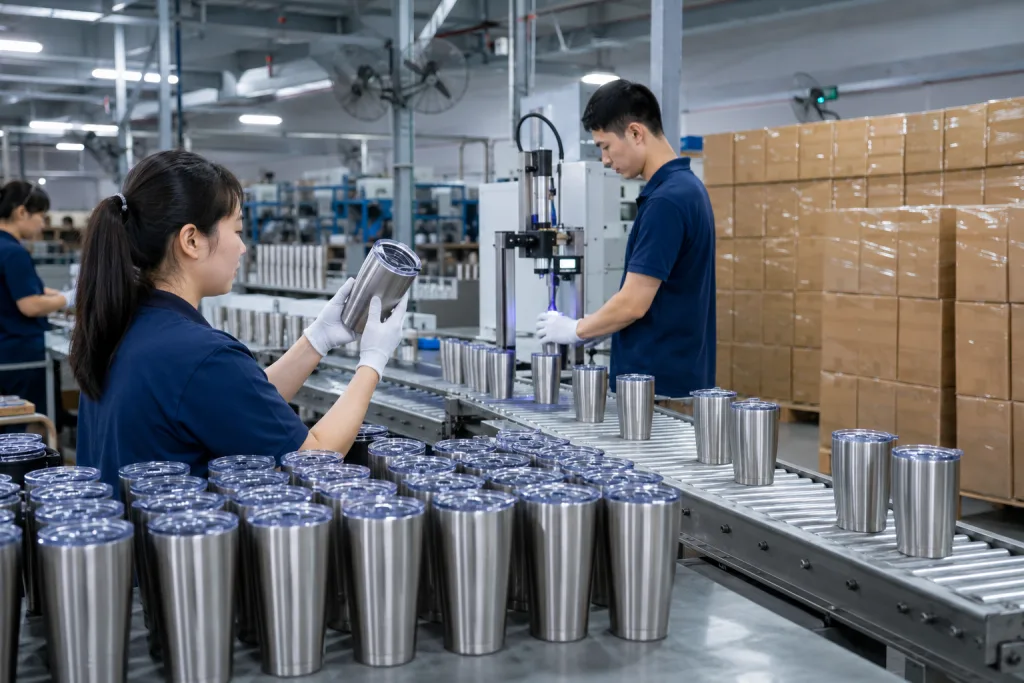
Ask for production photos from recent bulk coffee tumbler orders, not only catalog images. Catalogs sell nicely; they do not prove what happened at 10:30 on the polishing bench last Tuesday. A dependable coffee mug factory direct partner should show incoming material checks with a PMI gun or material certificate, polishing, welding, vacuum testing, coating, logo application, assembly, and final packing. If they refuse every process photo, it is not automatic fraud, but we treat it as a risk signal, especially when the order is 3,000 pcs with a custom powder coating.
For coffee brands, repeatability matters. The second order should match the first order’s color, lid fit, logo size, and carton layout. Keep one sealed golden sample in your office and require the factory to keep one in Zhejiang or at the production site in China; we label ours with the PO number because one buyer once typed “matte black” instead of “Pantone Black 6C” on a repeat order. Put the sample approval date, Pantone code, gross weight, and packaging version in the purchase order. Boring paperwork saves arguments six months later.
Build a clean RFQ package
A clean RFQ gets you sharper pricing in 24-48 hours instead of a loose “send me your catalog” reply. It also exposes weak suppliers fast, because they have to answer real details, not charm you on WhatsApp. For a coffee mug promotional order, 1 page can be enough if the logo is simple and the MOQ is 1,000 pcs. For a retail coffee mug private label line, treat it like a product spec sheet. We run quotes from a 12-field checklist on the sales desk; if capacity, finish, lid, and packing are blank, the math doesn't work.
Put the basics in one place: product type and target capacity, stainless grade and body finish, lid style and leak claim, logo method with artwork size in mm, packaging, order quantity, delivery country, compliance needs, and shipping term. If you already sell a reference mug, send caliper dimensions, weight in grams, and 4 clear photos from front, side, lid, and bottom. Do not ask a coffee mug oem manufacturer to copy protected design features. We've seen this go sideways when a buyer sent a “copy exact lid” note on the PO, then their own customer flagged the hinge shape before mass production.
Corporate-gift buyers should add the event date, required arrival date, carton sorting rules, and whether each gift needs an insert card. Coffee brands should add retail channel, barcode size and placement, dishwasher claim expectations, and spare-lid needs. Spare parts are not glamorous, but 2-3% spare lids can save a customer-service team during the first launch. QC pulled one 40 oz sample last month where the printed insert card was 3 mm too tall for the gift box, and that small miss would have slowed the line by half a day.
Here is the practical buying advice: pay attention to the supplier that asks precise questions. If they ask about cup-holder diameter, lid leak claim, coating finish, AQL level, FNSKU placement, or REACH testing, they are protecting both sides. If they only say “yes friend, best price,” you may still get a shipment, but you are doing the engineering work yourself. The buyer flagged this exact problem on a 5,000 pcs job when the base measured 78 mm, the target car cup holder needed 74 mm, and nobody asked before tooling confirmation.
BottleForge Industrial can quote standard and coffee mug customized travel tumblers from existing molds, with factory direct support for artwork checking, sample approval, production inspection, and export packing. We ship with pre-production sample photos, logo position checks against a paper ruler, and carton marks matched to the final PI. That is the support you should expect when your brand name is printed on the mug.
Send your private label mug brief for review
Share capacity, quantity, logo, packaging, and market. We will return a practical FOB quote, MOQ, sample plan, and lead time.
Frequently asked questions
What is the realistic MOQ for a private label coffee mug?
For most stainless travel tumbler projects, realistic MOQ starts at 1,000 pieces per SKU when you use an existing mold, standard lid, and available coating color. If you need custom powder coating, expect 2,000-3,000 pieces per color. If you need a special lid color, new handle, or new plastic part, MOQ can move to 5,000 pieces because injection molding and resin matching require separate production setup. For coffee mug promotional products with simple one-color logo, 1,000 pieces is usually workable. For a full retail coffee mug private label launch with printed color box, barcode labels, and carton marks, 3,000 pieces gives better unit economics and fewer setup-cost surprises.
How much should a bulk coffee travel mug cost FOB China?
A normal FOB China price range is about USD 3.20-7.80 per unit for double-wall stainless travel tumblers, depending on capacity, steel grade, lid, coating, decoration, and packaging. A 12 oz standard bulk coffee mug with one-color logo and plain box may be near USD 3.20-4.20. A 16 oz bulk coffee tumbler with 304/304 steel, powder coating, laser engraving, and printed gift box may sit around USD 4.80-6.50. Ceramic lining, premium leak-resistant lids, handles, and full-wrap artwork push pricing higher. Always compare quotes using the same specification; a USD 0.60 difference may simply mean one coffee mug supplier removed the retail box or used thinner steel.
Can you make a coffee mug custom made shape from scratch?
Yes, but a coffee mug custom made shape is a tooling project, not a normal logo order. New stainless body tooling often costs USD 2,000-8,000, depending on the curve, capacity, base, and whether the lid also needs new tooling. Development usually takes 25-45 days for drawings, tooling, first samples, adjustment, and approval before mass production starts. MOQ is usually 3,000-5,000 pieces or higher because the factory must recover setup time and stabilize the process. If you are launching a first coffee brand merchandise line, using an existing mold with custom color and logo is usually safer. Move to exclusive tooling after sales volume is proven.
Which logo method is best for coffee mug promotional orders?
For coffee mug promotional orders, the best method depends on budget and logo style. One-color silk screen is usually the lowest-cost option, often adding USD 0.08-0.18 per unit, and works well for simple logos on powder-coated mugs. Laser engraving costs more, often USD 0.20-0.45 per unit, but it is more durable and looks cleaner for executive gifts. Heat transfer is useful for full-color artwork, but it can add USD 0.45-1.20 and needs careful adhesion testing. If the mug will be used daily, avoid tiny text under 5 mm high on curved surfaces. Ask for a pre-production logo sample before approving 2,000 or 5,000 pieces.
What documents should I request from a coffee mug manufacturer?
At minimum, request a formal quotation, product specification sheet, material declaration, artwork proof, packing details, and sample approval record. For Europe, ask for food-contact test reports such as LFGB where applicable, plus REACH-related material statements. For North America, buyers often ask for FDA food-contact compliance statements and Prop 65 review if selling into California. For larger corporate buyers, BSCI, ISO 9001, or factory audit documents may be required. Also ask for an inspection standard using AQL 2.5 for major defects and AQL 4.0 for minor defects unless your channel requires stricter limits. A serious coffee mug manufacturer should provide these before shipment, not after problems appear.