Key Takeaways
- A practical private label beer growler MOQ starts around 1,000 units per color for OEM branding
- 304 stainless steel at 0.5-0.6 mm wall thickness is the normal retail-grade baseline
- FOB China pricing often ranges from USD 4.80-8.50 depending on capacity, coating, lid, and carton spec
- AQL 2.5/4.0 inspection and 7-10 day sampling prevent most avoidable launch problems
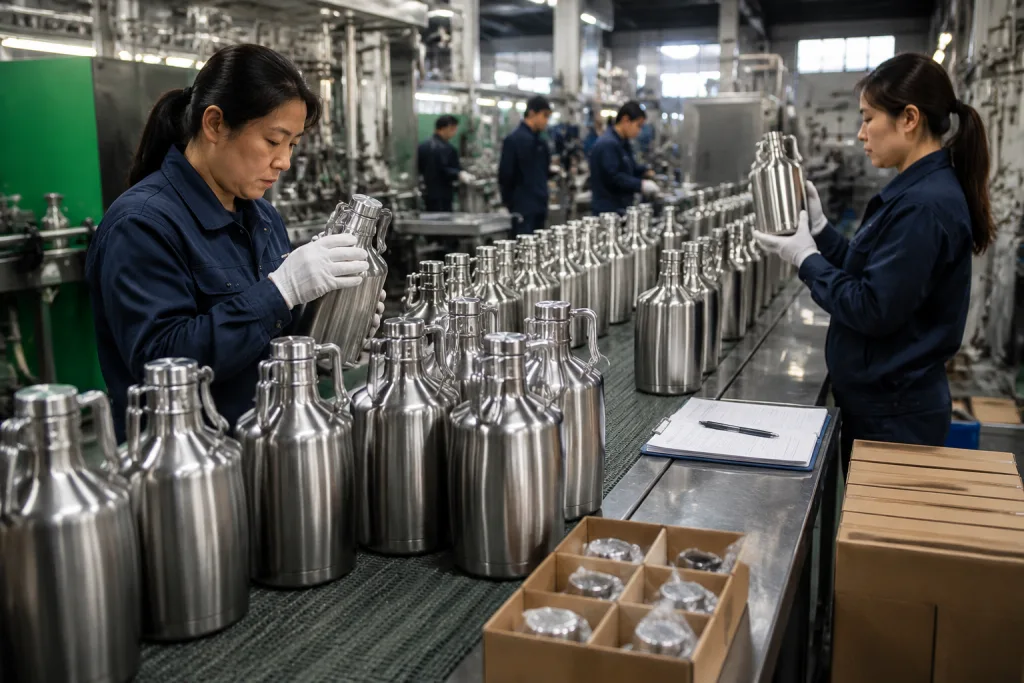
A private label beer growler looks straightforward until you start buying it in carton loads. Then the real questions show up fast: will the lid seep in transit, will the coating hold up if a retailer makes dishwashing claims, and does the logo method fit the price point? You are not buying one nice bottle. You are buying the same result on every pallet, and QC still has to pull the sample off the line at 1.2 mm wall thickness.
At BottleForge Industrial in Hangzhou, Zhejiang, we see this every week with new B2B buyers. They compare growlers by capacity and unit price, then get surprised when chargebacks and delays hit the first reorder. That is the wrong question to ask. A solid custom growler program starts with stainless grade, closure design, compliance, and an MOQ the factory can actually hold, like 1,000 pcs without pushing the line into chaos.
Start With The Use Case
Before you ask for a quote, lock down where the private label beer growler will sit and how it will be used. A brewery taproom refill growler is one job, a camping retail growler is another, and a giveaway piece is a third. We’ve seen buyers mix those up, and the order goes sideways fast.
For beer, the buyer usually pushes on oxygen pickup, odor retention, lid sealing, and a mouth opening wide enough for brush cleaning. For outdoor or distributor programs, the line cares more about dent resistance, powder coat hold, and whether the carton survives a 1.2 m drop test. If you also sell a custom canteen range, do not assume the same cap system will pass. Beer growlers get opened and closed with wet hands, cold bottles, and carbonation inside, so thread feel and gasket compression matter.
The common B2B sizes are 32 oz, 40 oz, and 64 oz. The 64 oz format moves well for breweries and outdoor retail, but a filled unit is heavy, so packaging has to be tougher. For private label orders, we usually run 304 stainless steel inside and out, 0.5-0.6 mm wall thickness, and powder coat at about 60-80 microns. That spec gives a solid customized growler without bloating the cost. QC pulled the sample at 68 microns last week, and it held up fine.
If you are a canteen distributor or growler buyer, build the spec sheet around the channel first. Retail shelf, e-commerce, brewery refill, and corporate gift all ask for different things. This is the wrong question to ask: “What is the standard growler?” The better question is, “Where will we ship it, how many pieces per carton, and what MOQ fits the channel?”
Materials Decide Your Complaint Rate
Most buyer complaints start with a spec that leaves too much room for the factory to guess. “Stainless steel growler with logo” is not a buying spec; it is a sketch. We ask buyers to write food-contact 304 stainless steel for the inner surface, silicone gasket material, coating type, capacity tolerance, lid construction, and single-wall or vacuum insulated body. On our line, QC checks wall thickness with a digital caliper at the neck and base, because a 0.15 mm difference can change dent resistance. For beer growlers, vacuum insulation usually earns its cost when the retail shelf price allows it, since cold retention is easy for customers to understand.
A normal vacuum insulated private label beer growler uses double-wall 304 stainless construction, optional copper coating between walls, and a leak-resistant screw lid. Single-wall models cost less and weigh about 80-120 g less on a 64 oz growler, but they sweat on a cold fill and give no temperature protection. We have seen this go sideways when a buyer chose single-wall to save USD 0.90, then got photos of wet picnic tables from end users. For premium customized drinkware, double-wall vacuum is the safer call.
Be careful with claims. If you print “keeps beer cold 24 hours,” you need test data and a defined test method. We run a practical internal benchmark with water starting at 4°C, tested at 20-25°C ambient temperature, with temperature recorded after 6, 12, and 24 hours. QC pulled one sample last season where the carton artwork said 36 hours but the PO said 24 hours; the buyer flagged it before mass printing, which saved roughly 3,000 color boxes from scrap. Aggressive marketing copy looks good in a deck, but the math does not work when retailers ask for proof.
For compliance, European buyers normally ask for LFGB or EU food-contact documentation, REACH for coatings, and sometimes BSCI audit records. North American buyers often ask for FDA food-contact material statements and, for kids or mixed-use drinkware, ASTM-related documentation. A canteen manufacturer in China should be able to match each document to the actual material, such as 304 stainless body, PP lid insert, silicone gasket, or powder coating. If a canteen supplier only sends a glossy catalog and avoids test reports, slow down; we ship cleaner orders when the buyer sends the compliance checklist before the first 12 pcs pre-production samples.
Branding Is More Than A Logo
Branding method changes the quote fast: cost, lead time, finish, and defect rate all move with the process. For a private label beer growler, we run 5 common options on the line: laser engraving, silk screen printing, heat transfer, water transfer, and full-body powder coating with logo application. The wrong question is “which one looks best in the mockup?” Ask which one survives packing, rubbing, and 1,000 pcs of real production without rework.
Laser engraving is durable and clean. On 304 stainless or powder-coated bodies, a 20W fiber laser gives a premium mark with low scrap, and QC usually checks depth and edge burn under a 10x loupe. It does not work if your brand needs exact Pantone color. Silk screen printing fits simple one- or two-color logos, especially flat artwork on a print area with less than 8 mm curve change across the logo. Heat transfer handles gradients and 4-color artwork, but adhesion must pass the 3M tape test, especially on textured powder coating; we have seen this go sideways when the buyer approved only a PDF proof.
For a customizable growler sold through retail, we usually recommend keeping the artwork under 70 x 90 mm for first production unless the design has already passed testing. Big prints sell well on screen. They fail more often during rubbing tests, tape tests, or dishwasher-style customer use; QC pulled one 2L sample last season where the lower-left corner lifted after 30 rub cycles. If you want a canteen customizable program with 12 SKUs, standardize the logo position across growlers, custom canteen bottles, and travel tumblers. It saves setup time and cuts artwork mistakes, including the classic PO typo where “matte black” becomes “matt black” and the box label follows it.
Private label packaging matters too. A color box, kraft box, hang tag, barcode, and master carton marks all need approval before we book carton printing. For online marketplace orders, FNSKU or carton labels must sit in the right panel area, usually within a 2 mm placement tolerance, or the warehouse rejects it. A good canteen vendor should ask for label files before mass production, not after 86 sealed cartons are stacked by the dock.
MOQ, Price, And Lead Time
For a real factory order in Zhejiang, China, the working MOQ for a private label beer growler is usually 1,000 units per color on standard shapes. If you need a new mold, custom lid, or special coating, the line usually wants 3,000-5,000 units. At BottleForge Industrial, we run about 600,000 units a month across stainless drinkware, and growlers go through welding, vacuum testing, coating, then packing in fixed batches.
FOB China pricing changes with the build. A 32 oz single-wall stainless custom growler usually sits around USD 3.20-4.60 FOB. A 64 oz vacuum insulated customized growler with powder coating, laser logo, silicone gasket lid, color box, and export carton usually lands around USD 6.20-8.50 FOB. The buyer flagged a 2 mm lid gasket once, and that small change added cost fast; copper lining, handle lids, special PMS coating, molded inserts, and retail gift packaging all move the number.
Sampling normally takes 7-10 days for a stock shape with custom logo, or 15-25 days when color matching and packaging mockups are part of the job. Mass production is usually 30-45 days after deposit and final artwork approval. QC pulled the sample on one order because the laser mark sat 3 mm off center, so we reworked it before the line went into bulk. Peak season can add 10-15 days, especially before summer retail programs and Q4 gift orders.
Do not squeeze MOQ too low and expect the same price. That is the wrong question to ask. A canteen factory can run smaller lots, but setup cost gets spread over fewer units and your inspection leverage drops. If you are testing a new distributor canteen or distributor drinkware line, cut colors first, not specs. Two colors at 1,000 units each usually beats six colors at 300 units each.
Quality Control Before Shipment
Treat quality control as part of buying the growler, not a last-minute favor from the factory. A private label beer growler can fail in 8 common places: vacuum loss, weld pinholes, rough mouth edges, leaking lids, coating scratches, logo drift, gasket odor, and cartons that crush in courier handling. We’ve seen this go sideways when the PO only says “good quality.” QC needs a clear checklist before the line starts, including lid fit checked with a torque meter and mouth edge checked by hand under a 600-lux inspection lamp.
Put AQL inspection language in the purchase order. A common setup is AQL 2.5 for major defects and AQL 4.0 for minor defects, with critical defects not accepted. For growlers, critical defects include leaks, unsafe sharp edges, rust, contamination, and wrong food-contact material. Major defects include poor logo placement, obvious coating damage, failed vacuum test, wrong packaging, or incorrect barcode. Minor defects include small visual marks within an agreed tolerance, such as a 1 mm coating speck outside the logo area. The buyer flagged this once after a PO typo listed “matte black” while the artwork file said “semi-gloss black.” The math doesn’t work if that is found after 3,000 pcs are packed.
For each production batch, ask the canteen manufacturers you are comparing to confirm the actual tests they run. Good checks are 100% leak testing, vacuum performance sampling at 95°C water fill, coating adhesion cross-hatch test, lid torque check, capacity check, carton drop test, and barcode scan test. Make them show the record sheet, not just say “passed.” For e-commerce, packaging is not cosmetic. A 64 oz growler in a weak color box can arrive dented even if the bottle left the factory perfect, so we run a 76 cm carton drop test on packed samples before release.
At our Hangzhou, Zhejiang facility, we hold sealed golden samples for production comparison and keep pre-shipment inspection records by PO number. Boring work. It protects your reorder. QC pulled the sample on one repeat order because the new lid gasket measured 0.4 mm thinner than the approved part, and that small change affected leak performance after hot filling. When you change a lid, coating, or carton, treat it as a new approval item.
Choosing The Right Supplier
The best canteen supplier for your private label beer growler is not the cheapest quote on line 17 of a spreadsheet. You need a factory team that understands custom drinkware production, export packing, compliance paperwork, and how your channel sells the item. We have seen buyers save USD 0.18 per piece, then lose the margin when QC pulled 46 growlers with loose lids from a 3,000 pcs pre-shipment lot. Catalog sellers can offer a growler. A real canteen manufacturer can repeat the same powder-coat color within Delta E 1.5, hold lid fit at 0.3 mm tolerance, and keep inspection photos tied to the PO number.
Ask blunt questions when you evaluate canteen suppliers. Who owns the tooling? Is the body formed on your line, or is it subcontracted after welding? What stainless steel grade certificate matches this batch? Can you support REACH-compliant coating with the actual paint code, not a generic PDF? What carton drop test do you run, 76 cm on 1 corner, 3 edges, and 6 faces? If mass production has a verified defect, do replacements ship in 12 days or 28 days? These questions separate a trading-only canteen vendor from a canteen manufacturer that has stood beside the vacuum tester at 9 p.m.
If you are a canteen distributor, the supplier also needs to understand assortment planning. You may need a private label beer growler, customizable canteen, sports bottle, and travel tumbler under one brand system, but this is where the math goes sideways if every SKU comes from a different workshop. We run brand sets with one Pantone master card, one packaging copy sheet, shared carton markings, and reorder lead times blocked by season. The buyer flagged it once because “matte navy” on the PO became “matt navy” on the carton artwork, and that typo made two SKUs look like separate programs.
China remains strong for stainless drinkware because the supply base is dense. Forming and welding can sit within 40 km of vacuuming, polishing, coating, lids, silicone parts, printing, and carton suppliers, so the line does not wait 10 days for one gasket revision. Zhejiang works well for export buyers because supplier density and Ningbo or Shanghai port access can cut a sample cycle from 18 days to 12 days. Still, buying on location alone is the wrong question to ask. Buy on verified capability, AQL 2.5 inspection records, and whether the factory can show you the failed sample from the last production problem.
Send Your Growler Spec For A Factory Quote
Share capacity, logo method, target MOQ, packaging, and destination port. We will return a practical FOB China quote and sampling timeline.
Frequently asked questions
What MOQ should I expect for a private label beer growler?
For an existing factory shape, expect about 1,000 units per color for a private label beer growler with logo and standard packaging. If you need a custom lid, new mold, special handle, or exclusive body profile, the MOQ often moves to 3,000-5,000 units because tooling, welding fixtures, and coating setup need to be justified. For test orders, it is smarter to limit colors instead of cutting the spec too far. For example, 2,000 units split into two colors is usually cleaner than six small color runs. Small batches below 500 units are possible only when using stock inventory, and the unit price can rise by 20-40%.
How much does a custom growler cost FOB China?
A realistic FOB China range depends on capacity and construction. A 32 oz single-wall stainless custom growler may cost around USD 3.20-4.60 with a simple one-color logo. A 64 oz vacuum insulated customized growler with powder coating, laser engraving, silicone gasket lid, color box, and export carton is more often USD 6.20-8.50 FOB. Premium upgrades such as copper lining, molded retail inserts, special PMS coating, or a custom cap can add USD 0.30-1.50 per unit. Always compare quotes line by line. If one supplier is much cheaper, check wall thickness, carton grade, lid material, and whether inspection is included.
Which logo method is best for beer growlers?
Laser engraving is the safest branding method for most private label beer growler orders because it is durable, clean, and low risk during shipping and handling. It works especially well on powder-coated stainless steel. Silk screen printing is better when you need exact brand colors, but it is more sensitive to curved surfaces, coating texture, and rubbing. Heat transfer works for multi-color artwork, but you should approve adhesion testing before mass production. For first orders, keep the logo size moderate, usually under 70 x 90 mm, and avoid wrapping artwork across welded or sharply curved areas. Ask for a physical sample, not only a digital mockup.
What compliance documents should B2B buyers request?
For Europe, request food-contact documents suitable for stainless steel, silicone, and coatings, plus REACH information for surface finishes. Some buyers also ask for LFGB test reports depending on the sales country and retailer policy. For North America, FDA food-contact material statements are common, and large retailers may add their own restricted substance list. If the growler could be marketed near children, clarify ASTM or CPSIA relevance with your compliance team. You should also ask for BSCI or similar social audit documents if your retailer requires factory-level review. Match documents to the exact materials used in your order, not a different catalog item.
How do I avoid leaks and dents in e-commerce shipping?
Start with the lid and carton, not the bottle photo. Require 100% leak testing at the factory and define the test method, such as filling with water, tightening to standard torque, inverting for 30 minutes, and checking for seepage. For dents, specify color box paper weight, inner protection, master carton strength, and a carton drop test. A 64 oz vacuum growler is heavy enough to damage itself if packaging is weak. For marketplace shipping, confirm FNSKU placement, barcode scanability, and whether the product ships in its retail box or inside an outer mailer. Spending USD 0.20-0.50 more on packaging can prevent much larger refund losses.