Key Takeaways
- A practical private label alcohol flask MOQ is usually 1,000-3,000 units per SKU
- 304 stainless steel at 0.4-0.6 mm wall thickness is the safer B2B baseline
- Laser engraving lasts longer than screen print on matte or mirror steel finishes
- Plan 7-10 days for samples and 30-45 days for mass production after approval
A private label alcohol flask looks simple until the first real PO lands. We’ve seen a 6 oz flask quoted as 304 stainless, then QC pulled the sample and found the cap thread shaved at 0.3 mm after 20 open-close cycles. Weak caps, vague steel grades, logo rub-off, and cartons that miss a distributor’s shelf size can turn a clean margin item into 48 emails about returns.
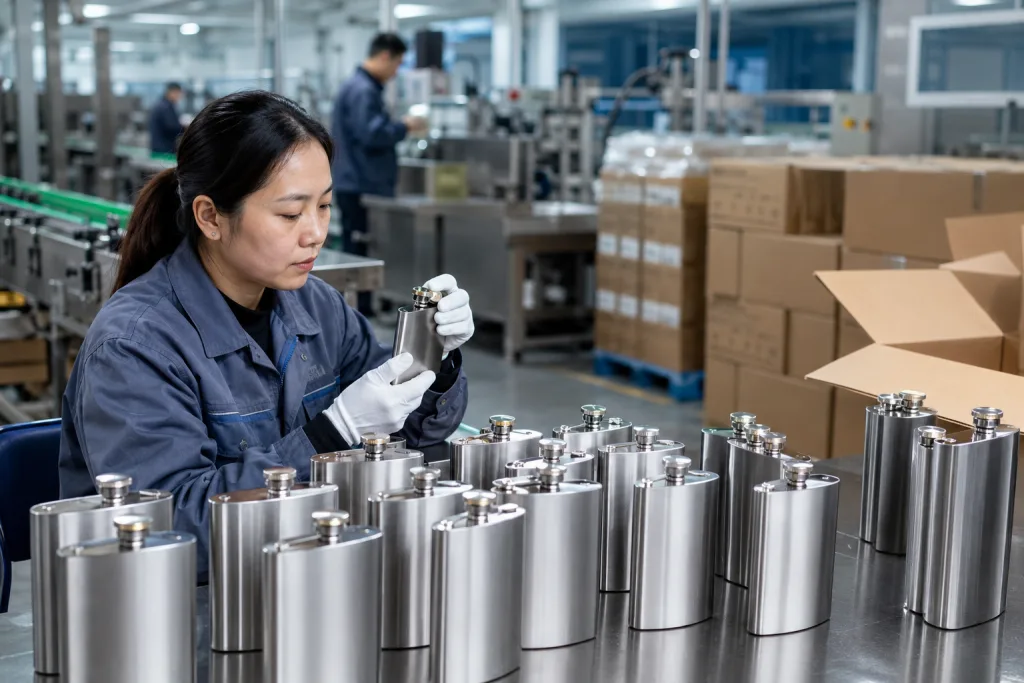
From Hangzhou, Zhejiang, we run flask programs, canteen custom orders, and small customized growler runs for buyers in Europe and North America. Fast sampling and fair pricing are possible, but the math doesn’t work if capacity, material, finish, compliance, packing, and AQL 2.5 inspection points are left open until the line starts cutting metal. Lock the spec sheet first.
Start With The Flask Use Case
Before you ask a canteen manufacturer for price, decide what your private label alcohol flask has to earn in the channel. A gift-boxed retail flask, a golf event promotional flask, and a distributor canteen program need different wall thickness, cap fit, insert tray, and carton strength. We see this go sideways when the buyer asks only for “best price”; last month QC pulled a 7 oz sample that looked fine on the bench, but the PU gift box was 4 mm too shallow for the cap.
Most B2B buyers choose 6 oz, 8 oz, or 10 oz hip flasks. The 8 oz size is the workhorse: enough capacity, still pocketable, and it fits a 165 mm gift box without making the tray feel oversized. For outdoor or heritage-style collections, a round custom canteen or canteen customized with a strap may make more sense, especially when we run a 20 mm webbing strap and a screw cap with a wider knurl. If you already sell custom growler or distributor growler products, a flask works as a lower-price add-on in the same drinkware range.
Define the sales route first. Retail needs barcode placement, shelf-ready packaging, and a cleaner surface finish, so we check the logo area under a 600-lux inspection lamp before packing. Event orders care more about logo impact and deadline certainty; the buyer flagged one PO typo where the artwork said “2025 Open” but the carton mark said “2024 Open.” Canteen promotional programs need lower unit cost and stronger cartons because the goods move through 2-4 warehouses. Canteen distributors and drinkware wholesalers need repeatable SKUs, not one-off gimmicks.
At BottleForge Industrial in Zhejiang, a typical flask line can handle about 450,000 stainless drinkware units per month across flasks, tumblers, bottles, and canteen customizable items. That number matters only when the spec is controlled. We ship cleaner when the brief includes capacity, material, finish, logo method, box style, carton drop requirement, and target MOQ; a clear file gets a stable quote in 24-48 hours. A reference photo alone creates 12 assumptions before the first sample is made, and that is where the math doesn't work.
Material And Construction Choices
For a private label alcohol flask, we start with food-grade stainless steel, not “whatever hits the target price.” We run 304 stainless steel on the inner contact surface for most export orders. Some low-cost suppliers quote 201 stainless steel to shave about USD 0.08-0.15 off a 6 oz flask, but the math doesn't work if the flask sits in a bonded warehouse for 4 months and the buyer gets rust complaints. QC pulled 32 samples from one 201 batch last year; 5 showed tea-stain marks around the welded shoulder after a salt-spray check.
Wall thickness needs a real decision. A 0.35 mm body feels light. It dents fast. A 0.4-0.5 mm wall is common for promotional and retail flasks, and it usually survives carton compression better when we ship 48 pcs per master carton. For premium programs, 0.6 mm gives better hand feel, but FOB cost and unit weight rise, so freight buyers should check the carton CBM before approving it. If you want a custom canteen or customizable growler, the thickness discussion changes because larger bodies need dent resistance, a cleaner TIG weld line, and tighter control on body roundness in mm.
The cap is where cheap factories quietly save money. Ask for cap thread engagement, gasket material, and leak test method; we like to see at least 3 full turns on the thread before sign-off. A screw cap with food-grade silicone gasket is standard. For attached caps, the hinge or retaining arm has to survive repeated opening, not just look good in the sample photo. Cheap caps can pass first visual inspection and fail after 20-30 cycles; we have seen this go sideways when a buyer flagged leaking samples after a trade show refill test. A practical factory test is 100% water leak checking for 2-3 minutes, plus random alcohol wipe testing on printed decoration.
Surface finish changes both cost and shelf impression. Mirror polish looks bright but shows fingerprints, especially after workers handle it with cotton gloves on the packing line. Brushed steel hides marks and fits corporate gifting. Matte powder coating gives stronger color range, but coating adhesion must be checked with cross-cut tape testing, commonly aligned to ISO 2409; QC normally cuts a 1 mm grid with a blade before taping. If your market requires REACH or LFGB-related material declarations, tell the canteen supplier before sampling, not after the PO. China factories can arrange testing, but it adds cost and usually 5-7 working days.
Logo Methods That Actually Last
Logo decoration is where 6 out of 10 customized drinkware projects get over-specified before anyone checks the flask body. For stainless flasks, we run laser engraving for permanent marks, silk screen printing for clean low-color logos, pad printing for small curved zones, debossing when the buyer wants a molded private label feel, or full-surface transfer on coated bodies. The right choice comes from the surface finish, MOQ, ink colors, plus the scratch abuse expected in a bar kit or gift box. The wrong question is “which logo method looks best on the mockup.” Ask what survives packing, shipping, and a buyer’s thumbnail test.
Laser engraving is the safest choice for a private label alcohol flask with a stainless or powder-coated surface. It does not peel. On our line, QC usually checks the engraving depth with a 10x loupe and rejects fuzzy edges before the carton is sealed. On raw stainless it leaves a quiet etched mark; on powder coating it cuts through to the metal underneath. For premium custom drinkware, that usually looks cleaner than a raised ink logo that starts looking tired after 200 pocket rubs.
Silk screen printing works better when you need a sharp one-color or two-color mark at a lower cost. It fits flat panels or a gentle curve, but ink adhesion lives or dies on degreasing, primer match, and oven curing time. On matte coated flasks, we test the print with 3M tape pull plus a 95% alcohol rub for 30 cycles. If the order is for canteen promotional distribution, write this into your QC checklist before production. We have seen this go sideways when the buyer flagged peeling ink after 18 days, not during the 12-day sampling window.
Embossing or debossing requires tooling, so it makes sense above 3,000-5,000 units. It gives a strong private label effect without relying on ink, but the logo plate has to match the flask radius within about 0.2 mm or the edge comes out soft. For a canteen customizable line or a customized growler program, the tooling cost is easier to defend because the same logo plate can run repeat orders. If you need variable names, regional distributor logos, or FNSKU labels for e-commerce, keep those as offline steps. Don’t slow the main line for a PO typo like “matte balck” in the artwork file.
Do not approve decoration from a digital mockup alone. Ask for a physical pre-production sample, then check logo position against a caliper mark, edge sharpness under shop lighting, color tolerance, and abrasion resistance before the order moves to mass production.
MOQ, Pricing, And Lead Time
For a private label alcohol flask, we normally quote MOQ at 1,000-3,000 units per SKU if the buyer uses our standard 8 oz or 6 oz shapes and stock powder colors. Ask for a new mold, custom cap, stitched leather sleeve, or canteen customized body shape, and the MOQ moves to 5,000-10,000 units because the line loses 2-3 hours on setup and first-piece adjustment. Trial orders can run, but the math does not work well: at 500 pieces, the logo screen, color change, and carton setup get spread across too few units. Last month QC pulled the sample on a 1,000-piece flask order because the logo sat 2 mm off center after the buyer changed artwork twice.
As a rough FOB China range, a basic 8 oz stainless flask with one-color logo and white box may land around USD 1.20-2.10 per unit at 3,000 pieces. A powder-coated flask with laser logo, funnel, and color gift box may sit around USD 2.20-3.80. Premium sets with cups, leatherette wrap, or rigid packaging can exceed USD 5.00. These are working ranges, not a quote. Steel price can move USD 80-120 per ton, packaging board thickness changes carton cost, and AQL 2.5 inspection adds labor on the packing table. We also check PO details hard; one buyer typed “matte black” in the email and “gloss black” on the PO, and the buyer flagged it only after pre-production samples were sealed.
Plan lead time honestly. Sampling takes 7-10 days for standard shapes, or 12-18 days if we need a new powder color panel or special packaging dieline. Mass production is normally 30-45 days after sample approval and deposit. Add 7 days if you need third-party lab testing for REACH, LFGB, or FDA food contact migration documentation. Before Q4 promotional campaigns, the polishing and powder-coating lines fill up fast; we have seen orders slip from 35 days to 48 days because artwork approval sat with the buyer for 6 days.
Payment terms are commonly 30% deposit and 70% balance before shipment for new buyers. Long-term canteen distributors or distributor drinkware accounts may negotiate credit terms after 3-5 stable orders, but factories rarely offer that on the first PO. If a canteen vendor promises very low MOQ, full customization, and below-market pricing at the same time, this is the wrong question to ask. Ask what got removed. It is often 304 stainless thickness, QC time at final inspection, 5-layer export carton strength, or after-sales responsibility when a cap leaks in the buyer’s warehouse test.
Compliance And Inspection Standards
Compliance cannot sit in the last email before shipment. For alcohol flasks entering Europe or North America, we confirm food contact safety, coating safety, and retail packaging marks before we open the mass-production work order. For EU buyers, REACH, LFGB, and general food contact declarations often get requested. For the US, FDA food contact expectations and California Proposition 65 screening come up with chain stores, Amazon sellers, and gift-box programs; last March, QC pulled a 304 stainless hip flask sample because the black coating report did not mention the printed ink layer.
Ask your flask factory or flask suppliers for test reports on the exact material and coating you are buying, not a similar bottle from two years ago. Check the material name, test item, standard, lab, date, and sample description line by line. A report for a plain stainless bottle does not cover a powder-coated flask with printed ink and a silicone gasket. We have seen this go sideways: one buyer approved “matte navy” on the PO, but the lab sample description said “blue painted vacuum bottle,” so their retailer rejected the file before production even reached 500 pcs.
Inspection should use AQL, not a quick warehouse look. A common setup is AQL 2.5 for major defects and 4.0 for minor defects, with critical defects set at 0. Critical defects include leakage, sharp edges, metal dust inside the flask, broken glass-like packaging parts, or wrong compliance labeling. Major defects include dents over 1.0 mm, poor cap fit, unreadable logo, and color mismatch outside the approved tolerance; on the line we run a 30-second leak test, and one loose cap thread can fail a whole carton pull.
For each production lot, define the checks in writing: capacity test, leak test, cap torque, logo rub test, coating adhesion, carton drop test, barcode scan, and packing quantity. If the goods go to Amazon FBA or another e-commerce warehouse, carton size, gross weight, suffocation warning, FNSKU, and outer carton labels must be right before shipment. This is the wrong place to save 2 hours. Fixing labels in a US or EU warehouse can cost USD 0.35 to 0.80 per unit, while our Zhejiang packing line can re-label 3,000 gift boxes before loading if the buyer flags it before the container truck arrives.
Packaging For Retail And Distribution
Packaging is a margin decision, not decoration. A private label alcohol flask going into retail needs a box that protects the brushed surface, carries the brand story, and scans cleanly at receiving. We had one buyer flag a 13-digit barcode because the quiet zone was squeezed by 2 mm on the side panel. A flask shipped as a canteen promotional giveaway can often run in a white tuck box and master carton. A distributor canteen program may need both: plain inner boxes for wholesale orders and gift boxes for 20-30 key accounts.
The basic packaging structure is polybag, white box, and export carton. For a stronger retail feel, we run a 300-350 gsm color box with an insert card, usually checked against the dieline before mass print. For premium gift sets, a rigid box or EVA insert looks sharp but adds freight volume fast. Do the cube math. A USD 0.35 packaging upgrade is the wrong choice if it adds 18% to ocean freight volume and turns a 40HQ plan from 12 pallets into 15 pallets.
Carton strength should match the route. For export, we usually recommend 5-ply corrugated cartons for flask orders, especially when the goods pass through distributor warehouses and get restacked twice. A typical master carton may hold 50 or 100 units depending on packaging. Keep gross weight under 15-18 kg where possible; warehouse teams hate cartons that are heavy and easy to crush. QC pulled one sample carton at 19.6 kg last season, and the corner failed after a basic drop check. For glass-bottle or customized growler programs, the carton rules get tighter because breakage risk rises.
Labeling is another detail buyers underestimate. You may need SKU, PO number, carton number, country of origin, barcode, FNSKU, recycling marks, and importer information, but each mark needs a fixed position on the carton layout. Confirm whether “Made in China” must be printed on the product, box, or carton for your market. Settle it during artwork approval. We have seen this go sideways when a PO had the importer name spelled one way and the carton mark file used another, which cost 2 days of relabeling before shipment.
Choosing The Right Factory Partner
The best canteen manufacturer is not always the one with the lowest spreadsheet price. We’ve seen a 3-cent saving disappear after QC pulled 42 pieces with sharp mouth burrs under a 0.05 mm feeler gauge. You need a canteen supplier that knows metal forming, welding, polishing, coating, decoration, packing, and export paperwork as separate control points, not one vague “production” box. For a private label alcohol flask, small defects show fast because the buyer holds it near the hand and face. One crooked logo at 1.5 mm off-center makes the item feel cheap.
Ask direct questions. How many units per month can the line run on this body shape, 50,000 or 120,000? What is the MOQ by laser logo versus silk print? Is 304 stainless used for the full body or only the inner surface? What AQL level is standard? Can the factory provide BSCI audit status, ISO 9001 process controls, or recent material test reports? Canteen vendors that answer with line capacity, fixture photos, and inspection limits are easier to work with than canteen manufacturers that only say “no problem.” That phrase is not a control plan.
Check communication discipline before you pay the deposit. A good factory confirms drawings, Pantone colors, carton marks, and packing method on one spec sheet, then stamps the sample tag with SKU and date. A weak factory waits until the line starts, then asks urgent questions about lid color or logo size. We’ve seen this go sideways on customized canteen, customizable canteen, and customizable growler orders: delivery moved from 12 days to 18 days because the PO said matte black, while the artwork file said Pantone 426C. If you are building a repeat line, choose a partner who keeps samples, artwork files, and QC records by SKU.
BottleForge Industrial works from Hangzhou, Zhejiang, with production partners across China for stainless steel drinkware, flasks, canteens, tumblers, and growlers. We run samples with calipers on the mouth diameter, tape tests on coating, and carton drop checks at 12 kg when the packing needs it. Our practical advice is simple: pay for a proper sample, approve a written spec sheet, and inspect against that sheet. Chasing the lowest FOB price sounds smart in a sourcing meeting, but the math doesn’t work when returns, chargebacks, and awkward distributor calls land after shipment.
Send Your Flask Spec For A Factory Quote
Share capacity, logo method, quantity, packaging, and destination. We will return practical MOQ, FOB pricing, and sampling lead time.
Frequently asked questions
What MOQ should I expect for a private label alcohol flask?
For standard flask shapes, expect 1,000-3,000 units per SKU as a normal MOQ from a China canteen factory. If you need only laser engraving on an existing 8 oz body, 1,000 pieces may be workable. For powder coating, custom color, gift box, or multiple logo positions, 3,000 pieces is more realistic. New mold work, special caps, leather sleeves, or fully customized canteen shapes often require 5,000-10,000 units. Below 1,000 pieces, you may still get a supplier to accept the order, but setup cost, logo cost, and packing labor will push the unit price up sharply.
Is 304 stainless steel necessary for alcohol flasks?
For B2B private label alcohol flask programs, 304 stainless steel is the safer baseline because it has better corrosion resistance than 201 stainless steel. Alcohol itself is not extremely aggressive, but buyers may store spirits for long periods, and residue, cleaning chemicals, or humid storage can expose weak material. We normally recommend 0.4-0.5 mm wall thickness for standard retail or promotional flasks, and 0.6 mm for premium programs. If a canteen vendor quotes far below market price, ask whether the body is 201 or 304 stainless and request material documentation before sampling.
Which logo method is best for a flask?
Laser engraving is the most durable choice for stainless or powder-coated flasks because it does not peel or wash off. It works well for premium customized drinkware and private label orders where long-term appearance matters. Silk screen printing costs less and gives stronger solid color, but it needs proper ink curing and adhesion testing. For orders above 3,000-5,000 units, debossing or embossing can create a stronger brand effect, especially for custom canteen or customized growler lines. Always approve a physical sample and test the logo with tape pull and alcohol rub before mass production.
How long does production take after I approve the sample?
For a standard private label alcohol flask, plan 7-10 days for sampling and 30-45 days for mass production after sample approval and deposit. If the order includes new powder color, special packaging, lab testing, or multiple distributor drinkware SKUs, add 5-10 working days. Third-party testing for REACH, LFGB, FDA-related food contact, or Prop 65 screening usually takes about 5-7 working days after the lab receives samples. During September to November, many China factories are busy with holiday and promotional orders, so earlier booking is the safer choice.
Can one supplier handle flasks, canteens, and growlers together?
Yes, but confirm the supplier’s real production scope. Some canteen suppliers only trade products from different workshops, while stronger canteen manufacturers control or closely manage metal forming, coating, printing, and packing. Combining a private label alcohol flask with canteen customizable products or a custom growler range can reduce communication work and make branding more consistent. The risk is mixed quality if the vendor does not use the same QC standard across SKUs. Ask for one shared spec sheet format, AQL 2.5/4.0 inspection, matching Pantone standards, and carton label rules for every item in the program.