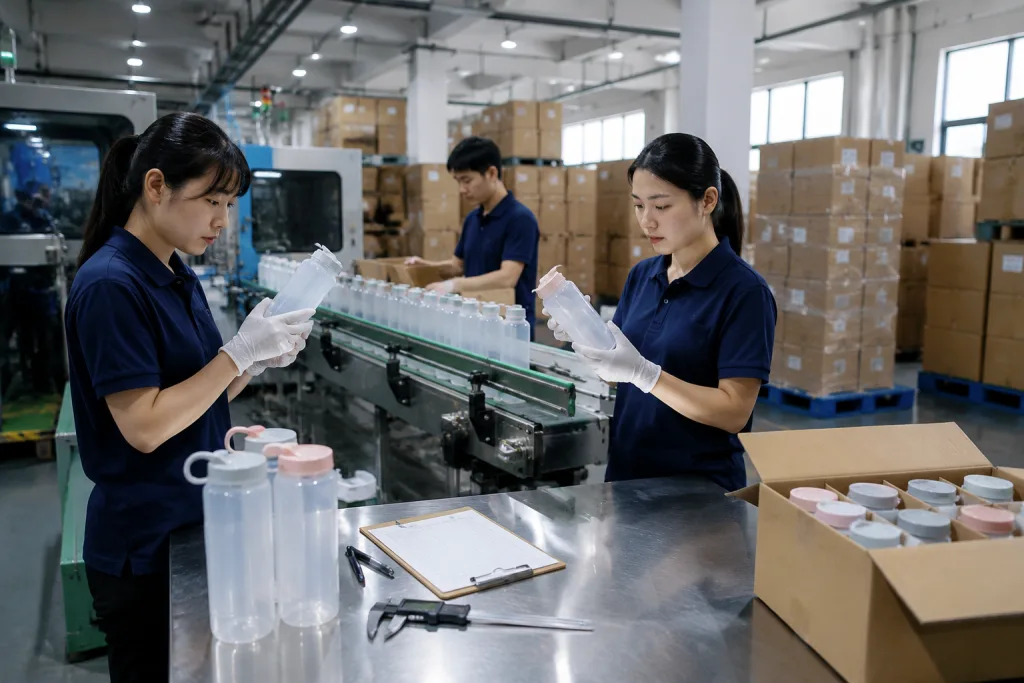
Key Takeaways
- A practical MOQ for custom PP bottles is usually 3,000-5,000 pcs per color, with 25-35 days production after approval
- Food-contact PP should be checked against LFGB, FDA, REACH, or EU 10/2011 depending on your market
- Cap tooling, silicone gaskets, and color matching often create more risk than the PP bottle body
- AQL inspection at 2.5/4.0 is a basic requirement for wholesale drinkware orders, not an optional extra
If you are sourcing pp water bottles wholesale, finding 30 suppliers on Alibaba is easy. The hard part is knowing which factory can hold the same Pantone shade after 8,000 pcs, keep the cap thread within 0.2 mm, control PP odor after hot-water rinsing, place the logo 18 mm below the shoulder, and still ship before your retail DC slot closes. PP is not expensive. Bad PP is. We’ve seen this go sideways when QC pulled the sample from carton 7 and the flip cap leaked after a 1.2 m drop test.
From our Hangzhou, Zhejiang export desk, we see buyers run PP bottles beside stainless tumblers, bulk canteen orders, beer tumbler bulk programs, and seasonal wholesale drinkware launches. The sourcing logic is close, but the wrong question is “who has the lowest FOB China price?” Start with the use case, lock the spec sheet, test before mass production, then price the landed product with carton CBM, inner bag rules, barcode label cost, and the 12-day sea booking gap we often see before peak season. Last month, one buyer flagged a PO typo: “PP 450 ml” on page 1, “500 ml” on page 3. That mistake would have stopped the line.
Start With The Use Case
PP water bottles sell well in drinkware wholesale because they are light, take daily knocks, and cost less than Tritan or stainless steel. Do not buy them as a generic bottle. This is the wrong question to ask. A school bottle that rides in a backpack, a gym bottle squeezed between machines, and a bicycle bottle sitting in a cage need different PP resin flow, cap sealing, and wall thickness; last month QC pulled a 600 ml sample at the line and found the shoulder was 0.78 mm on one side, which would not pass our drop check.
For most PP bottle programs, we start with three numbers: capacity, target retail price, and expected drop environment. A 500 ml school bottle may use a 1.0-1.2 mm wall and a flip lid with a lock. A 750 ml sports bottle may need a larger drinking spout, a 1.2-1.5 mm wall, and a carry loop that survives 5 kg pull testing on a digital force gauge. A 1 L bulk canteen or canteen wholesale item may need a wider mouth, stronger shoulder radius, and a cap that opens with gloves; we run the first-shot check with a 0.02 mm caliper before the mold trial report goes to the buyer.
Be careful when a supplier says one mold can cover every channel. That is sales talk, and we have seen it go sideways. If your buyer wants the best wholesale drink bottle for a retail shelf, the grip feel, color finish, lid click noise, and 24 pcs carton presentation all get checked. If you are buying drinkware bulk for a corporate event, unit price and pad-print speed usually decide the job; one buyer flagged us over a PO typo that changed “logo 45 mm” to “logo 54 mm.” If you also source growler wholesale, alcohol flask bulk, or beer growler bulk, keep those programs on separate spec sheets. PP is normally for water and cold beverages, not carbonated beer storage or alcohol contact unless the design and compliance file support it.
Know The Material Limits
Polypropylene is a practical resin, not a thermos wall in disguise. Standard food-grade PP is fine for cold drinks and short warm-water contact, usually around 80-100°C depending on the resin grade, wall thickness, and cap structure. We run 600 ml samples with 2.2-2.6 mm body walls, and QC checks deformation after hot-fill trials with a digital caliper. Boiling-water safe? Wrong question unless the test backs it up. If your product page says boiling-water safe, dishwasher safe, freezer safe, or microwave safe, ask for the report before you print the carton artwork.
For Europe, ask for LFGB or EU 10/2011 food-contact testing on the actual material color, not only a generic natural PP chip. For North America, FDA food-contact compliance is common. REACH may apply to coatings, pigments, inks, or accessories. If the bottle is for children, you may also need ASTM, CPSIA, EN 71, or small-parts review depending on age grading. We had a buyer flag a PO once because the lid was listed as “PP” while the lab report showed a silicone gasket and PE straw; that mismatch delayed shipment by 6 days. A Zhejiang factory that exports regularly should discuss these documents before sampling, not after mass production.
Odor control is a real issue. PP can pick up smell from cheap masterbatch, recycled resin, dusty workshops, or cartons stored beside ink and glue. For wholesale drinkware, we normally specify virgin PP for food-contact parts, silicone gaskets with proper migration testing, and no recycled resin unless the buyer approves the exact claim and standard in writing. On the line, QC pulled 32 bottles from a 5,000 pcs pilot run last spring because the blue pigment left a waxy smell after 24 hours in a sealed carton. For transparent bottles, PP will never look as glass-clear as Tritan. If your brand wants a premium clear bottle, do not force PP into a job it does not do well.
Price The Full Bottle
For pp water bottles wholesale quotes, do not stop at the body price. Price the full bottle. On our line, the cap often takes 20-40% of the finished cost when it has a flip button, safety lock, silicone straw, carry handle, or 304 stainless pin. We have seen a USD 0.06 “saving” turn into leakage claims because QC pulled the sample and found a 1.2 mm gasket instead of the 1.8 mm spec, plus a hinge that loosened before 200 open-close cycles.
As a rough China FOB range, a basic 500-750 ml PP bottle with one-color silkscreen may land around USD 0.85-1.60 per piece at 5,000 pcs, depending on gram weight, cap structure, packing, and logo area. A sports bottle with a button lid and straw usually sits around USD 1.80-3.20. Custom mold work can cost USD 2,000-8,000 for a simple PP bottle set, and the bill climbs fast when the cap needs sliders, springs, or a metal pin. Resin cost, RMB/USD rate, 5-layer carton spec, and AQL 2.5 inspection level all move the number; the math does not work if a supplier quotes low and still promises thicker PP, retail box, and free testing.
For procurement, build the quote table line by line: bottle body weight, lid, gasket, straw, logo, Pantone color matching, inner bag, retail box, master carton, testing, inspection, and freight. We run the same table for wholesale canteen, growler bulk, beer tumbler wholesale, and alcohol flask wholesale bulk programs because buyers often flag the missing carton cost only after the PO is typed. FOB Ningbo or Shanghai is common for Zhejiang and nearby China factories. If you need DDP, ask the supplier to split product cost from freight and duty assumptions; we have seen reorders go sideways when the first DDP price hid USD 0.18 per piece in “free” freight margin.
MOQ And Lead Time Reality
For an existing PP bottle mold, we usually quote MOQ at 3,000 pcs per color for a one-position logo, and 5,000 pcs per color when the order needs custom Pantone resin, retail box packing, or two lid colors on the same bottle. Yes, 1,000 pcs is possible with some suppliers. The math often does not work. You may get a mold already on the line, stock blue or clear resin only, a USD 80-150 screen setup charge, and no firm slot on the injection machine schedule. For a new mold, 10,000-20,000 pcs is the cleaner first production commitment; below that, the tooling cost per bottle makes buyers push back after they see the PI.
At BottleForge Industrial in Hangzhou, Zhejiang, we run about 350,000 units/month across mixed plastic and stainless drinkware projects, and PP bottle slots are planned 2-4 weeks ahead in peak season. Our planner checks this on the machine board, not from a sales guess. Sample lead time is usually 7-12 days for existing molds with logo, 20-30 days for new tooling samples, and mass production is commonly 25-35 days after sample, deposit, artwork, and packaging files are approved. Add 3-5 days for final inspection and shipment booking. QC pulled one 650 ml PP bottle sample last month because the logo was 2 mm off-center, so sample timing is not just waiting for a courier tracking number.
Do not approve a delivery date before the artwork and test plan are locked. We have seen this go sideways. A common mistake is placing a drinkware bulk order, then changing the lid color, barcode, FNSKU label, or carton mark after production starts; that change can burn 5-10 days before anyone notices the launch calendar is broken. Last quarter, the buyer flagged a PO typo where “matte black lid” became “match black lid,” and the carton mark file still showed the old SKU. If your launch includes canteen bulk, wholesale growler, beer growler wholesale bulk, or beer tumbler in bulk items alongside PP bottles, schedule the longest-lead item first and consolidate shipment only if the delay risk is acceptable.
Logo And Packaging Choices
PP bottles take logos, but PP has lower surface energy than stainless steel or glass. Ink adhesion needs flame or corona treatment before printing, then a quick check on the line. For basic wholesale drinkware, one-color silkscreen is still the safest choice. It is cheap and fast. We run it best on a flat panel or a soft curve, usually with a 45 mm x 70 mm logo window on a 650 ml bottle. Heat transfer gives more color detail, but QC should pull the sample for rub testing before anyone promises a dishwasher claim. In-mold labeling looks sharp once the mold is locked, but the math doesn't work for a 3,000 pcs trial order.
For logo durability, ask for a 3M tape test, 50-cycle wet rub test, and alcohol rub test if your product will be used in gyms or outdoor retail. We had one buyer flag a gym bottle because hand sanitizer softened a blue logo after 28 rubs, so we changed ink and re-tested before shipment. Laser engraving is not relevant for most PP bottle bodies, although it can apply to stainless accessories in a mixed bulk drinkware program. If you sell online, keep the logo position consistent within ±1.5 mm if possible, because crooked branding shows up badly in product photos. QC should check this with a printed jig, not by eye.
Packaging should match the sales channel. For B2B promotional orders, a polybag and export carton may be enough. For retail, use a white box or color box with a barcode, warning text, capacity, material mark, and country of origin. For Amazon-style prep, confirm FNSKU placement, suffocation warning, carton drop test, and master carton weight under 15-18 kg where possible. We ship safer when a master carton stays near 14.5 kg, because crushed corner claims start rising above 18 kg. The same packaging logic applies to alcohol flask wholesale and beer tumbler wholesale bulk programs, but food-contact claims and age warnings may differ.
Quality Control Before Shipment
A PP bottle usually fails in plain places: cap leak after 30 seconds upside down, straw cut 3 mm short, flashing on the mouth, black resin dots, color drift, warped body, loose hinge, weak carry loop, poor print adhesion, or a carton that crushes at the bottom row. We see 8 to 12 of these issues in a normal first-article review, not because the line is careless, but because PP shrinkage and lid fit move fast when the mold temperature changes. QC pulled one 650 ml sample last month with a 0.4 mm burr on the drinking lip. Small burr. Big complaint.
Use a golden sample signed by both sides, then lock the spec in the PO. State capacity tolerance, bottle weight tolerance, wall thickness range in mm, Pantone reference, logo size, print position, gasket material, lid torque or fit requirement, packing method, and acceptable defect standard. AQL 2.5 for major defects and 4.0 for minor defects is a common baseline. For high-risk retail programs, we run 100% leak testing on the factory line, then random leak testing during pre-shipment inspection, usually 80 to 125 pcs depending on lot size. The wrong question is “does it look okay?” The better question is whether a 6 kg carton survives stacking, scanning, and one corner drop without the buyer flagging it.
Ask for photos and 15-second videos during production, but do not count them as inspection. A third-party or buyer-appointed final random inspection should check function, appearance, barcode scanning, carton size, gross weight, and drop-test result. For China export orders, confirm HS code, material declaration, test reports, commercial invoice, packing list, and shipping marks before the container leaves Ningbo or Shanghai. We have seen this go sideways over one PO typo: “PP botle” on the packing list did not match the invoice, and customs held the mixed wholesale drinkware, canteen wholesale, and growler wholesale shipment for 4 days. A missed document can cost more than 200 defective bottles.
Choose The Supplier Carefully
The best supplier for pp water bottles wholesale is rarely the lowest-quote PP injection shop. Cheap can get expensive fast. You need a factory that understands export tolerances, food-contact paperwork, carton drop-test risk, and repeat-order color control. Ask whether the factory is audited under BSCI, Sedex, ISO 9001, or a retailer-specific program if your customer requires it. If they say yes, request the current certificate and audit scope, not a cropped JPG from 2021. On our line, QC checks mouth diameter with a digital caliper; a 0.4 mm drift can make the flip lid feel loose. Trading companies can work, but you still need the production address, workshop photos, and who signs the quality file.
During supplier screening, ask for three recent examples: one PP sports bottle, one retail packed bottle, and one mixed bulk drinkware shipment. Review how they handled color matching, inspection, and shipment. A serious supplier can show Pantone approval notes, AQL 2.5 findings, and at least 2 shipment records with carton counts matching the packing list. If they also offer beer growler wholesale, alcohol flask wholesale, beer tumbler bulk, or wholesale growler products, check whether those items are made in the same facility or sourced from partners. Mixed sourcing is fine if they say it clearly. It goes sideways when a buyer flags a leaking cap and no one knows which partner molded it.
For a first order, keep the design controlled. Use an existing mold, one bottle color, one logo method, and one carton style. We usually tell buyers to start with 3,000 pieces per color before pushing 8 SKUs into one PO. After the first production run proves stable, expand to more colors or a private mold. Less exciting, better math. Zhejiang and broader China supply chains are strong for drinkware wholesale because component suppliers, mold shops, packaging printers, and Ningbo/Shanghai logistics sit close together; a new insert can reach the line in 2 days instead of 7. Use that advantage, but write the spec like the factory has never seen your brand before, down to carton size, barcode position, and whether “PP bottle” was misspelled on the PO.
Send Your PP Bottle Spec For Factory Review
Share capacity, target price, logo, market, and launch date. We will return MOQ, tooling, compliance, and lead-time options without guessing.
Frequently asked questions
What MOQ should I expect for pp water bottles wholesale?
For an existing mold, expect 3,000 pcs per color as a workable starting MOQ, and 5,000 pcs per color if you need custom Pantone material, retail box packaging, or several lid components. Some factories in China may quote 1,000 pcs, but the unit price can rise by 15-35% because setup, color change, and printing losses are spread over fewer pieces. For a private mold, budget for 10,000-20,000 pcs over the first production cycle, plus tooling cost. If you are testing a new channel, start with one color and one logo method before adding more SKUs.
Are PP water bottles safe for Europe and North America?
They can be, but only if the material, pigment, gasket, ink, and packaging claims are controlled. For Europe, ask for LFGB or EU 10/2011 food-contact testing and REACH review where relevant. For the United States, FDA food-contact compliance is common, and children’s products may also need CPSIA or ASTM review. Do not rely on a generic resin certificate from 3 years ago. Testing should match the actual color and food-contact parts used in your order. If the bottle includes silicone, straw, or printed measurement marks, those parts should be included in the compliance file.
How long does a custom PP bottle order take?
For an existing mold with logo, plan 7-12 days for samples and 25-35 days for mass production after approval and deposit. Add 3-5 days for final inspection, carton correction if needed, and vessel or air booking. A new mold usually adds 20-30 days before the first tooling sample, then another adjustment round if the cap fit, capacity, or surface finish needs correction. During peak China export periods before summer and Q4, book production 2-4 weeks earlier. Artwork changes, late barcode files, or packaging revisions can easily add 5-10 days.
Can I combine PP bottles with canteen or growler products?
Yes, but treat each product family separately in the spec. A wholesale canteen, beer growler in bulk, beer tumbler wholesale, or alcohol flask in bulk may use stainless steel, glass, or other materials with different testing and packaging needs. You can consolidate shipment from Zhejiang or other China production areas, but do not force one inspection checklist across all items. For example, PP bottles need cap leak testing and odor checks, while a bulk growler may need coating adhesion, vacuum or seal checks, and different food-contact documentation. Mixed cartons are usually avoided unless the distributor specifically requests them.
What defects should I check before shipment?
Focus on leaks, cap fit, gasket placement, odor, color difference, black dots, flashing around the mouth, sharp edges, warped bodies, incorrect capacity marks, weak hinges, and poor logo adhesion. For a normal drinkware wholesale order, use AQL 2.5 for major defects and 4.0 for minor defects. Ask the inspector to fill bottles, invert them for at least 30 minutes, test several open-close cycles, scan barcodes, and check carton drop performance. If the order is retail packed, verify country of origin, warnings, capacity, material marking, and FNSKU or EAN labels before the goods leave the factory.