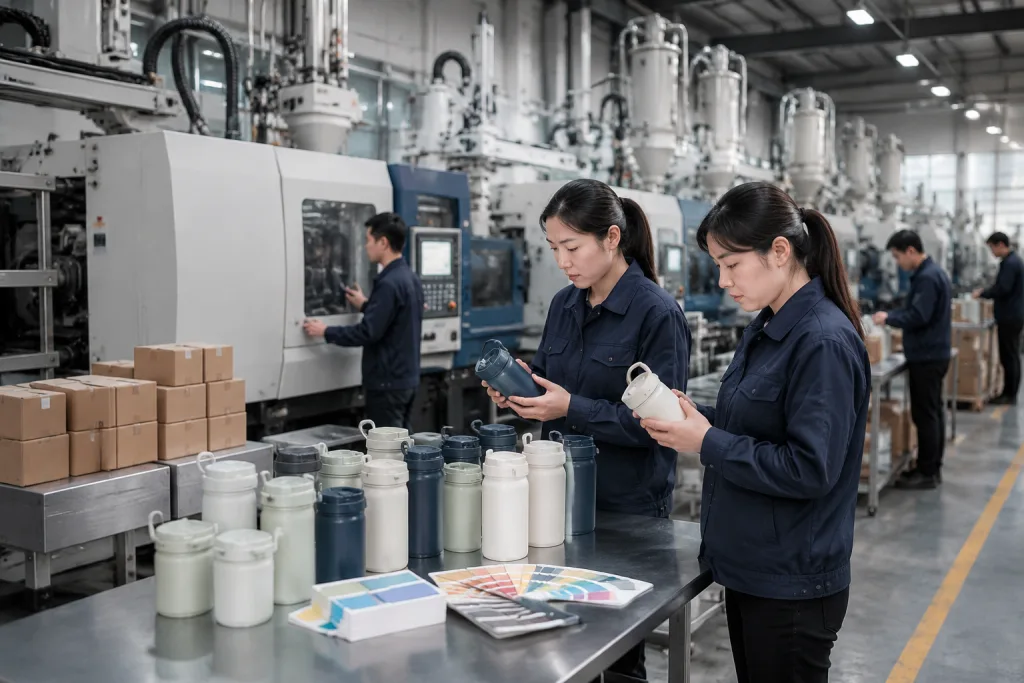
Key Takeaways
- A realistic MOQ for custom PP canteens is usually 3,000-5,000 pcs per color
- Food-grade PP should be checked against LFGB, FDA, REACH, or market-specific rules
- New private molds can take 25-40 days before mass production starts
- AQL inspection and leak testing cost less than one rejected container
Buying from a pp water bottles factory looks simple until the quote sheets land. One canteen supplier shows USD 0.42 FOB Ningbo, another hides a USD 1,200 mold charge in the PI, and a third skips resin grade, leak test pressure, and 5-layer carton drop height. Bad sign. If you are building a retail line or distributor drinkware program, those small lines decide whether the order makes money after QC pulled the sample and found 3 caps leaking out of 50.
We manufacture custom drinkware in Zhejiang, China, and we see 11 repeat buying mistakes most months: chasing the cheapest canteen factory, signing off a soft T0 sample, and leaving the color box dieline until the last 7 days. PP canteens work well, but the math doesn't work if material, tooling, printing, inspection, and logistics are treated as separate jobs. On the line, we run melt-flow checks, caliper the wall at 1.8 mm, and flag PO typos like “matte blue” in the email but “gloss blue” on the artwork approval.
What PP Canteens Are Good For
PP, short for polypropylene, will not give the shelf look of stainless steel or borosilicate glass. That is the point. We see roughly 6 out of 10 B2B canteen inquiries choose PP because it is light, impact-resistant, low cost, and better for sports days, school packs, outdoor kits, military-style promos, and canteen giveaways where the buyer needs 20,000 pcs more than a luxury feel. On the line, a PP body that drops from the 90 cm QC bench usually survives with only a scuff.
A typical PP canteen weighs 70-140 g depending on capacity and wall thickness. For a 600 ml to 1,000 ml custom canteen, a sensible wall thickness is usually 1.2-1.8 mm. Go thinner and the bottle can deform during hot filling, 5-layer carton stacking, or 38°C summer warehouse storage. Go too thick and the math does not work; one buyer asked for 2.4 mm walls, and the resin cost pushed the FOB up by 8% with no real field benefit. Our caliper check starts at the shoulder, not the flat side.
PP handles normal drinking water well, but do not sell it as a thermos or hot-water bottle. Most PP resin can tolerate around 100°C in short contact, but lids, gaskets, prints, and colorants do not always behave the same way. If your market needs dishwasher-safe claims, microwave use, or boiling-water instructions, ask the canteen manufacturer to validate the full assembled product, not only the raw resin. QC pulled one sample after the black lid gasket warped 0.7 mm in a heat test, while the bottle body still looked fine.
For buyers, PP is strongest in these programs:
- Promotional orders: events, clubs, schools, outdoor campaigns, and charity kits where MOQ starts around 3,000 pcs per color and the logo area matters more than gift-box weight.
- Distributor canteen lines: basic SKUs with stable colors, repeat replenishment, and carton labels that match the warehouse barcode system.
- Custom drinkware sets: bundles with straps, carabiners, lunch boxes, or sports accessories, checked on a packing table with a 1-set master sample beside the workers.
If you want a high-margin retail item, PP can work, but this is the wrong question to ask if the design still looks like a giveaway. The design needs clean mold texture, tight color matching, and a logo centered within 1.5 mm. Simple sells. We ship better PP canteens in printed color boxes with a PE bag folded flat, because the buyer flagged loose bags in 2 cartons during a pre-shipment inspection. A poor canteen looks like landfill on arrival.
Factory Capability You Should Verify
A real pp water bottles factory should be able to name the press, show the mold plate, explain how the lid gasket is seated, and walk you from raw PP resin to carton sealing. No foggy sales talk. If a canteen vendor cannot give you the cavity count with output per 10-hour shift, or cannot say injection molding versus blow molding, you are probably talking to a trading desk instead of the line engineer. We run 8-cavity cap molds on the injection floor, and QC pulled one sample last month because the thread height was 0.3 mm short.
At BottleForge Industrial in Hangzhou, Zhejiang, our PP drinkware lines support about 180,000-260,000 plastic bottle and canteen units per month depending on model mix. Standard MOQ starts at 3,000 pcs for existing molds and 5,000 pcs per color for fully customized drinkware. Normal sample lead time is 7-10 days for logo samples, while mass production is usually 25-35 days after deposit and artwork approval. For one 500 ml bottle order, the buyer asked for 18 days; the math did not work because the color masterbatch approval alone took 3 days and the line needed 2 mold-change slots.
When you audit or screen canteen manufacturers in China, ask for these numbers before you talk price:
- Machine tonnage: for PP caps and bodies, we usually check whether the press is in the 160-300 tons range and whether pressure holds steady on thicker parts.
- Mold ownership: confirm whether the mold is public, semi-private, or exclusive to your brand, then ask whose name is on the mold tag in the tool room.
- Color control: request Pantone matching tolerance and a signed color chip approval; a 2 mm darker lid will still get flagged by retail buyers.
- Assembly testing: each lid should be torque-checked with a torque meter and leak-tested on the bench, not passed by eye.
- Compliance files: ask for FDA, LFGB, REACH, BPA-free, or California Proposition 65 support if your market needs it, and match the file to the PP resin grade on the BOM.
A good canteen supplier will not promise every certificate for free. Testing costs money. The better question is whether the factory knows which tests apply to PP resin, silicone seals, ink, coating, and the export carton. We have seen this go sideways when a PO says “BPA-free sticker” but the buyer later asks for full LFGB migration on both the bottle and the printed sleeve. For Europe, LFGB and REACH questions are common. For North America, FDA food-contact compliance and ASTM packaging expectations often matter more.
Molds, Logos, and Custom Options
Buyers throw around the word custom too easily. On our quotation sheet, it splits into four separate jobs: printing a logo on an open mold, changing cap color, swapping accessories such as a 12 mm strap, or cutting a private mold. The tooling room treats those as different orders, and the cost gap is not small. We had one PO last month that said “custom blue bottle,” but the buyer meant a new flip lid. The math does not work unless the scope is pinned down first.
If you need a custom canteen fast, start with an existing mold. We run body color, lid color, strap color, logo method, and packaging changes without touching steel tooling. For canteen distributor programs, this keeps repeat orders cleaner: a re-order can ship in 18 days instead of 35 days when the mold and color masterbatch are already approved. QC still pulls a first-shot color chip against the Pantone card, because a 2% masterbatch change can make the body look wrong under warehouse light. A canteen customizable by color and print covers most school, camping, festival, and corporate campaigns.
Logo methods for PP are more limited than stainless steel. Laser engraving does not suit most PP bodies; it can burn the surface or leave a weak grey mark. On the line, we check logo position with a 0.5 mm alignment film before packing, because buyers flag crooked prints faster than small color drift. Common choices are:
- Silkscreen printing: economical for 1-2 color logos, usually USD 0.04-0.12 per position. Best on flat or gently curved panels; a 60 mm wide logo starts to distort on a tight radius.
- Heat transfer: better for multi-color artwork, often USD 0.15-0.35 per bottle. We ask for vector files because low-resolution JPG art leaves fuzzy edges after transfer.
- In-mold labeling: cleaner and more durable, but needs higher MOQ and tighter planning. The label must sit stable in the cavity, or QC will find wrinkles near the shoulder.
- Embossed mold logo: good for long-term brands, but requires mold insert cost. It also locks the logo into the tool, so it is the wrong choice for seasonal promo orders.
A fully customized canteen mold makes sense when you need a unique silhouette, grip texture, lid interface, or retailer-exclusive item. For a 750 ml PP body and lid set, private tooling can run from USD 3,000 to USD 12,000 depending on cavity count and complexity. Tooling lead time is usually 25-40 days, and you should budget at least two sample rounds before approving mass production. We measure T1 samples with calipers at the thread, shoulder, and base; a 0.2 mm miss on the cap thread can turn into a leakage complaint after carton drop testing.
The same logic applies if you are comparing a customizable growler, customized growler, or distributor growler project. Plastic growler-style containers can save cost, but the closure design needs careful testing. A large opening looks good in photos, then goes sideways if the thread, gasket hardness, and cap torque are not matched. In our QC room, we run the cap torque meter before the leak test; one 1.5 L sample passed upright storage but leaked after 30 minutes on its side because the gasket was 1 mm too soft.
Pricing, MOQ, and Quote Traps
Cheap PP bottles are out there. Reliable PP canteens cost a little more, and the math is easy to see on the scale. For an existing 600-1,000 ml PP model, a realistic FOB China price is often USD 0.65-1.80 depending on capacity, PP resin grade, cap structure, logo method, packing style, and order quantity. If a quote sits 20-30% below the market, ask for the body weight in grams first; last month QC pulled a 750 ml sample at 74 g when our normal line spec was 86 g. The shortcut is simple: take grams out of the body.
MOQ is not just a sales rule. It ties back to 25 kg resin bags, masterbatch color mixing, injection machine setup, printing screens, carton production, and who we can put on the line that week. A normal canteen factory may accept 1,000 pcs for a blank stock color, but custom color usually needs 3,000-5,000 pcs because the color mixer still has to clean the hopper and run purge material. For private mold canteen customized projects, 10,000 pcs per first order is more realistic if you want the unit cost to make sense; below that, the mold trial, T1 sample courier fee, and setup waste eat the savings.
When comparing canteen suppliers, make every quote use the same basis. Same sheet. Same assumptions. We once saw a buyer compare our FOB Ningbo price with another vendor’s EXW price, then flag a USD 0.11 gap that came mostly from export carton and local trucking. This is the wrong question to ask; ask what is included before asking who is cheaper:
- Incoterm: FOB Ningbo or FOB Shanghai is common for factories in Zhejiang, China; confirm whether local port charges and export documents are inside the price.
- Packaging: bulk polybag, white box, color box, PDQ tray, or Amazon-ready carton, with carton size and 5-ply or 3-ply material stated.
- Logo: number of colors and positions, plus setup fees and artwork proofing; a 2-color silk screen logo needs a different screen count than a 1-color logo.
- Testing: whether third-party lab testing is included or billed separately, and whether the report covers the bottle body, cap, seal, and strap.
- Inspection: whether AQL inspection is factory internal or buyer-appointed; if the buyer sends SGS, we need the inspection date locked before carton sealing.
Watch for quotes that hide export carton cost, inner bag cost, color matching cost, or spare parts. A canteen vendor may quote low and then add USD 0.08 for a strap, USD 0.05 for a silicone seal, and USD 0.12 for packaging after you have already invested time in sampling. We have seen this go sideways: the PO said “strap included,” but the supplier’s PI had “strap optional” in 7-point text at the bottom. That is not partnership; it is quote fishing.
Ask for a one-page cost breakdown before sample approval. You do not need every factory secret, but you do need to know what is included.
Quality Control Before Shipment
PP canteens usually fail in plain factory-floor ways: cap threads leak after the torque gun is set wrong, bodies warp by 2 mm after cooling, Pantone color drifts between two injection machines, pad print rubs off, the bottle smells oily, or export cartons crush at 18 kg stacking. We’ve seen this go sideways when a buyer approved a pretty photo but never signed off a defect board or AQL sheet.
Before mass production, approve one golden sample and seal it in a bag with date, PO number, and both signatures. Photos are not enough. The sealed sample needs to lock body color, logo position, lid fit, strap material, gasket Shore hardness, carton layout, barcode, and warning text; QC keeps ours in the sample cabinet beside the caliper and color card. If you are a canteen distributor selling into 3 retailer channels, make one approved sample set for each channel because carton marks and barcode placement often differ.
For inspection, use AQL instead of “check some pieces.” A common setup is AQL 2.5 for major defects and AQL 4.0 for minor defects, with critical defects set to zero tolerance. Critical defects include sharp plastic flash, foreign material inside the bottle, wrong food-contact material, leaking under normal inversion, and incorrect compliance marking. The buyer sometimes asks us to “just inspect 20 pcs”; that is the wrong question to ask on a 5,000 pcs shipment, because the math doesn’t work.
Basic factory tests should include these checks from the QC table, not just a quick look at the line:
- Leak test: fill to rated capacity, invert for 30 minutes, then check the cap thread and silicone gasket with the sample tray under it.
- Drop test: packed carton drop from 76 cm on corners, edges, and faces for export cartons; QC pulled the sample when one 5-ply carton split at the bottom tape.
- Odor check: inspect after 24 hours closed storage, especially for dark colors, because recycled-looking black PP once got flagged at unpacking.
- Print adhesion: run a 3M tape test or rub test based on the logo method; pad print and heat transfer do not fail the same way.
- Capacity check: verify actual fill volume against the claimed 600 ml, 750 ml, or 1 L using a marked measuring cylinder.
If you sell through online channels, add FNSKU labels, scannable barcodes, suffocation warnings, and carton weight limits before the artwork is released. Retrofitting 3,000 labels in a China warehouse costs more than printing them correctly at the canteen factory, and we have seen a PO delayed 12 days because one barcode digit was typed wrong.
Choosing the Right Supplier Type
Not every buyer needs the same supplier. A promotion agency often needs 7-day artwork checking and a quick PP sample photo before the client meeting. A retail brand may need private tooling, resin records, and compliance files ready before the first PO. A distributor drinkware buyer usually cares about repeat stock colors, carton strength, and 60-day replenishment planning; we once had a buyer flag a 2 mm color drift on the Pantone chip before they even asked about price.
A trading company works for mixed small orders, especially if you need PP canteens, stainless tumblers, glass bottles, and spare lids in one shipment. For a focused custom canteen program, a direct canteen factory gives tighter control over molds, resin grade, color matching, and the production slot on the line. The trade-off is simple. Factories expect clearer specs from you: capacity in ml, lid type, logo size in mm, carton drop-test requirement, and target MOQ, because the math doesn't work if we quote from a blurry screenshot.
When comparing canteen vendors, do not ask only, “What is your best price?” That is the wrong question to ask. Ask how they handle repeat orders, production slots, defective replacement, lab testing, and engineering changes; last month QC pulled the sample because a hinge pin was 0.4 mm short, and that small miss would have cracked after 300 open-close cycles. Good canteen manufacturers will push back if your design is risky. That pushback is useful. A factory that says yes to everything often creates problems later.
For North American and European buyers, our practical advice is simple: choose a canteen supplier that can document what it makes, not just photograph it. Ask for production videos, material declarations, BSCI or ISO-related documents if relevant, and pre-shipment inspection access. We ship inspection files with carton markings, gross weight, inner bag check, and AQL photos when the buyer asks for them. If the supplier refuses third-party inspection, walk away.
China still offers strong value for customized drinkware, but the best results come from clear specifications and disciplined approvals. From our base in Zhejiang, we would rather quote a slightly higher but complete FOB price than win an order with missing details; we have seen this go sideways when a PO typo changed “matte black lid” to “black body,” costing 12 days for rework instead of 18 days for a clean new run. Your landed cost is what matters, not the cheapest line on a spreadsheet.
Send your PP canteen brief for a factory quote
Share capacity, target price, logo, packaging, and destination. We will reply with MOQ, lead time, and practical production notes.
Frequently asked questions
What MOQ should I expect from a pp water bottles factory?
For existing molds, expect 3,000 pcs per color for custom logo orders and 5,000 pcs if you need a matched Pantone body color. Some factories accept 1,000 pcs for blank stock, but the unit price will be higher and color choice is limited. For a private mold customized canteen, 10,000 pcs for the first production run is more realistic because tooling setup, sampling, and machine time need volume to amortize. If a canteen supplier offers 500 pcs with custom color and low pricing, check whether it is using stock parts or outsourcing.
How much does a custom PP canteen usually cost?
A common 600-1,000 ml PP custom canteen from China usually falls between USD 0.65 and USD 1.80 FOB, depending on resin weight, cap design, strap, logo method, and packaging. Silkscreen printing may add USD 0.04-0.12 per position. Heat transfer can add USD 0.15-0.35. A color box may add USD 0.08-0.25 depending on board grade and print coverage. Always compare quotes using the same Incoterm, usually FOB Ningbo or FOB Shanghai for Zhejiang-area production.
Can PP water bottles pass EU and US food-contact requirements?
Yes, if the correct food-grade PP resin, color masterbatch, gasket material, and printing ink are used. For Europe, buyers often request LFGB, EU food-contact documentation, and REACH screening. For the US, FDA food-contact compliance is commonly requested, and some retailers ask for California Proposition 65 review. Do not accept a generic resin certificate as proof for the finished bottle. The finished assembled product should be reviewed because lids, seals, inks, and packaging can introduce separate compliance risks.
How long does sampling and production take?
For an existing mold with a printed logo, logo samples usually take 7-10 days after artwork confirmation. Mass production normally takes 25-35 days after deposit, approved sample, and final packaging files. If you need a new private mold, add 25-40 days for tooling and first trial samples. A second sample round is common, especially for a custom canteen with new lid geometry or embossed branding. Peak season before summer and Q4 can add 7-14 days if production slots are already booked.
Should I work with a canteen factory or a trading company?
If you need one focused PP canteen line with stable repeat orders, work directly with a canteen factory. You get better control over mold ownership, resin weight, color matching, leak testing, and production scheduling. If you need a mixed container with stainless bottles, glass bottles, custom growler items, and accessories, a trading company may simplify coordination. For distributor canteen and distributor growler programs, the best setup is often direct factory production with a clear annual forecast, such as 30,000-100,000 pcs split across several shipments.