Key Takeaways
- Typical pp water bottle wholesale MOQ starts at 3,000-5,000 pcs per color for existing molds
- FOB China pricing often ranges from USD 0.65-2.20 per unit depending on capacity, lid, and printing
- Ask for FDA, LFGB, EU 10/2011, REACH, and BPA-free documentation before sample approval
- Plan 7-10 days for samples and 30-40 days for mass production after deposit and artwork approval
If you are buying pp water bottle wholesale for a retail line, promotion, school program, or outdoor brand, finding 20 suppliers on Alibaba is not the hard part. The hard part is choosing a bottle that passes your market requirements, keeps margin after freight, and lands without color drift, plastic odor, leaking lids, or a crooked logo. QC pulled one 750ml sample last month where the cap thread was short by 0.4mm; the buyer only noticed after the promo date was locked.
PP looks simple. It is not. Resin grade, wall thickness, lid material, mold wear, printing method, carton packing, and AQL inspection level all move the landed cost. We run PP bottles in Hangzhou, Zhejiang, and we’ve seen quotes change by 8–15% after a buyer adds LFGB testing, a thicker 1.2mm wall, or individual opp bags. The wrong question is “what is your cheapest price?” Ask what spec that price covers, because vague POs usually come back as odor complaints, weak cartons, or a lid color that does not match the approved Pantone chip.
What PP Bottles Are Best For
PP, or polypropylene, works when the buyer needs a light bottle that survives a 1.2 m carton drop and lands below stainless steel or Tritan on cost. We run PP most often for school bottles, gym bottles, office giveaway bottles, and low-to-mid retail drinkware wholesale lines at 3,000-10,000 pcs per color. It is not the premium answer for every project. A good supplier should say that before the mold deposit is paid.
PP handles warm filling better than 7 common low-cost plastics we see in RFQs, but the temperature range still needs to be written on the spec sheet. For most bottle bodies, we recommend testing at 0-100°C only if the structure, lid gasket, and printed decoration are designed for it. QC pulled one sample last quarter where the PP body passed, but the cheap sports cap ovalized at 78°C in the water bath. For cold-water promotional programs, a lighter 1.2-1.6 mm wall may be enough. For canteen bulk orders going into camping or school channels, 1.8-2.2 mm walls usually give better drop performance.
Procurement teams ask whether PP fits beside other bulk drinkware items like bulk growler, beer tumbler bulk, or alcohol flask wholesale products. This is the wrong question to ask if the end use is not fixed. PP is fine for hydration bottles and simple bulk canteen projects. For beer growler wholesale, beer growler in bulk, alcohol flask bulk, or alcohol flask in bulk, stainless steel, glass, or certified food-contact metal is usually the safer choice because alcohol contact, pressure, and flavor retention bring different risks. We have seen this go sideways when a PO only said “plastic bottle 750 ml” and the buyer flagged odor transfer after the first pilot order.
If you want the best wholesale drink bottle for a budget retail program, PP can be a strong candidate. If you want a premium hot-and-cold bottle, PP should usually stay in the lid, handle, straw, or inner parts rather than the full body. The math does not work for premium positioning when the shelf sample feels too light in hand; our line scale usually shows a 650 ml PP bottle body at 82-110 g before cap assembly.
Specify Before You Ask Pricing
A pp water bottle wholesale quote without a specification sheet is a guess dressed up as a price. We run into this every week. Two bottles look the same in a buyer’s PDF, then QC pulls the sample and the digital caliper shows 1.35 mm wall thickness on one, 1.95 mm on the other. Resin grade, lid construction, mold polish level, gasket fit, packing method: any one of these can move the price by USD 0.30 per unit. On 20,000 pcs, that is USD 6,000 before freight.
Start with capacity, dimensions, and where the bottle will be used. A 500 ml school bottle needs a smaller grip and a lid kids can open without cracking the hinge. A 750 ml fitness bottle needs better cap torque; we usually check this with a torque meter at the line. A 1,000 ml outdoor bottle needs stronger carton compression because 24 pcs per carton can hit 11 kg. If you are buying drinkware bulk for retail shelves, send barcode placement, hangtag size, inner box style, and pallet dimensions. If you are buying wholesale drinkware for events, the carton can be simpler, but logo durability still matters because people wash and reuse the bottle. We have seen this go sideways when the buyer approved the bottle but forgot the dishwasher claim.
For a clean RFQ, include these details. Send them in one sheet, not scattered across 6 emails and a WhatsApp photo of a competitor sample.
- Material: food-grade PP body, optional PE straw, silicone gasket, PP or ABS lid.
- Capacity: measured brimful and practical fill volume, such as 750 ml brimful and 700 ml usable.
- Wall thickness: target 1.5 mm for light use, 2.0 mm for stronger outdoor handling.
- Decoration: one-color silkscreen, heat transfer, in-mold label, or laser on metal accessories.
- Packing: bulk pack for promo jobs, white box or color box for retail, PDQ tray or e-commerce mailer when the carton drop test matters.
- Inspection: AQL 2.5 for major defects and 4.0 for minor defects is a normal starting point.
Do not mix 4 product families into one loose request. If you also need wholesale canteen, growler wholesale, beer tumbler wholesale bulk, or alcohol flask wholesale bulk, split them by material and certification. Your supplier can still quote one consolidated program, but each product needs its own test logic. We once had a PO typo that put “PP bottle” and “stainless growler” on the same test line; the math did not work, and the buyer flagged it two days before sample shipment.
MOQ, Tooling, And Real Pricing
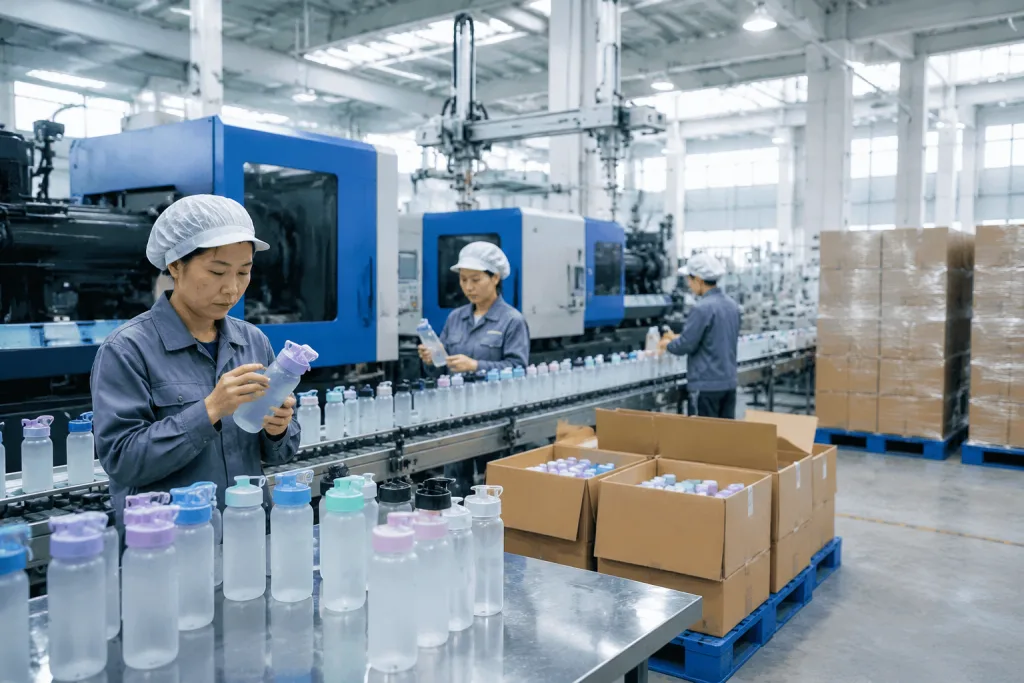
For existing molds at BottleForge Industrial in Zhejiang, standard MOQ is 3,000 pcs per color for simple PP bottles and 5,000 pcs per color when we need a Pantone match. We run about 600,000 units per month across injection, assembly, printing, and packing lines. Lead time is 30-40 days after deposit, sample approval, and final artwork confirmation; on our last 750 ml PP job, QC pulled the sample after the first injection shot because the cap thread was 0.18 mm tight on the GO/NO-GO gauge. During March-June, add 5-10 days if you are booking peak summer drinkware wholesale programs.
FOB Ningbo or Shanghai pricing for pp water bottle wholesale sits around USD 0.65 to USD 2.20 per unit. USD 0.65 means a single-color body with a simple screw cap, bulk packing, and one-color logo. USD 2.20 is a different animal: flip lid, straw, silicone grip, two-color printing with a custom color masterbatch, retail color box, plus tighter inspection. A new private mold can cost from USD 3,000 to USD 12,000 for a simple bottle set, and more if the lid has moving parts or multiple cavities; our mold shop will ask for 2D drawings, 3D files, and a target bottle weight in grams before quoting steel.
Buyers sometimes push for 1,000 pcs because they want to test the market. Fair request. The math often does not work. For stock colors or sample runs, we can talk, but unit cost may rise 20-40% because machine setup, ink mixing, carton printing, and QC time stay almost the same. Last month a buyer flagged this after seeing the proforma invoice: the PO said “matte black,” but the artwork file named “black glossy,” so the line stopped for half a day before printing. If your launch plan is still soft, choose an existing mold and put the budget into stronger packaging or better photography instead of opening a custom mold too early.
For mixed programs such as canteen wholesale, drinkware wholesale, beer growler wholesale bulk, and beer tumbler in bulk, ask for a pricing ladder at 3,000, 5,000, 10,000, and 30,000 pcs. A serious China factory will show where the cost drops, including resin kg price, logo setup, carton MOQ, and the inspection level. We ship these mixed orders often, and the buyer usually learns more from the 10,000 pcs line than from another round of sample photos.
Compliance Is Not Optional
PP water bottles touch drinking water and lips, so the paperwork travels with the bottle. It is not a loose PDF we chase later. For Europe, ask for EU 10/2011 food contact migration testing, LFGB where relevant, REACH screening for restricted substances, and packaging compliance if the bottle goes into retail. For North America, FDA 21 CFR food-contact suitability and California Prop 65 review may be required depending on the sales channel. Children’s bottles may also need ASTM, CPSIA, and phthalate or heavy metal testing. On our line, QC checks the report number against the BOM before mass packing; last month we held 6,000 pcs because the PO said "PP lid" but the approved BOM listed a Tritan flip cap.
One common mistake is treating a generic "BPA-free" statement as proof. That is the wrong question to ask. PP itself is normally BPA-free, but the lid, straw, colorant, gasket, ink, and packaging can create other compliance risks. A bright pigment can save USD 0.018 per bottle and still fail migration testing. A soft straw can pass odor testing on the bench but fail phthalate limits if the material batch is not locked. Printing ink is another weak spot when it sits near the lip area or peels after 10 dishwasher cycles; we have had QC pull the sample with ink flakes on the 3M tape test.
Ask your supplier for test reports that match the material and color family you will buy. A clear PP report from 2021 does not automatically cover a dark blue bottle ordered in 2026. For private label programs, budget USD 300-1,200 for third-party tests depending on the number of materials and standards. The math doesn’t work if a buyer saves that fee and then loses a container at destination inspection. We have seen 18 days disappear while a lab retested a silicone gasket that was changed from 55 Shore A to 60 Shore A after sampling.
Our practical advice from Zhejiang is simple: approve the exact resin, masterbatch, gasket, and ink before production. We run the pre-production sample with the same injection mold, the same color card, and the same pad-print ink that will be used for bulk. China sourcing works well when documentation follows the bill of materials, not when it is collected after the goods are already packed. Once cartons are sealed, every fix costs money; reopening 300 cartons for a label mismatch is not sourcing skill, it is avoidable cleanup.
Logo And Packaging Choices
Decoration is where 4 out of 10 pp water bottle wholesale complaints start, at least in the orders we run. PP has lower surface energy than PET or AS, so ink adhesion needs flame or corona pretreatment plus the right PP ink system. On the line, QC pulled a sample after a 38 dyne pen check and the logo still looked fine, but the buyer flagged rub-off after 20 dishwasher cycles and 7 days inside a gym bag when pretreatment was skipped.
For most PP bottles, one-color silkscreen is still the cheapest logo choice. Simple wins. It suits basic brand marks and costs roughly USD 0.03-0.08 per position at normal wholesale drinkware quantities; our usual screen jig holds 12 bottles per pass. Heat transfer handles more colors and gradients, but it adds cost and needs abrasion testing with 3M tape and wet rubbing. In-mold labeling gives a cleaner retail shelf look on large runs, but the math doesn't work for 3,000 pcs. Embossed logos need mold changes, so use them only when your annual forecast is stable.
Packaging should match the sales channel, not the nicest mockup on your desk. For drinkware bulk sold into corporate promotion, an OPP bag and export carton is often enough; we usually see 24 pcs per carton on 650 ml PP bottles. For retail drinkware wholesale, you need a color box with EAN/UPC, warning text, recycling marks, country of origin, and a product claim your legal team can stand behind. For online fulfillment, especially if you use FBA or similar third-party logistics, plan for drop-test packaging, FNSKU labeling, carton weight under 15 kg, and outer carton marks that scan after the carton corners get crushed by 8 mm.
The same logic applies to adjacent items such as wholesale growler, growler bulk, beer growler bulk, beer tumbler wholesale, and wholesale canteen orders. A heavy stainless item needs stronger partition packing than a PP bottle; we ship some 1.9 L growlers with 5-layer cartons and molded pulp because paper dividers split during vibration testing. One generic master carton specification for a mixed container is the wrong shortcut. We've seen this go sideways when a PO typo changed “single color box” to “single wall box.”
How To Control Production Risk
A good purchase order is more than quantity and price. It must lock the sample standard, inspection timing, and release rules before the line starts. For pp water bottle wholesale, we run 3 checkpoints: an approved sample with signed photos, an inline inspection at around 30% output, and a final random inspection before balance payment. If your order is above 10,000 pcs or the bottle is for retail, skipping inspection to save USD 200-350 is false economy. We have seen this go sideways over a 1 mm lid mismatch that QC caught only after cartons were taped.
The approved sample should show the actual PP grade, Pantone color chip, logo size in mm, lid build, gasket hardness, straw length, retail packaging, and carton marks. Keep one signed sample at the factory and one with your team; we tag ours with the PO number because buyers have flagged one-digit PO typos before. During production, check color consistency, injection marks, black spots, flash, cap fit, leakage, logo position, and carton labeling. For final inspection, AQL 2.5 major and 4.0 minor is common. Critical defects such as leakage, strong odor, sharp edges, incorrect material, wrong barcode, or missing warning label should be zero tolerance.
Write the leak test like a work instruction, not a wish. For example, fill to 95% capacity, close cap at defined torque with a torque wrench, invert for 30 minutes, then shake 20 times. Drop testing also needs a standard: 1.0 m drop on three faces and one corner with bottle filled to 80% is a reasonable practical test for 600-1000 ml PP sports bottles. If your sales claim says dishwasher safe, run at least 20 cycles before approving mass production. The math doesn't work if the first real dishwasher test happens after 8,000 pcs are packed.
If you are consolidating canteen bulk, beer tumbler wholesale bulk, alcohol flask wholesale, and pp water bottle wholesale in one shipment, inspect each SKU separately. A passed bottle inspection does not clear the flask caps, growler seals, or tumbler coating. QC pulled one mixed-container sample last season where the PP bottles passed, but the tumbler coating failed cross-hatch tape test after 24 hours. Separate SKU reports cost less than a retail chargeback.
Choosing A Supplier You Can Scale
For brand owners and procurement managers, the cheapest supplier is often the wrong target. Ask who can explain the trade-off before you send the 30% deposit. A solid China partner will say when PP works, when 304 stainless makes more sense, and when a flip lid or straw lock adds mold risk. We run into this on the sample bench: a buyer asks for a 0.6 mm wall PP bottle with a side button, then QC pulls the sample after 3 drops from 1.2 m because the hinge turns white. If every answer is yes, you are not getting engineering advice. You are getting a quotation clerk.
Check the boring controls first: ISO 9001 process discipline, BSCI or similar social audit if your retailers require it, incoming material checks, traceable resin batches, documented injection parameters, print adhesion testing, and carton drop testing. Ask for photos or video of the actual production line, not a clean showroom with 12 perfect bottles on a shelf. For Zhejiang orders, confirm whether injection, printing, assembly, and packing sit in one facility or move through subcontractors. Split production is not a deal breaker, but the handoff must be written down; we have seen cartons marked “PP-750” while the PO said “PP-700,” and that 50 ml typo became a retailer claim.
Payment terms tell you how the supplier thinks about risk. A normal first order may be 30% deposit and 70% before shipment after inspection. For repeat wholesale drinkware programs, partial credit or staged payment may open up after 3 or 4 clean orders, not on the first email. Watch suppliers offering FOB prices that sit USD 0.10 below the market while staying vague on resin grade, AQL 2.5 inspection, or inner-box thickness. The math does not work. One weak 5-layer carton can wipe out the saving when 38 boxes arrive crushed at the buyer’s DC.
If you are building a wider line across drinkware bulk, canteen wholesale, growler wholesale, beer growler wholesale, beer tumbler bulk, and alcohol flask wholesale bulk, pick a supplier that is honest about category control. One factory may run PP bottles well and source metal items through audited partners. That can work if responsibility, QC plan, and documentation are fixed before the line starts. We ship mixed programs like this only after the buyer signs off on sample seals, logo color cards, and carton marks; otherwise, we have seen it go sideways in week 2 of packing.
Send Your PP Bottle RFQ For Factory Review
Share capacity, quantity, market, logo, and packaging needs. We will return practical MOQ, FOB pricing, lead time, and compliance comments.
Frequently asked questions
What is the normal MOQ for pp water bottle wholesale?
For existing molds, a realistic MOQ is 3,000 pcs per color for simple PP bottles and 5,000 pcs per Pantone custom color. If you accept stock colors and a one-color logo, some factories may support 1,000-2,000 pcs, but expect a higher unit price and fewer packaging options. For new private molds, the practical production run is usually 10,000 pcs or more because tooling, sampling, testing, and setup costs need volume. At BottleForge Industrial in Zhejiang, we usually quote price breaks at 3,000, 5,000, 10,000, and 30,000 pcs so you can see the real cost curve before placing a purchase order.
How much should I budget per PP bottle from China?
Most pp water bottle wholesale projects from China fall between USD 0.65 and USD 2.20 FOB Ningbo or Shanghai. A basic 500-750 ml bottle with screw cap, stock color, bulk packing, and one-color logo may sit near the low end. A 1,000 ml bottle with flip lid, straw, silicone gasket, custom Pantone color, retail box, and multi-color print will be closer to the high end. Testing, mold fees, photography, barcode labels, and inspection are usually separate. For landed cost, add sea or air freight, duty, customs broker fees, domestic trucking, and any retailer compliance labeling.
Can PP bottles be sold as BPA-free and food safe?
PP resin is normally BPA-free, but you should not rely on a verbal claim. Ask for food-contact test reports covering the bottle body, lid, straw, gasket, pigment, and printing if the print is near the drinking area. For Europe, request EU 10/2011 migration testing, LFGB where needed, and REACH screening. For North America, ask for FDA food-contact support and review Prop 65 exposure risk when selling into California. If the product is for children, add CPSIA and relevant ASTM checks. Budget USD 300-1,200 for third-party testing depending on materials and colors.
What lead time should I plan for a private label order?
For an existing mold with standard packaging, plan 7-10 days for pre-production samples and 30-40 days for mass production after deposit and artwork approval. Custom color matching can add 3-5 days, and retail packaging can add another 7-10 days if dielines, translations, or barcode approvals are slow. New mold projects usually need 25-45 days for tooling before production timing starts. If you are ordering for summer retail or back-to-school, book earlier. Zhejiang and other China manufacturing areas get busy before major export seasons, and production slots are not guaranteed by a quote alone.
Can one supplier handle PP bottles plus canteens, growlers, and flasks?
Yes, but manage the categories separately. PP bottles, wholesale canteen products, beer growler wholesale bulk, beer tumbler wholesale bulk, and alcohol flask wholesale bulk use different materials, tests, and packing. A supplier may manufacture PP bottles directly and source stainless steel or glass items through audited partner factories. That can work if you receive separate specifications, test reports, approved samples, and AQL inspection plans for each SKU. Do not accept one generic certificate for all items. Alcohol flask and beer growler products often need stricter checks for odor, corrosion, leakage, coating adhesion, and food-contact suitability.