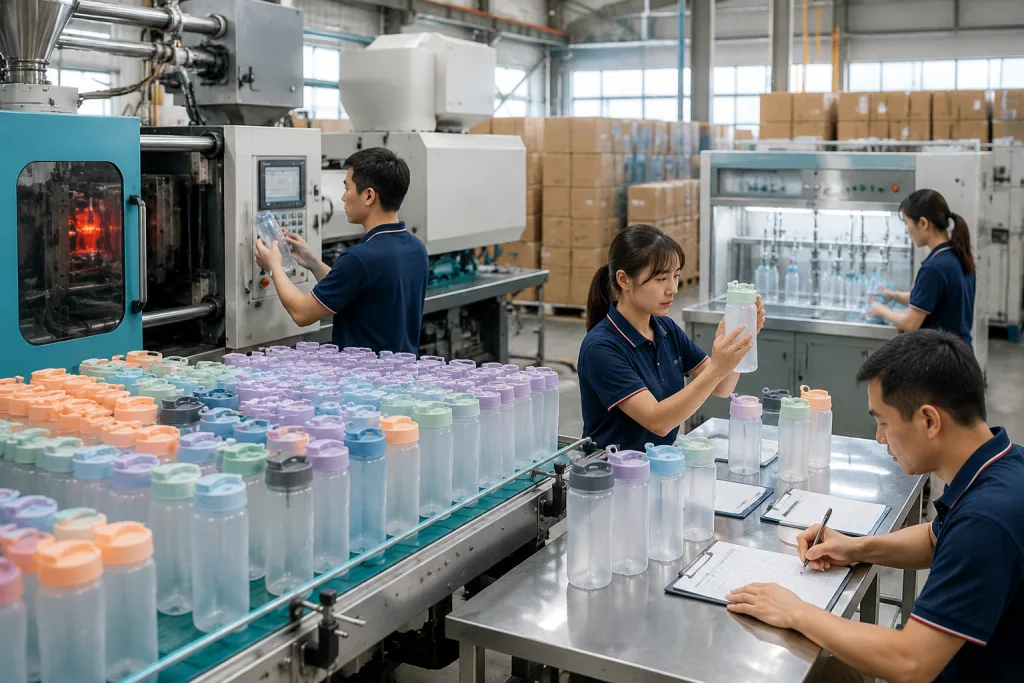
Key Takeaways
- A realistic pp water bottle bulk MOQ is 5,000 units per color for custom colors and logos
- Food-contact PP should be checked against LFGB, FDA, REACH, or relevant market rules before shipment
- A USD 0.10 saving can disappear if the bottle wall drops from 1.2 mm to 0.8 mm
- For custom packaging, allow 7-10 extra days for color box proofing and carton drop testing
Buying pp water bottle bulk looks easy until the quotes land. One supplier writes USD 0.42, another writes USD 0.88, and both claim food-grade PP. On our line, that gap usually comes from a 0.8 mm wall versus 1.2 mm, a loose flip cap, virgin resin instead of mixed resin, who owns the mold, silk-screen versus heat-transfer print, 5-layer carton strength, or a test fee left off the PI.
If you handle procurement for bulk drinkware, canteen wholesale, or a private-label sports line, samples are not the first question. The math comes first. BottleForge Industrial runs from Hangzhou, Zhejiang, and we ship drinkware bulk projects from China for European and North American buyers. Our standard PP bottle MOQ starts at 5,000 units per color, with typical mass production lead time of 25-35 days after artwork approval. Last month QC pulled a 600 ml PP sample because the cap torque read 6.5 kgf·cm instead of the buyer’s 8 kgf·cm target, which is exactly the kind of detail a low quote hides.
Start With The Bottle Specification
Do not open a pp water bottle bulk project by asking for the lowest FOB Ningbo price. That is the wrong question to ask. Start with a spec sheet we can hand to the injection line: resin grade, bottle weight in grams, target wall thickness, cap drawing, color chip, print area, and packing method. PP works well for lightweight promo bottles, school bottles, gym bottles, and event drinkware because it costs less than Tritan and does not break like glass. But PP is not one material. Copolymer PP, random copolymer PP, recycled-content claims, pigment quality, and cap material all change the part after molding; last month QC pulled a sample where the blue masterbatch shifted against the Pantone card by one full shade under the light box.
For most wholesale drinkware orders, we ask you to lock capacity, wall thickness, temperature range, lid structure, drinking spout, and packaging before we quote. A 650 ml single-wall PP bottle with a 1.0-1.2 mm body wall is not the same job as a 750 ml bottle with a thin 0.75 mm wall made for a one-day event giveaway. Photos hide it. The scale does not. On our floor, a 650 ml daily-use bottle might run around 72 g before the lid, while the cheap event version can drop near 48 g; the buyer flagged the difference only after a backpack drop test cracked 3 samples out of 20.
For procurement, write down what you are buying: PP body with resin grade, PE or PP straw with diameter in mm, silicone sealing ring with hardness, stainless steel pin if the lid flips, and food-grade masterbatch with the color code. If the product is positioned as the best wholesale drink bottle for school or fitness channels, ask for screw torque, leakage test method, and dishwasher guidance. We run a simple inverted leakage test for 30 minutes after tightening the lid with a torque meter, then QC checks the carton packing against the PO; we have seen this go sideways from one typo, “PE straw” changed to “PP straw,” and the math did not work after the buyer asked for a softer bite feel. Zhejiang factories can produce sharp pricing, but China sourcing rewards buyers who specify early and punishes vague sample approvals.
MOQ, Price, And Real Cost
For pp water bottle bulk, the lowest unit price is often the wrong question to ask. The landed cost usually changes at the color, packing, and carton level. A normal custom color order starts at 5,000 units per color. For existing mold and stock colors, some factories accept 1,000-3,000 units, but the logo area may stay under 45 mm wide, packaging choices get narrow, and color tolerance is usually checked against one Pantone chip under a D65 light box. At BottleForge Industrial, our practical factory capacity for plastic and metal drinkware is around 450,000 units per month across active lines, but small messy orders still eat engineering time. We’ve seen this go sideways when a PO says “blue” and the buyer later expects Pantone 2925C.
Typical FOB China pricing for a 500-750 ml PP bottle is around USD 0.45-1.20 depending on cap complexity, wall thickness, logo process, and packaging. A simple silkscreen logo may add USD 0.03-0.08 per unit. A custom color box may add USD 0.10-0.25. Quote the extras cleanly. If your buyer asks for hang tags, barcode labels, FNSKU labels, or retail-ready trays, list them as separate lines instead of hiding them in the bottle price. On the line, QC pulled the sample last month because a 38 mm barcode label curled on the bottle shoulder after the heat tunnel, and rework cost more than the label itself.
The same math applies when you compare canteen bulk, wholesale canteen, alcohol flask bulk, or beer tumbler bulk projects. Product names change, but the cost drivers stay boring and real: material weight in grams, mold cycle time in seconds, labor steps at assembly, reject rate after leak testing, and carton cube. For drinkware wholesale, request a price breakdown at 3,000, 5,000, 10,000, and 30,000 units. You will see fast whether the supplier is quoting from real production data or guessing. We run this check with a packing mockup and carton drop record; if the carton jumps from 0.062 CBM to 0.085 CBM per 50 pcs, the freight math doesn’t work.
Safety Testing And Compliance Checks
PP water bottles are food-contact products. Compliance is not a sales-deck decoration; it sits inside your landed cost. For the EU, buyers usually ask for LFGB or Regulation (EU) No 10/2011 migration testing, plus REACH for restricted substances. For the US, FDA food-contact expectations apply, and CPSIA comes into play when the bottle is sold for children. Canada and the UK often ask for channel-specific paperwork. We had one PO delayed 4 days because the buyer typed “LFBG” instead of LFGB on the compliance checklist, so check the document names before the deposit is paid.
Ask if the report matches the same PP grade, color masterbatch, and supplier batch used on your order. A 3-year-old generic PP report is thin support if the bottle now uses a fluorescent green pigment like Pantone 802C. Dark colors can carry different pigment chemistry; translucent colors show contamination faster; soft-touch coatings need their own migration check. If your brand has strict compliance review, budget USD 300-800 for third-party lab testing on the actual pre-shipment sample set. QC should pull the tested samples from the same injection lot, not from a clean showroom carton.
Quality inspection should use AQL, not a casual photo check. For most bulk drinkware orders, AQL 2.5 for major defects and 4.0 for minor defects works as a baseline. Major defects include leakage at the cap thread, cracked caps after torque testing, incorrect capacity on the fill line, sharp flash around the mouth, poor logo adhesion after tape pull, or visible contamination inside the bottle. Minor defects include small color variation against the approved swatch, light scuffing on the body, or slight print misalignment under 1 mm. In our Zhejiang production workflow, we run inline checks before final inspection, with a 30-piece leak test every 2 hours, because finding 2% leaking lids after packing is expensive for everyone.
Logos, Colors, And Packaging
Logo method catches new buyers off guard. On the line, we run silkscreen printing for 1-color or 2-color marks on round PP bottles because the screen jig is simple and the reject rate usually stays under 2% after first-piece approval. Heat transfer gives fuller artwork coverage, but QC pulled samples after 24-hour tape testing before we release mass production. In-mold labeling looks clean for 30,000-unit repeat programs; for a 5,000-unit trial order, the mold setup math does not work. Laser engraving belongs on 304 stainless tumblers, not PP.
For custom PP colors, use Pantone references and leave room for real production tolerance. Plastic color shifts with resin grade, 1.2 mm versus 1.8 mm wall thickness, and matte or glossy surface finish. A translucent blue bottle and an opaque blue cap using the same Pantone target will still read differently under a D65 light box. If color matters, approve one golden sample, then keep one sealed sample in our QC room and one with your team; we have seen this go sideways when a buyer approved photos on WeChat instead of the physical chip.
Packaging is where pp water bottle bulk projects lose margin. A master carton of 48 units can look good on FOB price, then fail when the buyer’s 3PL flags the carton as awkward for shelf picking. Amazon or 3PL channels usually need individual polybags, FNSKU labels, suffocation warnings, and 5-ply cartons tested to 12-15 kg gross weight; our carton drop test is done at 76 cm for this type of bottle. For wholesale drinkware, drinkware bulk, and wholesale canteen shipments, confirm carton dimensions before you issue the PO, including whether the carton mark says “PP Bottle” or the SKU code from your spreadsheet. Carton cube affects sea freight and warehouse fees. Cheap packaging is not always cheap.
Comparing PP With Other Drinkware
PP is the wrong pick for some drinkware programs. We run PP bottles when the brief calls for 55–90 g lightweight bodies, low unit cost, and a bottle that can take a squeeze without denting, usually for 3,000–20,000 pcs event orders, school giveaways, gym promos, or outdoor campaign kits. It is a poor fit for hot coffee, 6-hour heat retention claims, or premium gifting; our QC pulled one PP sample after a buyer tested it at 95°C and the cap thread showed slight whitening. If your customer asks for a bulk growler, growler wholesale, or beer growler bulk program, stainless steel or glass makes more sense because beer and carbonated drinks need tighter sealing, cleaner taste, and pressure checked on the line with a 0.3 MPa air-leak test.
For beer tumbler wholesale bulk, stainless steel double-wall construction takes drops better and holds temperature longer, such as 12 hours cold versus 2–3 hours for a single-wall PP cup in our lab check. For alcohol flask wholesale or alcohol flask in bulk, stainless steel is the normal material because buyers expect a slim pocket shape, brushed or mirror finish, and resistance to spirits; one EU buyer flagged PP immediately because the 180 ml flask felt like a giveaway item, not retail stock. PP still earns its place for sports caps, flip lids, and low-cost promotional bottles, with cap torque checked at 8–12 kgf·cm before packing. Don’t sell it as a universal fix. The math doesn’t work.
A practical procurement mix can use PP bottles for entry-level price points, stainless steel travel tumblers for stronger retail margins, glass bottles for lifestyle shelves, and canteen wholesale products for outdoor or military-inspired ranges with thicker straps and 0.8 mm body options. We ship these as separate lines because the buyer’s channel changes the inspection focus: PP needs injection flash checks, stainless needs vacuum testing, and glass needs carton drop testing from 76 cm. If a supplier says one material covers every use case, be careful; we’ve seen this go sideways when a PO even listed “PP growler 64 oz for craft beer” and the buyer came back asking why the seal failed. A good China factory should match the product to the channel, not push the easiest SKU in its catalog.
Factory Checks Before Purchase Order
Before you place a pp water bottle bulk PO, check the factory like a buyer, not like a tourist. Ask for the business license name in Chinese, export record for the last 12 months, BSCI or Sedex status if your retailer asks for it, and 2 recent food-contact test reports tied to PP resin or finished bottles. Skip the 40-page slide deck. You need proof the supplier controls resin batching, injection molding, assembly torque, logo printing, carton packing, and export documents. On our line, QC pulled a cap sample last month because the silicone ring sat 0.6 mm proud after assembly; that small finding matters more than a pretty showroom photo.
A proper pre-production process should include approved artwork, Pantone target, signed sample, packing layout, barcode file, and inspection standard. For orders above 10,000 units, we recommend 1 pre-production sample before mass production, not a hand-made sales sample from the sample room. The pre-production sample should use the same mold, PP resin grade, cap components, and logo method planned for the order. This is the wrong place to save 3 days. We run the first shot on the actual mold, measure bottle height and mouth ID with a digital caliper, then check carton fit before the buyer signs off.
Payment terms also deserve attention. A common arrangement in China is 30% deposit and 70% balance before shipment, or before release of original bill of lading. Larger buyers with order history may negotiate OA, LC, or staged payments. For a new buyer sourcing from Zhejiang, a clean first order beats aggressive terms almost every time. Get the specification right, approve samples within 48 hours, book inspection 7 days before ETD, and confirm shipping marks before cartons are printed. We have seen this go sideways from one typo on a PO, where “blue lid” became “black lid” and 186 cartons needed re-labeling before the truck could leave Hangzhou.
Send Your PP Bottle Spec For Quotation
Share capacity, color, logo, packaging, MOQ, and target market. We will reply with practical FOB pricing and production timing.
Frequently asked questions
What is a realistic MOQ for pp water bottle bulk orders?
For a custom pp water bottle bulk order, 5,000 units per color is a realistic MOQ if you want a custom logo and controlled color. Stock bottle colors with a simple one-color logo may sometimes start from 1,000-3,000 units, but options are narrower. If you need a custom mold, the MOQ can move to 20,000-50,000 units because mold cost, trial runs, and production setup need volume. For mixed drinkware wholesale programs, we usually advise buyers to start with one or two core SKUs instead of spreading 5,000 units across too many colors. That keeps AQL inspection, packaging, and reorder planning cleaner.
How much should I budget for a custom PP bottle?
A standard 500-750 ml PP bottle usually lands around USD 0.45-1.20 FOB China, depending on material weight, cap design, wall thickness, and packaging. A simple silkscreen logo may add USD 0.03-0.08 per unit. Custom color box packaging can add USD 0.10-0.25, and retail labels or FNSKU application add more labor. If a quotation is 20-30% lower than the market, check the bottle weight and wall thickness first. A lighter bottle may pass a photo review but fail leakage, drop, or daily-use expectations. Always compare total packed cost, not only bottle cost.
Can I source canteen bulk and PP bottles from the same supplier?
Yes, but only if the supplier has real capability across materials. PP bottles are injection or blow molded plastic products, while canteen bulk, wholesale canteen, and metal outdoor bottles may require stainless steel forming, welding, polishing, and coating. Some exporters handle both through partner factories; that can be fine if quality control is transparent. Ask which items are made in-house and which are outsourced. For canteen wholesale programs, confirm stainless steel grade, coating test, leak test, and carton drop standard separately from the PP bottle specification. Do not assume one inspection checklist fits every drinkware bulk item.
Are PP bottles safe for children’s drinkware programs?
PP can be suitable for children’s bottles when the material, pigments, lid parts, and testing are controlled. For the US, ask whether CPSIA applies to your product positioning, especially if the bottle is marketed to children 12 and under. For the EU, food-contact migration testing and REACH screening are common requirements. Also check the physical design: no small detachable parts, no sharp flash around the drinking spout, and no brittle cap hinge. For kids’ channels, we normally recommend 100% leakage testing during assembly and AQL inspection before shipment. Budget extra time, usually 7-14 days, for proper lab testing.
What about growler bulk, beer tumbler bulk, or alcohol flask wholesale orders?
Those products sit in the wider bulk drinkware category, but they are usually not PP products. Growler bulk, growler wholesale, beer growler in bulk, and beer growler wholesale bulk projects normally use stainless steel or glass because beer needs better taste neutrality and sealing. Beer tumbler in bulk and beer tumbler wholesale bulk usually use double-wall stainless steel for insulation. Alcohol flask wholesale bulk programs are also commonly stainless steel, often 4-8 oz capacity. You can source these together with PP bottles if the supplier manages separate material standards, production lines, and inspection plans. Treat each category as its own engineering project.