Key Takeaways
- A practical MOQ for custom thermos colors is usually 1,000-3,000 pcs per SKU
- 304 stainless steel at 0.40-0.50 mm body gauge is common for retail-grade vacuum bottles
- PP lids should be declared as food-contact PP, with silicone seals tested separately
- A normal China factory lead time is 35-50 days after sample approval and deposit
If you searched for a pp vacuum bottle factory, you probably do not want a plastic bottle. In 8 out of 10 RFQs we see, the buyer means a 304 stainless steel vacuum thermos with PP parts: lid, stopper, straw cap, or bottom bumper. Small wording. Big cost difference. On the line, our caliper check starts with body diameter, lid thread fit, and PP part weight in grams, because insulation, food-contact testing, and retail compliance sit in different purchase orders.
Outdoor retailers and promo brands usually push us on insulation hours and logo position first. Fair, but this is the wrong question to ask if the lid material, wall thickness, carton drop test, and AQL 2.5 level are still open. We have seen this go sideways: QC pulled the sample after a 1.2 m carton drop, the cup passed the render, then the buyer flagged a cracked PP handle 12 days before launch. A good thermos supplier should put these choices on the table before you pay for tooling.
What PP means in thermos sourcing
Buyers throw around “PP vacuum bottle” too casually. PP means polypropylene. On a thermos, PP is usually in the lid, stopper, spout, handle, inner cap, or the outer cup on an old-style flask, not the vacuum body. The insulated shell is normally 304 stainless steel inside, with 201 or 304 stainless steel outside depending on the price lane and shelf target. On our line, QC checks this with a handheld XRF gun before polishing; one buyer once sent a PO saying “PP body,” and we had to stop the order for 2 days just to correct that typo.
For a retail outdoor line, do not accept “plastic lid” on the spec sheet. Ask for the resin type, color masterbatch status, silicone ring grade, and whether food-contact testing covers the full assembled lid or only raw material pellets. For Europe, buyers normally ask for LFGB or EU 10/2011 migration checks on plastic and silicone parts, plus REACH attention for coatings. For North America, FDA food-contact declarations and CPSIA attention may apply if the product is marketed to children. We had a German buyer flag this after QC pulled the sample and found the test report listed PP granules only, while the actual lid included a black pigment batch and a silicone vent plug.
A pp vacuum bottle factory should also tell you why PP is used. PP handles hot liquid contact better than cheaper plastics, holds up well on flip-lid hinges after about 3,000 open-close cycles in our jig, and keeps cost stable on 5,000-20,000 pc thermos runs. Still, PP is not magic. Thin cap walls can warp, and dishwasher heat can bend a closure if nobody validated it. If you need dishwasher-safe claims, say it before sampling. This is the wrong question to ask after tooling. It affects testing, pad printing ink, powder coating, and sometimes the lid wall thickness by 0.3-0.5 mm.
At BottleForge Industrial in Hangzhou, Zhejiang, our standard stainless thermos projects usually start with 304 inner steel, 0.40-0.50 mm wall material before forming, PP lid components, and food-grade silicone gaskets. That is not the cheapest recipe in China, but the math works when you count fewer leaking-cap returns and fewer “plastic smell” complaints. We run odor checks after hot-water soaking at 95°C for 2 hours, and if the sample smells sharp when the lid opens, it does not leave the sample room.
Choose body construction before branding
About 7 out of 10 promotional buyers send us a logo file before they choose the bottle body. That is backwards. Pick the construction first: capacity, steel grade, mouth diameter, lid system, coating spec, and insulation target. Last month QC pulled a 500 ml sample with a clean laser mark, but the mouth was 38 mm and the buyer needed ice-cube filling. The logo was fine. The bottle was wrong.
For a factory thermos range, the common outdoor sizes are 350 ml, 500 ml, 750 ml, 1,000 ml, and 1,200 ml. Retailers usually prefer 500-750 ml for daily carry, then 1,000-1,200 ml for camping or worksite use. Promotional thermos buyers often choose 500 ml because carton weight, courier cost, and logo visibility balance well. We run most 500 ml orders at 24 pcs per carton; once the carton goes over 15 kg, the buyer usually flags the freight quote.
Vacuum performance is not just “double wall stainless steel.” This is the wrong question to ask if nobody checks the test sheet. Look at these practical points:
- Steel grade: 304 inner steel is the safe default for coffee, tea, sports drinks, and soup. 316 is possible, but on most campaign orders the math doesn't work unless the buyer has a clear corrosion requirement.
- Wall thickness: 0.40-0.50 mm stainless sheet is common before forming. On the line, bottles below this range dent faster during drop handling and repacking.
- Vacuum process: copper lining can improve heat retention, but it must be stable and declared. Do not accept “24 hours hot” unless the supplier writes the test method on the spec sheet.
- Mouth design: wide mouth is easier to clean and fill with ice. Narrow mouth pours cleaner and usually loses less heat.
- Powder coating: matte powder coat gives a strong hand feel, but color matching should use Pantone references and a signed tolerance sample. We once had a PO typo, “Panton 186C,” and production held until the buyer confirmed Pantone 186 C.
A realistic insulation target for a 500 ml thermos manufacturer spec is often 6 hours above 65°C when filled with 95°C water at 20°C ambient. Some models can beat that, but the test condition must be written. We ship samples with a simple temperature log: start time, water temperature, room temperature, fill volume, and final reading. If a thermos vendor promises “24 hours hot” with no starting temperature, room temperature, fill volume, or pass threshold, treat it as marketing copy, not engineering.
MOQ, tooling, and real unit costs
MOQ is where 7 out of 10 custom thermos projects get real. For existing mold bottles, BottleForge usually accepts 1,000 pcs for laser logo or single-color screen print, 2,000-3,000 pcs for custom powder coating per color, and 5,000 pcs or more for a new PP lid color or molded logo. A fully new lid mold can require USD 2,500-8,000 tooling, mainly tied to slider count, thread fit, and leak-proof structure. On the line, we check the first PP lid with a 0.02 mm feeler gauge around the sealing ring before QC signs the sample card.
FOB Ningbo or Shanghai pricing for a stainless steel manufacturer thermos is driven by capacity, steel weight, lid build, coating, logo process, packing spec, and test requirement. The math matters. As a rough export range, a 500 ml customized thermos in 304 inner/201 outer steel with powder coating and one logo may sit around USD 3.20-5.80 FOB at 3,000 pcs. A heavier 1,000 ml outdoor bottle with carry handle and better lid can move into USD 6.50-10.50 FOB. These are not quotes; they are guardrails for catching offers that look cheap because the supplier quietly removed 18 g of steel or changed the lid gasket.
Watch thermos bulk pricing that looks too clean. A supplier thermos quote should say if cartons and polybags are included, then spell out instruction sheets, barcode stickers, desiccant, master carton marks, and drop-test packing line by line. For Amazon or retail distribution, FNSKU or UPC labels, suffocation warnings, and carton dimensions are not small details. They change labor time and chargeable weight. We have seen this go sideways when a buyer flagged a missing “Made in China” mark after 126 cartons were already sealed.
For a normal thermos custom order using an existing body and lid, sample development takes 7-12 days after artwork confirmation. Bulk lead time is commonly 35-50 days after deposit and sample approval. Our Zhejiang, China production line can assemble about 450,000 stainless drinkware units per month across bottles, tumblers, and thermos models, but capacity does not replace a clear purchase specification. A typo on a PO, such as “matte black” instead of “sand black,” can cost 12 days vs 18 days once powder coating panels are already matched.
Logo methods that survive handling
Outdoor retailers and promo buyers are not buying the same decoration spec. A 3,000 pc event giveaway only has to survive the booth, the bus ride home, and maybe a dishwasher mistake. A retail thermos can sit on a peg hook for six months, then spend two years rubbing against keys in a backpack. We see this at incoming sample review: the buyer flagged one matte-black bottle because the logo edge polished shiny after 300 cycles on our RCA abrasion tester.
Laser engraving is still the safest choice on coated 304 stainless bodies. It cuts through the powder coat and shows the metal underneath, so the logo will not peel like ink. Clean edges. No drama. We run it for one-color logos, 500 pc trial orders, and corporate thermos programs where the buyer cares more about consistency than artwork effects. The weak point is color: laser cannot print full-color art, and contrast drops on champagne, white, and light gray coatings when QC checks the sample under a 6500K light box.
Silkscreen printing makes sense for simple logos on straight walls or a gentle curve. For thermos promo orders, 1 or 2 spot colors cover most POs. The factory needs to lock print size, position tolerance, and adhesion test method before the deposit, not after the line starts. We normally set logo position tolerance at ±1.5 mm, then do 3M tape pulls and 500-cycle rubbing checks before mass packing. If you sell through outdoor retailers, ask for a sample after 24 hours of curing; a fresh print on the bench is the wrong sample to approve.
Heat transfer and water transfer handle color, gradients, full-wrap graphics, camo, and seasonal artwork better than screen print. They also expose weak surface prep fast. On our line, QC pulled a full-wrap sample last month because the seam lifted 2 mm after hot-water soaking and abrasion testing. If you want a premium customizable thermos with a full-wrap design, plan for sampling to take 10-15 days, and treat pre-production approval as a real gate. Rushing this step is where we have seen projects go sideways.
For molded PP lid branding, raised logos or debossed logos mean tool modification or a new insert. It looks built-in, and retail buyers like that clean plastic-part finish. The tradeoff is commitment: one insert can cost more than the decoration budget on a small 1,000 pc reorder, and it locks the brand into that lid. For distributor thermos programs where the same bottle body serves 4 or 5 brands, printed or laser decoration keeps the math workable compared with lid tooling.
Quality control for fewer returns
Most drinkware returns we see are not dramatic: leaking lids, weak heat retention, scratched paint, crushed cartons, color mismatch, or a logo sitting 2 mm off center. QC pulled 200 samples from one 3,000 pcs run last spring and found 11 lids with silicone gaskets twisted during assembly. Not a mystery. Loose specs and lazy line checks cause most of it.
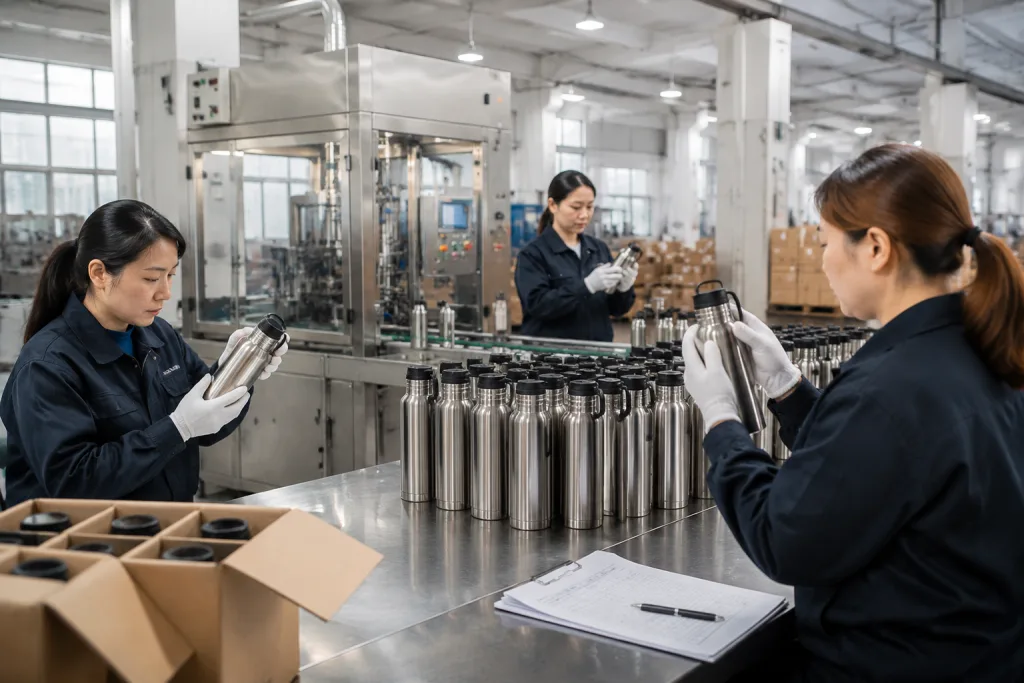
For a thermos factory order, we run QC from stainless sheet receiving to final carton sealing: incoming material checks with a thickness gauge, vacuum testing, assembly leak testing, coating checks, and final AQL inspection. Common final inspection levels are AQL 2.5 for major defects and AQL 4.0 for minor defects, though stricter retail buyers may request AQL 1.5 for major defects. Critical defects, such as sharp metal edges or severe leakage, should be zero tolerance. The wrong question is “does the factory have QC?” Ask who signs the inspection sheet, at which station, and how many pieces get stopped before packing.
Practical QC points include:
- Vacuum retention: test hot water temperature drop under a written method, for example 95°C water checked after 6 hours with a probe thermometer, not by touching the bottle wall.
- Leak test: fill, invert, shake, and hold bottles horizontally for a defined time, often 30 minutes for sampling checks; the line should record cap type and gasket batch.
- Coating adhesion: run a cross-hatch or 3M tape test on powder coating where the finish needs it, especially matte black and gradient colors.
- Odor check: inspect PP and silicone parts after unpacking; dark color caps can carry a smell if the material sat sealed in bags for 18 days.
- Carton drop: ISTA-style drop checks make sense for e-commerce and distributor thermos shipments, since one dented master carton can turn into 24 customer photos.
Certifications help, but they do not replace inspection. BSCI, ISO 9001, or a social audit tells you the factory has systems on paper. It does not prove your thermos customized order has the correct gasket hardness, or that the logo sits exactly 2 mm from the requested position. Your purchase order should attach the approved sample, artwork file, material spec, packing method, and inspection standard; we once had a buyer flag a PO typo that changed “silicone ring” to “silicon ring,” and the argument wasted 3 days. If a thermos supplier will not write these points down, we have seen this go sideways.
Packing and shipping for retail channels
Packing is not a decoration afterthought; it is part of product engineering. A stainless thermos survives daily use, then gets dented by a loose divider in ocean freight or one bad drop at a courier hub. We have seen 0.4 mm wall bottles pass leak testing, then arrive with shoulder dents because the inner box had 3 mm of empty space. For outdoor retailers, the bottle moves from China factory carton to distributor warehouse, store back room, shelf, and consumer bag. For promotional brands, it goes through event kits and fulfillment centers before single courier shipments. This is where the math doesn't work if packing is treated as “just a box.”
Standard export packing is usually one bottle in a polybag or tissue wrap, then a white box or kraft box, then a 24 pcs or 30 pcs master carton depending on capacity. A 500 ml bottle often ships in 24 pcs per carton to keep carton weight manageable, around 12-16 kg gross depending on bottle weight and gift box. Larger 1,000 ml models may use 12 pcs per carton. On our line, QC checks carton burst strength with a simple edge-crush reading and pulls one packed carton for a 60 cm corner drop before we approve the packing method.
If you sell online, ask your thermos suppliers for carton dimensions before confirming price. Volumetric weight can turn a cheap bottle into an expensive shipment. We had one buyer flag a quote because a 46 x 32 x 28 cm carton pushed air cost up by 18%, even though the unit price looked fine. If you need individual mailer boxes, foam inserts, molded pulp trays, or plastic-free packaging, state it at RFQ stage. Sustainable packaging works, but it changes cost and drop-test results. Say it early.
For North American programs, buyers request FNSKU labeling, carton labels, and pallet guidance on most Amazon or retail orders we ship. For Europe, distributors often need EAN labels, multilingual warnings, and recycling marks. This is routine for an experienced thermos manufacturer, but it must be scheduled. Labeling 20,000 pcs after final inspection can add 2-4 working days if it was not planned, and we have seen a PO typo turn “FNSKU on box” into “FNSKU on carton.” QC pulled the sample, the buyer flagged it, and the line had to rework 1,200 boxes. Good suppliers thermos teams build packing mockups before mass production, not after the container is booked.
How to brief a factory correctly
A clean RFQ saves more money than hard negotiation. If you ask 5 thermos manufacturers for “500 ml stainless bottle, logo, best price,” you will get 5 different bottles hiding under the same loose line: different wall thickness, cap material, coating grade, carton size. No fair comparison. Last month QC pulled two 500 ml samples for a buyer in Germany; one body measured 72.4 mm wide, the other 68.8 mm, and both suppliers called them “standard.”
Your brief should include target capacity, market, expected retail price, steel requirement, lid type, coating color, logo method, packing, compliance market, order quantity by SKU, delivery term, and launch date. If you already have a reference sample, send front, back, bottom, and lid photos with caliper measurements in mm, then mark what must change. If you accept existing molds, write that in the first email. We run existing molds faster: sampling is usually 7 days vs 18 days for a new 3D design and tooling review, and the mold shelf in our Hangzhou office already has 40+ bottle bodies we can quote from.
For a custom thermos order, include these details in the first message:
- Quantity per color and total annual forecast, for example 3,000 pcs first order and 20,000 pcs yearly. MOQ is not magic; the line needs enough pieces to cover color change, jig setup, and carton printing.
- Target FOB price range, not just “cheap.” Give a serious range, such as USD 3.20 to 3.60 FOB Ningbo, so the manufacturer can choose the right body and lid instead of guessing.
- Logo file in AI, PDF, or SVG format, plus Pantone colors if printing. We still get POs with “blue logo” typed in the remark column, and the buyer flagged the shade only after the pre-production sample.
- Compliance needs such as REACH, LFGB, FDA, Prop 65 review, or retailer-specific test protocols. Tell us the sales country and test lab if fixed, because SGS and Intertek sometimes ask for different food-contact sample cuts.
- Packing channel: retail shelf, promotional gift, e-commerce parcel, or thermos distributors warehouse. A mailer box for Amazon drop test is not the same as a 24 pcs export carton for a distributor pallet.
As a China manufacturer thermos team, we prefer buyers who are direct about price and risk. If your budget only supports 201 outer steel, say it. If your brand promise requires dishwasher testing, say it before sampling, because the math does not work after 30,000 pcs are powder coated and logo printed in Zhejiang. We have seen this go sideways: one buyer approved the color chip, then asked for 304 stainless outer wall after the PO, and the whole launch moved from 12 days to 26 days.
Send your thermos brief for a factory quote
Share capacity, quantity, logo file, market, and packing needs. We will return a practical Zhejiang factory spec and FOB price range.
Frequently asked questions
Is a PP vacuum bottle the same as a stainless steel thermos?
Usually, yes in buyer language, but not technically. The vacuum body is normally stainless steel, while PP refers to polypropylene parts such as the lid, stopper, handle, cup, or push button. For a retail-grade stainless thermos, we normally recommend 304 stainless steel inside, 201 or 304 outside, PP lid parts, and silicone gaskets. When you ask a pp vacuum bottle factory for a quote, request a component breakdown instead of accepting one material line. The body, lid, seal, coating, and logo all need separate material and compliance notes. This is especially important for Europe, where food-contact migration testing may apply to the PP and silicone parts, not only the steel body.
What MOQ should I expect for a custom thermos order?
For an existing bottle shape, 1,000 pcs is a practical starting MOQ for laser engraving or simple one-color logo printing. Custom powder coating usually makes more sense at 2,000-3,000 pcs per color because coating line setup and color change waste are real costs. If you want a new PP lid color, molded logo, or private cap design, expect 5,000 pcs or higher, plus tooling if the structure changes. For a fully customized thermos with new lid tooling, budget USD 2,500-8,000 for molds depending on complexity. If a thermos supplier offers 100 pcs with fully custom color, custom lid, gift box, and low unit price, check whether it is a trading stock solution rather than factory production.
How long does bulk thermos production take in China?
For existing molds, sampling usually takes 7-12 days after artwork and color confirmation. Mass production commonly takes 35-50 days after deposit and approved pre-production sample. Add 5-10 days if you need third-party testing before shipment, and more if a retailer requires its own protocol. Sea freight to North America or Europe can add 25-45 days depending on port and season. Zhejiang and broader China supply chains are efficient, but stainless thermos production still includes forming, welding, vacuum processing, polishing, coating, printing, assembly, inspection, and packing. A safe launch calendar for a first custom thermos order is 90-120 days from RFQ to warehouse arrival.
Which logo process is best for promotional thermos programs?
For most promotional thermos orders, laser engraving is the safest choice because it is clean, durable, and works at 1,000 pcs without complicated setup. Silkscreen printing is cheaper for larger one-color logos, but it needs adhesion checks and enough curing time. Heat transfer is better for full-color artwork, gradients, and wrap designs, but sampling and defect control take longer. If your product will be sold by outdoor retailers rather than handed out at an event, I would prioritize durability over artwork complexity. Ask for a decorated sample, tape test, rub test, and logo position tolerance. A normal tolerance is around ±1.5-2.0 mm depending on bottle shape and fixture.
What should distributors check before approving shipment?
Distributors should check the approved sample against production units, not only the carton count. Review capacity, weight, coating color, logo size, lid fit, gasket placement, odor, leak performance, insulation test results, barcode labels, carton marks, and packing strength. Use AQL inspection, commonly AQL 2.5 for major defects and 4.0 for minor defects, with zero tolerance for critical safety issues. For thermos bulk shipments, also confirm master carton dimensions, gross weight, pallet plan, and HS code documents before the vessel closes. If the order is for e-commerce, run a carton drop check and verify FNSKU or UPC placement. Small label mistakes can delay receiving even when the bottles are fine.